
Chapter 1 The Study of Life SECTION 1






- Slides: 46
Chapter 1: The Study of Life SECTION 1: INTRODUCTION TO BIOLOGY SECTION 2: THE NATURE OF SCIENCE SECTION 3: METHODS OF SCIENCE
Section 1: All living things share the characteristics of life. Section 2: Science is a process based on inquiry that develops explanations. Section 3: Biologists use specific methods when conducting research.
Essential Questions What is biology? What are possible benefits of studying biology? What are the characteristics of living things? What are the characteristics of scientific inquiry? What are the differences between science and pseudoscience? Why is scientific literacy important? What are the differences between an observation and an inference? What are the differences among a control, independent variable, and dependent variable? What are the scientific methods a biologist uses for research? Why are the metric system and SI important?
Vocabulary Review environment investigation theory New biology organism organization growth development reproduction species stimulus response homeostasis adaptation science New continued • • • • • theory law peer review ethics observation inference scientific method hypothesis experiment control group experimental group independent variable constant data metric system SI
Introduction to Biology SECTION 1
Main Idea All living things share the characteristics of life K What I Know W What I Want to Find Out L What I Learned
Essential Questions What is biology? What are possible benefits of studying biology? What are the characteristics of living things?
Vocabulary Review environment New biology organism organization growth development reproduction species stimulus response homeostasis adaptation science
BIO - LOGY ? ? ? Biology comes from the Greek bio, meaning “life”, and from logos, meaning “study” Whenever you see –ology, it means “the study of” In Biology we study: The origins and history of life, both past and present The structures of living things How living things interactive with one another How living things function
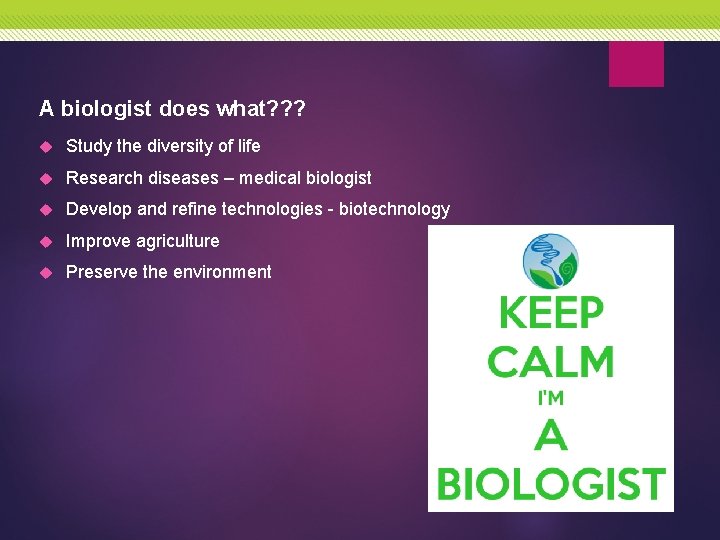
A biologist does what? ? ? Study the diversity of life Research diseases – medical biologist Develop and refine technologies - biotechnology Improve agriculture Preserve the environment
Characteristics of Life Organisms had or have all of the characteristics of life (8 Total): 1. Made of one or more cells Cells are the basic unit of all living things – the building blocks One cell = unicellular; more than one cell = multicellular 2. Displays organization They arrange in an orderly way Unicellular contain organized functional structures and often work together; multicellular have specialized cells organized into tissues, tissues organized into organ, organs organized into organ systems that work together to support life 3. Grows and develops Most everything starts as a single cell Mass is then added (usually by added new cells) through cell growth, and have natural changes over organism’s lifetime that is called development 4. Reproduces Make offspring! Species are organisms that can breed to produce fertile offspring
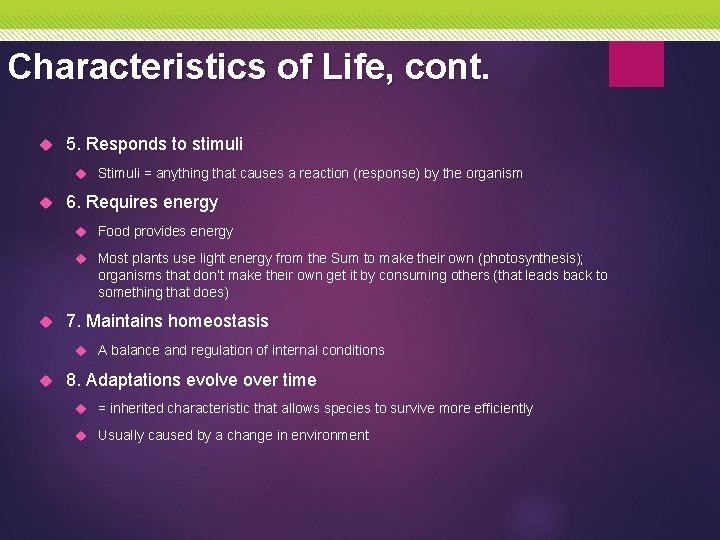
Characteristics of Life, cont. 5. Responds to stimuli Stimuli = anything that causes a reaction (response) by the organism 6. Requires energy Food provides energy Most plants use light energy from the Sum to make their own (photosynthesis); organisms that don’t make their own get it by consuming others (that leads back to something that does) 7. Maintains homeostasis A balance and regulation of internal conditions 8. Adaptations evolve over time = inherited characteristic that allows species to survive more efficiently Usually caused by a change in environment
BNTSG Biodiversity Full episode Characteristics of Life - good video
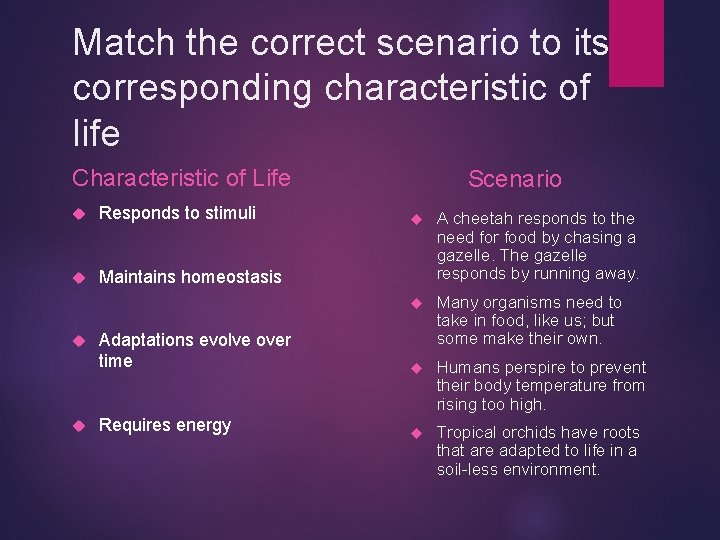
Match the correct scenario to its corresponding characteristic of life Characteristic of Life Responds to stimuli Maintains homeostasis Scenario A cheetah responds to the need for food by chasing a gazelle. The gazelle responds by running away. Adaptations evolve over time Many organisms need to take in food, like us; but some make their own. Humans perspire to prevent their body temperature from rising too high. Requires energy Tropical orchids have roots that are adapted to life in a soil-less environment.
Review – Did I get it? • Are you able to answer this section’s questions? (from beginning of section notes) • Are you comfortable with the vocabulary words from this section? • Fill in your KWL
The Nature of Science SECTION 2
Main Idea Science is a process based on inquiry that develops explanations K What I Know W What I Want to Find Out L What I Learned
Essential Questions What are the characteristics of scientific inquiry? What are the differences between science and pseudoscience? Why is scientific literacy important?
Vocabulary Review Investigation New Science Theory Law Peer Review Ethics
What is S C I E N C E ? ? ? Science is a body of knowledge based on the study of nature. The nature or essential characteristics, of science is scientific inquiry. Scientific inquiry is both a creative process and a process rooted in unbiased observations and experimentation.
BNTSG Play until 3: 00
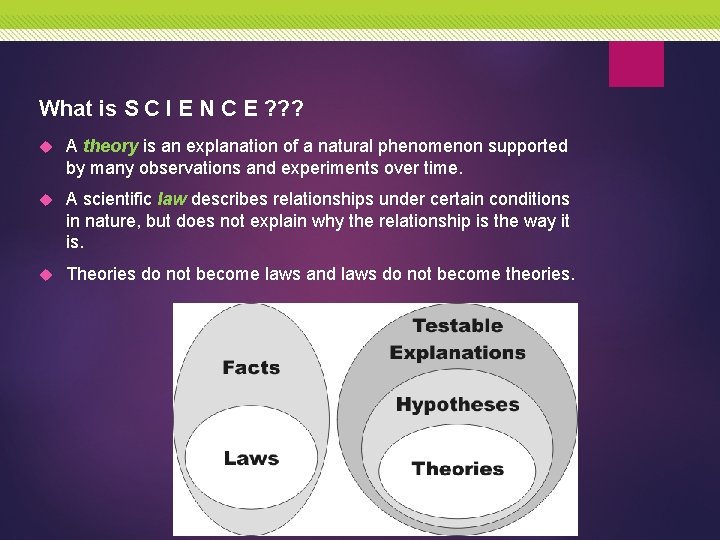
What is S C I E N C E ? ? ? A theory is an explanation of a natural phenomenon supported by many observations and experiments over time. A scientific law describes relationships under certain conditions in nature, but does not explain why the relationship is the way it is. Theories do not become laws and laws do not become theories.
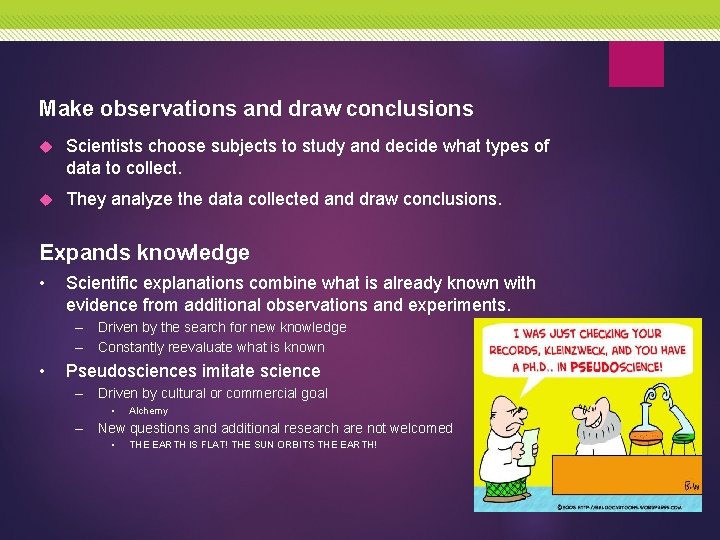
Make observations and draw conclusions Scientists choose subjects to study and decide what types of data to collect. They analyze the data collected and draw conclusions. Expands knowledge • Scientific explanations combine what is already known with evidence from additional observations and experiments. – Driven by the search for new knowledge – Constantly reevaluate what is known • Pseudosciences imitate science – Driven by cultural or commercial goal • Alchemy – New questions and additional research are not welcomed • THE EARTH IS FLAT! THE SUN ORBITS THE EARTH!
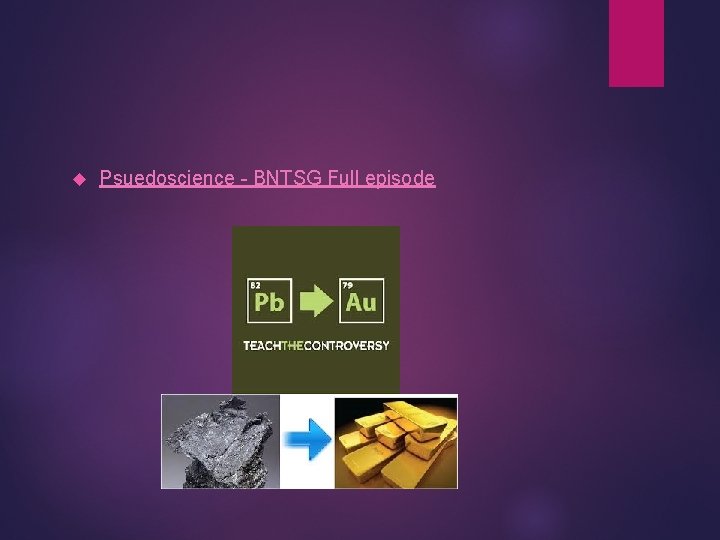
Psuedoscience - BNTSG Full episode
Challenge accepted theories Scientists welcome debate about one another’s ideas. Sciences advance by accommodating new information as it is discovered Challenge accepted theories • • • In science, observations or data that are not consistent with current scientific understanding are of interest. These inconsistencies often lead to further investigations. In pseudoscience, inconsistencies are discarded, or even ignored
Test Claims Scientists use standard experimental procedures. Their claims based on a large amount of data and observations obtained from unbiased investigations and carefully controlled experimentation. Pseudoscientists make claims that cannot be tested, or are a mixture of fact and opinion. Undergoes peer review • • Before it is made public, science-based information is reviewed by scientists’ peers. Peer review is a process by which the procedures used during an experiment and the results are evaluated by other scientists who are in the same field or who are conducting similar research.
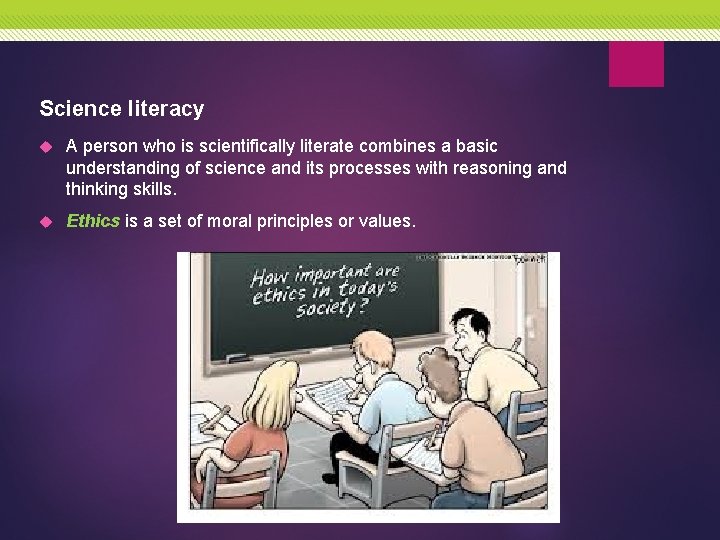
Science literacy A person who is scientifically literate combines a basic understanding of science and its processes with reasoning and thinking skills. Ethics is a set of moral principles or values.
Review – Did I get it? • Are you able to answer this section’s questions? (from beginning of section notes) • Are you comfortable with the vocabulary words from this section? • Fill in your KWL
Methods of Science SECTION 3
Main Idea Biologists use specific methods when conducting research K What I Know W What I Want to Find Out L What I Learned
Essential Questions What are the differences between an observation and an inference? What are the differences among a control, independent variable, and dependent variable? What are the scientific methods a biologist uses for research? Why are the metric system and SI important?
Vocabulary Review Theory New Observation Inference Scientific method Experiment Control group Experimental group Independent variable Dependent variable Constant Data Metric system SI
Science literacy Scientific inquiry begins with observation. Scientific inquiry involves asking questions and processing information from a variety of reliable sources. The process of combining what you know with what you have learned to draw logical conclusions is called inferring; the conclusions themselves are called inferences. The methods scientists use to gather data and answer questions are referred to as scientific methods.
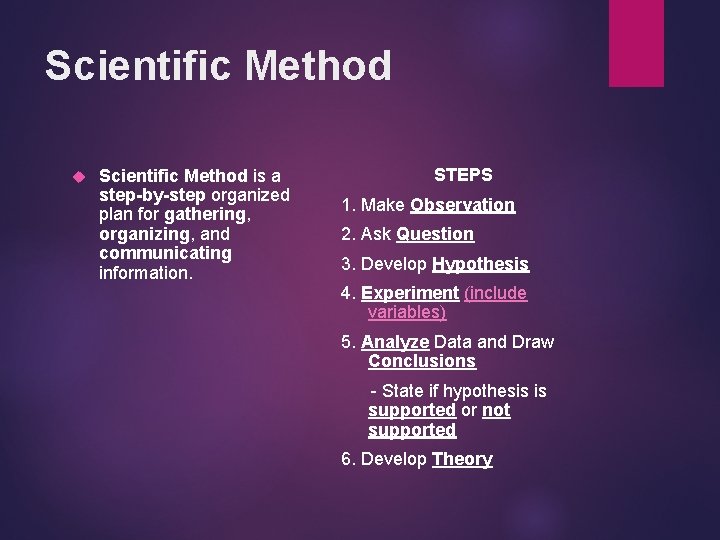
Scientific Method is a step-by-step organized plan for gathering, organizing, and communicating information. STEPS 1. Make Observation 2. Ask Question 3. Develop Hypothesis 4. Experiment (include variables) 5. Analyze Data and Draw Conclusions - State if hypothesis is supported or not supported 6. Develop Theory
Scientific Method Detailed 1&2. Making observations - Information that you obtain from your senses that provides you with a question 3. Develop a hypothesis Hypothesis – A proposed answer to a question. It’s used to answer questions raised by one of your observations. In order for a hypothesis to be useful, it must be testable.
Scientific Method 4. Experiment or Testing a Hypothesis – Scientists perform experiments to test a hypothesis. In an experiment, any factor that can change is called a variable. Variable- variable that causes change in another variable Manipulated variable or independent variable- variable that causes a change in another variable. Responding variable or dependent variable- variable that changes in response to the manipulated variable. Controlled experiment- An experiment in which only one variable, the manipulated variable, is deliberately changed at a time. The responding variable is observed for changes, all other variables are kept constant, or controlled. 5. Analyze Data and Draw Conclusions – See if your data from you experiment supports your hypothesis. If it does not, you must revise your hypothesis, or propose a new one. Then you must design a new experiment.
Variables explanation HTTP: //WWW. YOUTUBE. COM/WATCH? V=WEU 4 IMV 0 YLC HTTPS: //WWW. YOUTUBE. COM/WATCH? V=HXBZ 656 EUYW
Come up with 2 example scenarios and identify their dependent and independent variables
Scientific Method 6. Developing a Theory- Once a hypothesis has been supported in repeated experiments, scientists can begin to develop a theory.
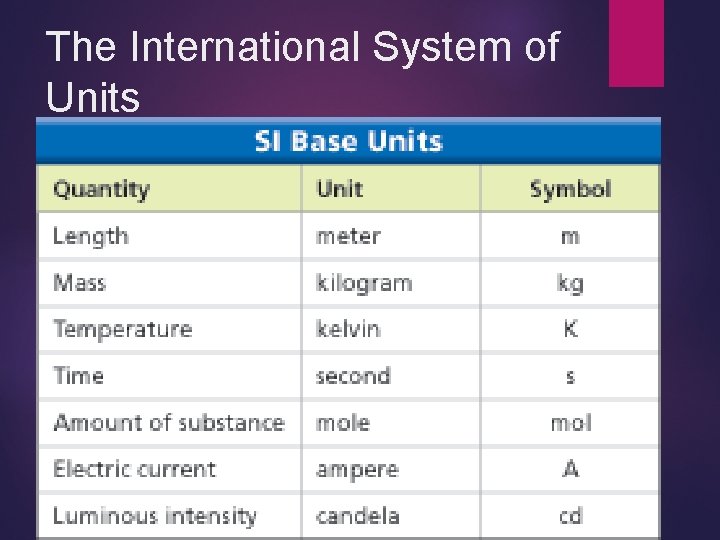
SI Units of Measure All measurements need a number and a unit. Example: 5 ft 3 in or 25ºF The metric system uses units with divisions that are powers of ten (used in most of the world besides us – use the imperial system Scientists usually do not use these units. They use a unit of measure called SI or International System of Units. Base Units – more examples on following slide Length- straight line distance between 2 points is the meter (m) Mass- quantity of matter in an object or sample is the kilogram (kg)
The International System of Units
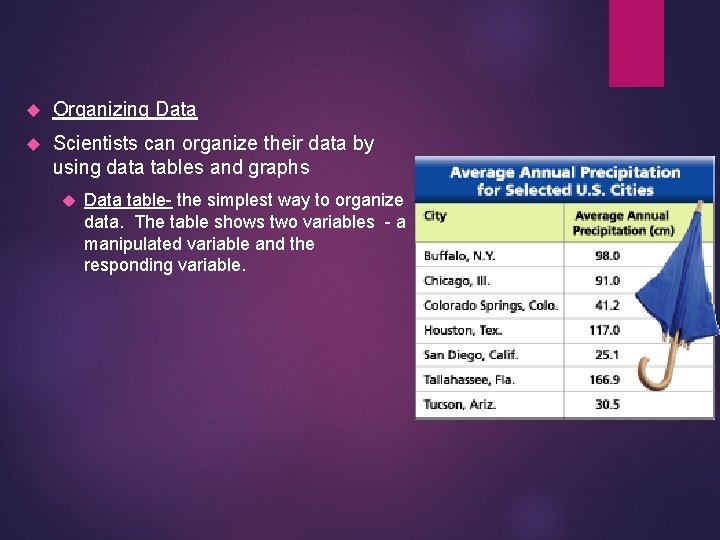
Organizing Data Scientists can organize their data by using data tables and graphs Data table- the simplest way to organize data. The table shows two variables - a manipulated variable and the responding variable.
Line graphs are useful for showing changes that occur in related variables. It shows the manipulated variable on the x-axis and the responding variable on the y-axis. Slope- (steepness) The ratio of a vertical change to the corresponding horizontal change. Slope = Rise Run Rise represents the change in the y-variable Run represents the corresponding change in the x-variable.
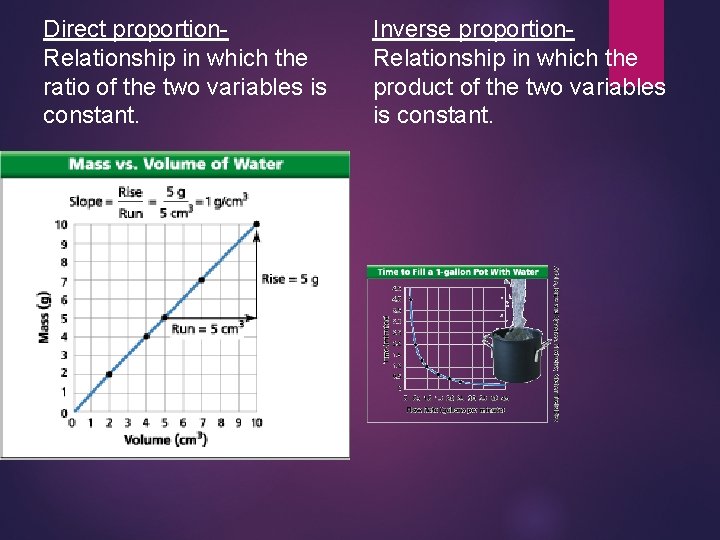
Direct proportion. Relationship in which the ratio of the two variables is constant. Inverse proportion. Relationship in which the product of the two variables is constant.
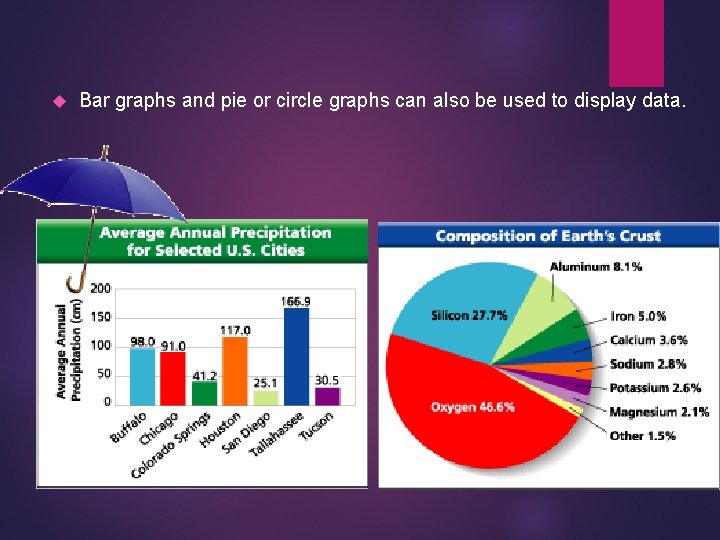
Bar graphs and pie or circle graphs can also be used to display data.
Review – Did I get it? • Are you able to answer this section’s questions? (from beginning of section notes) • Are you comfortable with the vocabulary words from this section? • Fill in your KWL