
CHAPTER 1 THE SCIENCE OF DEVELOPMENT DEFINING DEVELOPMENT

- Slides: 42
CHAPTER 1 THE SCIENCE OF DEVELOPMENT
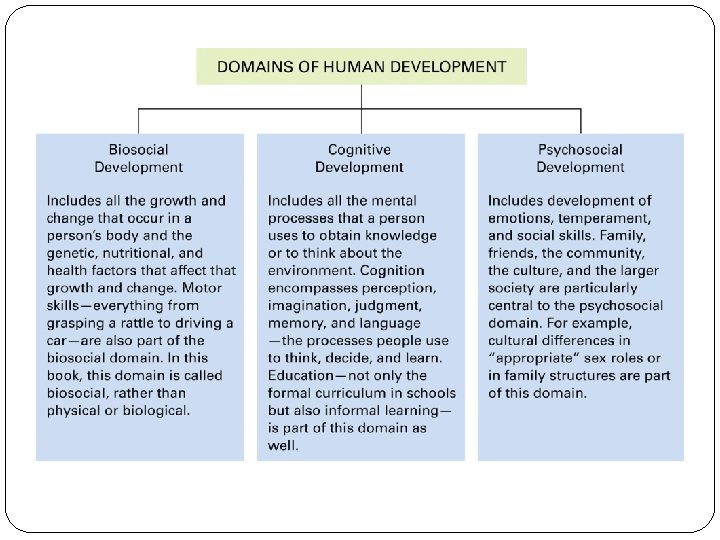
DEFINING DEVELOPMENT �The Science of Human Development ? � 3 Crucial elements in the definition �Understanding How and Why �Including All Kinds of People �Observing Changes Over Time
UNDERSTANDING HOW AND WHY �Scientific Method �Steps of the Scientific Method �Formulate a research question o. Examples? �Develop a hypothesis o. Examples �Test the hypothesis �Draw conclusions �Make the findings available
INCLUDING ALL KINDS OF PEOPLE � Diversity �The challenge is to identify universalities and differences then describe them in ways that unify humanity and distinguish each human being � The Nature-Nurture Debate �Nature � Genes �Nurture � Environmental Influences �Nature and Nurture Always Interact �How much of any characteristic, behavior, or pattern of development is the result of genes and how much is the result of experience?
The Nature-Nurture Debate �Hyperactivity �Nature � They are usually boys who have male relatives with the same problem � They are overactive in every context, home as well as school � They are often calmed by stimulants, such as Ritalin, Adderall, and even coffee �Nurture � The rapid increase in ADHD (from 1 to 5 percent of all U. S. children within the past 50 years) cannot be genetic, since selective adaptation takes centuries � Many environmental factors correlate with ADHD, including crowded homes, television, lead, food additives, and rigid teaching
THE NATURE-NURTURE DEBATE �Sexual Orientation �Nature v. Nurture �Children raised by homosexual couples (either adopted or the biological offspring of one of the parents) become heterosexual or homosexual in about the same proportions as children raised by heterosexual couples �More support for the influence of NATURE on sexual orientation �Homosexual urges and heterosexual urges (Nature) �Sexual orientation is different than sexual
INCLUDING ALL KINDS OF PEOPLE �Critical And Sensitive Periods �Critical Period �A time when a particular type of developmental growth must occur for normal development � For example, the fetus develops arms and legs, hands and feet, fingers and toes, each on a particular day between 28 -54 days after conception. If this is disrupted, the child never develops normal limbs. o Thalidomide �Sensitive Period �A time when a certain type of development occurs most easily � For example, if a child does not master a first language during the sensitive period, they may still do so later, but might experience difficulty.
OBSERVING CHANGES OVER TIME �Do individuals change or remain the same over time? �The science of human development studies all the changes and the consistencies of human life, from conception until death. �Change is lifelong
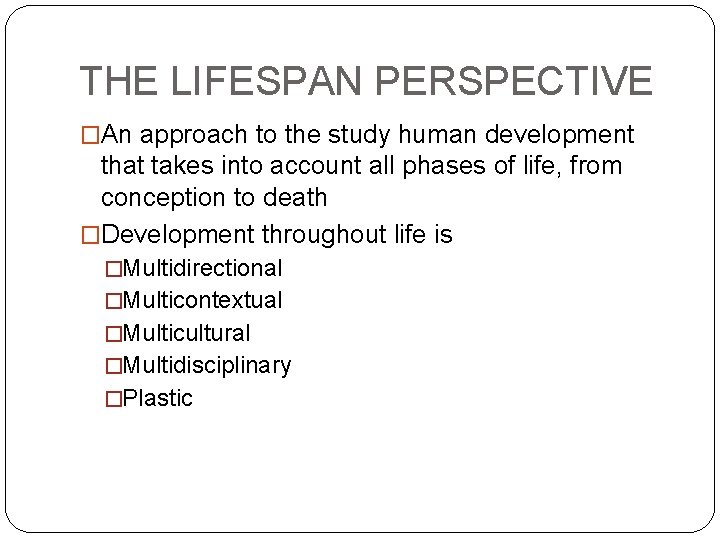
THE LIFESPAN PERSPECTIVE �An approach to the study human development that takes into account all phases of life, from conception to death �Development throughout life is �Multidirectional �Multicontextual �Multicultural �Multidisciplinary �Plastic
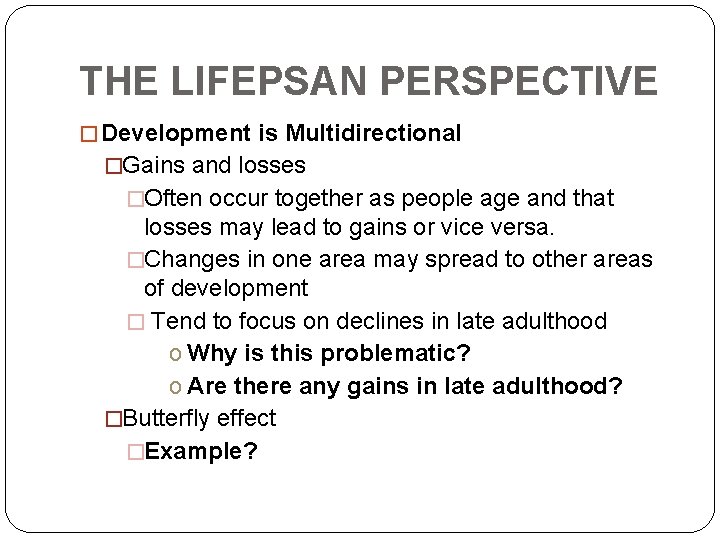
THE LIFEPSAN PERSPECTIVE � Development is Multidirectional �Gains and losses �Often occur together as people age and that losses may lead to gains or vice versa. �Changes in one area may spread to other areas of development � Tend to focus on declines in late adulthood o Why is this problematic? o Are there any gains in late adulthood? �Butterfly effect �Example?
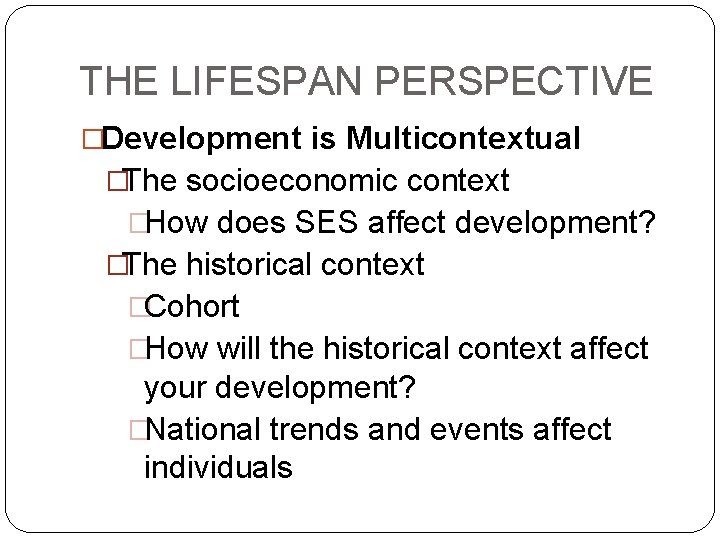
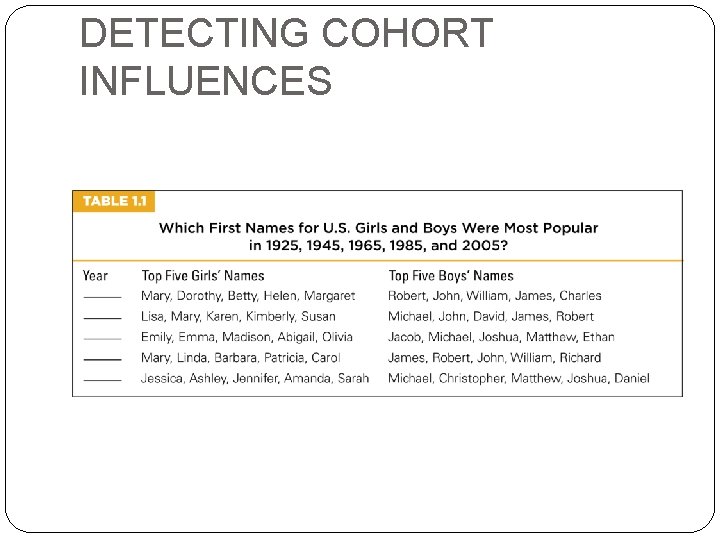
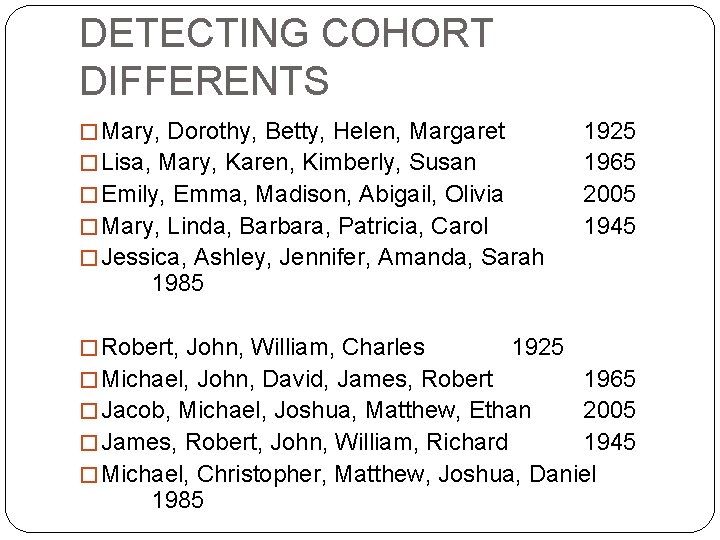
THE LIFESPAN PERSPECTIVE �Development is Multicontextual �The socioeconomic context �How does SES affect development? �The historical context �Cohort �How will the historical context affect your development? �National trends and events affect individuals
DETECTING COHORT INFLUENCES
DETECTING COHORT DIFFERENTS � Mary, Dorothy, Betty, Helen, Margaret 1925 1965 2005 1945 � Lisa, Mary, Karen, Kimberly, Susan � Emily, Emma, Madison, Abigail, Olivia � Mary, Linda, Barbara, Patricia, Carol � Jessica, Ashley, Jennifer, Amanda, Sarah 1985 � Robert, John, William, Charles � Michael, John, David, James, Robert 1925 1965 � Jacob, Michael, Joshua, Matthew, Ethan 2005 � James, Robert, John, William, Richard 1945 � Michael, Christopher, Matthew, Joshua, Daniel 1985
THE LIFESPAN PERSPECTIVE �Development is Multicultural �How does culture affect childrearing? �Learning Within A Culture �Vygotsky’s Sociocultural Theory �Guided Participation �Scaffolding
Vygotsky’s Sociocultural Theory http: //www. youtube. com /watch? v=hx 84 h-i 3 w 8 U
THE LIFEPSAN PERSPECTIVE �Development is Multidisciplinary �Many disciplines study development �Epigenetic Theory �Environmental forces affect the expression of an individual’s genetic inheritance
THE LIFESPAN PERSPECTIVE �Development is Plastic �Human traits can be molded �Every individual, and every trait within each individual, can be altered at any point in the life span �Hope and realism
THEORIES OF HUMAN DEVELOPMENT �Developmental Theory �A systematic statement of principles and generalizations that provides a coherent framework for understanding how and why people change as they grow older �Lead to pivotal hypotheses �Generate discoveries �Offer practical guidance
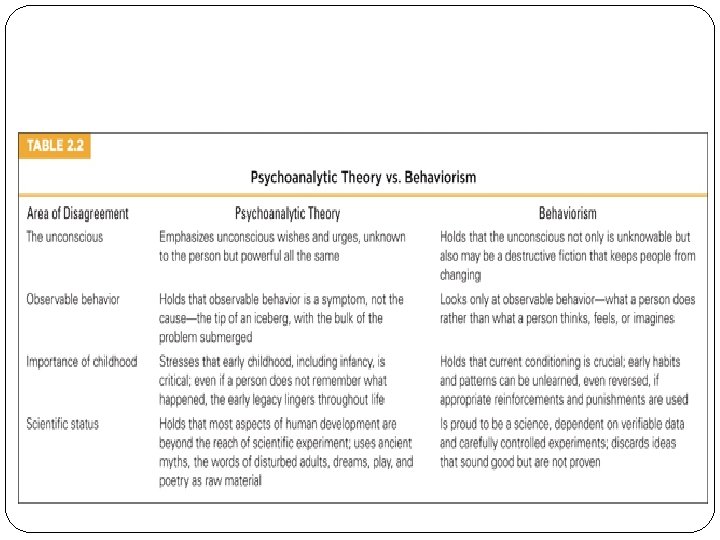
THEORIES OF HUMAN DEVELOPMENT �Psychoanalytic Theory �A theory of human development that holds that irrational, unconscious drives and motives, often originating in childhood, underlies human behavior �Freud �Erikson
PSYCHOANALYTIC THEORY �Freud’s Psychoanalytic Theory (Psychosexual Development) �Freud 1856 -1939 �Development in the first six years has three stages, each characterized by sexual pleasure… �infancy – the mouth – the oral stage �early childhood – the anus – the anal stage �preschool years – the penis – the phallic stage �beginning of adolescence through death – latency – genital stages
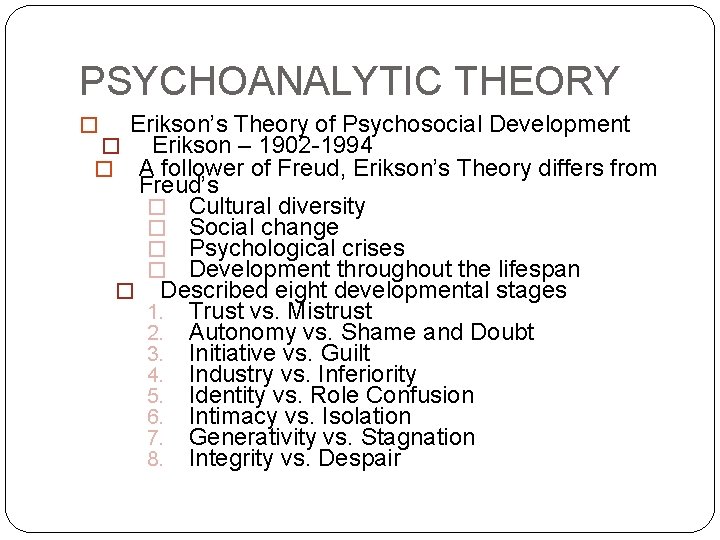
PSYCHOANALYTIC THEORY Erikson’s Theory of Psychosocial Development � Erikson – 1902 -1994 � A follower of Freud, Erikson’s Theory differs from Freud’s � Cultural diversity � Social change � Psychological crises � Development throughout the lifespan � Described eight developmental stages 1. Trust vs. Mistrust 2. Autonomy vs. Shame and Doubt 3. Initiative vs. Guilt 4. Industry vs. Inferiority 5. Identity vs. Role Confusion 6. Intimacy vs. Isolation 7. Generativity vs. Stagnation 8. Integrity vs. Despair �
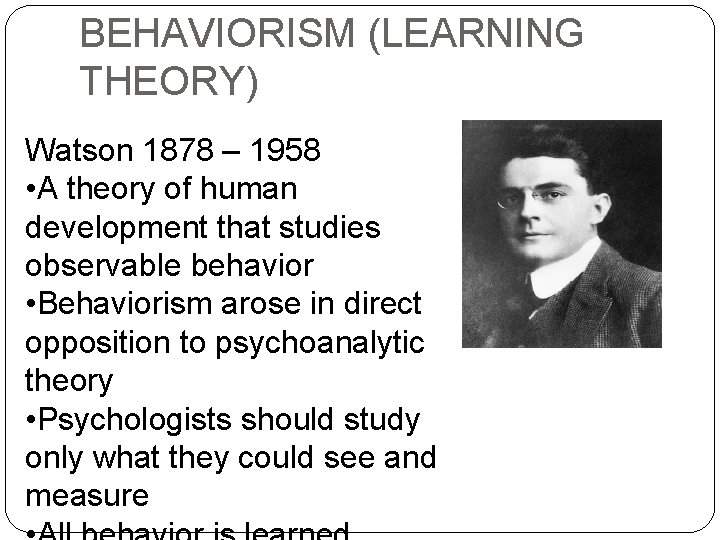
BEHAVIORISM (LEARNING THEORY) Watson 1878 – 1958 • A theory of human development that studies observable behavior • Behaviorism arose in direct opposition to psychoanalytic theory • Psychologists should study only what they could see and measure
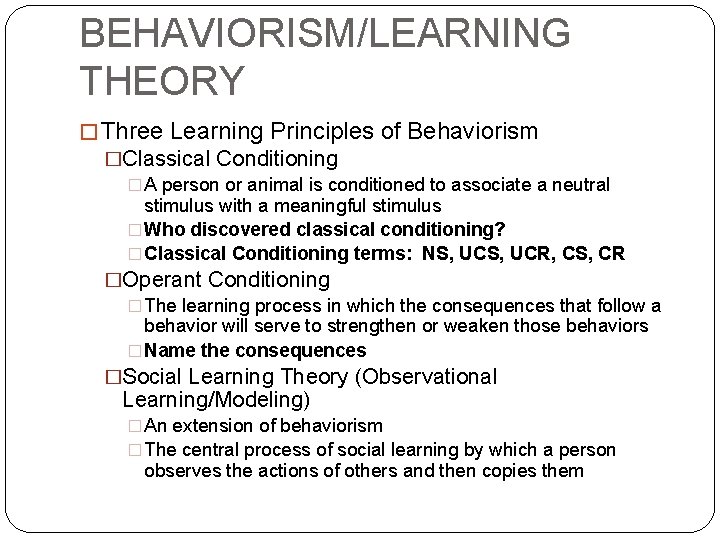
BEHAVIORISM/LEARNING THEORY � Three Learning Principles of Behaviorism �Classical Conditioning � A person or animal is conditioned to associate a neutral stimulus with a meaningful stimulus � Who discovered classical conditioning? � Classical Conditioning terms: NS, UCR, CS, CR �Operant Conditioning � The learning process in which the consequences that follow a behavior will serve to strengthen or weaken those behaviors � Name the consequences �Social Learning Theory (Observational Learning/Modeling) � An extension of behaviorism � The central process of social learning by which a person observes the actions of others and then copies them
Positive Reinforcement! �http: //www. youtube. com/watch? v=JA 96 Fba-WHk
�Mistake in the video? ?
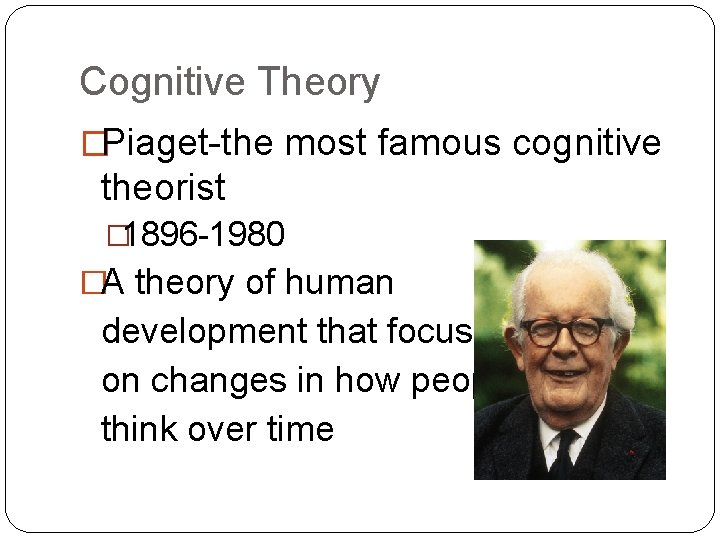
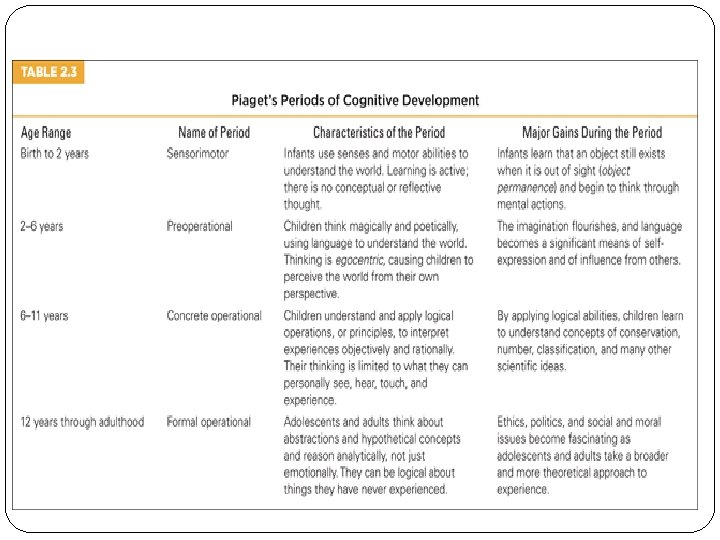
Cognitive Theory �Piaget-the most famous cognitive theorist � 1896 -1980 �A theory of human development that focuses on changes in how people think over time
COGNITIVE THEORY �Jean Piaget’s 4 Stages �Sensorimotor �Preoperational �Concrete Operational �Formal Operational
USING THE SCIENTIFIC METHOD (RESEARCH METHODS) �Observation �A method of testing a hypothesis by unobtrusively watching and recording participants’ behavior �Naturalistic observation �Laboratory observation
USING THE SCIENTIFIC METHOD (RESEARCH METHODS) �The Survey �The Case Study
USING THE SCIENTIFIC METHOD (RESEARCH METHODS) �The Experiment �A research method in which the researcher tries to determine the cause -and-effect relationship between two variables �Independent variable �Dependent variable �Experimental group �Control group / Comparison group
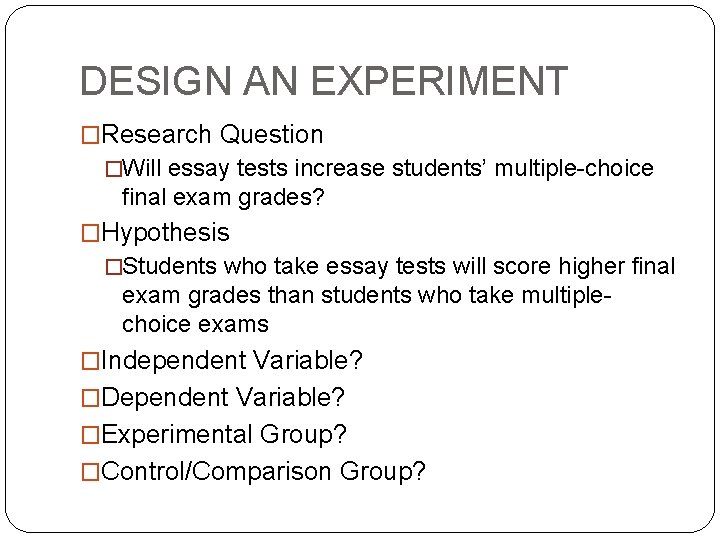
DESIGN AN EXPERIMENT �Research Question �Will essay tests increase students’ multiple-choice final exam grades? �Hypothesis �Students who take essay tests will score higher final exam grades than students who take multiplechoice exams �Independent Variable? �Dependent Variable? �Experimental Group? �Control/Comparison Group?
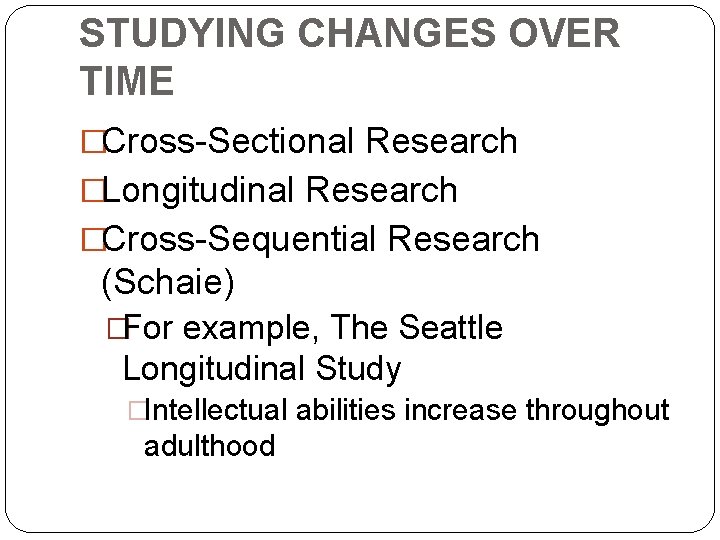
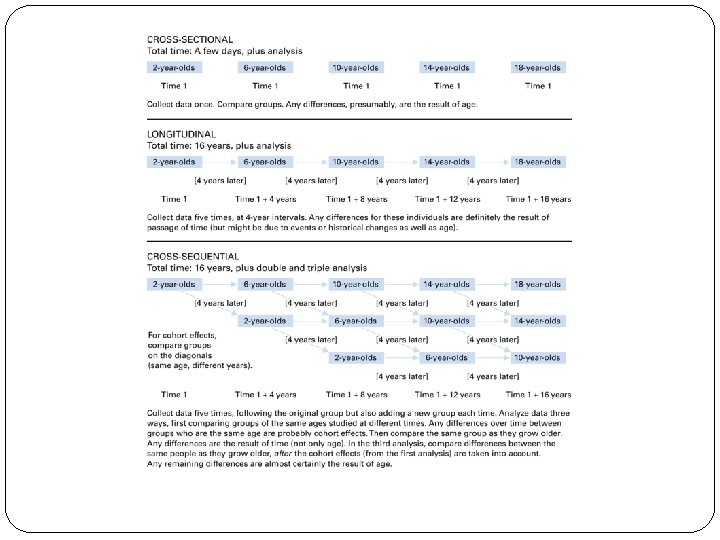
STUDYING CHANGES OVER TIME �Cross-Sectional Research �Longitudinal Research �Cross-Sequential Research (Schaie) �For example, The Seattle Longitudinal Study �Intellectual abilities increase throughout adulthood
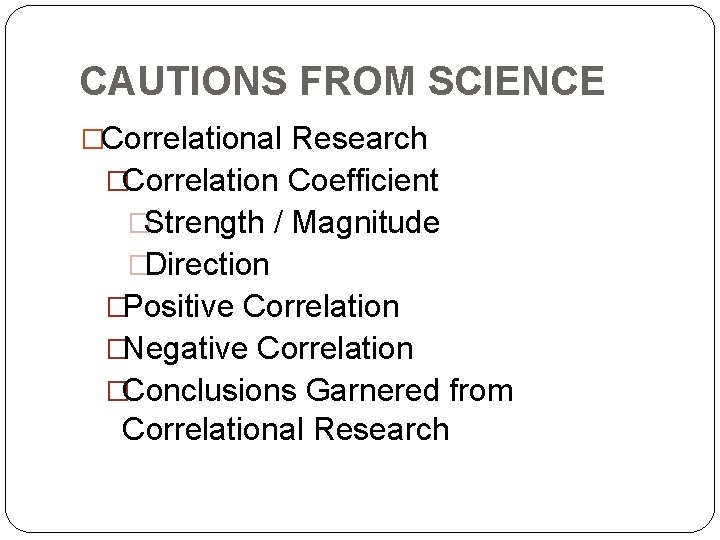
CAUTIONS FROM SCIENCE �Correlational Research �Correlation Coefficient �Strength / Magnitude �Direction �Positive Correlation �Negative Correlation �Conclusions Garnered from Correlational Research
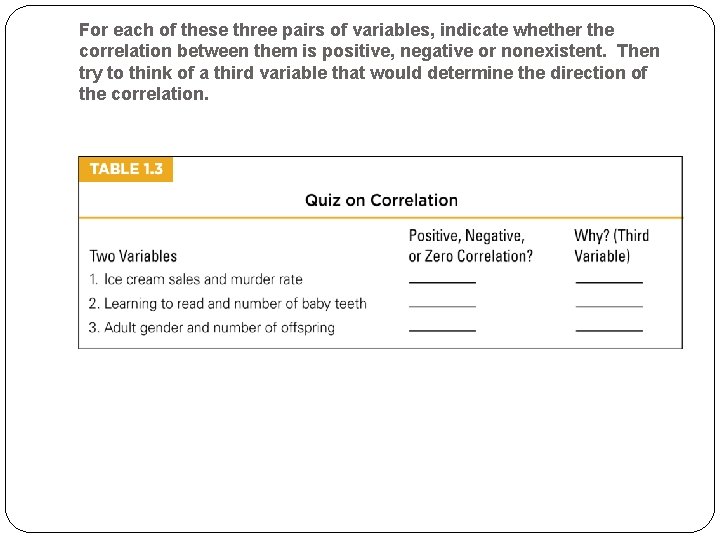
For each of these three pairs of variables, indicate whether the correlation between them is positive, negative or nonexistent. Then try to think of a third variable that would determine the direction of the correlation.
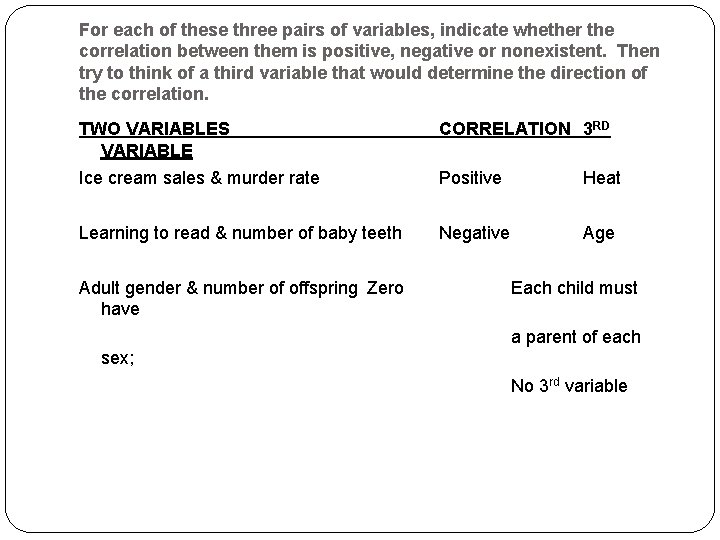
For each of these three pairs of variables, indicate whether the correlation between them is positive, negative or nonexistent. Then try to think of a third variable that would determine the direction of the correlation. TWO VARIABLES VARIABLE CORRELATION 3 RD Ice cream sales & murder rate Positive Heat Learning to read & number of baby teeth Negative Age Adult gender & number of offspring Zero have Each child must a parent of each sex; No 3 rd variable
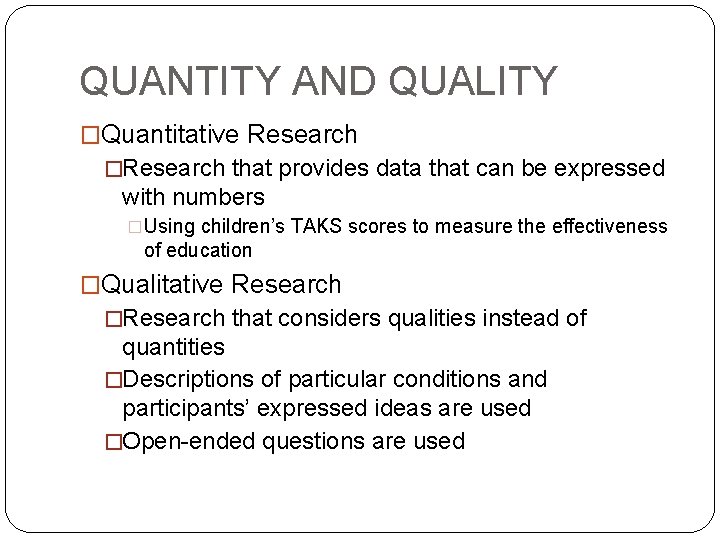
QUANTITY AND QUALITY �Quantitative Research �Research that provides data that can be expressed with numbers �Using children’s TAKS scores to measure the effectiveness of education �Qualitative Research �Research that considers qualities instead of quantities �Descriptions of particular conditions and participants’ expressed ideas are used �Open-ended questions are used
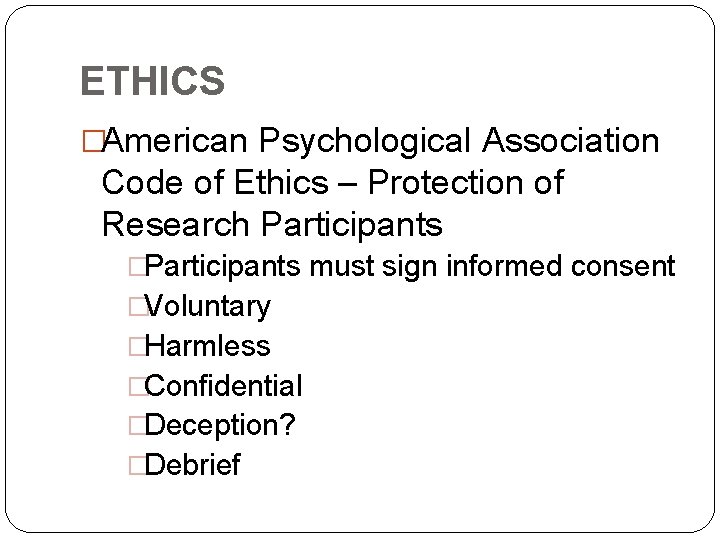
ETHICS �American Psychological Association Code of Ethics – Protection of Research Participants �Participants must sign informed consent �Voluntary �Harmless �Confidential �Deception? �Debrief
ETHICS �What should we study? �Studying issues that will help humans live satisfying and productive lives �Controversial Research Topics �Do we know enough about prenatal drug abuse to protect every fetus? �Do we know enough about the effects of poverty to enable everyone to be healthy? �Do we know enough about sexual urges to eliminate AIDS, unwanted pregnancy, and sexual abuse? �Do we know enough about dying to enable everyone to die with dignity?