
Chapter 1 The Science of Biology 1 What
Chapter 1 The Science of Biology 1
What is Science? • Science -an organized way of using evidence to learn about the natural world. • Goals of science: – Investigate & understand the natural world. – Explain events in the natural world. – Make predictions. 2
• Why science works: – Only deals w/ the natural world. – Scientists collect & organize info in a careful, orderly way. – Scientists look for patterns & connections b/t events. – Scientists explanations can be tested! 3
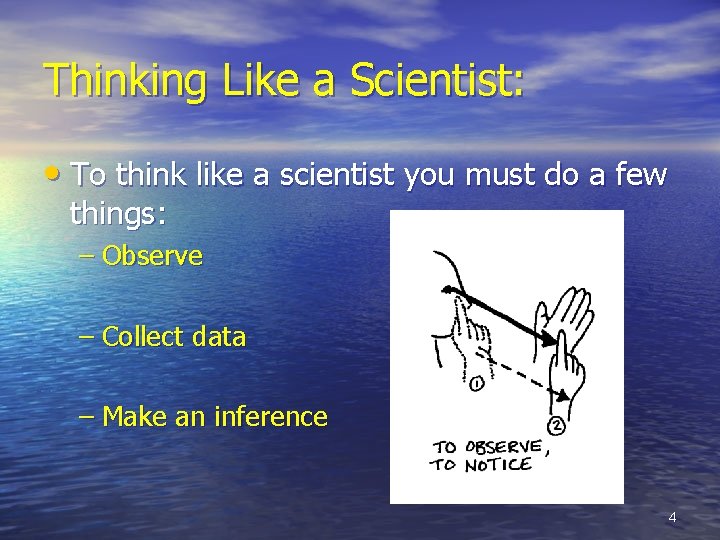
Thinking Like a Scientist: • To think like a scientist you must do a few things: – Observe – Collect data – Make an inference 4
• Observations use senses to get info. – Info is called data. • Data can be quantitative or qualitative. – Quantitative -counted or measured. • Example: there are 12 inches in a foot. – Qualitative -can’t be counted. • Example: “the scar on a manatee looks old” 5
• Once scientists have data, they make inferences. • Inference –a logical interpretation based on prior knowledge or experience. – Example: • You observe smoke coming from a building. – You infer that “where there is smoke there is fire”. 6
Explaining & Interpreting Evidence: • Example: – Many people contract an unknown disease after attending a public concert. – Public health officials will likely use the scientific method to try & solve why this happened. 7
• After making observations scientists will propose 1 or more hypothesis. • Hypothesis –a proposed scientific explanation for a set of observations. – It uses prior knowledge – Logical inferences – A creative imagination 8
• Possible hypothesis’ could be that: – The disease spread from person to person via contact. – It spread by insect bites. – Or, it spread through air, food, or water. 9
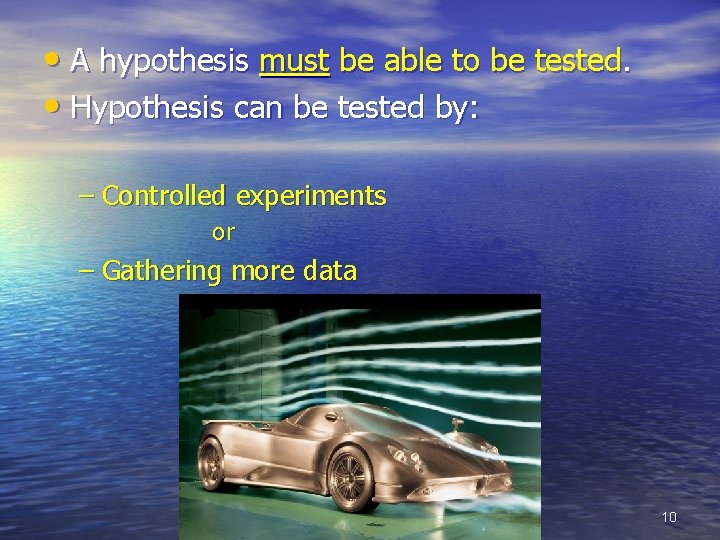
• A hypothesis must be able to be tested. • Hypothesis can be tested by: – Controlled experiments or – Gathering more data 10
Science as a way of Knowing: • Science is always changing. – New tools, techniques, & discoveries lead to new understandings. • Good scientists are skeptics: – You question everything? • You must be open minded. – Be open to new ideas & hypothesis. 11
Science & Human Values: • Science is in many of the questions of today. – How should chemical wastes be disposed of? • Who should be responsible for their disposal? – Should our electricity come from nuclear or hydroelectric? – Should the info in your genes be kept private? 12
• All of these question involve science in a way. • But, science can’t answer them. – Science makes recommendations. – Society has the final decision. • We consider our laws & moral principles, then we make a decision. 13
Section 2 How Scientists Work 14
Designing an Experiment: • Some old ideas about living things… – P. 8 – Fig. 1. 7 15
Required Steps in a Good Experiment: • Ask a question: – How, why? • Forming a Hypothesis: – Years ago people thought living things came from nonliving things. – This idea was called spontaneous generation. 16
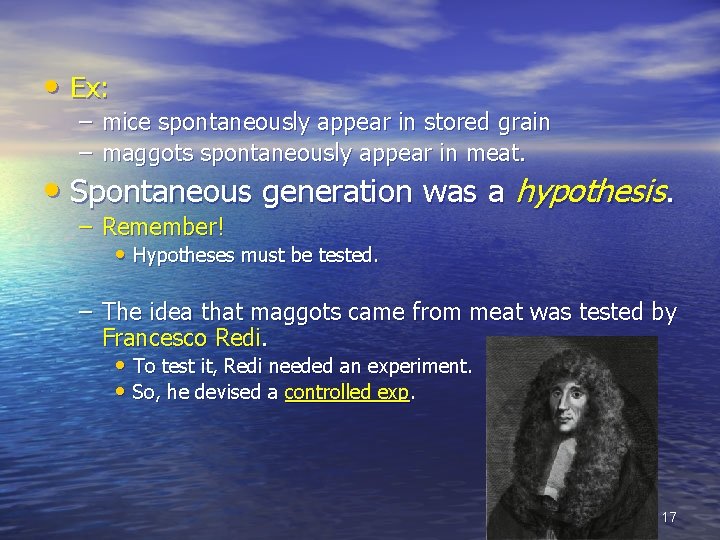
• Ex: – mice spontaneously appear in stored grain – maggots spontaneously appear in meat. • Spontaneous generation was a hypothesis. – Remember! • Hypotheses must be tested. – The idea that maggots came from meat was tested by Francesco Redi. • To test it, Redi needed an experiment. • So, he devised a controlled exp. 17
• Setting Up a Controlled Experiment: – Factors that can be changed in an exp. are called variables. • Examples: – Equipment used – Type of materials – Amount of materials – Temp. – Light – Time 18
• Hypotheses are tested in an experiments. where only 1 variable is changed at a time. – This is called a controlled exp. – Controlled exp. have 2 types of variables: • Manipulated variable – Variable that is deliberately changed. • Responding variable – Variable changes in response to the manipulating variable. – Refer to Redi’s Exp. Fig. 1 -8 19
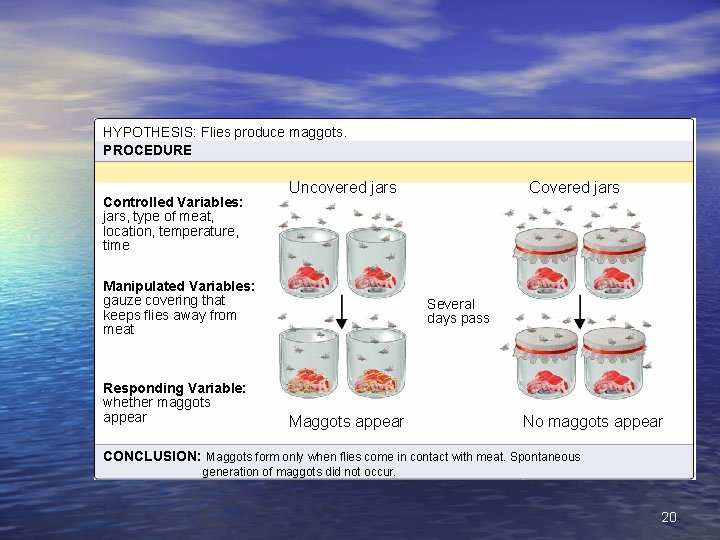
OBSERVATIONS: Flies land on maggots. meat that is left uncovered. Later, maggots appear on the meat. HYPOTHESIS: Flies produce PROCEDURE Controlled Variables: jars, type of meat, location, temperature, time Uncovered jars Manipulated Variables: gauze covering that keeps flies away from meat Responding Variable: whether maggots appear Covered jars Several days pass Maggots appear No maggots appear CONCLUSION: Maggots form only when flies come in contact with meat. Spontaneous generation of maggots did not occur. 20
• Recording & Analyzing Results: – Scientists keep records of their observations, experements, or data. – These records are kept in: • Journals • Notebooks • Drawings Fig. 1 -8 • Computers – Did Redi keep records? • Yes 21
Scientific Method (con’t) • Drawing Conclusions: – Evidence from a exp. either supports or disproves a hypothesis. – Did Redi’s exp. support his hypothesis? • Yes, it disproved theory of spontaneous generation. 22
Repeating Investigations • Often, scientists place their procedures & findings of an experiments in scientific journals. • They do this so other scientists can repeat their work. – Why? • Scientists can confirm or deny other scientists findings. 23
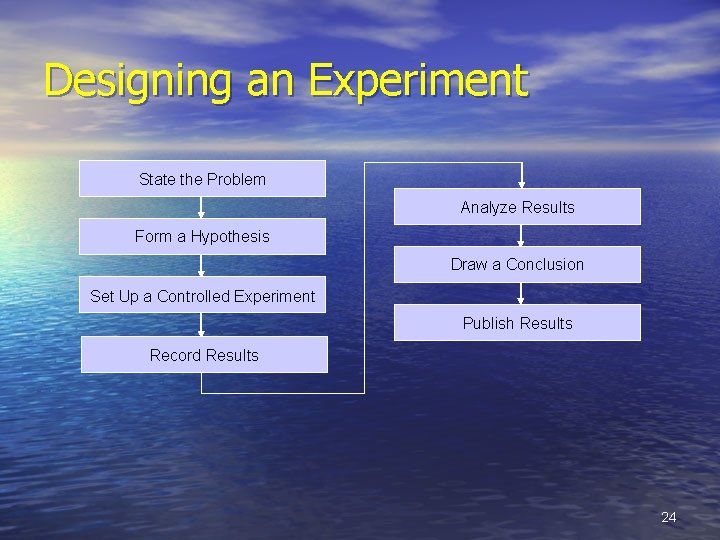
Designing an Experiment State the Problem Analyze Results Form a Hypothesis Draw a Conclusion Set Up a Controlled Experiment Publish Results Record Results 24
Scientific Method • Let’s look at some scientists who questioned Redi’s findings: • P. 11 -13 – Needham fig. 1 -10 – Spallanzani fig. 1 -10 – Pasteur fig. 1 -11 25
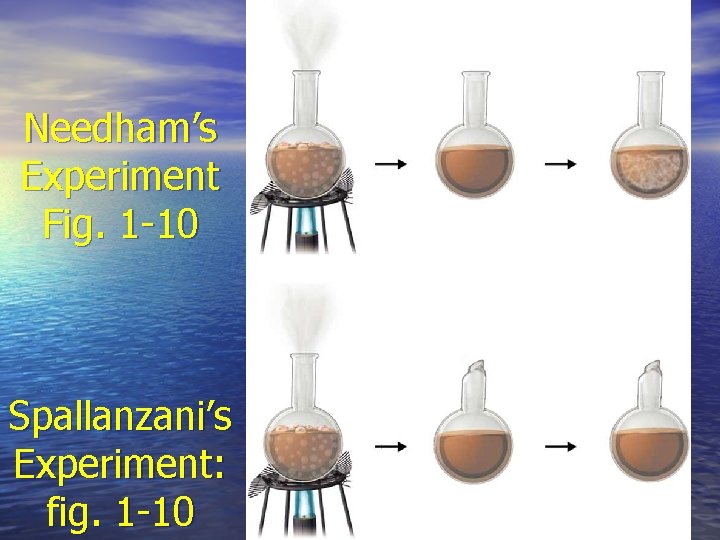
Needham’s Experiment Fig. 1 -10 Spallanzani’s Experiment: fig. 1 -10 26
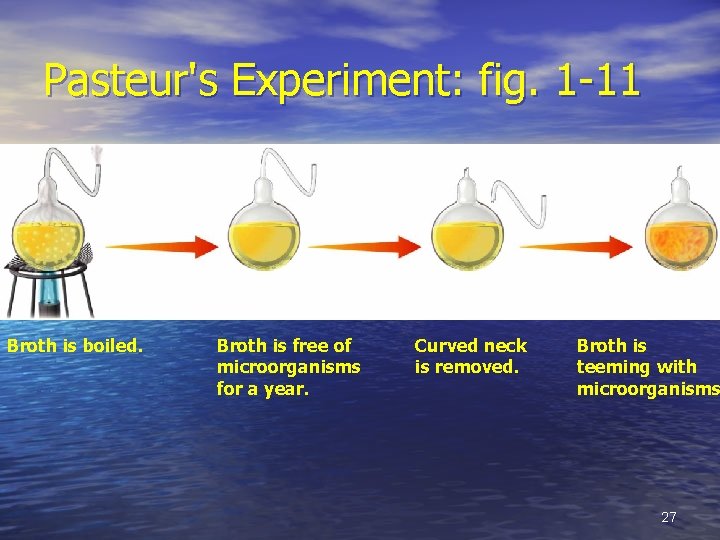
Pasteur's Experiment: fig. 1 -11 Broth is boiled. Broth is free of microorganisms for a year. Curved neck is removed. Broth is teeming with microorganisms 27
When Experiments Are Not Possible: • You can’t always do an exp. to test a hypothesis. – When this happens you can do: • Field studies & more observations – Enables us to study animal behavior – Fig 1 -12 • Medical studies & testing – Usually on volunteers 28
How a Theory Develops: • Theory -A very well tested explanation that unifies a broad range of observations. – Examples of theories: • Theory of Biogenesis – All living things come from other living things. v Verified by Pasteur • Theory of Evolution • The Cell Theory • Big Bang theory 29
The Big Picture! • Some explanations in life need more than one theory. – Fig. 1 -13 – Examples: • Theory of Evolution • Cell Theory • Theory of Plate Tectonics 30
Section 3 Studying Life 31
Fields of Science… • What is biology? – study of life – Biology –understanding the living world. 32
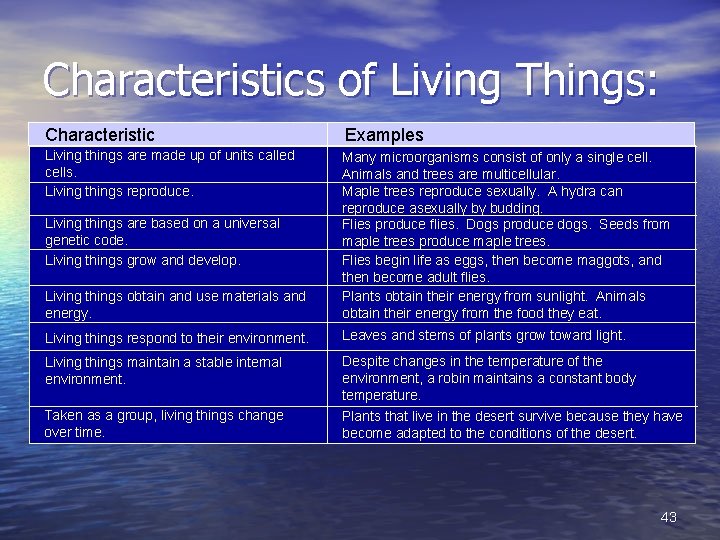
Characteristics of Living Things • All living things share these characteristics: 1. 2. 3. 4. 5. 6. 7. 8. made of cells reproduce a genetic code (DNA) grow & develop use materials & energy respond to their environment maintain their internal env. (homeostasis) evolve – Fig. 1 -14 33
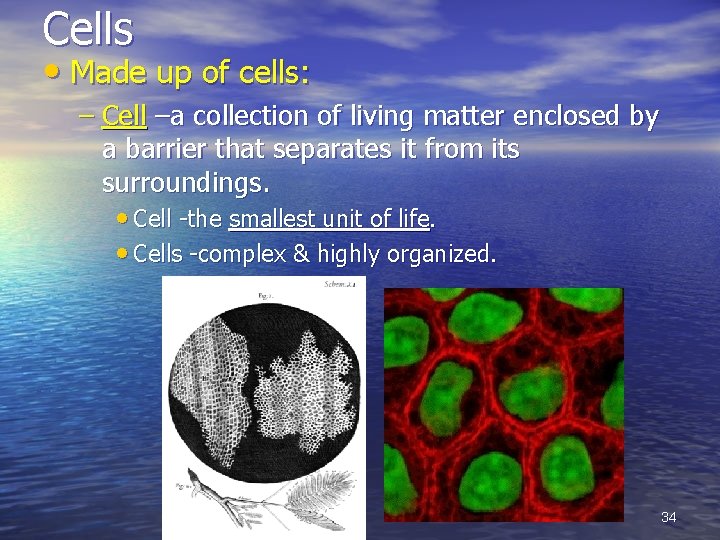
Cells • Made up of cells: – Cell –a collection of living matter enclosed by a barrier that separates it from its surroundings. • Cell -the smallest unit of life. • Cells -complex & highly organized. 34
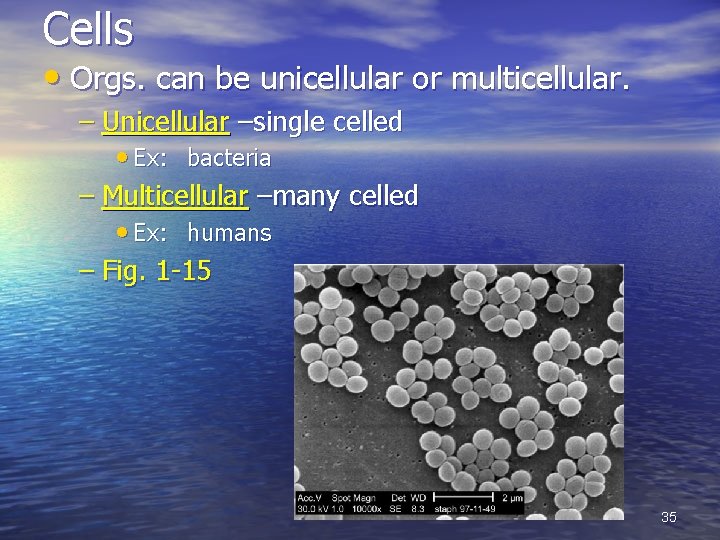
Cells • Orgs. can be unicellular or multicellular. – Unicellular –single celled • Ex: bacteria – Multicellular –many celled • Ex: humans – Fig. 1 -15 35
Cells • Reproduction: – There are 2 types of reproduction: • Asexual – “A” before a word means w/out. – The new org. has a single parent. – Offspring are exact duplicates of the parent. (clones) – Fig. 1 -16 shows “budding” of a hydra. • Sexual – Cells from 2 different parents unite to make the 1 st cell of the org. 36
Cells • Based on Genetic Code: – Offspring resemble their parents. – All living orgs. have DNA. • DNA =Deoxyribonucleic Acid • Determines the traits of every org. on Earth. 37
• Growth & Development: – All living things grow to some extent. • Growth = increase in size. • However, multicellular orgs. go through development. – Development involves cells dividing & becoming specialized or “differentiated”. – Ex: Stem cells can become: v nerve cells v skin cells v liver cells v brain cells • Fig. 1 -17 38
• Need for Materials & Energy: – Metabolism –set of chem. reactions through which an org. builds up/breaks down materials. – All orgs. need energy (E). • Plants, some bacteria, & most algae get E from the sun. • Animals get E from food. 39
• Response to the Env: – All orgs. sense & respond to stimuli in their env. – Stimulus –a signal to which an org. responds. • Ex: plant seeds respond to warmth & water. 40
• Maintaining Internal Balance: – Homeostasis –process by which orgs. maintain a relatively stable internal env. • Ex: home heating/cooling system. • Another example, the bird in fig. 1 -19. – When it is cold it hunches down & adjusts its feathers for maximum insulation. 41
• Evolution: – Evolution –process by which modern orgs. have descended from ancient orgs. over long periods of time. 42
Characteristics of Living Things: Characteristic Examples Living things are made up of units called cells. Living things reproduce. Living things obtain and use materials and energy. Many microorganisms consist of only a single cell. Animals and trees are multicellular. Maple trees reproduce sexually. A hydra can reproduce asexually by budding. Flies produce flies. Dogs produce dogs. Seeds from maple trees produce maple trees. Flies begin life as eggs, then become maggots, and then become adult flies. Plants obtain their energy from sunlight. Animals obtain their energy from the food they eat. Living things respond to their environment. Leaves and stems of plants grow toward light. Living things maintain a stable internal environment. Despite changes in the temperature of the environment, a robin maintains a constant body temperature. Taken as a group, living things change over time. Plants that live in the desert survive because they have become adapted to the conditions of the desert. Living things are based on a universal genetic code. Living things grow and develop. 43
Branches of Biology: • Some branches of biology: – Zoology –study animals – Botany-study plants – Paleontology-study of ancient life – Molecular/Cell biologists- study of the smallest life forms. – Population biologists & ecologists –study of the largest systems on Earth. 44
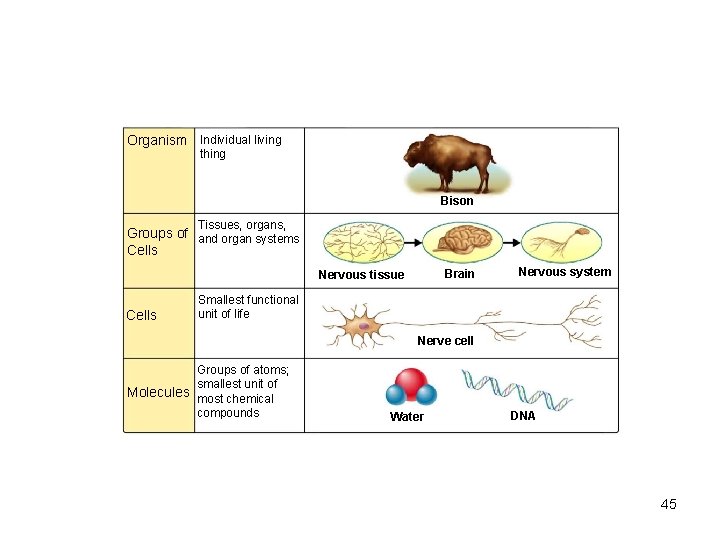
Organism Individual living thing Bison Tissues, organs, Groups of and organ systems Cells Brain Nervous tissue Cells Nervous system Smallest functional unit of life Nerve cell Groups of atoms; smallest unit of Molecules most chemical compounds Water DNA 45
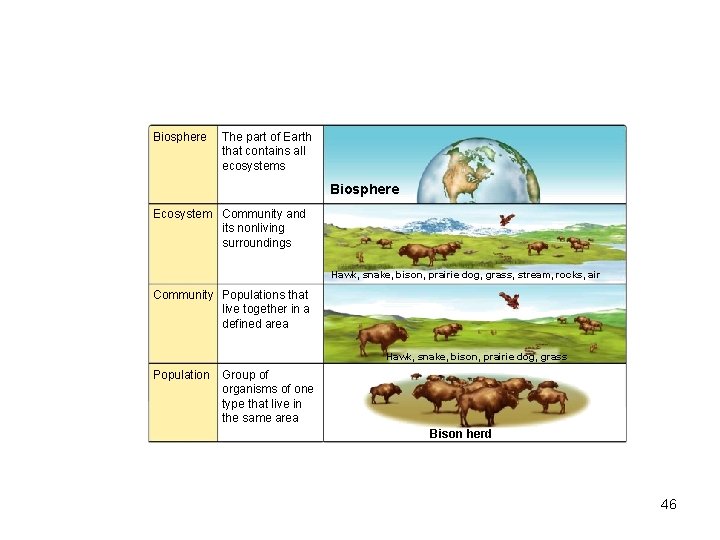
Biosphere The part of Earth that contains all ecosystems Biosphere Ecosystem Community and its nonliving surroundings Hawk, snake, bison, prairie dog, grass, stream, rocks, air Community Populations that live together in a defined area Hawk, snake, bison, prairie dog, grass Population Group of organisms of one type that live in the same area Bison herd 46
Biology in Everyday Life: • Read this section in class… 47

Section 4 Tools & Procedures 48
A Common Measurement System: • Scientists use the metric system for data & performing experiments. – Metric system: • -a decimal system of measurements w/ units that are based on multiples of 10. • International System of Units–revised version of the metric system. – Abbreviated as SI – Les Systeme International d’unites (French) 49
50
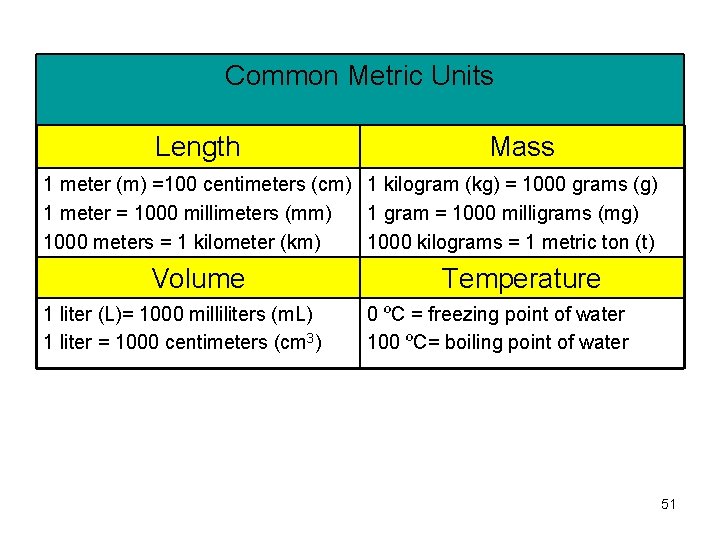
Common Metric Units Length Mass 1 meter (m) =100 centimeters (cm) 1 kilogram (kg) = 1000 grams (g) 1 meter = 1000 millimeters (mm) 1 gram = 1000 milligrams (mg) 1000 meters = 1 kilometer (km) 1000 kilograms = 1 metric ton (t) Volume 1 liter (L)= 1000 milliliters (m. L) 1 liter = 1000 centimeters (cm 3) Temperature 0 ºC = freezing point of water 100 ºC= boiling point of water 51
Analyzing Biological Data: • Once scientists collect data, they put it in tables & graphs. – Graphs make it easier to analyze data. 52
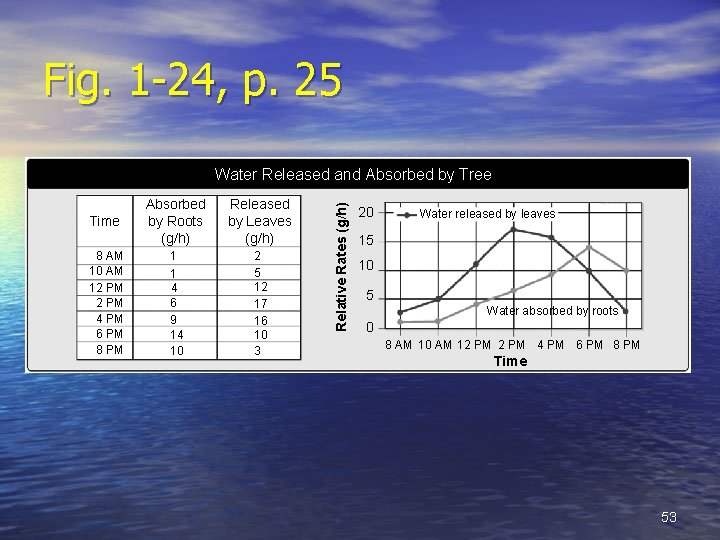
Fig. 1 -24, p. 25 Time Absorbed by Roots (g/h) Released by Leaves (g/h) 8 AM 10 AM 12 PM 4 PM 6 PM 8 PM 1 1 4 6 9 14 10 2 5 12 17 16 10 3 Relative Rates (g/h) Water Released and by Tree Water Released & Absorbed 20 Water released by leaves 15 10 5 Water absorbed by roots 0 8 AM 10 AM 12 PM 4 PM 6 PM 8 PM Time 53
• Today, computers help analyze data. – Examples: • They help determine structure of molecules. • They enable us to look through a DNA molecule. • Computers gather satellite data. – Global climate changes 54
Microscopes: • Microscope -device that magnifies images of structures. • There are 2 main types of microscopes: – Light microscope – Electron microscope 55
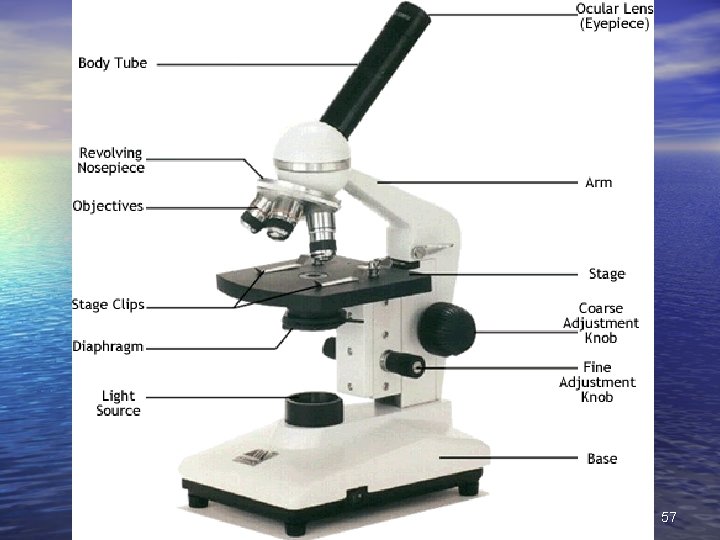
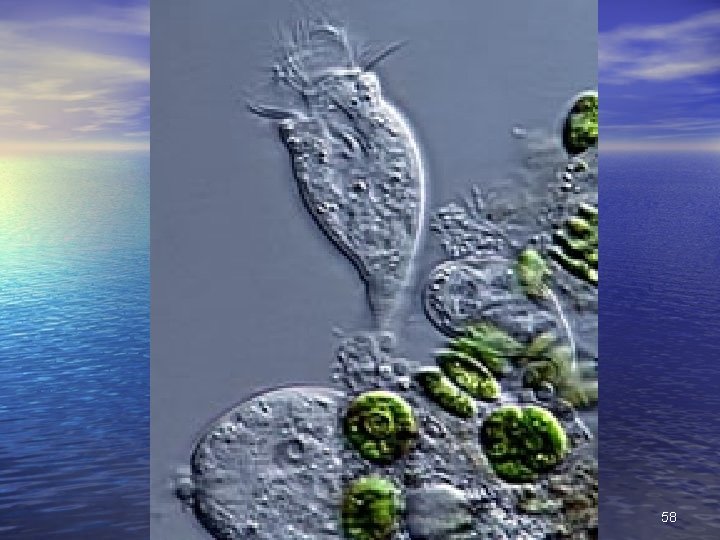
• Light Microscopes: – Most common – Can magnify up to 1000 x. – Compound light microscopes –uses light to pass through the specimen & uses 2 lenses to form an image. • We use the light microscope to: – Study dead orgs. & their parts. – Observe tiny orgs. & cells while alive. 56
57
58
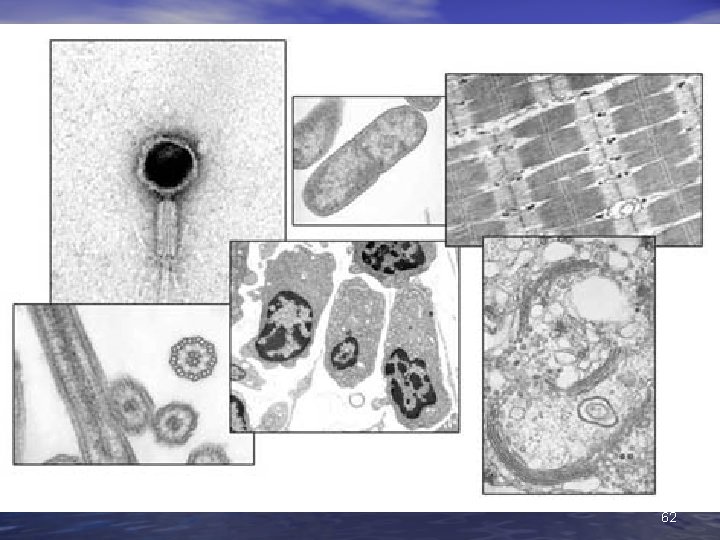
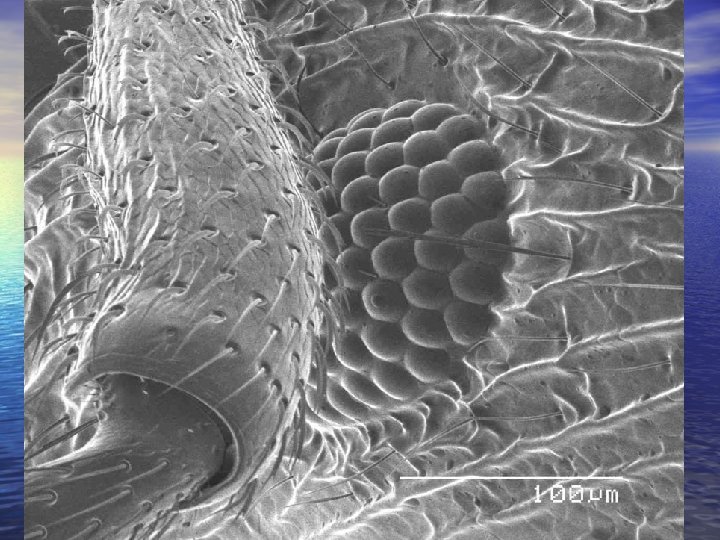
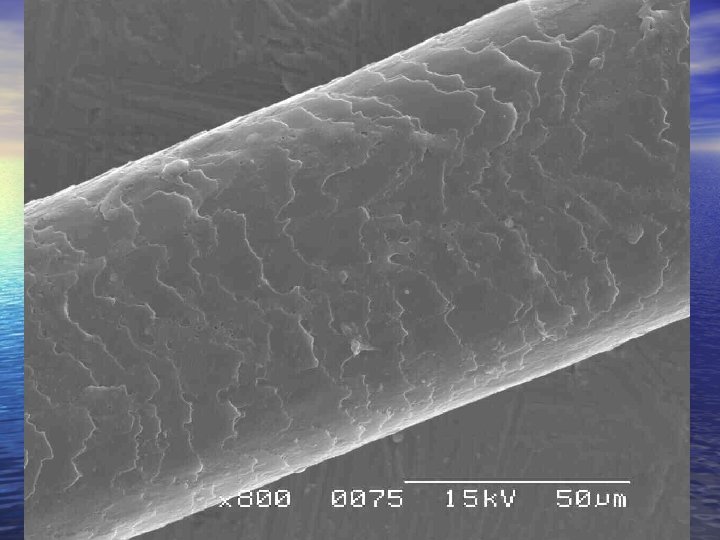
• Electron Microscopes: – When scientists look at even smaller objects they rely on Electron Microscopes (EM). • Electron microscopes use a beam of electrons, rather than light, to produce images. – The best EM can make images 1000 x more detailed than a light microscope. 59
• There are 2 types of EM: – Transmission EM (TEM) – Scanning EM (SEM) • The TEM produces images that are a cross section of an object. • The SEM produces 3 D images of an object. • There is a negative to the use of EM’s. – You cannot view living things. 60
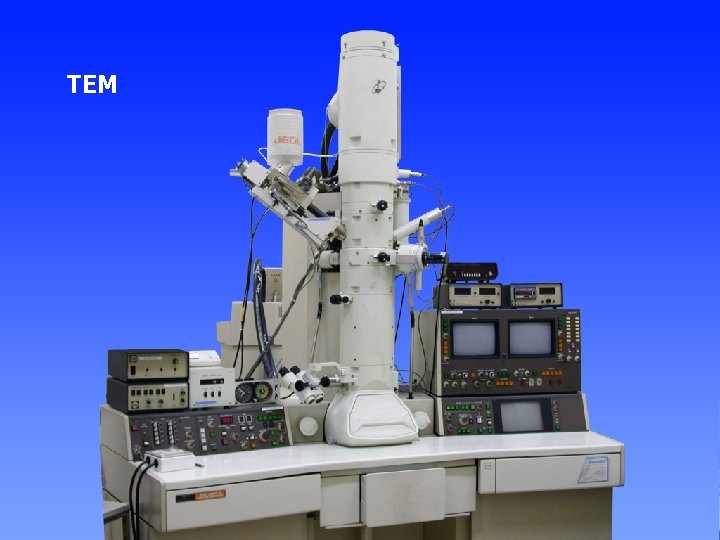
TEM 61
62
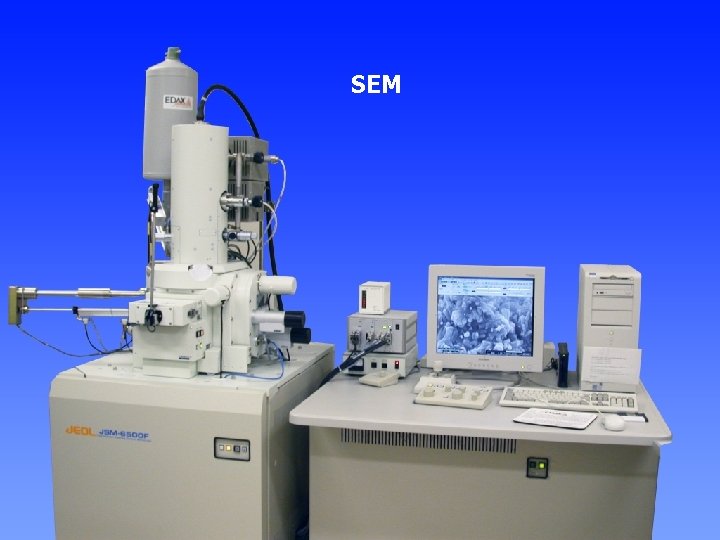
SEM 63
64
65
Lab Techniques: • Biologists use many ways to study cells. • 2 common ways are: – Cell cultures – Cell fractionation 66
• Cell cultures: – A group of cells grown in a nutrient solution from a single original cell. – Cell cultures are used for: • Testing cell responses under controlled conditions. • Studying the interactions b/t cells. • Selecting specific cells for further study. 67
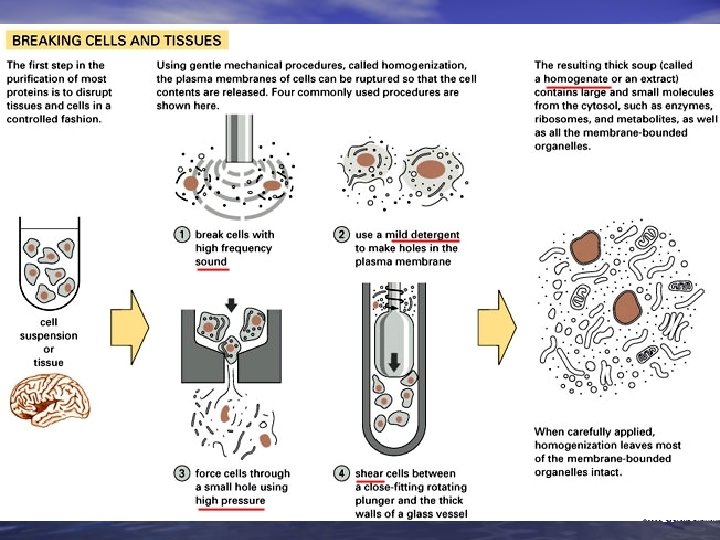
• Cell fractionation: – The technique in which cells are broken into pieces & the different cell parts are separated. 68
69
Working Safely in Biology: • Always follow safety rules. • Wash hands after every scientific activity. • Always wear protective gear when called for. 70
- Slides: 70