
Chapter 1 The Origins of Psychology The Science
- Slides: 37
Chapter 1: The Origins of Psychology: The Science of Behavior, 5 th Edition Ettinger © 2014 BVT Publishing Better textbooks, better prices.
The Study of Psychology investigates a wide variety of questions and attempts to answer them using scientific methods. Psychology helps us evaluate the many so-called psychological facts we encounter everyday. An understanding of psychology will help you to think critically and evaluate scientifically-based facts. Psychology: The Science of Behavior, 5 th Edition Ettinger © 2014 BVT Publishing Better textbooks, better prices.
Definition of Psychology is the scientific study of the behavior of humans and other animals � It is based on the careful application of scientific methods. � It is not just a matter of commonsense. � It deals with people effectively and is only a small part of the science of behavior. Psychology: The Science of Behavior, 5 th Edition Ettinger © 2014 BVT Publishing Better textbooks, better prices.
Psychology as a Science Latane and Darley (1970) � The presence of other people affects our perception of an emergency situation. � We tend to diffuse our responsibility to act onto others who are present. � We are more likely to act when we are alone. � This helps explain bystander apathy Psychology: The Science of Behavior, 5 th Edition Ettinger © 2014 BVT Publishing Better textbooks, better prices.
The Study of Behavior Contemporary psychologists are interested in studying both observable behavior and mental processes. Psychology: The Science of Behavior, 5 th Edition Ettinger © 2014 BVT Publishing Better textbooks, better prices.
The Study of Humans and Other Animals Five major reasons for the study of animal behavior: � Satisfies the need to find a simpler model � Provides greater control � Considers ethical issues Institutional review boards � Practicality (cost) � To learn more about animal behavior Psychology: The Science of Behavior, 5 th Edition Ettinger © 2014 BVT Publishing Better textbooks, better prices.
Psychology’s History (Slide 1 of 3) Psychology has roots in philosophy. Fundamental interest in the relationship between the mind and the body René Descartes proposed that mind and body are distinct entities that interact at the pineal gland— known as dualism. � The physical body was mechanical. � The mind or soul was not physical. It interacted through the pineal gland to produce intentional behavior. Psychology: The Science of Behavior, 5 th Edition Ettinger © 2014 BVT Publishing Better textbooks, better prices.
Psychology’s History (Slide 2 of 3) Descartes’ ideas have influenced our perception of mind and body. Free will: central to our assumption that behavior is caused or determined by physical events Determinism: central to the science of psychology Psychology: The Science of Behavior, 5 th Edition Ettinger © 2014 BVT Publishing Better textbooks, better prices.
Psychology’s History (Slide 3 of 3) Psychology has roots in physiology. � Physiologists adhere to the concept of empiricism. � They are well-versed in the scientific method. Scientific method: careful observation of events in the world, the formation of predictions based on these observations, and the testing of these predictions by manipulations of variables and systematic observation Psychology: The Science of Behavior, 5 th Edition Ettinger © 2014 BVT Publishing Better textbooks, better prices.
Structuralism (Slide 1 of 3) Structuralism: an approach to psychology that attempts to breakdown experience into its basic elements or structures � It uses a technique called introspection in which subjects provide scientific reports of perceptual experiences. Psychology: The Science of Behavior, 5 th Edition Ettinger © 2014 BVT Publishing Better textbooks, better prices.
Structuralism (Slide 2 of 3) Wilhelm Wundt established the first psychology laboratory in 1879 at the University of Leipzig. He defined the task of psychology as the systematic study of the structure of the conscious mind. � He believed that conscious mental processes could best be understood by breaking them down into basic elements. � He used introspection in the study of mental processes. Psychology: The Science of Behavior, 5 th Edition Ettinger © 2014 BVT Publishing Better textbooks, better prices.
Structuralism (Slide 3 of 3) One of Wundt’s students, Edward Titchener, established a psychology laboratory at Cornell University in 1892. Structuralism was short-lived and fell out of favor with psychologists. American psychologist fount it to be impractical, and this paved the way for functionalism. Psychology: The Science of Behavior, 5 th Edition Ettinger © 2014 BVT Publishing Better textbooks, better prices.
Functionalism (Slide 1 of 4) Functionalism: an approach to psychology that emphasizes the functional, practical nature of the mind Influenced by Darwin’s theory of natural selection, functionalists attempted to learn how mental processes—such as learning, thinking, and perceiving—helped people adapt. Psychology: The Science of Behavior, 5 th Edition Ettinger © 2014 BVT Publishing Better textbooks, better prices.
Functionalism (Slide 2 of 4) William James felt that the science of psychology would be better served by attempting to understand the fluid, functional, continually changing personal nature of the conscious experience. � He wanted to understand the mental processes that helped humans and animals adapt to their environments. Psychology: The Science of Behavior, 5 th Edition Ettinger © 2014 BVT Publishing Better textbooks, better prices.
Functionalism (Slide 3 of 4) William James’ emphasis was on the functional, practical nature of the mind. � Influenced by Charles Darwin � Principles of Psychology (1890)—his landmark text Functionalists wanted to learn how various mental process helped people adapt Psychology: The Science of Behavior, 5 th Edition Ettinger © 2014 BVT Publishing Better textbooks, better prices.
Functionalism (Slide 4 of 4) Structuralism brought psychology into the laboratory by demonstrating that mental processes were a legitimate focus for scientific research. Functionalism broadened psychology to include the study of nonhuman animals, and it expanded the data of psychology to include observations of behavior. Psychology: The Science of Behavior, 5 th Edition Ettinger © 2014 BVT Publishing Better textbooks, better prices.
Psychoanalysis (Slide 1 of 2) Sigmund Freud developed psychoanalysis. � Named after the procedure employed in interviewing patients with neurotic symptoms—Anna O. � The talking cure became known as catharsis. � Freud believed that sexual urges were powerful energizers of human behavior. � Its emphasis was the unconscious mind. Psychology: The Science of Behavior, 5 th Edition Ettinger © 2014 BVT Publishing Better textbooks, better prices.
Psychoanalysis (Slide 2 of 2) Much of the impact of psychoanalysis lies in the critical reactions it has generated, not on the contributions made to modern psychology. Psychoanalysis’ assertions cannot be tested in the laboratory. Freud’s impact on psychology was profound. Psychoanalysis is still practiced today. Psychology: The Science of Behavior, 5 th Edition Ettinger © 2014 BVT Publishing Better textbooks, better prices.
Behaviorism (Slide 1 of 3) By 1913, John Watson initiated a sudden and dramatic approach to psychology, which replaced both structuralism and functionalism. Behaviorism: a scientific approach to the study of behavior that emphasizes the relationship between environmental events and an organism’s behavior Psychology: The Science of Behavior, 5 th Edition Ettinger © 2014 BVT Publishing Better textbooks, better prices.
Behaviorism (Slide 2 of 3) Watson believed it was impossible to study the mind objectively, and he opposed introspection. � His stimulus-response (S-R) approach was a radical change from the focus on mental processes. � The goal of behaviorism is to identify the processes by which stimuli and responses become connected or associated; essentially, it is how we learn. Psychology: The Science of Behavior, 5 th Edition Ettinger © 2014 BVT Publishing Better textbooks, better prices.
Behaviorism (Slide 3 of 3) The early goal of behaviorism was to discover the rules of association and how combinations of simple associations lead to complex behavior. Behaviorism is characterized by its insistence upon an empirical, objective science of behavior that has no need for theories of mind or personal freedom. Psychology: The Science of Behavior, 5 th Edition Ettinger © 2014 BVT Publishing Better textbooks, better prices.
Gestalt Psychology Gestalt psychology: an approach to psychology arguing that the whole of an experience is different from the sum of its parts An active force in current investigations of perceptual processes, learning, and therapy—emphasizing the whole person Started by a group of German psychologists who disagreed with the principles and methods of both structuralism and functionalism The whole (our perception) is more than the sum of its parts (sensory elements). Psychology: The Science of Behavior, 5 th Edition Ettinger © 2014 BVT Publishing Better textbooks, better prices.
Humanistic Psychology (Slide 1 of 2) Humanistic psychology: an approach to psychology that emphasizes the role of free choice and our ability to make conscious, rational decisions about how we live our lives Developed out of strong criticism to behaviorism and psychoanalysis Does not view humans as being controlled either by events in the environment or by internal, unconscious forces Psychology: The Science of Behavior, 5 th Edition Ettinger © 2014 BVT Publishing Better textbooks, better prices.
Humanistic Psychology (Slide 2 of 2) Maslow and Rogers de-emphasize the influence of both environmental events and unconscious processes in determining human behavior. � Emphasis on free will and self-actualization Humanistic psychology increased awareness of the importance of such things as love, feeling needed, personal fulfillment, and self-esteem. It has been criticized for its reliance on a nonscientific approach to understanding human behavior. Psychology: The Science of Behavior, 5 th Edition Ettinger © 2014 BVT Publishing Better textbooks, better prices.
Fields of Specialization in Psychology (Slide 1 of 9) Cognitive psychology: an approach to psychology that focuses on the ways in which organisms process information—investigating processes, such as thinking, memory, language, problem solving, and creativity Developmental psychology: a field of specialization in psychology concerned with factors that influence development and shape behavior throughout the life cycle from conception through old age Psychology: The Science of Behavior, 5 th Edition Ettinger © 2014 BVT Publishing Better textbooks, better prices.
Fields of Specialization in Psychology (Slide 2 of 9) Social psychology: a field of specialization concerned with understanding the impact of social environments and social processes on individuals Personality psychology: a field of specialization that focuses on exploring the uniqueness of the individual, describing the elements that make up human personality, investigating how personality develops, and how it influences people’s activities Psychology: The Science of Behavior, 5 th Edition Ettinger © 2014 BVT Publishing Better textbooks, better prices.
Fields of Specialization in Psychology (Slide 3 of 9) Experimental psychology: a field of specialization in which the primary activity is conducting research Biological psychology: a branch of neuroscience, also known as physiological psychology, that focuses on the relationship between behavior and physiological events within the brain and the rest of the nervous system Clinical psychology: an area of specialization involved in the diagnosis and treatment of behavioral problems Psychology: The Science of Behavior, 5 th Edition Ettinger © 2014 BVT Publishing Better textbooks, better prices.
Fields of Specialization in Psychology (Slide 4 of 9) Counseling psychology: an area of specialization involved in the diagnosis and treatment of problems of adjustment � Counseling psychologist focus on less serious problems than do clinical psychologists, and they often work in settings, such as schools. Educational psychology: a field of specialization concerned with the study and application of learning and teaching methods, focusing on areas, such as improving educational curricula and training teachers Psychology: The Science of Behavior, 5 th Edition Ettinger © 2014 BVT Publishing Better textbooks, better prices.
Fields of Specialization in Psychology (Slide 5 of 9) School psychology: a field of specialization concerned with evaluating students’ interests and abilities and resolving learning and emotional problems in school settings Industrial and organizational (I/O) psychology: a field of specialization concerned with using psychological concepts to make the workplace a more satisfying environment for employees and management Psychology: The Science of Behavior, 5 th Edition Ettinger © 2014 BVT Publishing Better textbooks, better prices.
Fields of Specialization in Psychology (Slide 6 of 9) Engineering psychology: a field of specialization concerned with creating optimal relationships among people, the machines they operate, and the environments they work in—sometimes called human factors psychology. Health psychology: an area of specialization concerned with the interaction between behavioral facts and physical health Psychology: The Science of Behavior, 5 th Edition Ettinger © 2014 BVT Publishing Better textbooks, better prices.
Fields of Specialization in Psychology (Slide 7 of 9) Positive psychology: the study of human behavior aimed at discovering and promoting the positive strengths and attributes that enable individuals to thrive and succeed Forensic psychology: a field of specialization that works with the legal, court, and correctional systems to develop personality profiles of criminals, make decisions about disposition of convicted offenders, and help law enforcement understand behavioral problems Psychology: The Science of Behavior, 5 th Edition Ettinger © 2014 BVT Publishing Better textbooks, better prices.
Fields of Specialization in Psychology (Slide 8 of 9) Artificial intelligence: a field of specialization in which researchers develop computer models to simulate human cognitive processes and solve problems Connectionism: the learning theory by Thorndike that proposed learning as the result of forming associations or connections between stimuli and responses � Modern connectionism is focused on discovering the neurobiological mechanisms underlying learned associations. Psychology: The Science of Behavior, 5 th Edition Ettinger © 2014 BVT Publishing Better textbooks, better prices.
Fields of Specialization in Psychology (Slide 9 of 9) Evolutionary psychology: a recent approach to both investigating and explaining human behavior in terms of natural selection � Can be traced to the early writings of Charles Darwin � Evolutionary psychologists argue that traits may be a result of selection pressures Cultural psychology: investigations of how cultural and religious traditions and practices shape and contribute to differences in human behavior Psychology: The Science of Behavior, 5 th Edition Ettinger © 2014 BVT Publishing Better textbooks, better prices.
Psychological Associations American Psychological Association (APA): the major professional organization of psychologists in the United States, founded in 1892 American Psychological Society (APS): professional group of academic and research psychologists, founded in 1988 Psychology: The Science of Behavior, 5 th Edition Ettinger © 2014 BVT Publishing Better textbooks, better prices.
The Goals of Psychology (Slide 1 of 2) Common goals include understanding, predicting, and controlling or influencing the phenomena that constitute the subject matter � The idea of applying psychology to control people’s behavior is controversial. Theory: a scientific theory is a logical explanation for all of the relevant data or facts scientists have observed regarding certain natural phenomena � Must be testable and refutable Psychology: The Science of Behavior, 5 th Edition Ettinger © 2014 BVT Publishing Better textbooks, better prices.
The Goals of Psychology (Slide 2 of 2) Hypothesis: a statement that proposes the existence of a relationship between variables; typically as a tentative explanation for cause and effect, hypotheses are often designed to be tested by research Hindsight bias: the tendency to believe we could have foreseen an event after it occurred Psychology: The Science of Behavior, 5 th Edition Ettinger © 2014 BVT Publishing Better textbooks, better prices.
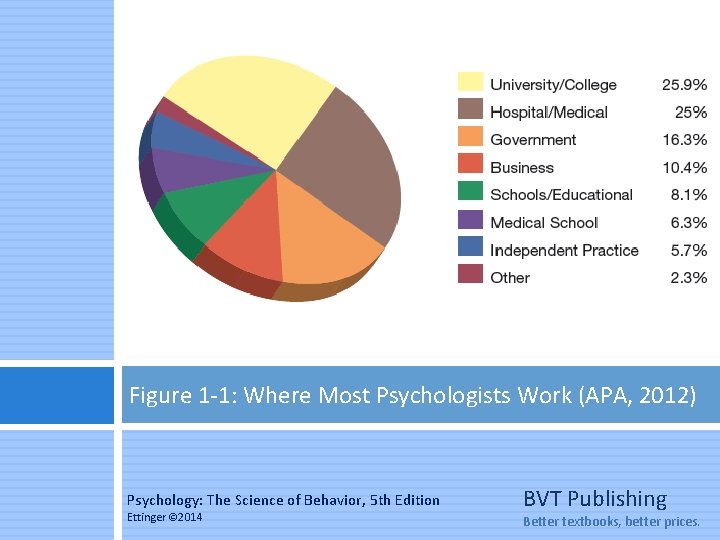
Figure 1 -1: Where Most Psychologists Work (APA, 2012) Psychology: The Science of Behavior, 5 th Edition Ettinger © 2014 BVT Publishing Better textbooks, better prices.