
CHAPTER 1 The Necessity of Intercultural Communication Learning
- Slides: 33
CHAPTER 1: The Necessity of Intercultural Communication
Learning Objectives • Describe why intercultural communication is a necessity. • Define and discuss the nature of communication. Neuliep, Intercultural Communication, 7 e. © SAGE Publications, 2018. 2
Learning Objectives • Define and discuss the nature of culture. • Explain the different contexts that make up the contextual model of intercultural communication. Neuliep, Intercultural Communication, 7 e. © SAGE Publications, 2018. 3
Learning Objectives • Summarize the five fundamental assumptions of intercultural communication. Neuliep, Intercultural Communication, 7 e. © SAGE Publications, 2018. 4
Learning Objectives • Identify and discuss the five academic approaches used in determining ethical behavior. • Describe why intercultural communication competence is a necessity. Neuliep, Intercultural Communication, 7 e. © SAGE Publications, 2018. 5
The Need for Intercultural Communication The history of our planet has been in great part the history of the mixing of peoples. —Arthur M. Schlesinger, Jr. 1 • • • Technology Information Dissemination Social Media International Tensions Neuliep, Intercultural Communication, 7 e. © SAGE Publications, 2018. 6
Benefits of Intercultural Communication • • Healthier communities Increased commerce Reduced conflict Personal growth through tolerance Neuliep, Intercultural Communication, 7 e. © SAGE Publications, 2018. 7
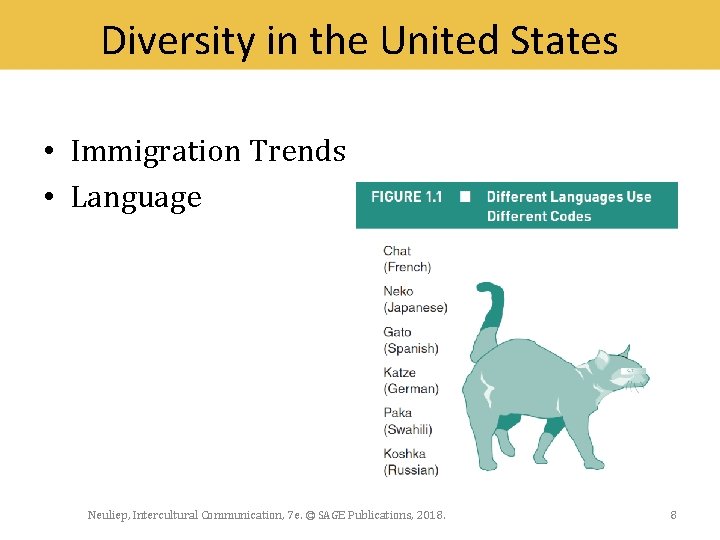
Diversity in the United States • Immigration Trends • Language Neuliep, Intercultural Communication, 7 e. © SAGE Publications, 2018. 8
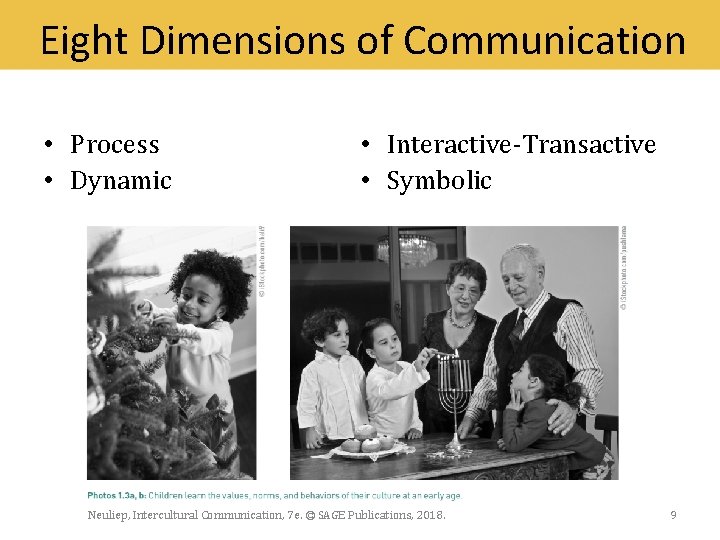
Eight Dimensions of Communication • Process • Dynamic • Interactive-Transactive • Symbolic Neuliep, Intercultural Communication, 7 e. © SAGE Publications, 2018. 9
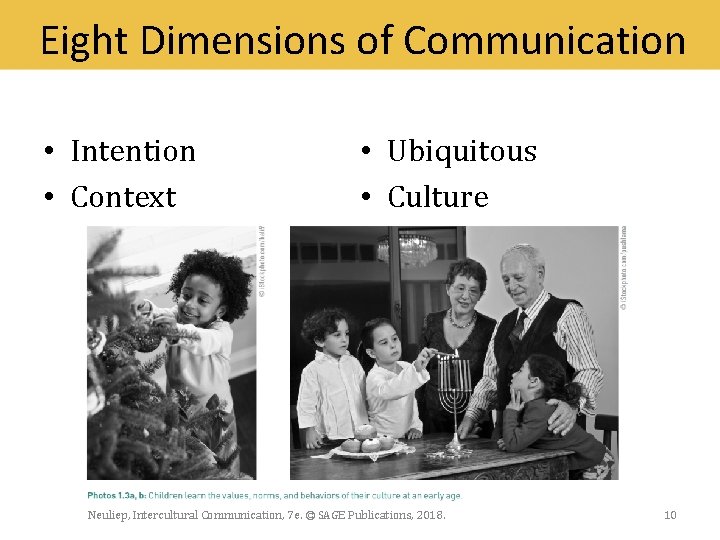
Eight Dimensions of Communication • Intention • Context • Ubiquitous • Culture Neuliep, Intercultural Communication, 7 e. © SAGE Publications, 2018. 10
Communication • Communication is the ubiquitous dynamic interactive process of encoding and decoding verbal and nonverbal messages within a defined cultural, physiological, relational, and perceptual context. Although many of our messages are sent intentionally, some others—perhaps our nonverbal messages—can unintentionally influence other people. 19 Neuliep, Intercultural Communication, 7 e. © SAGE Publications, 2018. 11
Communication Apprehension (CA) • 1 in 5 adults in the U. S. suffer from CA every time they communicate with others. (Mc. Croskey) • The fear or anxiety associated with either real or anticipated communication with another person or group of persons. Neuliep, Intercultural Communication, 7 e. © SAGE Publications, 2018. 12
Four Types of CA • • Traitlike Context based Audience based Situational Neuliep, Intercultural Communication, 7 e. © SAGE Publications, 2018. 13
Culture • An accumulated pattern of values, beliefs, and behaviors, shared by an identifiable group of people with a common history and verbal and nonverbal symbol systems. Neuliep, Intercultural Communication, 7 e. © SAGE Publications, 2018. 14
Nature of Culture • Accumulated Pattern of Values, Beliefs & Behaviors • Identifiable Group of People w/Common History • Verbal & Nonverbal Symbol Systems Neuliep, Intercultural Communication, 7 e. © SAGE Publications, 2018. 15
Microcultures • Microcultures coexist within the mainstream society…. within the broader rules and guidelines of the dominant cultural milieu but are distinct in some way, perhaps racially or linguistically, or via their sexual orientation, age, or even occupation. Neuliep, Intercultural Communication, 7 e. © SAGE Publications, 2018. 16
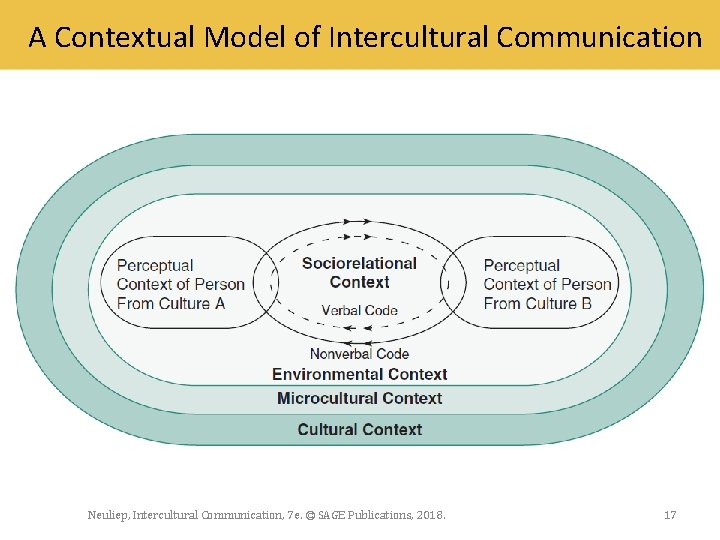
A Contextual Model of Intercultural Communication Neuliep, Intercultural Communication, 7 e. © SAGE Publications, 2018. 17
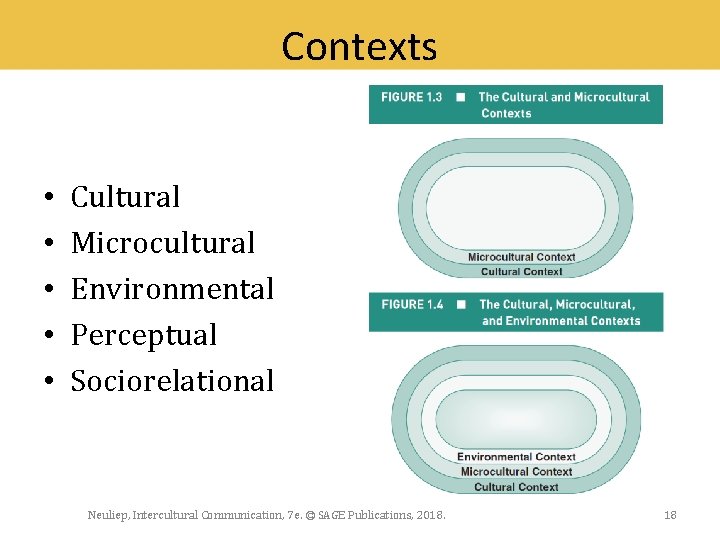
Contexts • • • Cultural Microcultural Environmental Perceptual Sociorelational Neuliep, Intercultural Communication, 7 e. © SAGE Publications, 2018. 18
Intercultural Communication and Uncertainty • Uncertainty can lead to anxiety. • Reduction of uncertainty can lead to certainty • Interaction with strangers is a process of reducing uncertainty Neuliep, Intercultural Communication, 7 e. © SAGE Publications, 2018. 19
Intercultural Communication Apprehension • Intercultural communication apprehension is the fear or anxiety associated with either real or anticipated interaction with people from different groups. 31 Neuliep, Intercultural Communication, 7 e. © SAGE Publications, 2018. 20
Communication Competence • Cognitive Components • Affective Components • Behavioral Components Neuliep, Intercultural Communication, 7 e. © SAGE Publications, 2018. 21
Fundamental Assumptions about Intercultural Communication • #1: During intercultural communication, the message sent is usually not the message received. Neuliep, Intercultural Communication, 7 e. © SAGE Publications, 2018. 22
Ethnocentrism • Ethnocentrism: the idea that one’s own culture is the center of everything and all other groups (or cultures) are scaled and rated with reference to it. • GENE Scale Neuliep, Intercultural Communication, 7 e. © SAGE Publications, 2018. 23
Fundamental Assumptions about Intercultural Communication • #2: Intercultural communication is primarily a nonverbal act between people. Neuliep, Intercultural Communication, 7 e. © SAGE Publications, 2018. 24
Fundamental Assumptions about Intercultural Communication • #3: Intercultural communication necessarily involves a clash of communicator style. Neuliep, Intercultural Communication, 7 e. © SAGE Publications, 2018. 25
Fundamental Assumptions about Intercultural Communication • #4: Initial intercultural communication is a group phenomenon experienced by individuals. Neuliep, Intercultural Communication, 7 e. © SAGE Publications, 2018. 26
Fundamental Assumptions about Intercultural Communication • #5: Intercultural communication is a cycle of stress, adaptation and growth. Neuliep, Intercultural Communication, 7 e. © SAGE Publications, 2018. 27
Five Ethical Approaches* • • • The Utilitarian Approach The Rights Approach The Fairness or Social Justice Approach The Common Good Approach The Virtues Approach • (*Western perspective) Neuliep, Intercultural Communication, 7 e. © SAGE Publications, 2018. 28
Ethical Principles of Eastern Cultures • Confucianism • Hinduism Neuliep, Intercultural Communication, 7 e. © SAGE Publications, 2018. 29
Intercultural Communication Competence • • • Empathy Intercultural experience/training Approach Tendencies Global Attitude Listening Skills Neuliep, Intercultural Communication, 7 e. © SAGE Publications, 2018. 30
Summary • Purpose of Chapter 1 – Emphasize the necessity of Intercultural Communication – Define & Clarify: Communication, Culture, & Intercultural Communication Neuliep, Intercultural Communication, 7 e. © SAGE Publications, 2018. 31
Summary • Part One: Technological, Political, Sociological advancements • Part Two: Definitions of Communication & Culture Neuliep, Intercultural Communication, 7 e. © SAGE Publications, 2018. 32
Summary • Part Three: Intercultural Communication Apprehension • Part Four: Ethics • Part Five: Intercultural Communication Competency Neuliep, Intercultural Communication, 7 e. © SAGE Publications, 2018. 33