
Chapter 1 The Nature of Intercultural Communication 2011



- Slides: 31
Chapter 1 The Nature of Intercultural Communication © 2011 Pearson Education, Inc. publishing as Prentice Hall
Topics • Globalization / Glocalization / Grobalization • Culture • Enculturation/Acculturation • Ethnocentrism • Norms, rules, roles, and networks • Subcultures and subgroups • Communication barriers • Multinational management orientations © 2011 Pearson Education, Inc. publishing as Prentice Hall 2
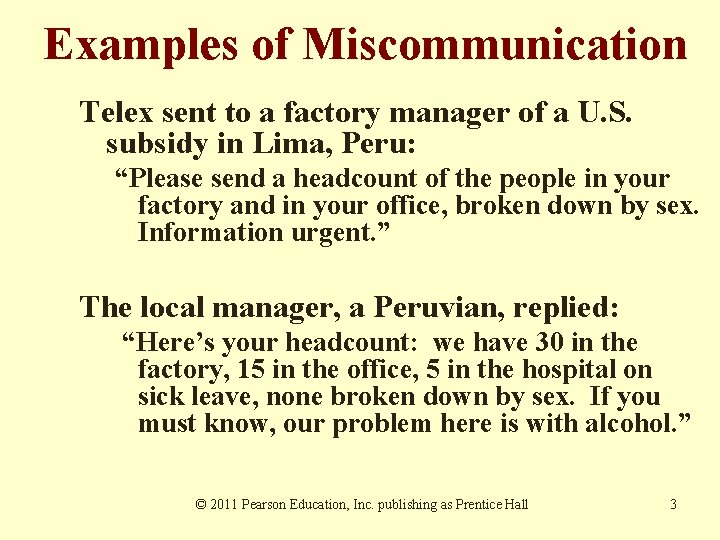
Examples of Miscommunication Telex sent to a factory manager of a U. S. subsidy in Lima, Peru: “Please send a headcount of the people in your factory and in your office, broken down by sex. Information urgent. ” The local manager, a Peruvian, replied: “Here’s your headcount: we have 30 in the factory, 15 in the office, 5 in the hospital on sick leave, none broken down by sex. If you must know, our problem here is with alcohol. ” © 2011 Pearson Education, Inc. publishing as Prentice Hall 3
Communication and Culture can only be known through communication, and communication is only understood in the culture it supports (Jandt, 2007). © 2011 Pearson Education, Inc. publishing as Prentice Hall 4
Definitions • International communication between governments or among nations • Intracultural communication between members of the same culture • Intercultural business communication – interpersonal communication within and between businesses that involve people from more than one culture © 2011 Pearson Education, Inc. publishing as Prentice Hall 5
Definitions (cont. ) • Melting pot - sociocultural assimilation of people of differing backgrounds and nationalities; implies losing ethnic differences and forming one large society (macroculture) • Diffusion - the process by which two cultures learn and adapt materials and adopt practices of each other © 2011 Pearson Education, Inc. publishing as Prentice Hall 6
Definitions (concl. ) • World culture - the idea that as traditional barriers among people of differing cultures break down, one culture will emerge • Globalization - the ability of a firm to take a product and market it in the entire civilized world © 2011 Pearson Education, Inc. publishing as Prentice Hall 7
Globalization, Glocalization, and Grobalization • Globalization—the worldwide diffusion of practices • Glocalization—the interpenetration of the global and local • Grobalization—focuses on the imperialistic ambitions of nations, corporations, and organizations to impose themselves on others © 2011 Pearson Education, Inc. publishing as Prentice Hall 8
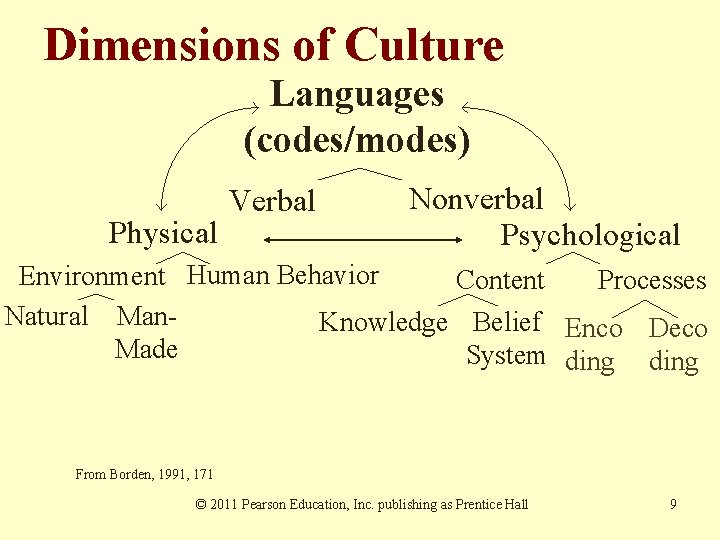
Dimensions of Culture Languages (codes/modes) Physical Verbal Nonverbal Psychological Environment Human Behavior Content Processes Natural Man. Knowledge Belief Enco Deco Made System ding From Borden, 1991, 171 © 2011 Pearson Education, Inc. publishing as Prentice Hall 9
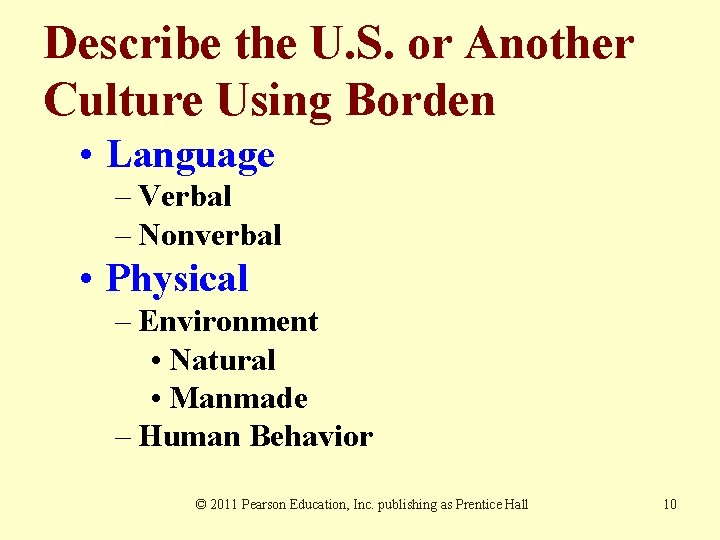
Describe the U. S. or Another Culture Using Borden • Language – Verbal – Nonverbal • Physical – Environment • Natural • Manmade – Human Behavior © 2011 Pearson Education, Inc. publishing as Prentice Hall 10
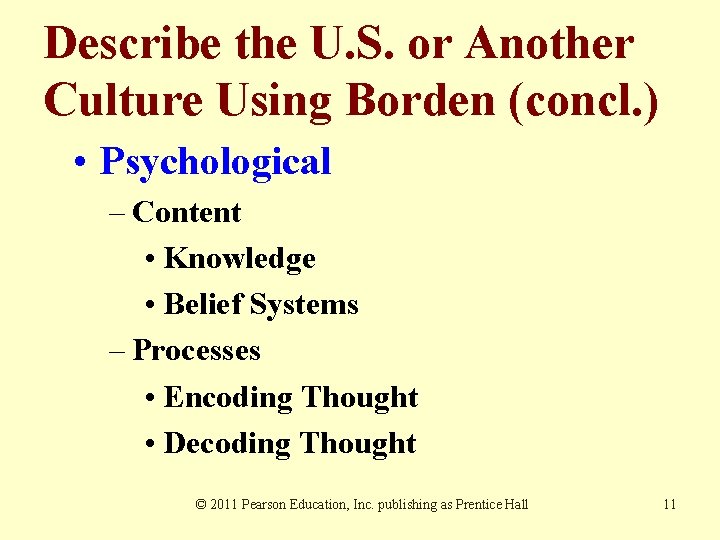
Describe the U. S. or Another Culture Using Borden (concl. ) • Psychological – Content • Knowledge • Belief Systems – Processes • Encoding Thought • Decoding Thought © 2011 Pearson Education, Inc. publishing as Prentice Hall 11
Perceptions & Stereotypes • Perceptions are learned through the dimensions of culture. Culture is learned through perception. • Stereotypes are perceptions about certain groups of people or nationalities, often based upon limited knowledge and/or exposure. © 2011 Pearson Education, Inc. publishing as Prentice Hall 12
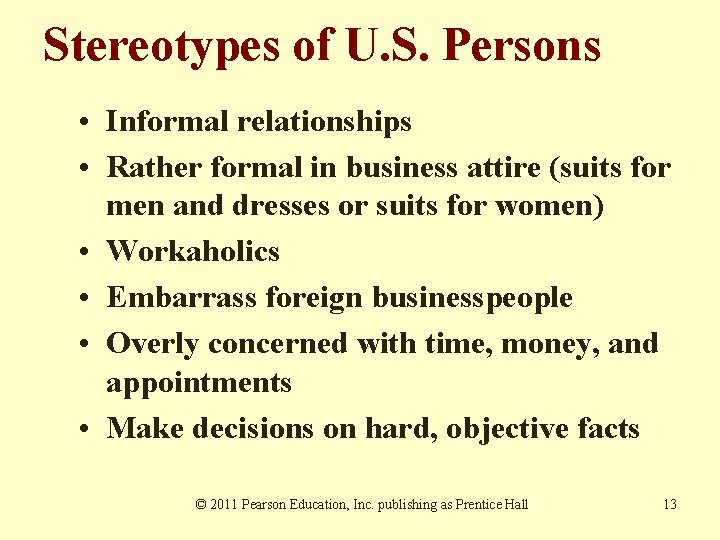
Stereotypes of U. S. Persons • Informal relationships • Rather formal in business attire (suits for men and dresses or suits for women) • Workaholics • Embarrass foreign businesspeople • Overly concerned with time, money, and appointments • Make decisions on hard, objective facts © 2011 Pearson Education, Inc. publishing as Prentice Hall 13
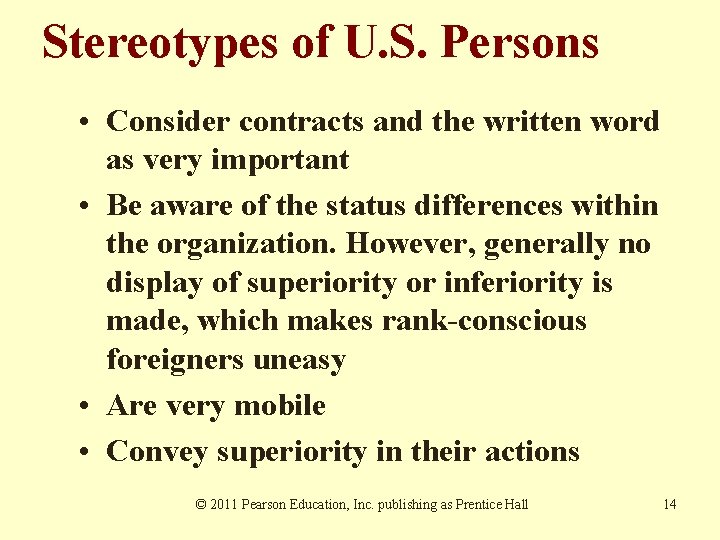
Stereotypes of U. S. Persons • Consider contracts and the written word as very important • Be aware of the status differences within the organization. However, generally no display of superiority or inferiority is made, which makes rank-conscious foreigners uneasy • Are very mobile • Convey superiority in their actions © 2011 Pearson Education, Inc. publishing as Prentice Hall 14
Stereotypes of People of Other Nationalities Culture English Image conservative, reserved, polite, proper, formal French arrogant, rude, chauvinistic, romantics, gourmets, cultural, artistic Italian demonstrative, talkative, emotional, romantic, bold, artistic Latin American mañana attitude, macho, music lovers, touchers inscrutable, intelligent, xenophobic (fear/hatred of strangers/foreigners), golfers, group oriented, polite, soft-spoken Asian © 2011 Pearson Education, Inc. publishing as Prentice Hall 15
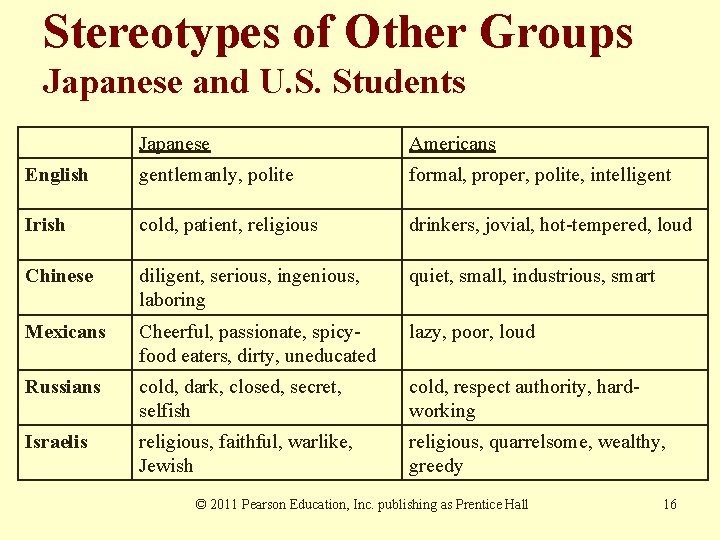
Stereotypes of Other Groups Japanese and U. S. Students Japanese Americans English gentlemanly, polite formal, proper, polite, intelligent Irish cold, patient, religious drinkers, jovial, hot-tempered, loud Chinese diligent, serious, ingenious, laboring quiet, small, industrious, smart Mexicans Cheerful, passionate, spicyfood eaters, dirty, uneducated lazy, poor, loud Russians cold, dark, closed, secret, selfish cold, respect authority, hardworking Israelis religious, faithful, warlike, Jewish religious, quarrelsome, wealthy, greedy © 2011 Pearson Education, Inc. publishing as Prentice Hall 16
Terms • Enculturation - socialization process you go through to adapt to your society – Frontstage culture - cultural information that you are willing to share with outsiders – Backstage culture - cultural information concealed from outsiders • Acculturation - process of adjusting and adapting to a new and different culture – Cultural synergy - two cultures merge to form a stronger overriding culture – Multicultural - people who can move between two or more cultures very comfortably © 2011 Pearson Education, Inc. publishing as Prentice Hall 17
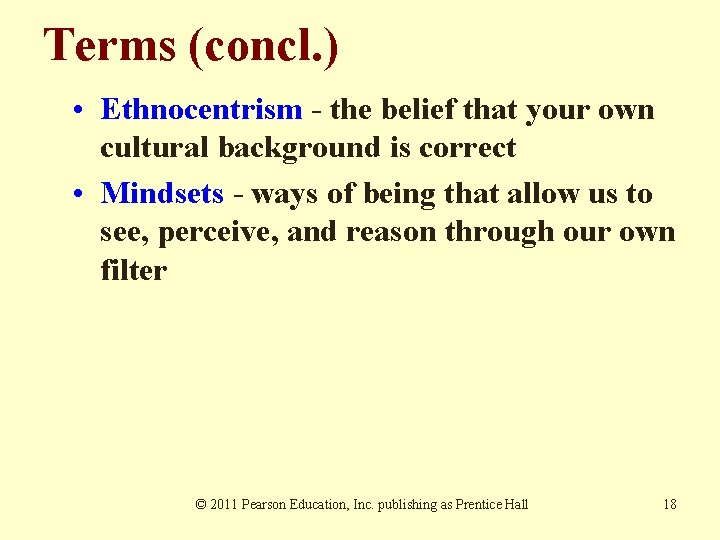
Terms (concl. ) • Ethnocentrism - the belief that your own cultural background is correct • Mindsets - ways of being that allow us to see, perceive, and reason through our own filter © 2011 Pearson Education, Inc. publishing as Prentice Hall 18
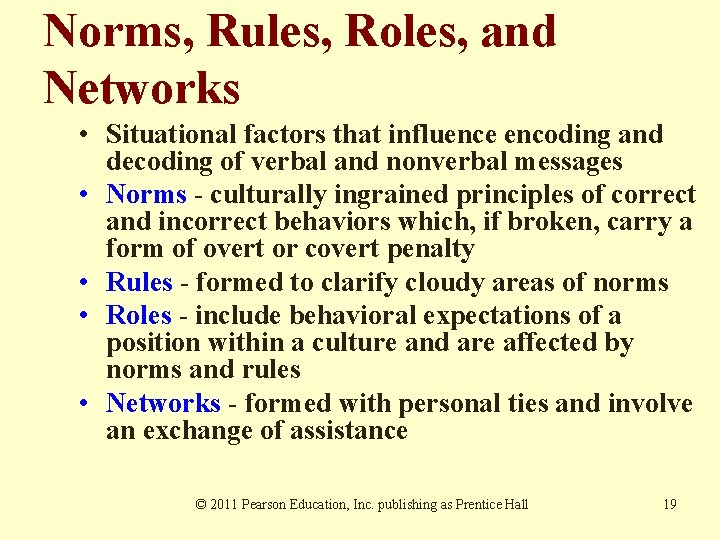
Norms, Rules, Roles, and Networks • Situational factors that influence encoding and decoding of verbal and nonverbal messages • Norms - culturally ingrained principles of correct and incorrect behaviors which, if broken, carry a form of overt or covert penalty • Rules - formed to clarify cloudy areas of norms • Roles - include behavioral expectations of a position within a culture and are affected by norms and rules • Networks - formed with personal ties and involve an exchange of assistance © 2011 Pearson Education, Inc. publishing as Prentice Hall 19
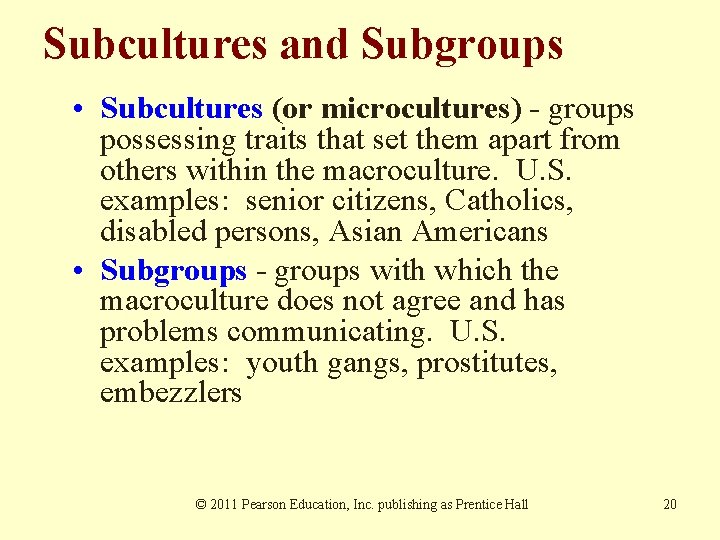
Subcultures and Subgroups • Subcultures (or microcultures) - groups possessing traits that set them apart from others within the macroculture. U. S. examples: senior citizens, Catholics, disabled persons, Asian Americans • Subgroups - groups with which the macroculture does not agree and has problems communicating. U. S. examples: youth gangs, prostitutes, embezzlers © 2011 Pearson Education, Inc. publishing as Prentice Hall 20
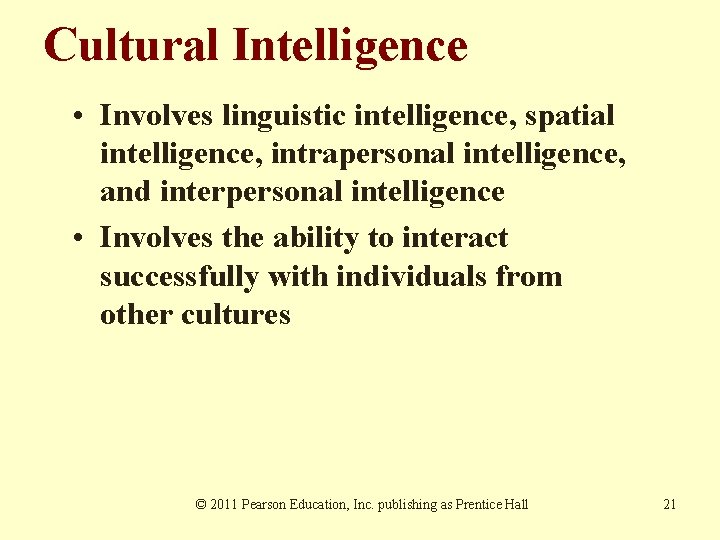
Cultural Intelligence • Involves linguistic intelligence, spatial intelligence, intrapersonal intelligence, and interpersonal intelligence • Involves the ability to interact successfully with individuals from other cultures © 2011 Pearson Education, Inc. publishing as Prentice Hall 21
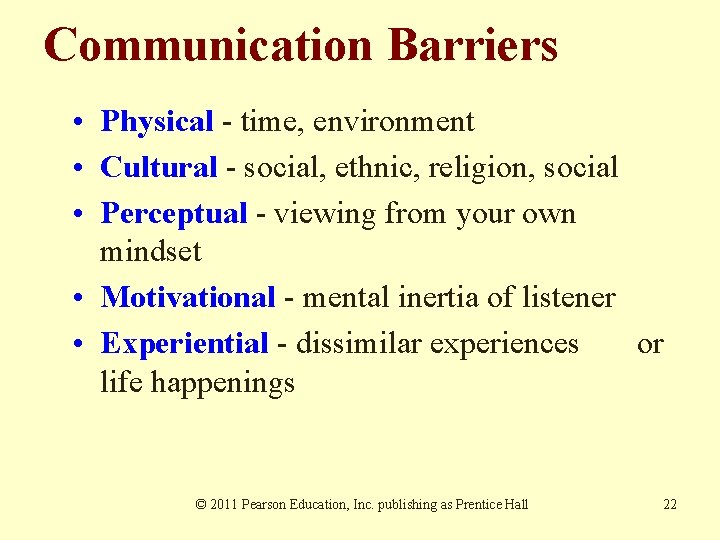
Communication Barriers • Physical - time, environment • Cultural - social, ethnic, religion, social • Perceptual - viewing from your own mindset • Motivational - mental inertia of listener • Experiential - dissimilar experiences or life happenings © 2011 Pearson Education, Inc. publishing as Prentice Hall 22
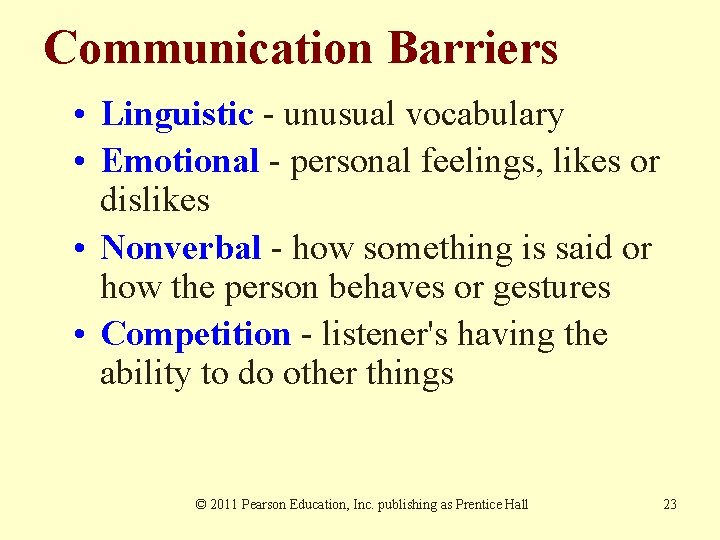
Communication Barriers • Linguistic - unusual vocabulary • Emotional - personal feelings, likes or dislikes • Nonverbal - how something is said or how the person behaves or gestures • Competition - listener's having the ability to do other things © 2011 Pearson Education, Inc. publishing as Prentice Hall 23
Cultural Iceberg • Above the waterline—what we can see; behaviors that are visible • Below the waterline—what we cannot see; behaviors that are not visible or that do not make sense to us © 2011 Pearson Education, Inc. publishing as Prentice Hall 24
Domestic and Global Mindsets Domestic Mindset • Functional expertise • Prioritization • Structure • Individual responsibility • No surprises • Trained against surprises Global Mindset • Bigger, broader picture • Balance of contradictions • Process • Teamwork and diversity • View change as opportunity • Openness to surprises © 2011 Pearson Education, Inc. publishing as Prentice Hall 25
Multinational Management Orientations • Ethnocentric Management - All workers treated the same; no allowance for cultural differences in the work force • Polycentric Management - Considers the cultural needs of the worker in the area in which the firm is located • Regiocentric Management - Considers the region rather than the country in which the firm is located • Geocentric Management - A synergy of ideas from different countries of operation © 2011 Pearson Education, Inc. publishing as Prentice Hall 26
Ten Commandments for Going International • • • Be well prepared. Ask questions; be observant; listen. Make an effort. When problems develop, assume the main cause is miscommunication. Be patient. Assume the best about people. Be sincere. Keep a sense of humor. Try to be likable. Smile. © 2011 Pearson Education, Inc. publishing as Prentice Hall 27
Dimensions of Acculturation • Integration - persons become an integral part of the new culture while maintaining their cultural integrity • Separation - individuals keep their culture and stay independent of the new culture • Assimilation - persons are absorbed into their new culture and withdraw from their old culture • Deculturation - when individuals lose their original culture and do not accept the new culture © 2011 Pearson Education, Inc. publishing as Prentice Hall 28
What foreign students WOULD like to see incorporated into their own culture: • Opportunity for individuals to raise their station in life • Efficiency of organizations • Hard work and productivity • Freedom to express opinions openly • General sense of freedom © 2011 Pearson Education, Inc. publishing as Prentice Hall 29
What foreign students WOULD NOT like to see incorporated into their own culture: • Excessive individualism • Weak family ties • Treatment of older people • Materialism • • Competitiveness Rapid pace of life Divorce “Free” male/ female relations • Impersonality © 2011 Pearson Education, Inc. publishing as Prentice Hall 30
© 2011 Pearson Education, Inc. publishing as Prentice Hall 31