
Chapter 1 The Nature and Method of Economics
- Slides: 13
Chapter 1 The Nature and Method of Economics Buffland Economics
Definition of Economics • • Study of how society uses its scarce resources to satisfy its unlimited wants Study of how society goes about the business of life Buffland Economics
The Economic Problem • Scarce resources – money, time, products § Resources – inputs, factors of production • • Labor – physical and mental efforts (wage) Capital – plant and equipment (interest) – – • • Physical Human – education Land – plots of land natural resources (rent) Entrepreneurial ability – management (profits) Buffland Economics
§ Unlimited wants – physical, material, intellectual, emotional, spiritual etc • Goods – tangible • Service – intangible § Requires choices Buffland Economics
Economic Perspective (Tenets of Economics) • Scarcity and Choice – Scarce goods have a cost § § Goods provide utility (satisfaction) Bads (pollution) provide disutility (dissatisfaction) Scarcity § • Resources to make these goods are scarce – • • § Make yourself scarce Time Money Choices must be made • Opportunity Costs – value of the best alternative not chosen Buffland Economics
• Rational Behavior – We choose with a purpose and are rational – We try to maximize our utility – material and otherwise • Marginalism: Benefits and costs – We think at the margin (the next one) – Marginal Benefits > Marginal Costs, pursue – Marginal Benefits = Marginal Costs, stop • Incentives matter – Prices act as signals • Values are subjective – We like different things: means more choices Buffland Economics
Economic Decision Makers § § Households - largest Firms Government Rest of the World Buffland Economics
• Branches of Economics Macroeconomics – the whole economy – • Macroeconomic Goals » Economic growth » Full employment » Price Stability » Economic Freedom Microeconomics – individual units – Microeconomic goals » Economic Efficiency » Equitable Distribution of Income » Economic Security » Balance of Trade Buffland Economics
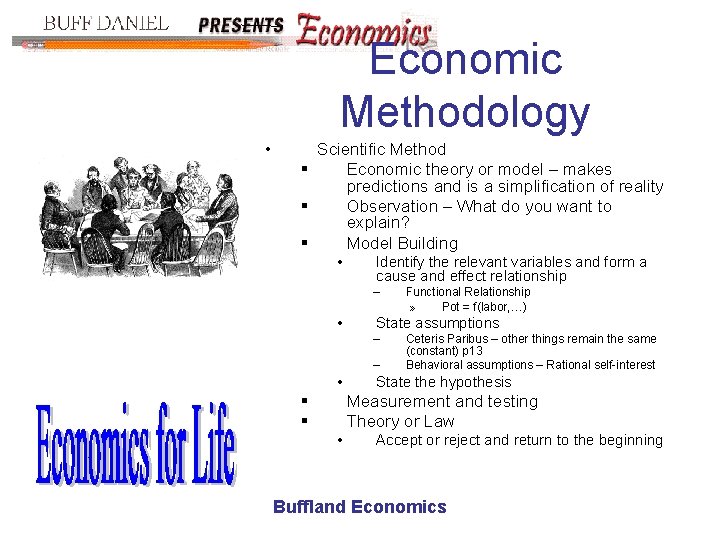
Economic Methodology • Scientific Method § Economic theory or model – makes predictions and is a simplification of reality § Observation – What do you want to explain? § Model Building • Identify the relevant variables and form a cause and effect relationship – • State assumptions – – • § § Functional Relationship » Pot = f(labor, …) Ceteris Paribus – other things remain the same (constant) p 13 Behavioral assumptions – Rational self-interest State the hypothesis Measurement and testing Theory or Law • Accept or reject and return to the beginning Buffland Economics
• Economists Toolbox – interpreting data § Verbal or written § Schedule § Graphical § Mathematical Buffland Economics
Types of Economics • • Theoretical Economics – Generalizing about economic behavior § To predict human behavior in the market § Laws, Theories and Principles are used to predict • Generalizations about the average person or group Descriptive Economics – Gathering Economic facts relevant to a problem Quantitative Economics – Mathematical and statistical approach Policy Economics – resolve specific problems by controlling economic behavior Buffland Economics
§ § Economic Statements Positive – “what is” Normative – “what should be” Buffland Economics
Fallacies of Presentation § § § Composition – what is good for one is good for all False Cause – If b follows a, then a caused b Criticizing the opposition Special pleading – giving only one side Appeal to “Authority” – make sure your endorser is an authority Appeal to the people – “everybody else does” Buffland Economics