
Chapter 1 The Human Body An Orientation Health
Chapter 1 The Human Body: An Orientation Health & Anatomy Mrs. Gunderson
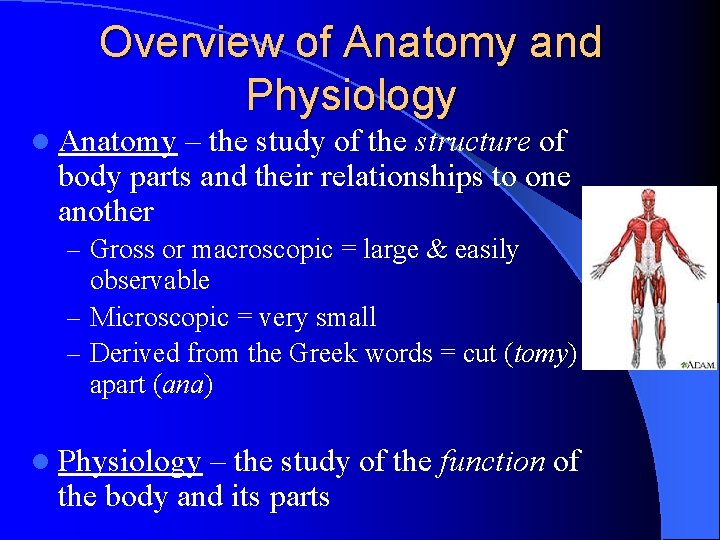
Overview of Anatomy and Physiology l Anatomy – the study of the structure of body parts and their relationships to one another – Gross or macroscopic = large & easily observable – Microscopic = very small – Derived from the Greek words = cut (tomy) apart (ana) l Physiology – the study of the function of the body and its parts

Levels of Structural Organization l l l Chemical – atoms combined to form molecules (simplest level) Cellular – cells are made of molecules and are the smallest units of all living things Tissue – consists of similar types of cells Organ – made up of 2 or more tissue types Organ system – consists of different organs that work closely together Organismal – made up of the organ systems (highest level)
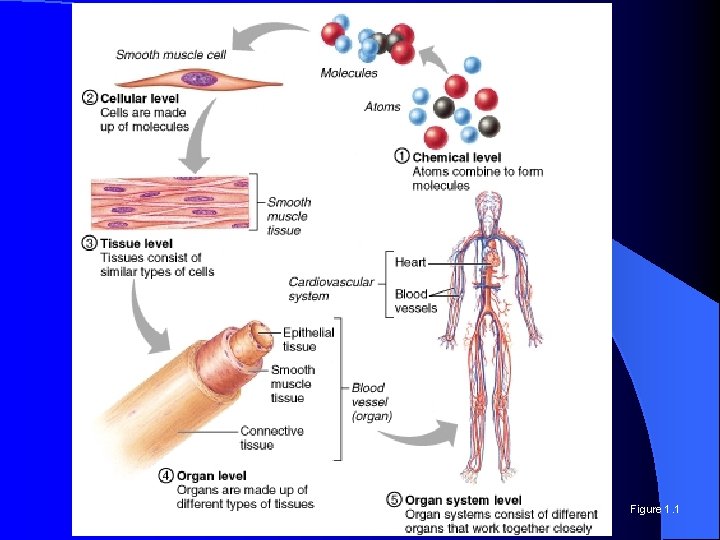
Figure 1. 1
Necessary Life Functions I l Maintaining boundaries – the internal environment remains distinct from the external – Cellular level – accomplished by plasma membranes – Organismal level – accomplished by the skin l Movement – locomotion, propulsion (peristalsis), and contractility l Responsiveness – ability to sense changes in the environment and respond to them l Digestion – breakdown of ingested foods

Necessary Life Functions II l Metabolism – all the chemical reactions that occur in the body l Excretion – removal of wastes from the body l Reproduction – cellular and organismal levels – Cellular – an original cell divides and produces two identical daughter cells – Organismal – sperm and egg unite to make a whole new person l Growth – increase in size of a body part or of the organism
Survival Needs l l l Nutrients – chemical substances used for energy and cell building Oxygen – needed for metabolic reactions Water – provides the necessary environment for chemical reactions Maintaining normal body temperature – necessary for chemical reactions to occur at life-sustaining rates Atmospheric pressure – required for proper breathing and gas exchange in the lungs
Homeostasis is the ability to maintain a relatively stable internal environment in an ever-changing outside world l The internal environment of the body is in a dynamic state of equilibrium l Chemical, thermal, and neural factors interact to maintain homeostasis l
Body Systems: Integumentary System. Function: Waterproof, external covering, protection, cushions, excretes salts, regulates body temp. Parts: external coverings (skin), including nails & hair. Skeletal System. Function: Provides framework that muscles use for movement, supports the body & stores minerals. Parts: bones, cartilage, ligaments and joints.
Nervous System. Function: Fastest Acting System- respond to stimuli, irritants. Detect these changes and send messages. Parts: Brain, spinal cord, nerves and sensory receptors. Endocrine System. Function: Produce chemicals molecules called hormones and release into the blood. To target organs Parts: Glands located throughout the body.
Cardiovascular System. Function: Carries oxygen, hormones & nutrients. Parts: Heart and blood vessels. Lymphatic System. Function: complement the Cardio. Helps circulates fluids leaked from the blood. Parts: Lymphatic Vessels, nodes, spleen and tonsils.
Respiratory System. Function: Keep body supplied with oxygen and to remove carbon dioxide. Parts: nasal passages, pharynx, larynx, trachea, bronchi, and lungs. Digestive System. Function: Break down food and deliver products to the blood for dispersal to body cells. Parts: oral cavity, esophagus, stomach, small & Large Intestines, & rectum.
Urinary System. Function: removes nitrogenous waste from blood and flushes them from the body. Parts: kidneys, ureters, bladder and urethra. Muscular System – Function: Contract, movement occurs. Parts: Cardiac, smooth and skeletal muscles.
Reproductive System. Function: produce offspring and supply the cell responsible for reproduction. Parts: Testes, ovaries, vas deferens, fallopian tubes, uterus, urethra, etc. Stop Day 1 NOTES!
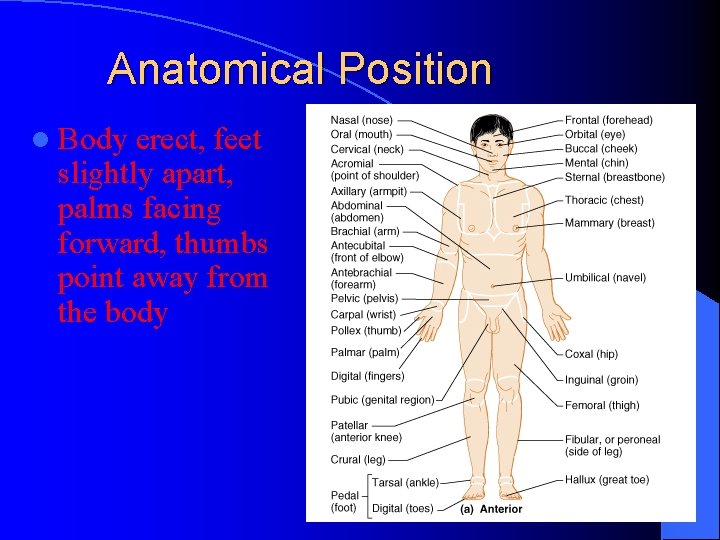
Anatomical Position l Body erect, feet slightly apart, palms facing forward, thumbs point away from the body Figure 1. 7 a
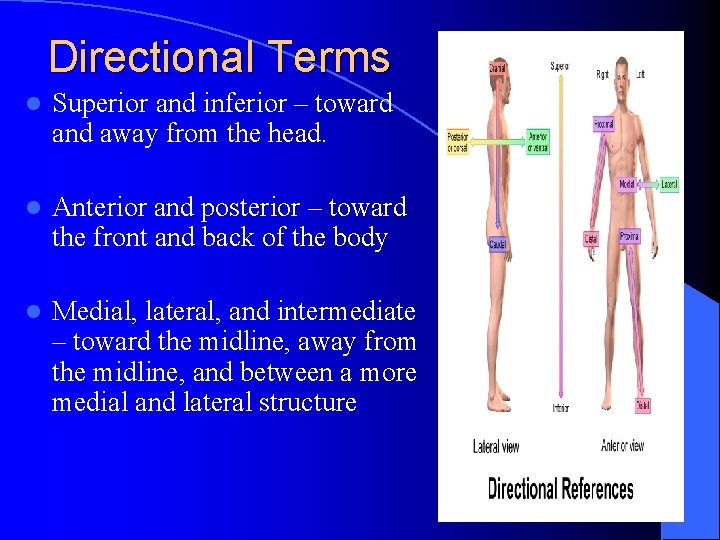
Directional Terms l Superior and inferior – toward and away from the head. l Anterior and posterior – toward the front and back of the body l Medial, lateral, and intermediate – toward the midline, away from the midline, and between a more medial and lateral structure
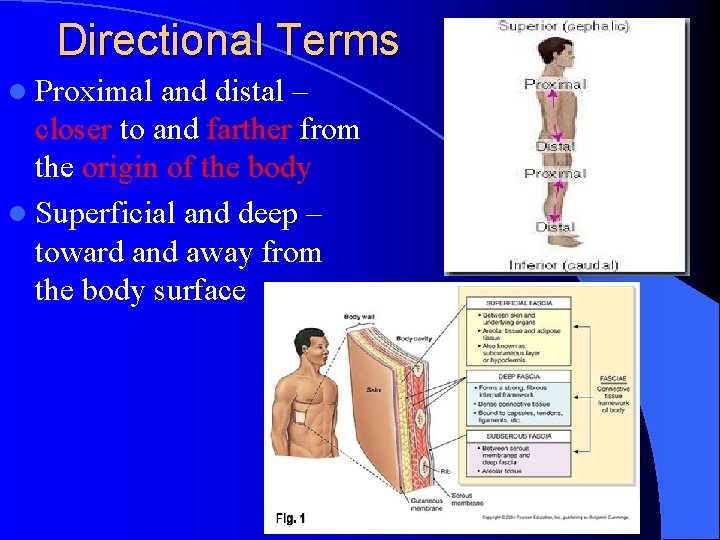
Directional Terms l Proximal and distal – closer to and farther from the origin of the body l Superficial and deep – toward and away from the body surface
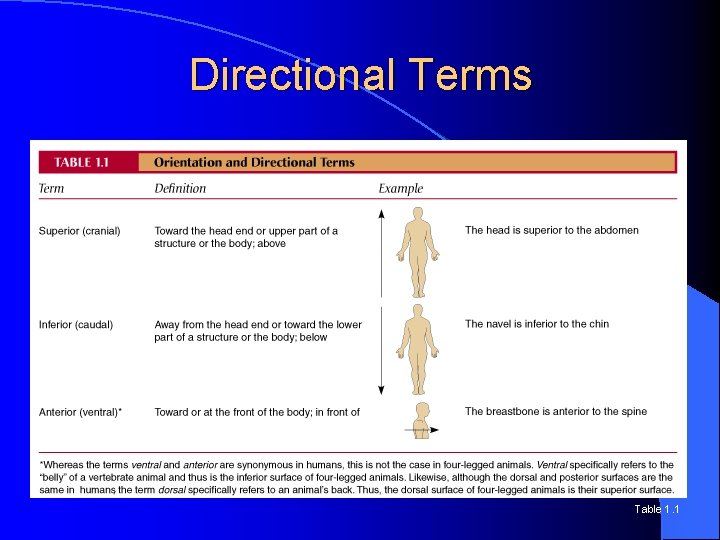
Directional Terms Table 1. 1
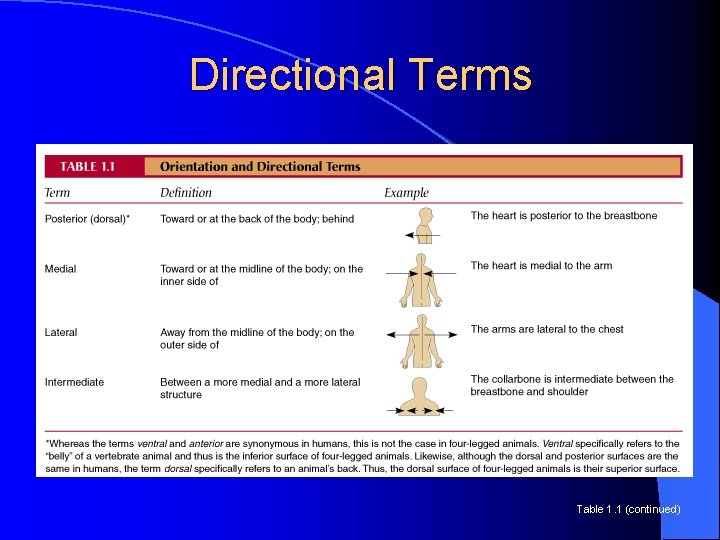
Directional Terms Table 1. 1 (continued)
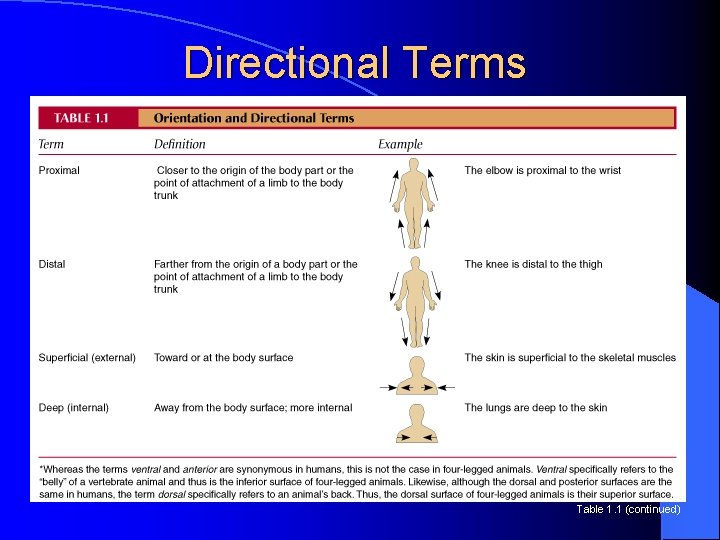
Directional Terms Table 1. 1 (continued)
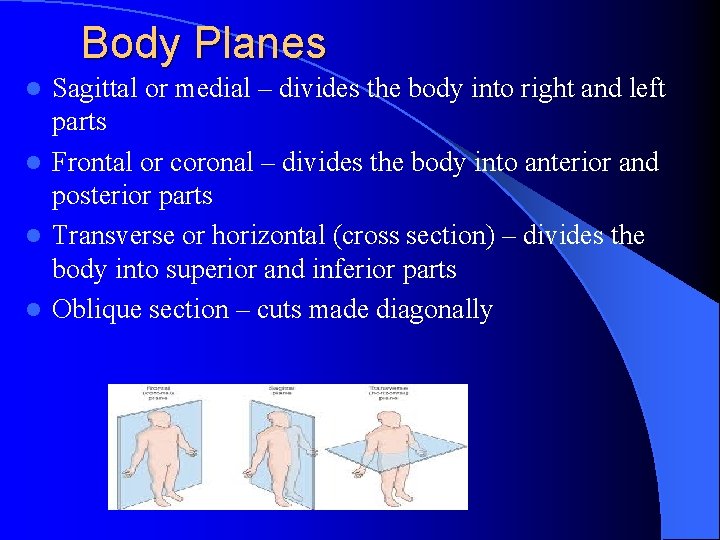
Body Planes Sagittal or medial – divides the body into right and left parts l Frontal or coronal – divides the body into anterior and posterior parts l Transverse or horizontal (cross section) – divides the body into superior and inferior parts l Oblique section – cuts made diagonally l
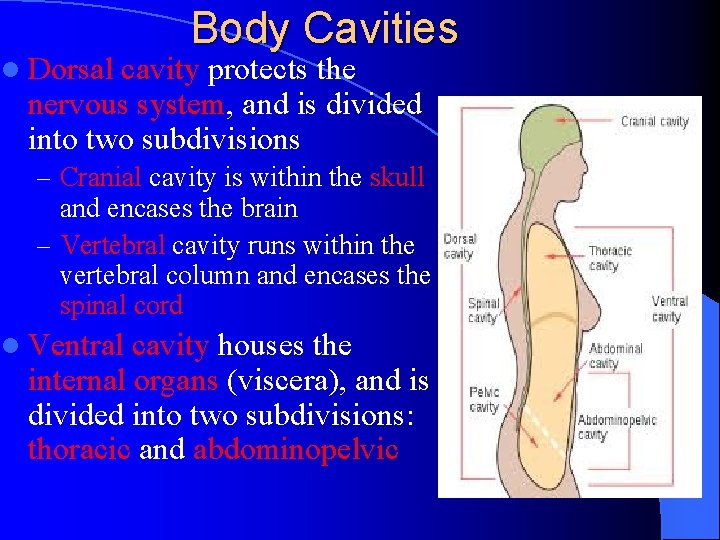
l Dorsal Body Cavities cavity protects the nervous system, and is divided into two subdivisions – Cranial cavity is within the skull and encases the brain – Vertebral cavity runs within the vertebral column and encases the spinal cord l Ventral cavity houses the internal organs (viscera), and is divided into two subdivisions: thoracic and abdominopelvic
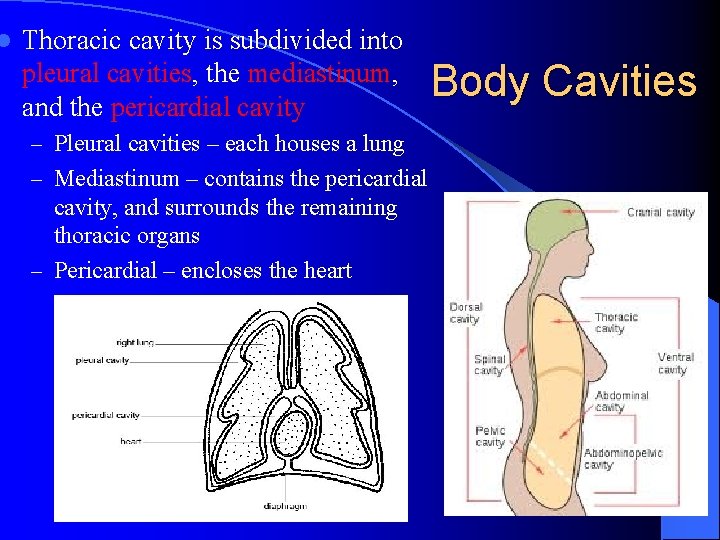
l Thoracic cavity is subdivided into pleural cavities, the mediastinum, and the pericardial cavity – Pleural cavities – each houses a lung – Mediastinum – contains the pericardial cavity, and surrounds the remaining thoracic organs – Pericardial – encloses the heart Body Cavities
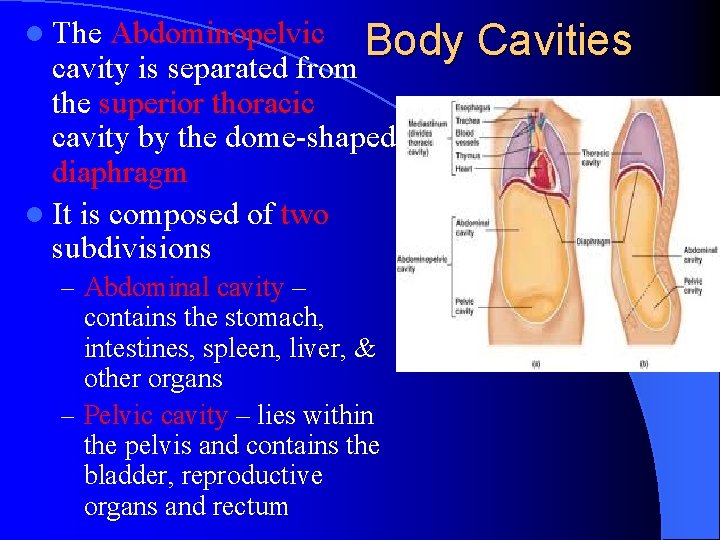
l The Abdominopelvic Body cavity is separated from the superior thoracic cavity by the dome-shaped diaphragm l It is composed of two subdivisions – Abdominal cavity – contains the stomach, intestines, spleen, liver, & other organs – Pelvic cavity – lies within the pelvis and contains the bladder, reproductive organs and rectum Cavities
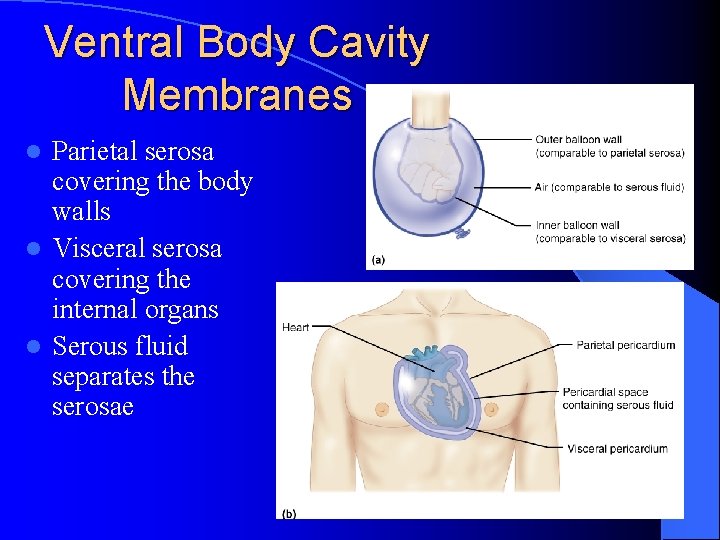
Ventral Body Cavity Membranes Parietal serosa covering the body walls l Visceral serosa covering the internal organs l Serous fluid separates the serosae l Figure 1. 10
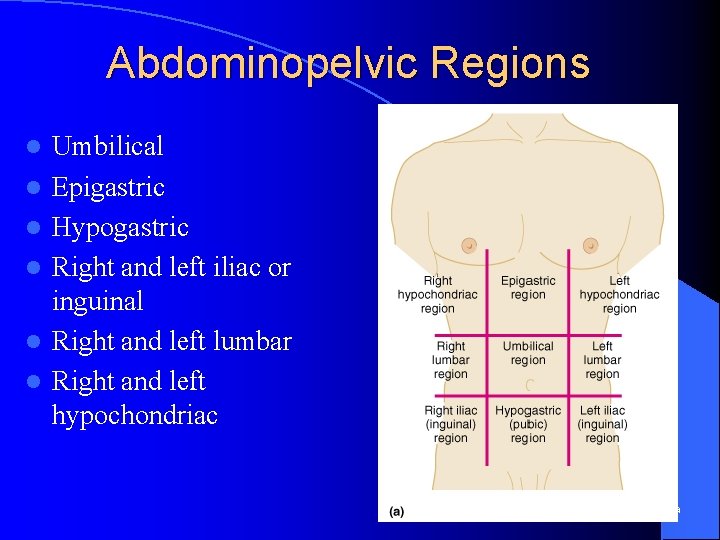
Abdominopelvic Regions l l l Umbilical Epigastric Hypogastric Right and left iliac or inguinal Right and left lumbar Right and left hypochondriac Figure 1. 11 a
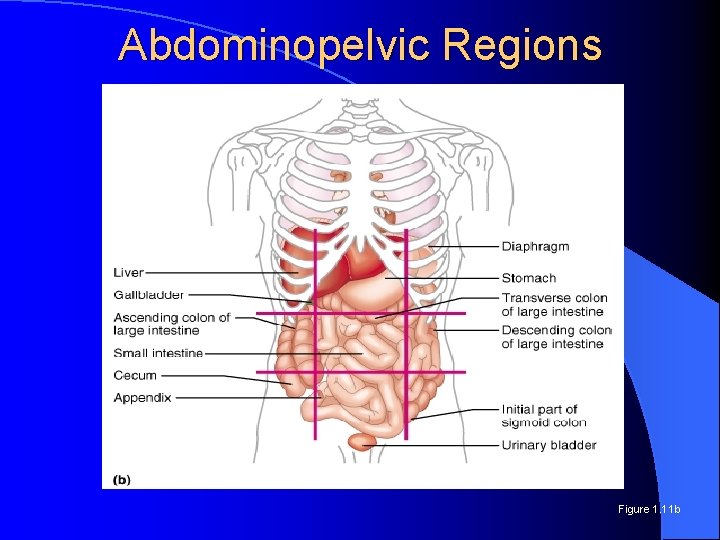
Abdominopelvic Regions Figure 1. 11 b
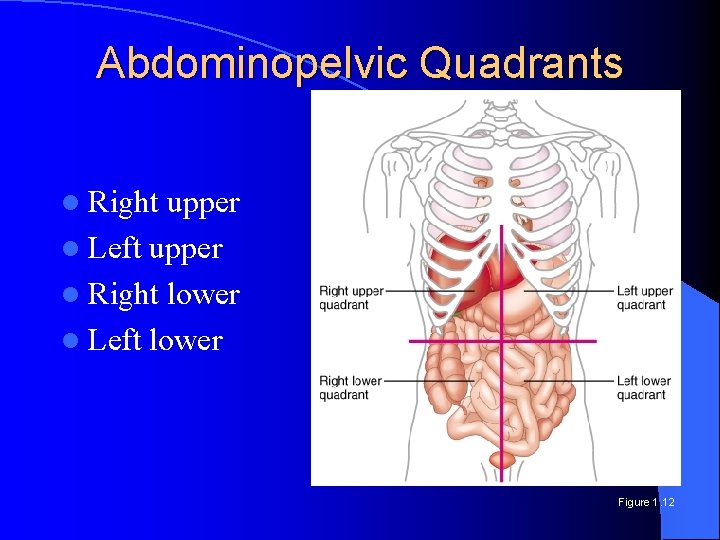
Abdominopelvic Quadrants l Right upper l Left upper l Right lower l Left lower Figure 1. 12
- Slides: 28