
Chapter 1 THE EMERGENCY MEDICAL SERVICE SYSTEM The
- Slides: 35
Chapter 1
THE EMERGENCY MEDICAL SERVICE SYSTEM The Citizen Responder The first and most crucial link in the EMS system. The person that recognizes an emergency exist and calls 911.
GOOD SAMARITAN LAWS All states have enacted Good Samaritan laws. This is a law that protects citizen responders who are willing to provide emergency care to injured or ill persons without accepting anything in return. AMERICAN RED CROSS. . KennyFA StuffWashington Laws FIRST AID– RESPONDING TO 1975. doc EMERGENCIES FOURTH EDITION Copyright © 2006 by The American National Red Cross All rights reserved.
GOOD SAMARITAN –OVERDOSE PREVENTION Good Samaritan Laws Video – A Parents Story
THE EMS DISPATCHER The second link. The dispatcher answers the call and determines what help is needed. They may give the caller instructions on how to care.
THE FIRST RESPONDER The 3 rd link in the EMS system. The first trained person to arrive on the scene. Police, fire fighter, emt. Can a first responder be the citizen responder.
THE EMERGENCY MEDICAL TECHNICIAN Fourth link in the EMS system. EMT is capable of providing more adequate first aid and life support techniques. Paramedics are highly specialized and are the highest trained compared to hospital care.
HOSPITAL CARE PROVIDERS Begins once the victim arrives at the hospital when an emergency department staff takes over.
REHABILITATION OR DEFINITIVE CARE The goal is to bring the person back to their previous state of health.
HOW TO BE PREPARED FOR AN EMERGENCY • • • Keep important information about you and your family in a handy place. Keep medical insurance up to date Keep important phone numbers in an easy to find place. 911 poison control Keep first aid kit ready and available Wear medical alert tags Make sure your house numbers are readable.
WHAT IS FIRST AID First Aid is the immediate care given to a victim of injury or sudden illness until more advanced care can be obtained
BODY’S IMMUNE SYSTEM The body’s immune system is the #1 protection against infections disease.
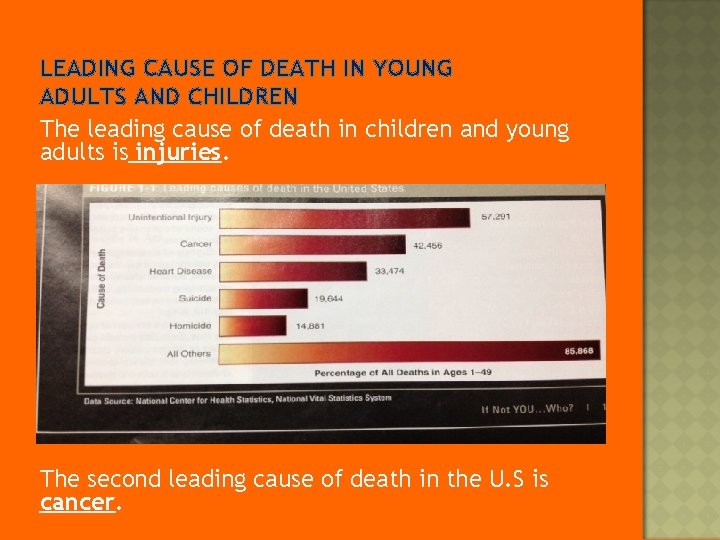
LEADING CAUSE OF DEATH IN YOUNG ADULTS AND CHILDREN The leading cause of death in children and young adults is injuries. The second leading cause of death in the U. S is cancer.
RECOGNIZING AN EMERGENCY Look the scene over and ask yourself the following questions 1. Is the scene safe? 2. What happened? 3. How many victims are there? 4. Can bystanders help? Do no Future Harm Do not move the victim unless: When faced with immediate danger such as fire, lack of oxygen, risk of explosion or collapsing structure. Moving to another victim *** Know how to move the victim*** ◦
MOST IMPORTANT THING TO DO IN THE CASE OF FIRST AID. . Call: Know your local emergency numbers (911) ◦ Call EMS if the victim is unconscious or if the conscious victim: ◦ Become unconscious Has trouble breathing or is breathing in a strange way Has chest pain Is bleeding severely Has pressure or pain in the abdomen that does not go away Is vomiting or passing blood Has seizures, a sever headache or slurred speech Appears to have been poisoned Has injures to the head neck or back Has possible broken bones
E. M. S Emergency Medical System A network of police, fire and medical personnel, as well as other community resources. What is the role of the EMS System? 1. 2. 3. 4.
4 STEPS WHEN CALLING E. M. S Call emergency # Give Dispatcher the necessary information Location Phone # Your Name What happened How many people are involved Conditions of the victim (s) What help is being given Do not hung up until told to do so Return to care for the victim
REASONS WHY PEOPLE DON’T ACT IN AN EMERGENCY Presence of bystanders Uncertainty about the victim Nature of injury (unpleasant) Fear of getting a disease Fear of doing something wrong.
WHAT SHOULD YOU LOOK FOR WHEN CHECKING AN ACCIDENT SCENE Check Is the scene safe? What happened? How many victims are there? Can bystanders help?
THE 3 C’S CHECK Check Look the scene over and ask yourself the following questions 1. Is the scene safe? 2. What happened? 3. How many victims are there? 4. Can bystanders help? Do no Future Harm Do not move the victim unless: When faced with immediate danger such as fire, lack of oxygen, risk of explosion or collapsing structure. Moving to another victim *** Know how to move the victim*** ◦
THE 3 C’S CALL Call: ◦ ◦ Know your local emergency numbers (911) Call EMS if the victim is unconscious or if the conscious victim: Become unconscious Has trouble breathing or is breathing in a strange way Has chest pain Is bleeding severely Has pressure or pain in the abdomen that does not go away Is vomiting or passing blood Has seizures, a sever headache or slurred speech Appears to have been poisoned Has injures to the head neck or back Has possible broken bones
CARE You may have to provide care in an emergency situation. Get the victims permission. You must tell the victim. 1. Who you are 2. How much training you have 3. How you plan to help
ALSO CALL FOR ANY OF THESE…… Fire Explosion, downed electrical wires, rapidly rising water
WHAT DO YOU DO IF THE ACCIDENT SCENE IS UNSAFE
UNUSUAL SIGNS/APPEARANCES IN A PERSON IN NEED OF FIRST AID When you see something out of the ordinary. A stalled car Overturned pot on the floor Open pill bottle Downed electrical wires Smells Gasoline Fumes Chlorine Smoke Burning Tires
UNUSUAL BEHAVIORS OF A PERSON IN NEED OF FIRST AID • • Unconsciousness Difficulty Breathing Clutching chest or throat Slurred speech, or confused speech Confusion Drowsiness Sweating for NO reasons Skin discoloration
RECOGNIZING AN EMERGENCYNOISE Indicates someone is in distress: screaming, moaning, crying and or calling for help. Alarming noises such as screeching brakes, crashing metal or tires. Abrupt or loud noises that are not identifiable such as a collapsing building or falling ladder.
PROVIDING CARE You may have to provide care in an emergency situation. Always get permission to give care Always care for the life threatening injuries first Ask questions about what happened Never leave the victim until other help arrives Get the victims permission. You must tell the victim. 1. Who you are 2. How much training you have 3. How you plan to help
PROVIDING CARE CONTINUED Do not give care to a conscious victim who refuses it. Permission in implied if a victim is unconscious or unable to respond or if a condition is serious and an implied supervising adult is not available for the child/
DISEASE TRANSMISSION Most common germs are bacteria and viruses Bacteria can live outside the body Viruses depend on other organisms to live The immune system is the # 1 defender against infections
HOW TO BECOME INFECTED? If germs in a person’s blood or other body fluids pass into your body through breaks in the skin or through the linings of the eyes, nose and mouth. Common colds are transmitted through the air we breath. (coughing and sneezing) Diseases can be transmitted by: Touching Breathing Biting
7 GUIDELINES TO REDUCE DISEASE TRANSMISSION WHEN PROVIDING FIRST AID 1. 2. 3. 4. 5. 6. 7. Avoid contact with the body fluid Use barriers (gloves, masks) Wear protective clothing Wash your hands immediately after giving care Don’t eat, drink or touch your mouth, nose or eyes when giving first aid Don’t touch objects soiled with blood Be prepared with a first aid kit
AIDS What does AIDS stand for Acquired Immune Deficiency Syndrome It is a disease where the immune system is to weak to fight off common infections and viruses.
THREE WAYS AIDS IS TRANSMITTED AIDS is Transmitted Through direct contact with the blood Through mucous membranes in the lining of the eyes, mouth, throat, rectum, and vagina Through womb, birth canal, or breast milk
SUDDEN ILLNESSES (P. 151) When a person becomes suddenly ill, he or she usually looks and feels sick. Give 2 examples of a sudden illness Stroke Heart attack