
Chapter 1 The Basic Financial Statements Groups 1
Chapter 1 The Basic Financial Statements
Groups 1. Get Contact Information for each group member – you are stuck with each other for the next 15 weeks. 2. Decide what business you are going to start. 1. Company name 2. Company business 3. To Be Turned in: Fill out Group Sheet.
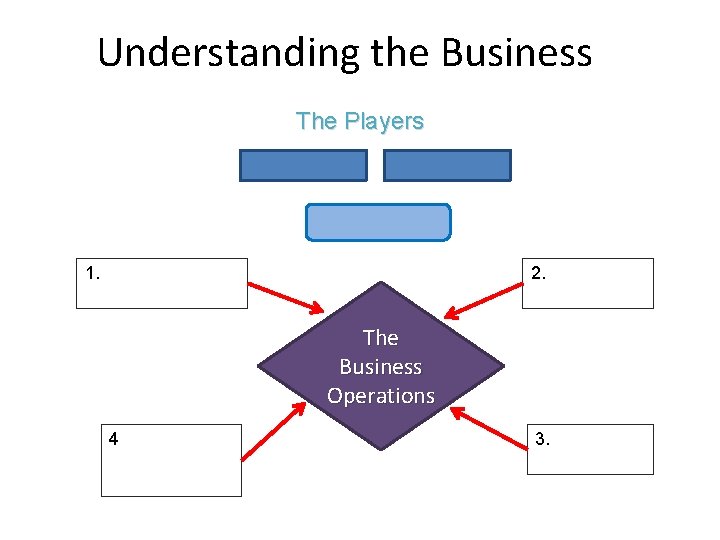
Understanding the Business The Players 1. 2. The Business Operations 4 3.
Responsibilities for the Accounting Communication Process Effective communication means that the recipient understands what the sender intends to convey. Decision makers need to understand accounting measurement rules.

How are Generally Accepted Accounting Principles Determined? Who is this dude?
How are Generally Accepted Accounting Principles Determined? Prior to 1933, the management teams of most companies were free to choose the accounting principles used to keep track of its transactions. What was going on in 1933?
Generally Accepted Accounting Principles Securities Act of 1933 Securities and Exchange Act of 1934 The Securities and Exchange Commission (SEC) has been given broad powers to determine measurement rules for financial statements.
Generally Accepted Accounting Principles The SEC has worked closely with the accounting profession to work out the detailed rules that have become known as GAAP. Currently, the Financial Accounting Standards Board (FASB) is recognized as the body to formulate GAAP.
Generally Accepted Accounting Principles Companies incur the cost of preparing the financial statements and bear the following economic consequences of the financial statements being published. . . Effects on the selling price of stock. Effects on the amount of bonuses received by managers and other employees. Loss of competitive information to other companies.
The Four Basic Financial Statements 1. On a company’s __________, all the revenues earned from sales to customers are listed along with the expenses incurred to produce those revenues.
Income Statement 1. Identify the REVENUE Accounts (amounts a company EARNS). 2. Identify the EXPENSE Accounts (amounts a company incurs in order to earn revenue) 3. Prepare the Income Statement in the Proper format.
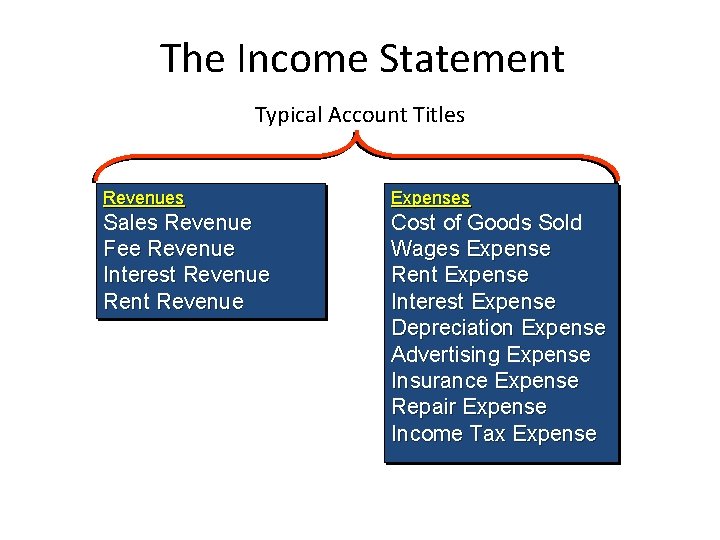
The Income Statement Typical Account Titles Revenues Expenses Sales Revenue Fee Revenue Interest Revenue Rent Revenue Cost of Goods Sold Wages Expense Rent Expense Interest Expense Depreciation Expense Advertising Expense Insurance Expense Repair Expense Income Tax Expense

Income Statement
The Four Basic Financial Statements On a company’s ________________ accumulated net earnings less the dividends paid to owners represent reinvestments in the core business. Net Earnings = Net Income from Income Statement
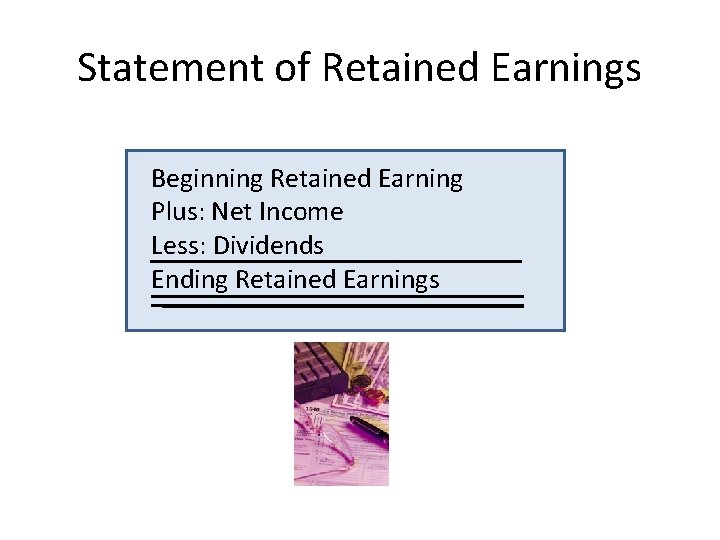
Statement of Retained Earnings Beginning Retained Earning Plus: Net Income Less: Dividends Ending Retained Earnings
The Four Basic Financial Statements On a company’s ________, all resources owned (CALLED ASSETS) and amounts owed (CALLED LIABILITIES) are listed in order of liquidity. The DIFFERENCE between the resources owned and the amounts owed, represents the stockholders’ equity in the business.
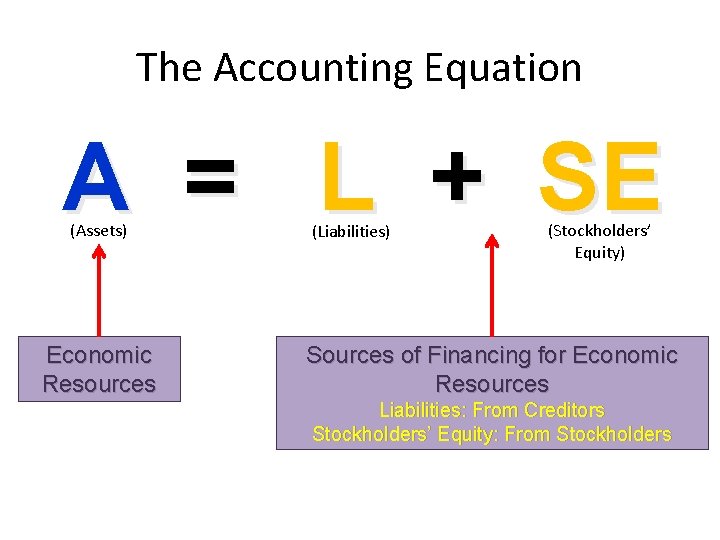
The Accounting Equation A = L + SE (Assets) Economic Resources (Liabilities) (Stockholders’ Equity) Sources of Financing for Economic Resources Liabilities: From Creditors Stockholders’ Equity: From Stockholders
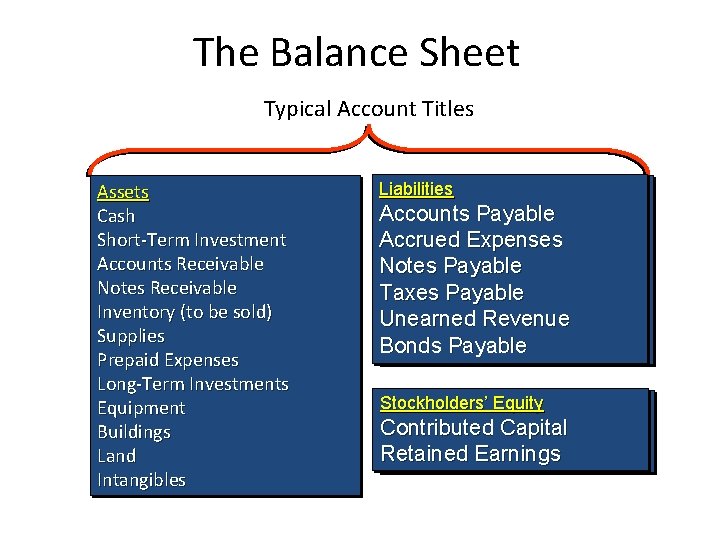
The Balance Sheet Typical Account Titles Assets Cash Short-Term Investment Accounts Receivable Notes Receivable Inventory (to be sold) Supplies Prepaid Expenses Long-Term Investments Equipment Buildings Land Intangibles Liabilities Accounts. Payable Accrued. Expenses Notes. Payable Taxes. Payable Unearned. Revenue Bonds. Payable Stockholders’Equity Contributed. Capital Retained. Earnings
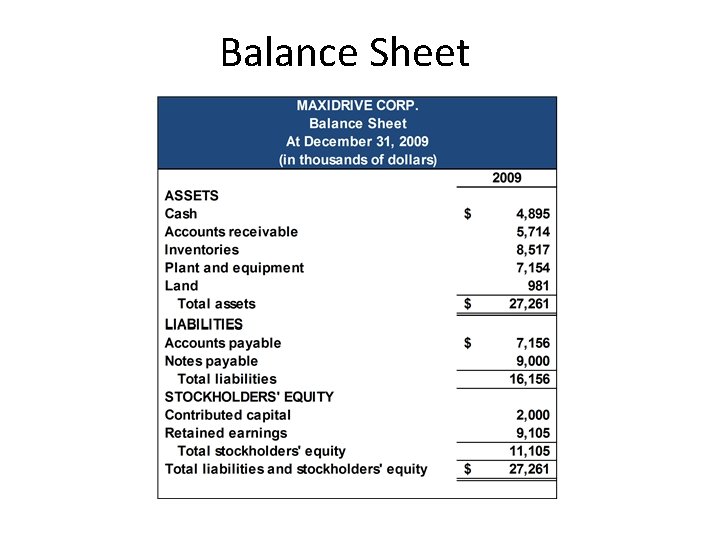
Balance Sheet
The Four Basic Financial Statements On a company’s _____________, all sources and uses of CASH are listed. Cash is generated by the company’s operations (CALLED OPERATING ACTIVITIES). Cash is spent on investments in buildings, manufacturing equipment, and other assets (CALLED INVESTING ACTIVITIES). FINANCING ACTIVITIES involve amounts borrowed (and paid back) from long-term creditors and sale of stock to owners.
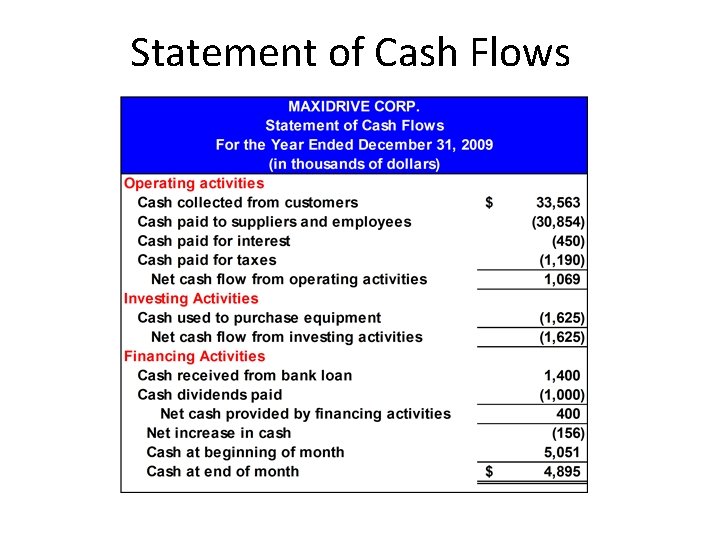
Statement of Cash Flows
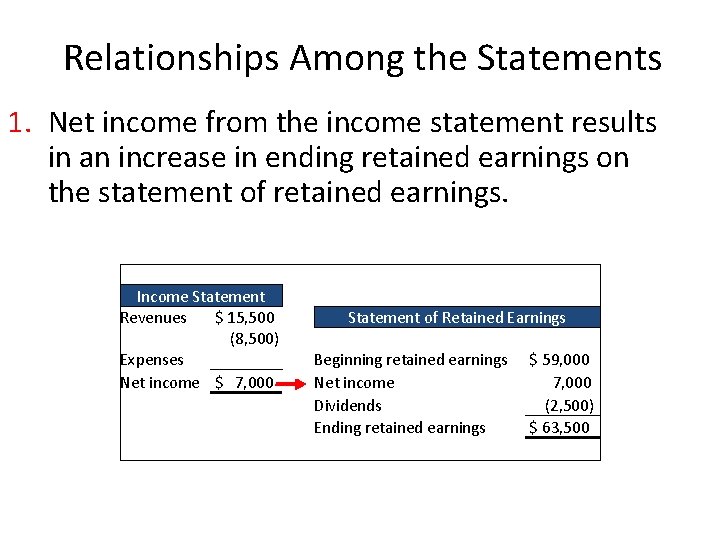
Relationships Among the Statements 1. Net income from the income statement results in an increase in ending retained earnings on the statement of retained earnings. Income Statement Revenues $ 15, 500 (8, 500) Expenses Net income $ 7, 000 Statement of Retained Earnings Beginning retained earnings Net income Dividends Ending retained earnings $ 59, 000 7, 000 (2, 500) $ 63, 500
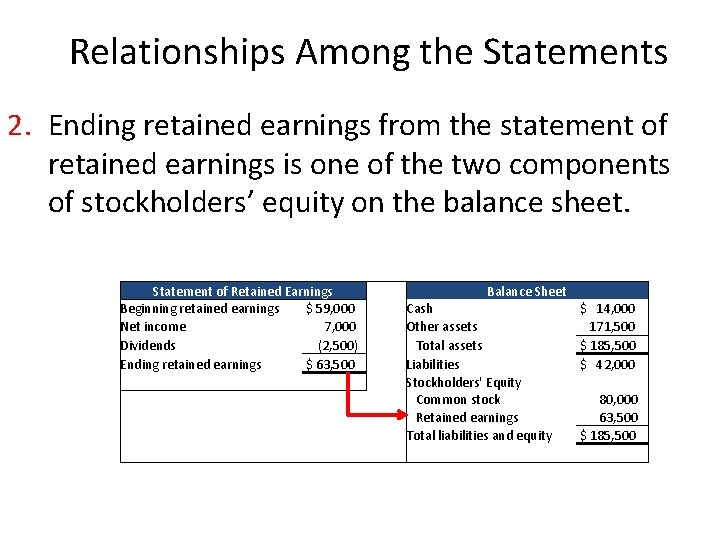
Relationships Among the Statements 2. Ending retained earnings from the statement of retained earnings is one of the two components of stockholders’ equity on the balance sheet. Statement of Retained Earnings Beginning retained earnings $ 59, 000 Net income 7, 000 Dividends (2, 500) Ending retained earnings $ 63, 500 Balance Sheet Cash Other assets Total assets Liabilities Stockholders' Equity Common stock Retained earnings Total liabilities and equity $ 14, 000 171, 500 $ 185, 500 $ 42, 000 80, 000 63, 500 $ 185, 500
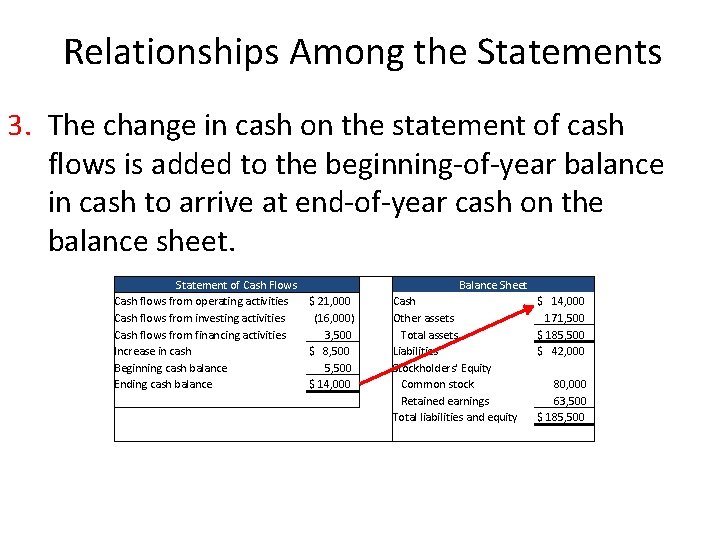
Relationships Among the Statements 3. The change in cash on the statement of cash flows is added to the beginning-of-year balance in cash to arrive at end-of-year cash on the balance sheet. Statement of Cash Flows Cash flows from operating activities Cash flows from investing activities Cash flows from financing activities Increase in cash Beginning cash balance Ending cash balance Balance Sheet $ 21, 000 (16, 000) 3, 500 $ 8, 500 5, 500 $ 14, 000 Cash Other assets Total assets Liabilities Stockholders' Equity Common stock Retained earnings Total liabilities and equity $ 14, 000 171, 500 $ 185, 500 $ 42, 000 80, 000 63, 500 $ 185, 500
Solving the Group Problem • ABC Company has Total Assets of $1, 000, Total Liabilities of $700, 000, Contributed Capital of $100, 000, Beginning Retained Earnings of $130, 000, Dividends of $40, 000, and Total Revenue of $350, 000. What is ABC's Net Income?
- Slides: 25