
Chapter 1 The Balance Sheet BAF 3 M
Chapter 1 The Balance Sheet BAF 3 M FINANCIAL ACCOUNTING FUNDAMENTALS
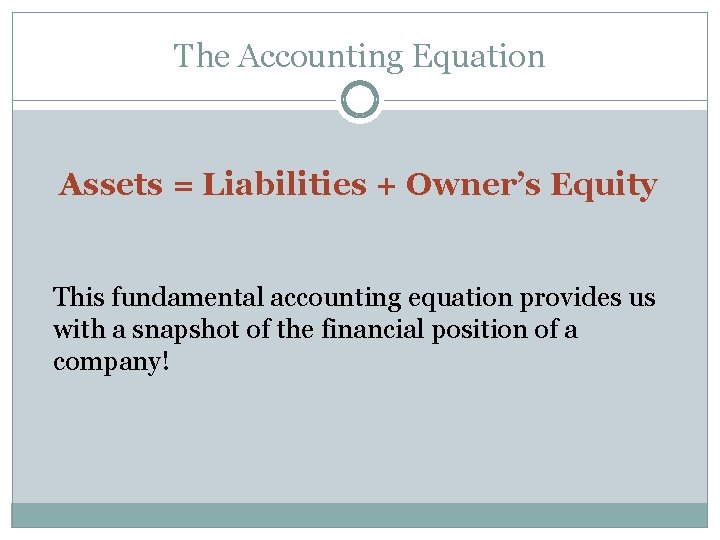
The Accounting Equation Assets = Liabilities + Owner’s Equity This fundamental accounting equation provides us with a snapshot of the financial position of a company!
Assets & Liabilities �What are Assets? Anything that a business (or person) owns of value. �What are Liabilities? Anything that a business (or person) owes of value. �Therefore: Assets = Owns Liabilities = Owes
Examples of Assets Cash ($ in the bank) Accounts Receivable �$ that is owed to you by customers – your money in someone else's hands Equipment Cars Computers Furniture (desks, chairs, cubicles) Factory Building Land • A business owns these!
Examples of Liabilities Bank Loan Credit Card Debt Accounts Payable Wages Payable Salaries Payable Mortgage Payable �Note: “Payables” are amounts that you owe to another business (e. g. , bank, employees, supplier) • A business owes these!
Owner’s Equity �Net worth of a business Difference between assets and liabilities �For now, we will use only one owner’s equity account – Capital �Recall A = L + OE We can rearrange this equation as: OE = A – L If A > L, a business has a positive net worth If A < L, a business has negative net worth
Account Type Activity �You will get a card with an account �Your goal is to place yourself in the correct category. . . Are you an Asset, Liability or Owner’s Equity? �Once everyone has his or her account, go to the place in the room where you belong – Asset, Liability, Owner’s Equity �Can you get to the right place in less than 20 seconds?
The Balance Sheet (page 7 of text) �Step 1 – Prepare Headings Line 1 – Who? Line 2 – What? Line 3 – When? � Note: ‘When’ is a specific date – a ‘snapshot’ �Step 2 – List Assets on Left Side Put Assets in order of Liquidity means how fast the assets can be converted into cash
The Balance Sheet (page 7 of text) �Step 3 - List Liabilities on Right Side Put Liabilities in order of Maturity means that the bills (or accounts) that are due first are listed first �Step 4 – Calculate Owner’s Equity & List on Right Side �Step 5 – Make sure that your Total Assets (left side) and your Total Liabilities & Owner’s Equity (right side) balance
Balance Sheet ‘Rules’ �$ included at top of each column and at final total �Single underline indicates a math calculation will occur �Double underline indicates a final total �No abbreviations �A = L + OE → Total Assets and Total Liabilities & Owner’s Equity are on the same line (thus, it balances!)
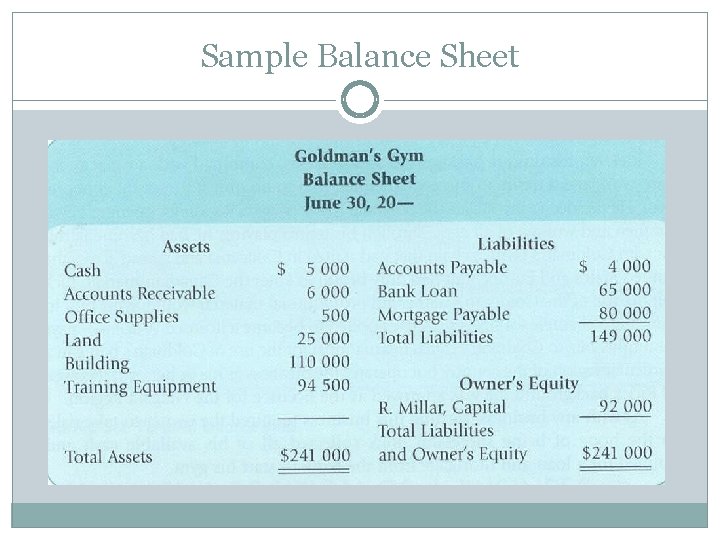
Sample Balance Sheet
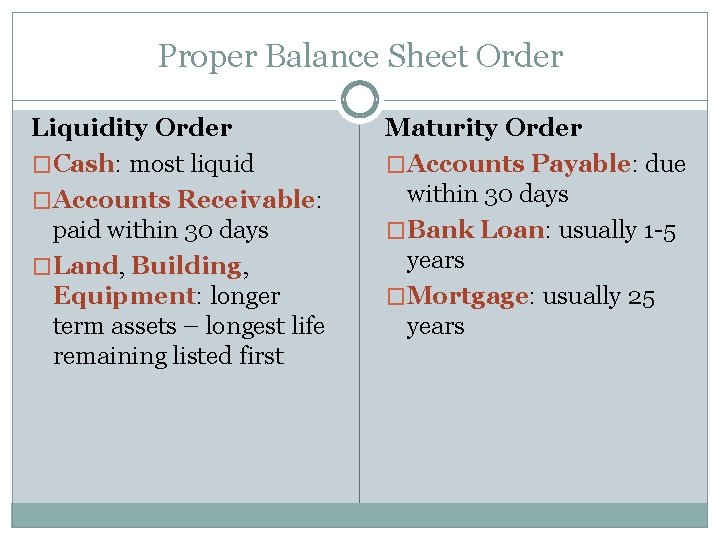
Proper Balance Sheet Order Liquidity Order �Cash: most liquid �Accounts Receivable: paid within 30 days �Land, Building, Equipment: longer term assets – longest life remaining listed first Maturity Order �Accounts Payable: due within 30 days �Bank Loan: usually 1 -5 years �Mortgage: usually 25 years
Balance Sheet Order Game �You will receive one card with an account or title or subtitle on it �Working with the rest of the class, you must build a Balance Sheet – properly formatted – on the board �Our goal: accurate Balance Sheet in less than 2 minutes
- Slides: 13