
Chapter 1 Test Review History of Law Laws

- Slides: 13
Chapter 1 Test Review History of Law
Laws �Enforceable rules of conduct in society �Reflect circumstances of the times �Created in this country by elected officials �Statutes- Written laws by elected officials �Ordinances- Local Statutes
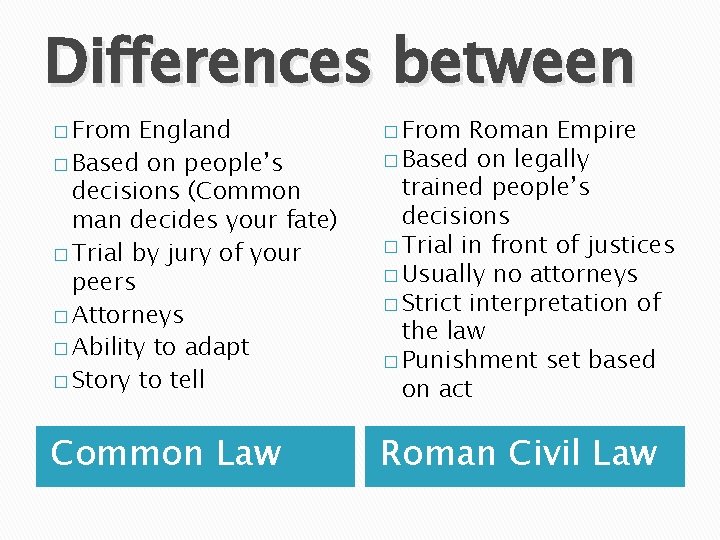
Differences between � From England � Based on people’s decisions (Common man decides your fate) � Trial by jury of your peers � Attorneys � Ability to adapt � Story to tell � From Roman Empire � Based on legally trained people’s decisions � Trial in front of justices � Usually no attorneys � Strict interpretation of the law � Punishment set based on act Common Law Roman Civil Law
Facts �Roman Civil law is most widely practiced form of law in the world today �English Common law practiced in 49 of 50 US states (Louisiana only civil law based state) and at the federal level �Positive law is based on King, queen or dictator and is NOT widely practiced anymore
Common Law Rules �Precedent is an idea that prior court rulings are used as a guide for future cases �Allows law to build over time �Stare Decisis is a Latin term that tells lower courts to follow established case law �Allows courts to use prior court judge decisions to follow
TYPES OF LAW �Criminal- Against society �Civil (Or Tort law)- Against a person or business �Uniform Commercial Code (UCC)Business based regulations �None of these are federal statutes, but rather they are codes (Grouped laws)
Constitution and law �The Federal Constitution sets the framework for what laws can and cannot be passed �The US Supreme court is always the final interpreter of the constitution �If a law conflict with the constitution, it is said to be……. �UNCONSTITUTIONAL
Who Controls �Administrative Laws- Executive branch (President, governor, mayor) �Statutory Laws- Legislative Branch (Congress, senators, local boards) �Case Laws- Judicial Branch (Judges or justices) �Shamus, stop talking!
Legal Facts �Old English Law separated law courts and equity courts where the US has merged them into “ONE” system �There are “ 4” distinct stages in the growth of every legal system, with the goal being order �Police will NOT investigate a civil (Tort) matter, only criminal
Jurisdiction �Defined as the power to decide a case �Gives local governments more power and separates power between federal levels, state levels and local levels �Case must be tried in the area it took place �Local judges given authority over case
Criminal Law �Against Society �Based on punishment �Jail, fines or death �Police involved �Guaranteed a lawyer �Burden of proof on the government
Civil Law �Against a person or business �Based on restitution (Money) �Property or personal rights �Police NOT involved �NOT Guaranteed a lawyer �Burden of proof on the plaintiff (Person bringing the case �Also known as tort law
Questions? ?