
Chapter 1 Studying Geography World Geography Jones Geography
- Slides: 74
Chapter 1: Studying Geography World Geography Jones
Geography • Geography (from the Greek words Geo or Gaea, both meaning "Earth", and graphy meaning "to describe“) is the study of the earth and its features, inhabitants, and phenomena. A literal translation would be "to describe the Earth".
What is geography? • IT IS NOT – memorizing cities, states, countries and capitals. • IT IS NOT – looking at pictures and maps. • IT IS NOT – the study of rocks. • IT IS – the study of the earth, its people and how they interact. • IT IS – how the world is changing. • IT IS – a look at cities, cultures, resources, plants and why and where events occur.
Is the world getting smaller?
Perspective • perspective – the way a person looks at something. • Geographers use a spatial perspective – look for patterns in where things are located and how they are arranged.
Organize Yourselves • Get up! • Organize yourself according to birthday (oldest to youngest) • Now, organize yourself according to where you were born (by state alphabetically) • This is an example of spatial perspective (on a class scale)
Landscape • landscape – the scenery of a place – human, physical and cultural features • Describe the landscape at home: – Human, varying ages, grass, yard, home, trees, religious, entertaining, good food • Describe the landscape at school: – Brick, concrete, tile, educational, athletic, clubs, human – mostly young people with some old people
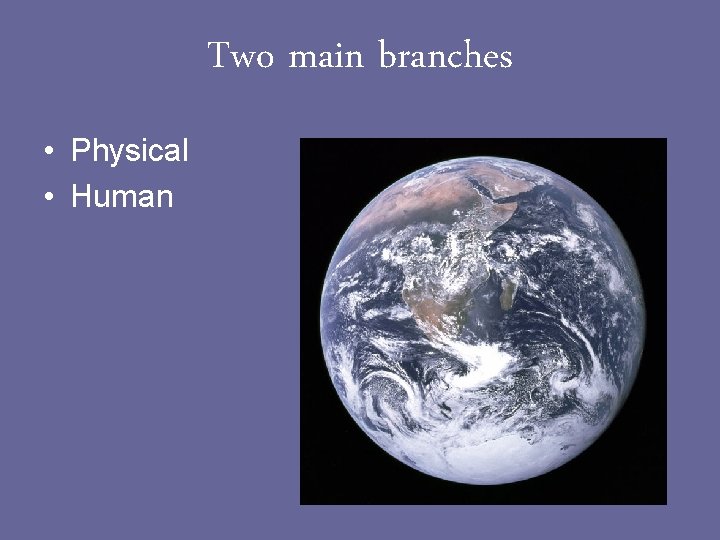
Two main branches • Physical • Human
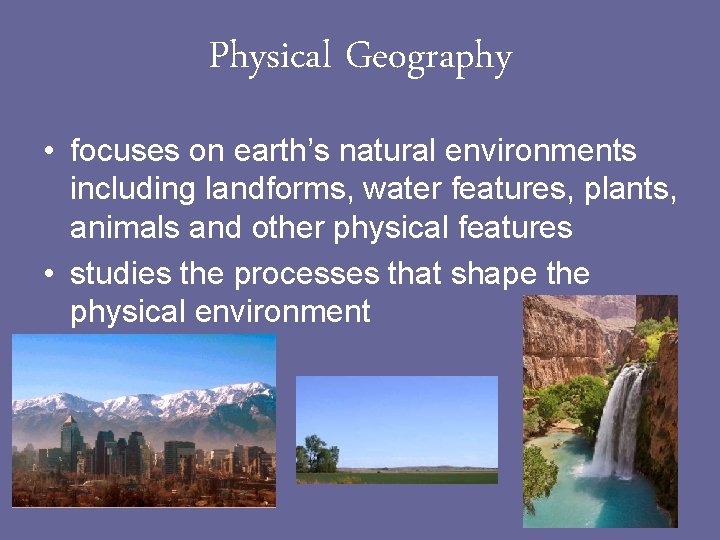
Physical Geography • focuses on earth’s natural environments including landforms, water features, plants, animals and other physical features • studies the processes that shape the physical environment
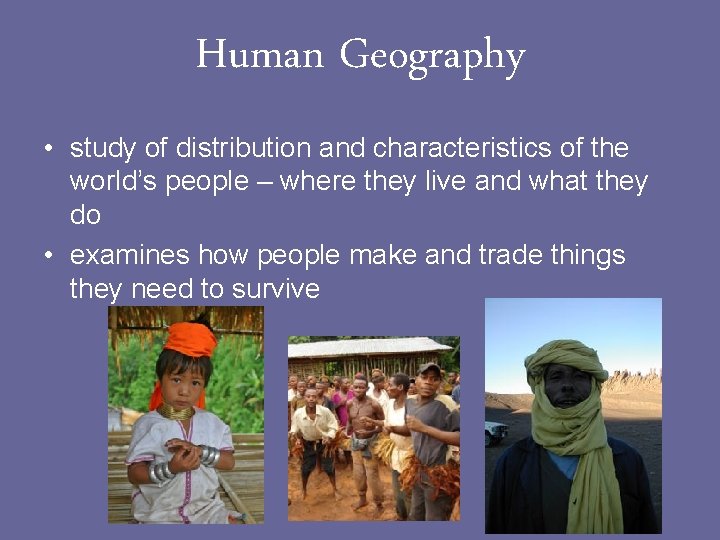
Human Geography • study of distribution and characteristics of the world’s people – where they live and what they do • examines how people make and trade things they need to survive
How do we use geography in our everyday lives?
What do you do every day? • Deciding where to go and how to get there, planning cities, preparing for weather events or hazards, choosing spots for restaurants, choosing military training areas, choosing hobbies and pastimes, etc.
What jobs require you to use geography?
Almost all of them! • Oil search, people who search for store locations, military, city developers, housing/land developers, marketers, agricultural companies, engineers, fashion designers, etc.
Geography jobs • cartography – study of maps and mapmaking • meteorology – study of weather
The Five Themes of Geography
Five Themes of Geography • • • 1. Movement 2. Region 3. Human-Environment Interaction 4. Location 5. Place
#1 Movement • The movement of people, goods, and ideas • “Where do your things come from? ”
#2 Region • region – An area with 1 or more common features that make it different from surrounding areas. It is defined by human or physical characteristics • Regions can be physical or human
Physical Regions • Physical Region: climate, river systems, soils, vegetation • What are examples of physical regions? • Great Plains, Rocky Mountains, Great Lakes. In Virginia? Tidewater, Shenandoah Valley
Human Region • language, religion, trade networks, food • Example: Quebec (French language), Northern/Southern Ireland (Protestant/Catholic), Hollywood (makes movies), Florida (tourism), Kansas/Texas – barbeque, New England – seafood, lobsters, here in Virginia – crabs, seafood • Boundaries can be defined or undefined
What? • Defined – political boundaries (states, countries) • Undefined - Where is the Corn Belt? Where is “The Heartland” – can be any size – can be subdivided
Other Types of Regions • Formal: has 1 or more common features that make it different from surrounding areas. – can be based on population, income, crops, temperature, rainfall, physical features (mountains)
Examples of Formal Regions – Rust Belt – old factories shut down – Pgh, Gary, Detroit, Cleveland – Death Valley – Snow Belt (Buffalo) – Beverly Hills (income) – Southern California (temperature, weather) – In Virginia • • Eastern Shore Tidewater “Virginia Beach” Northern Virginia/Beltway (northern Virginia near DC)
Other Types of Regions • Functional: different places that are linked together as a unit • Examples: city transit system, school system, shopping mall and surrounding neighborhoods • Virginia Beach examples: – – Little Creek, Oceana, Dam Neck, Fort Story Town Center & Pembroke Part of Hampton Roads Cox High School district
Perceptual Regions • perception – Our awareness and understanding of the environment around us. • Different for different people • Regions that reflect feelings and attitudes – Ex. Back Home, the South
#3 Human-Environment Interaction • How do people use their environment? • How do people control their environment? – Trashman, dams, air conditioning
#4 Location • absolute - use latitude and longitude • relative – where it is located in relation to other places – can change over time (distance and time)
#5 Place • Every place has features that distinguish it from other places. • Places are similar and different • Physical characteristics: – Landforms (mountains to flat) – Vegetation (tropical to tundra to desert) – Climate (warm, hurricanes, flood, drought) • Human characteristics: – Job, language, politics, food, religion, farming techniques, architectural styles, clothes
Six Essential Elements of Geography • 1. The world in spatial terms – Focuses on geography’s spatial perspective and uses maps to study people, places and environments. • 2. Places and regions – Deals with physical and human features of a places and how we define and perceive various regions.
Six Essential Elements of Geography • 3. Physical systems – Physical systems shape earth’s features. Study of earthquakes, mountains, rivers, volcanoes, weather patterns. Also study how plants and animals relate to these systems.
Six Essential Elements of Geography • 4. Human systems – Our activities, movements and settlements shape the earth’s surface. Our way of life – things we produce and trade – looks at causes and results of conflict between peoples. The study of governments we set up and the features of cities and other settlements we live in.
Six Essential Elements of Geography • 5. Environment and Society – Human actions affect the environment. Earth’s systems affect humans. We depend on what the earth provides to survive. The relationship between people and the environment.
Six Essential Elements of Geography • 6. The uses of geography – Helps us understand the relationships among people, places and environments over time. Geography can help us interpret past and present or plan for the future.
How does geography affect our lives? (Where are you from)
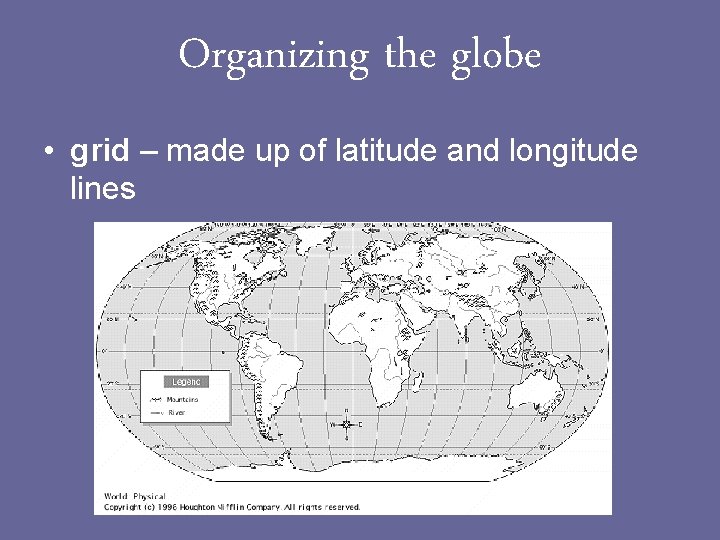
Organizing the globe • grid – made up of latitude and longitude lines
Latitude & Longitude • Determines absolute location • Latitude: imaginary lines that run east and west and measure north and south – Measured from the equator – N = north – S = south – Also called parallels – Measured from 0 – 90 degrees
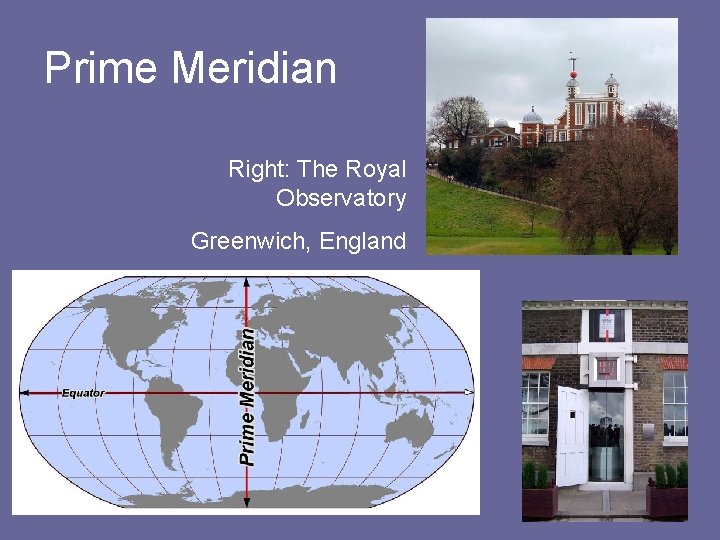
Latitude & Longitude • Longitude: imaginary lines that run north south and measure east and west – E = east – W = west – Meet at north and south poles – Also called meridians – Measured from 0 to 180 degrees (runs through Greenwich, England)
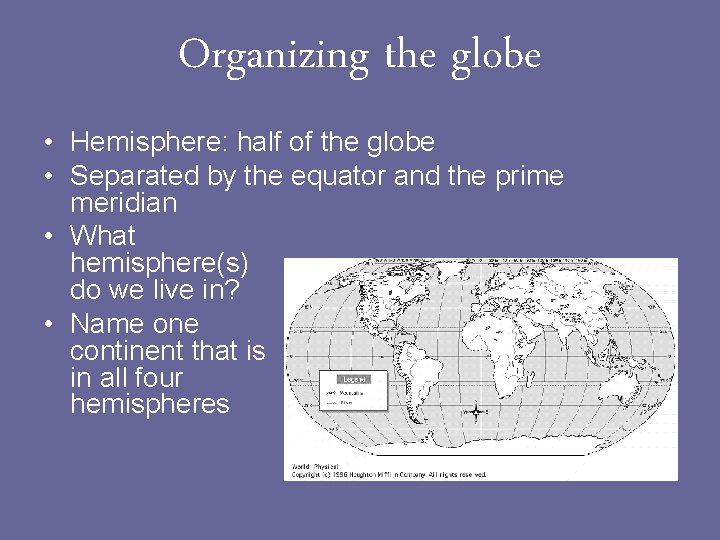
Organizing the globe • Hemisphere: half of the globe • Separated by the equator and the prime meridian • What hemisphere(s) do we live in? • Name one continent that is in all four hemispheres
Organizing the globe • Continent: large land mass – How many continents are there? – Seven: North America, South America, Europe, Asia, Africa, Australia, and Antarctica – Largest island = Greenland • How many oceans are there? – Four: Atlantic, Pacific, Indian, Arctic • “Continent exercise”
Organizing the globe • There also bays, seas, gulfs, lakes (determined by size and salt) • Largest lake: Caspian Sea
Making Maps • atlas – collection of maps into 1 book • ATLAS PROJECT • • Complete 1 st map: World Map Label 7 continents & 4 oceans Color each continent a different color Color water blue
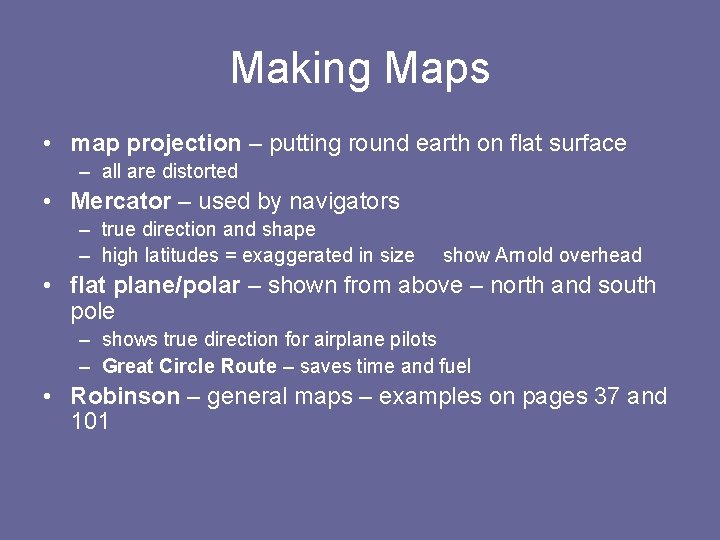
Making Maps • map projection – putting round earth on flat surface – all are distorted • Mercator – used by navigators – true direction and shape – high latitudes = exaggerated in size show Arnold overhead • flat plane/polar – shown from above – north and south pole – shows true direction for airplane pilots – Great Circle Route – saves time and fuel • Robinson – general maps – examples on pages 37 and 101
Understanding Map Elements • scale – helps determine real distances – a ratio – less area shown = more detail = large scale = large detail • compass rose – directional indicator • legend – key – tells what symbols and colors represent
Using Special Purpose Maps • Special purpose maps are called thematic maps (use color and symbols)
Thematic Maps • • political – shows borders, countries, cities, states physical – shows natural features climate – shows climate regions (changes are gradual) precipitation – amount of snow, rain, sleet, hail over a year • population – shows people per square mile/km • economic – shows important resources and how land was used elevation – height above sea level- relief • topography – shows contour – connects points of equal elevation – close = steep
Climate Graphs & Population Pyramids • climate graph – shows average temperature and precipitation – Do samples of climate graphs – Use page 19 to help you • population pyramid – shows % of males and females by age group – helps understand trends – Do sample of a population pyramid using the data for the United States on pg. 22
Chapter 2: The Solar System
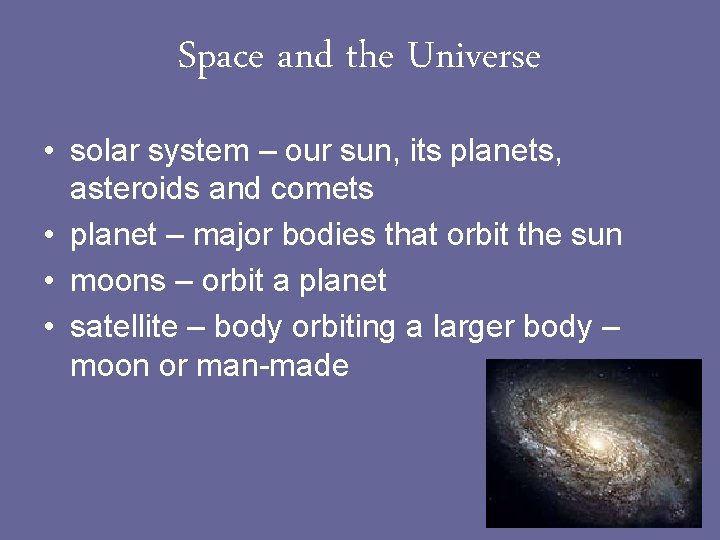
Space and the Universe • solar system – our sun, its planets, asteroids and comets • planet – major bodies that orbit the sun • moons – orbit a planet • satellite – body orbiting a larger body – moon or man-made
Earth’s Rotation, Revolution, and Tilt • solar energy – from the sun – different latitudes get different amount • rotation – 24 hours – helps distribute the sun’s heat – causes day and night • revolution – takes 1 year • tilt – 23½º – causes seasons – “Making the seasons – flashlight game”
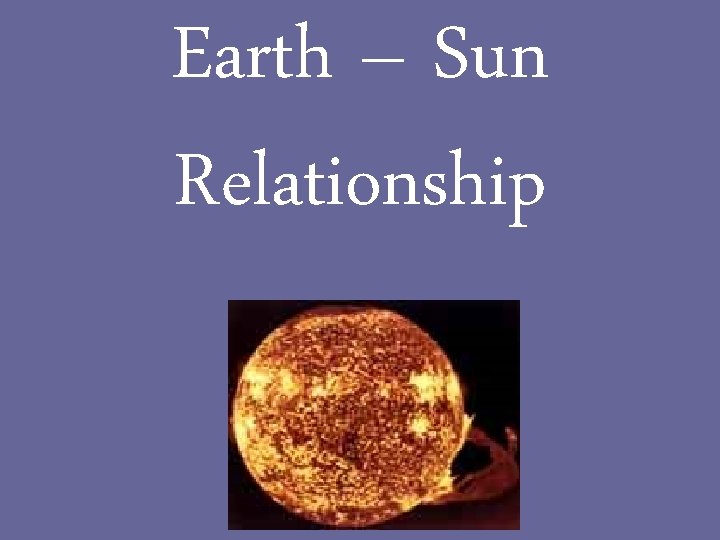
Earth – Sun Relationship
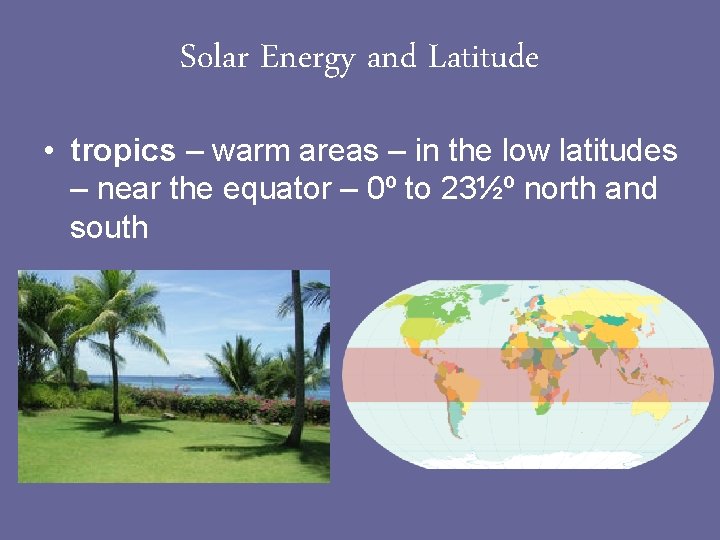
Solar Energy and Latitude • tropics – warm areas – in the low latitudes – near the equator – 0º to 23½º north and south
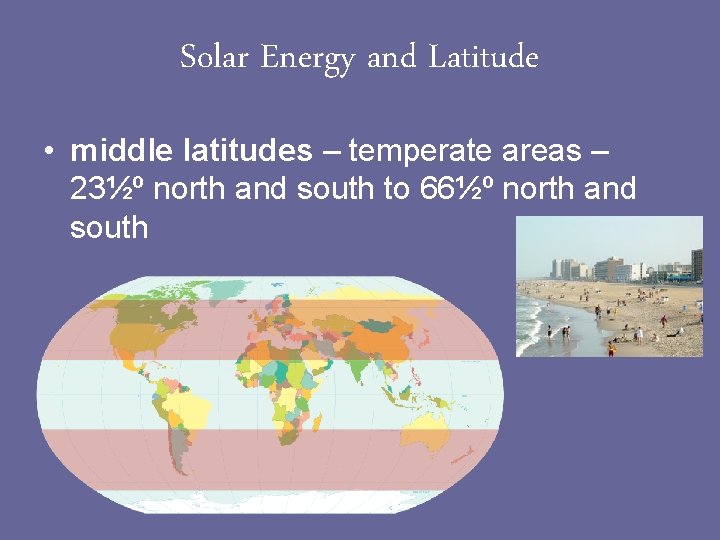
Solar Energy and Latitude • middle latitudes – temperate areas – 23½º north and south to 66½º north and south
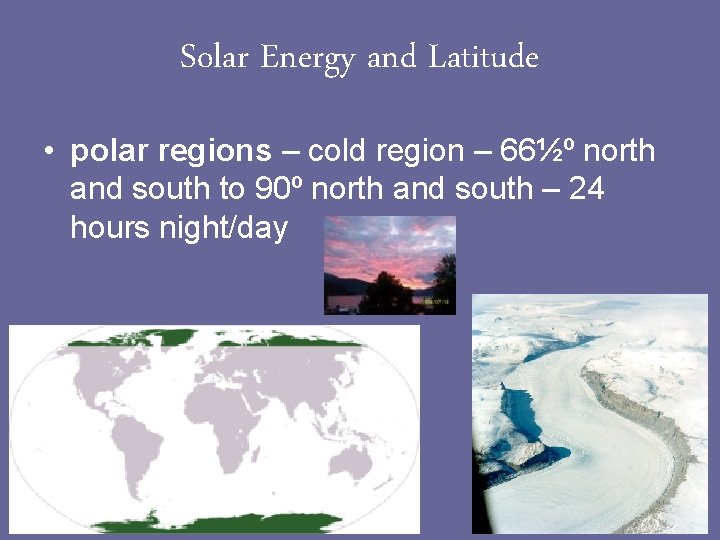
Solar Energy and Latitude • polar regions – cold region – 66½º north and south to 90º north and south – 24 hours night/day
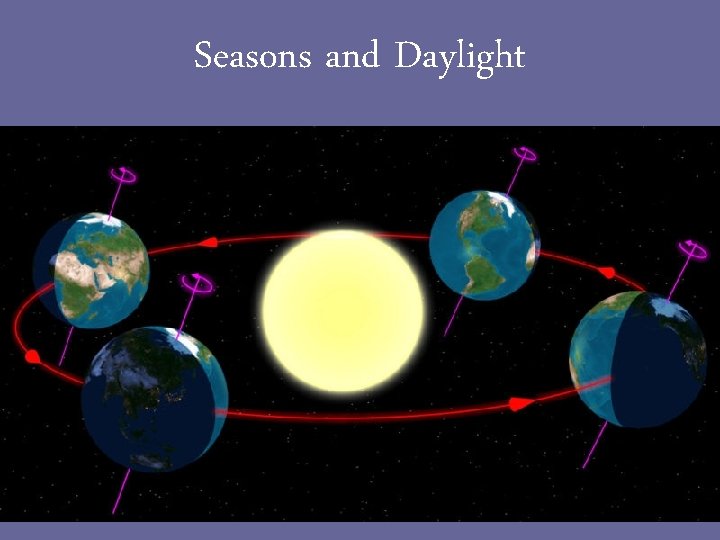
Seasons • seasons – caused by the tilt – north and south hemispheres are opposite • solstice – – summer = June 21 winter = December 21 poles point to sun at greatest angle shortest and longest day • equinox – – sun is directly over the equator 12 hours of day and night March 21 = spring equinox September 21 = fall equinox
Seasons and Daylight
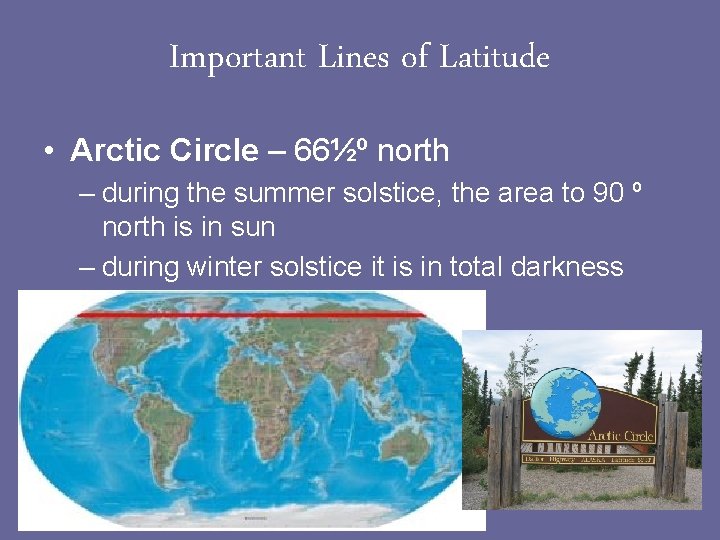
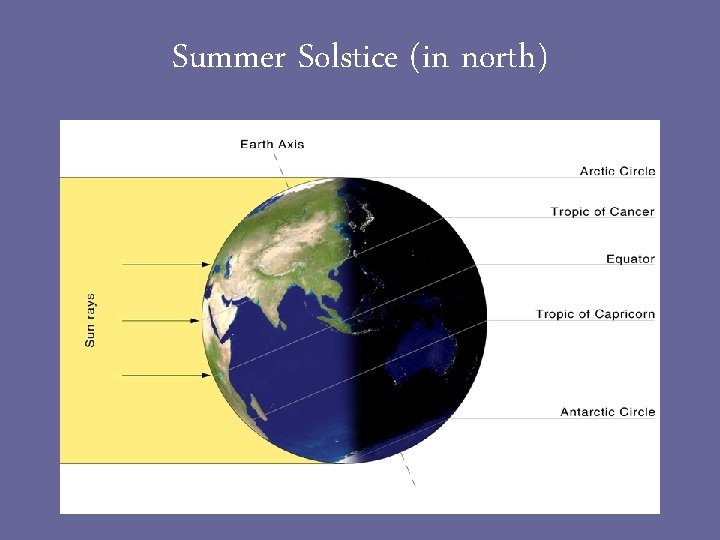
Important Lines of Latitude • Arctic Circle – 66½º north – during the summer solstice, the area to 90 º north is in sun – during winter solstice it is in total darkness
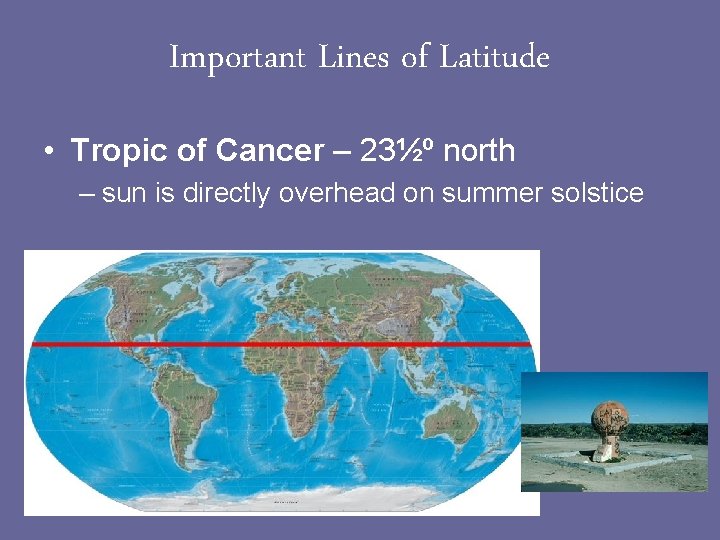
Important Lines of Latitude • Tropic of Cancer – 23½º north – sun is directly overhead on summer solstice
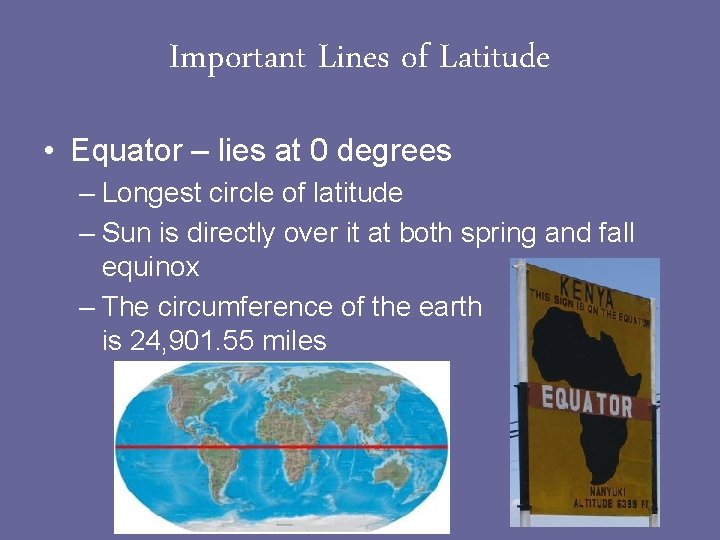
Important Lines of Latitude • Equator – lies at 0 degrees – Longest circle of latitude – Sun is directly over it at both spring and fall equinox – The circumference of the earth is 24, 901. 55 miles
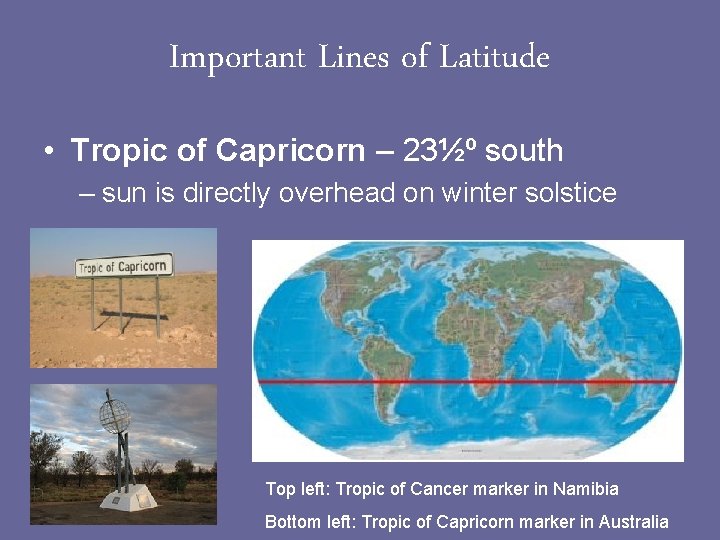
Important Lines of Latitude • Tropic of Capricorn – 23½º south – sun is directly overhead on winter solstice Top left: Tropic of Cancer marker in Namibia Bottom left: Tropic of Capricorn marker in Australia
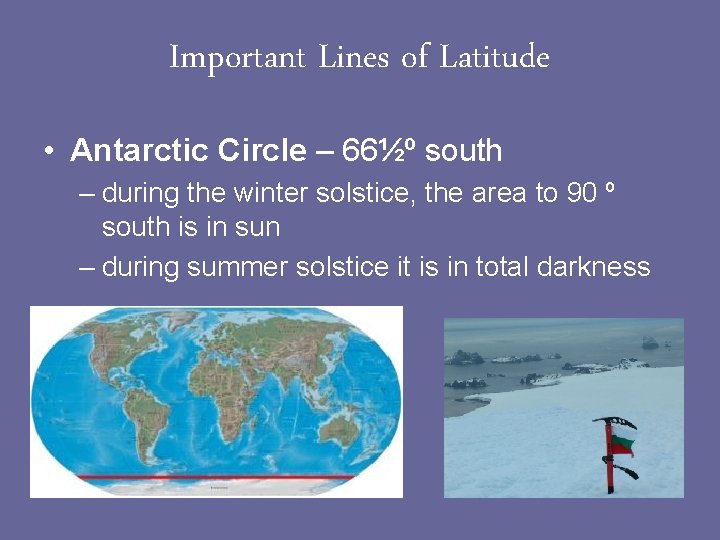
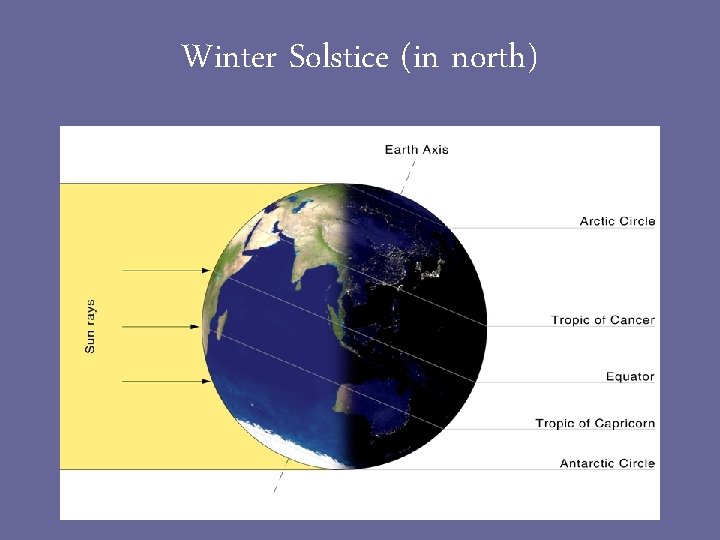
Important Lines of Latitude • Antarctic Circle – 66½º south – during the winter solstice, the area to 90 º south is in sun – during summer solstice it is in total darkness
Summer Solstice (in north)
Winter Solstice (in north)
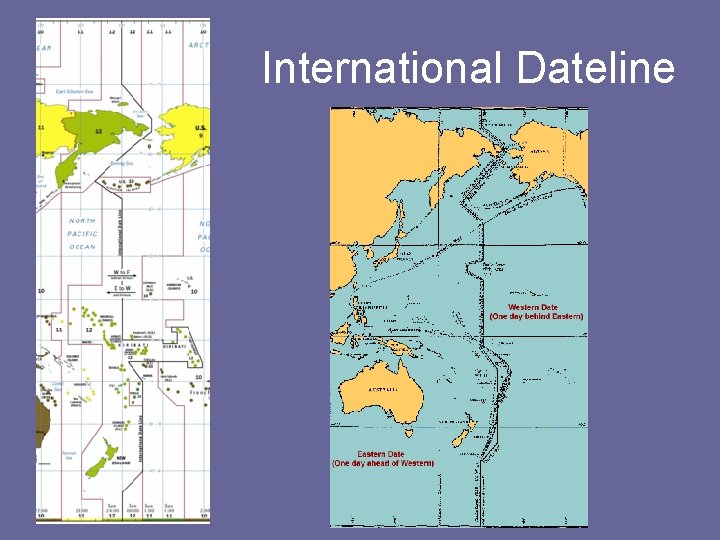
Longitude • Does not affect climate • Two major lines of longitude – Prime Meridian: marks 0 degrees – International Dateline: marks 180 degrees
Prime Meridian Right: The Royal Observatory Greenwich, England
International Dateline
Longitude & Latitude • On a map of the world, label the five important lines of latitude and two major lines of longitude • Trace each line on the map • Write what the line is called • Write the degree where each line lies
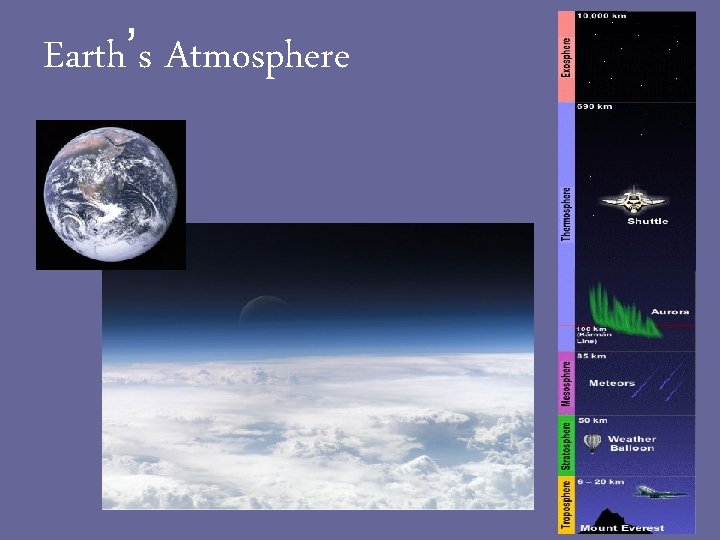
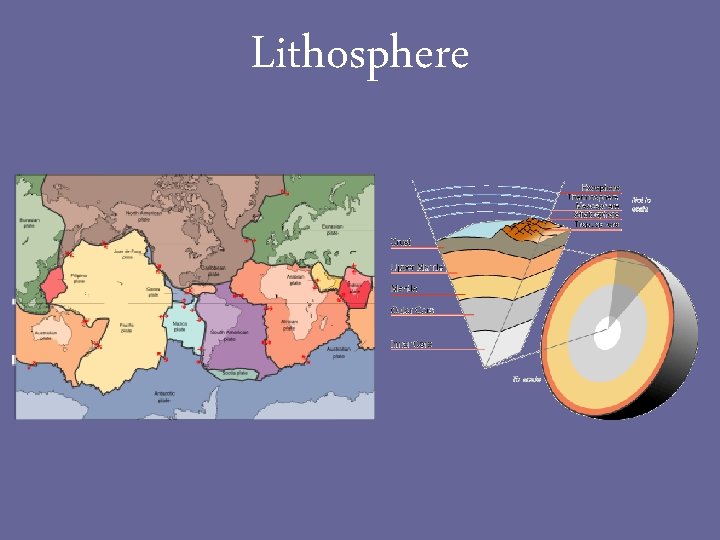
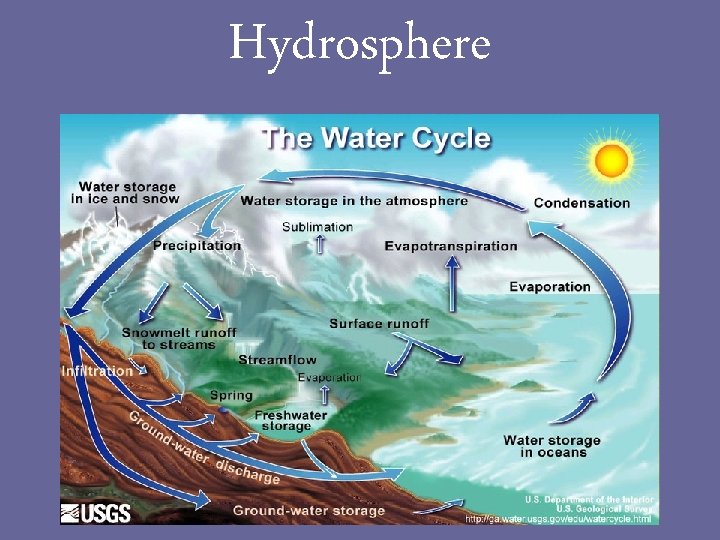
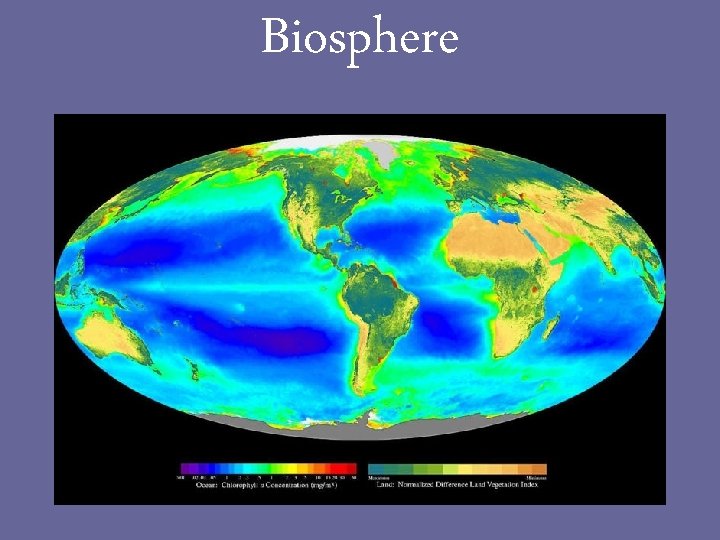
The Earth’s Systems • Atmosphere – gas vapor around the earth – protects us from the sun • lithosphere – solid crust – rock and soil of earth – forms islands, continents, ocean floor • hydrosphere – all of the earth’s waters • biosphere – includes all life forms – plants and animals – overlaps other 3 spheres
Earth’s Atmosphere
Lithosphere
Hydrosphere
Biosphere
Earth’s Environment • The four spheres = the environment = our surroundings – are the key to our survival
Assignments • READ: Using a Time Zone Map – Answer questions 1 - 3 • READ: Environmental Issues on page 36. – Question: What are the positives and negatives of manipulating the environment? • READ: page 37 – Geography for life – Answer questions at end of page