
Chapter 1 Software and Software Engineering Dual role


- Slides: 20
Chapter 1 Software and Software Engineering - Dual role of software - Software questions haven't changed - A definition of software - Differences between hardware and software - Changing nature of software - Dealing with legacy software - Software myths (Source: Pressman, R. Software Engineering: A Practitioner’s Approach. Mc. Graw-Hill, 2005)
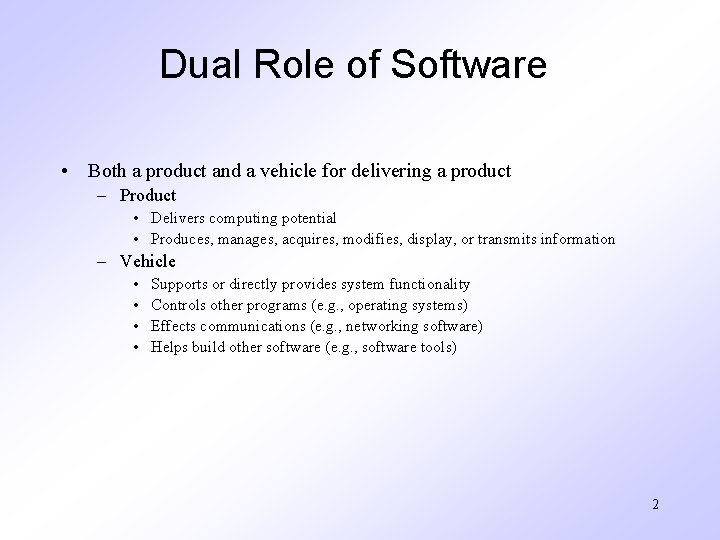
Dual Role of Software • Both a product and a vehicle for delivering a product – Product • Delivers computing potential • Produces, manages, acquires, modifies, display, or transmits information – Vehicle • • Supports or directly provides system functionality Controls other programs (e. g. , operating systems) Effects communications (e. g. , networking software) Helps build other software (e. g. , software tools) 2
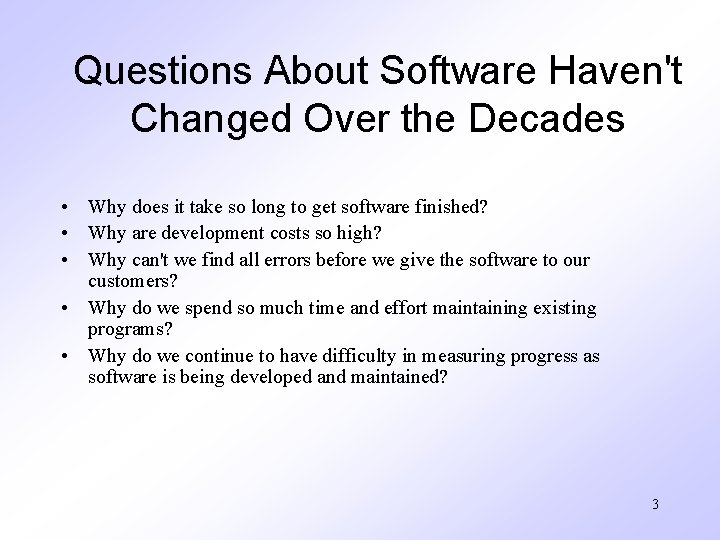
Questions About Software Haven't Changed Over the Decades • Why does it take so long to get software finished? • Why are development costs so high? • Why can't we find all errors before we give the software to our customers? • Why do we spend so much time and effort maintaining existing programs? • Why do we continue to have difficulty in measuring progress as software is being developed and maintained? 3
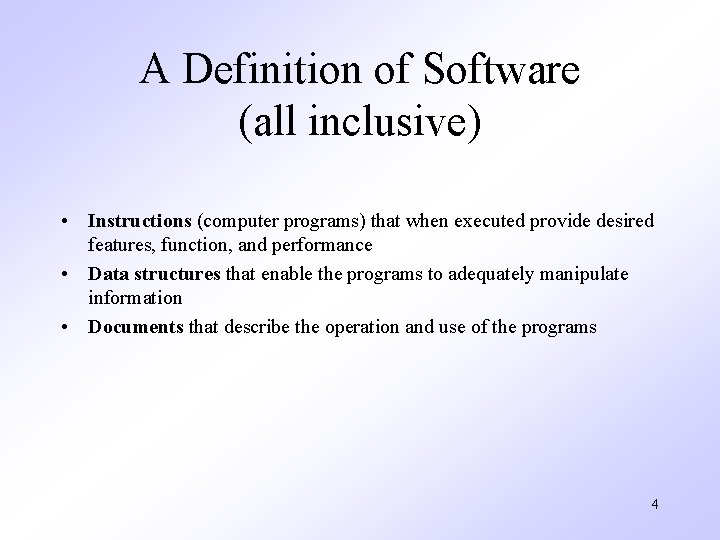
A Definition of Software (all inclusive) • Instructions (computer programs) that when executed provide desired features, function, and performance • Data structures that enable the programs to adequately manipulate information • Documents that describe the operation and use of the programs 4
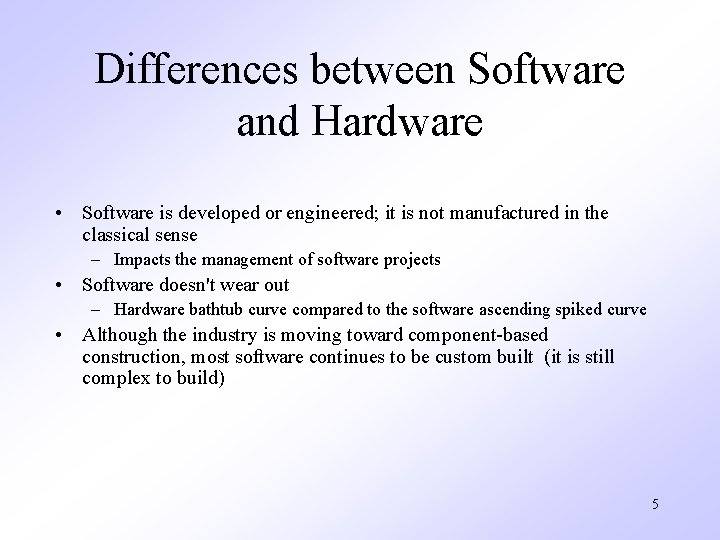
Differences between Software and Hardware • Software is developed or engineered; it is not manufactured in the classical sense – Impacts the management of software projects • Software doesn't wear out – Hardware bathtub curve compared to the software ascending spiked curve • Although the industry is moving toward component-based construction, most software continues to be custom built (it is still complex to build) 5
Software Failure Curve 6
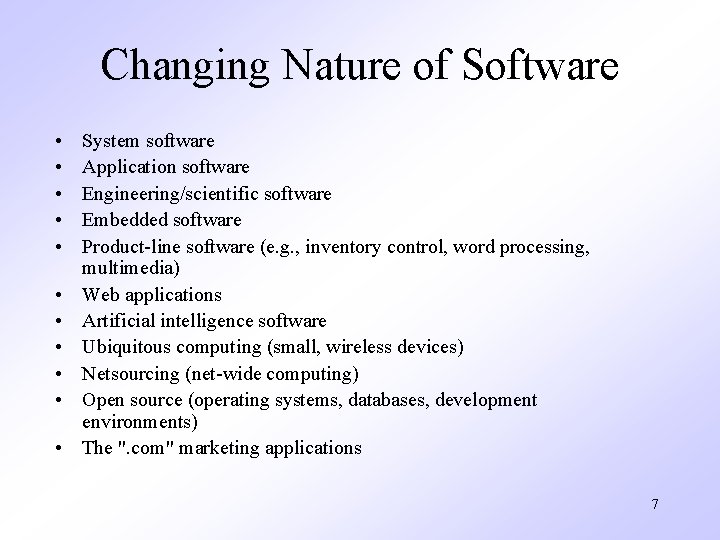
Changing Nature of Software • • • System software Application software Engineering/scientific software Embedded software Product-line software (e. g. , inventory control, word processing, multimedia) Web applications Artificial intelligence software Ubiquitous computing (small, wireless devices) Netsourcing (net-wide computing) Open source (operating systems, databases, development environments) The ". com" marketing applications 7
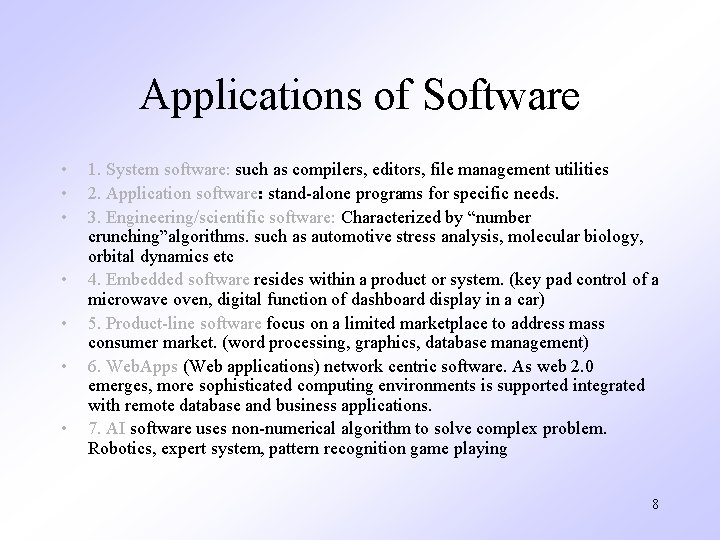
Applications of Software • • 1. System software: such as compilers, editors, file management utilities 2. Application software: stand-alone programs for specific needs. 3. Engineering/scientific software: Characterized by “number crunching”algorithms. such as automotive stress analysis, molecular biology, orbital dynamics etc 4. Embedded software resides within a product or system. (key pad control of a microwave oven, digital function of dashboard display in a car) 5. Product-line software focus on a limited marketplace to address mass consumer market. (word processing, graphics, database management) 6. Web. Apps (Web applications) network centric software. As web 2. 0 emerges, more sophisticated computing environments is supported integrated with remote database and business applications. 7. AI software uses non-numerical algorithm to solve complex problem. Robotics, expert system, pattern recognition game playing 8
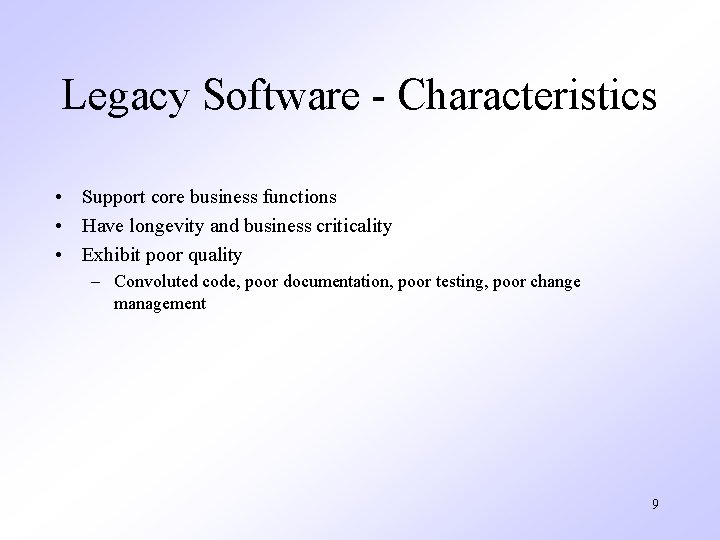
Legacy Software - Characteristics • Support core business functions • Have longevity and business criticality • Exhibit poor quality – Convoluted code, poor documentation, poor testing, poor change management 9
Reasons for Evolving the Legacy Software • (Adaptive) Must be adapted to meet the needs of new computing environments or more modern systems, databases, or networks • (Perfective) Must be enhanced to implement new business requirements • (Corrective) Must be changed because of errors found in the specification, design, or implementation (Note: These are also the three major reasons for any software maintenance) 10
Software Myths - Management • "We already have a book that is full of standards and procedures for building software. Won't that provide my people with everything they need to know? " – Not used, not up to date, not complete, not focused on quality, time, and money • "If we get behind, we can add more programmers and catch up" – Adding people to a late software project makes it later – Training time, increased communication lines • "If I decide to outsource the software project to a third party, I can just relax and let that firm build it" – Software projects need to be controlled and managed 11
Software Myths - Customer • "A general statement of objectives is sufficient to begin writing programs – we can fill in the details later" – Ambiguous statement of objectives spells disaster • "Project requirements continually change, but change can be easily accommodated because software is flexible" – Impact of change depends on where and when it occurs in the software life cycle (requirements analysis, design, code, test) 12
Software Myths - Practitioner • "Once we write the program and get it to work, our job is done" – 60% to 80% of all effort expended on software occurs after it is delivered • "Until I get the program running, I have no way of assessing its quality – Formal technical reviews of requirements analysis documents, design documents, and source code (more effective than actual testing) • "The only deliverable work product for a successful project is the working program" – Software, documentation, test drivers, test results • "Software engineering will make us create voluminous and unnecessary documentation and will invariably slow us down" – Creates quality, not documents; quality reduces rework and provides software on time and within the budget 13
Quiz • During software development which factor is crucial? • a. People • b. Product • c. Process • d. All the above
What is software? a. Instructions (computer programs) that when executed provide desired features, function, and performance b. Data structures that enable the programs to adequately manipulate information c. Documents that describe the operation and use of the programs d. All the above 15
• What are the two roles of software? a. b. c. d. Product and vehicle Process and communication Product and network 16
• What are the Reasons for Evolving the Legacy Software ? a. Adaptive, Perfective, Corrective b. Adaptive, Perfective, Reliable c. Adaptive, Perfective, Extensible Ans: All the above, a&b, a&c, b&c 17
• If we get behind, we can add more programmers and catch up. Does it work? a. Yes b. No 18
• Software doesn't wear out. . True or false? a. True b. False 19
• Who is the Author of our SE Text book? a. Pressman, R. b. Ian Sommerville c. Silberschatz 20