
Chapter 1 Scientific Thinking Learning objectives 1 Describe
Chapter 1: Scientific Thinking Learning objectives 1. Describe what is life 2. Describe what is science 3. Difference between hypothesis and theory 4. Be able to list steps of scientific method. 5. Describe key aspects of well-designed experiments.

How do you decide if something is alive?
Characteristics shared by all living organisms 1. Made up of one or more cells: All cells contain DNA 2. Order: Exhibit complex organization 3. Regulation and homeostasis: Maintain a constant internal environment 4. Growth and development 5. Energy processing 6. Respond to environment 7. Reproduce 8. Evolutionary adaptation leading to descent with modification
What is Science? “There are two ways to live life, as though nothing is a miracle, and as though everything is a miracle” - Einstein Science is a collection of facts and a process for understanding the world Not simply a list of facts to be memorized but rather an intellectual activity
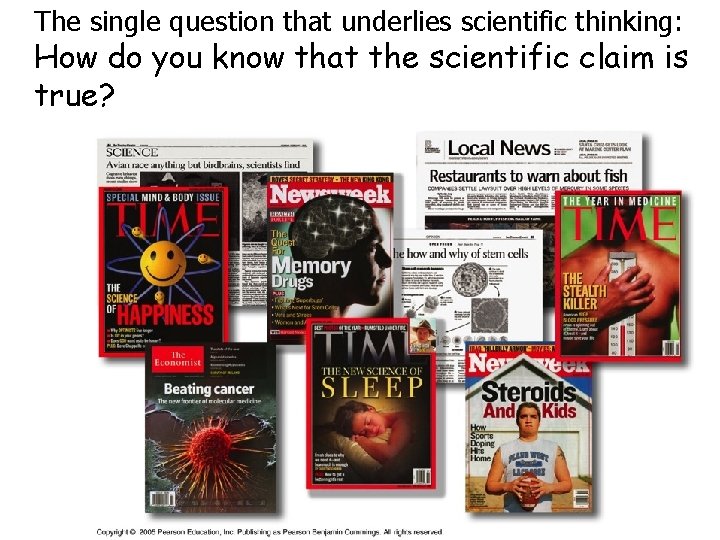
The single question that underlies scientific thinking: How do you know that the scientific claim is true?
Scientific Literacy q how to think scientifically q how to use the knowledge we gain to make wise decisions q increasingly important in our lives q literacy in matters of biology is especially essential
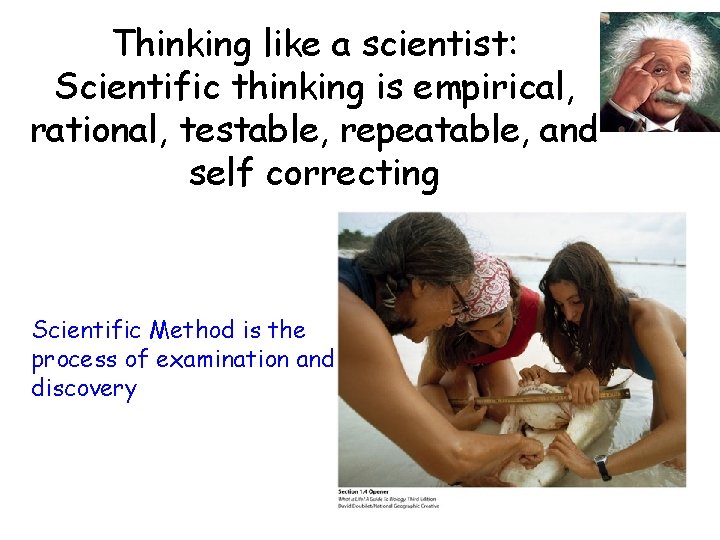
Thinking like a scientist: Scientific thinking is empirical, rational, testable, repeatable, and self correcting Scientific Method is the process of examination and discovery

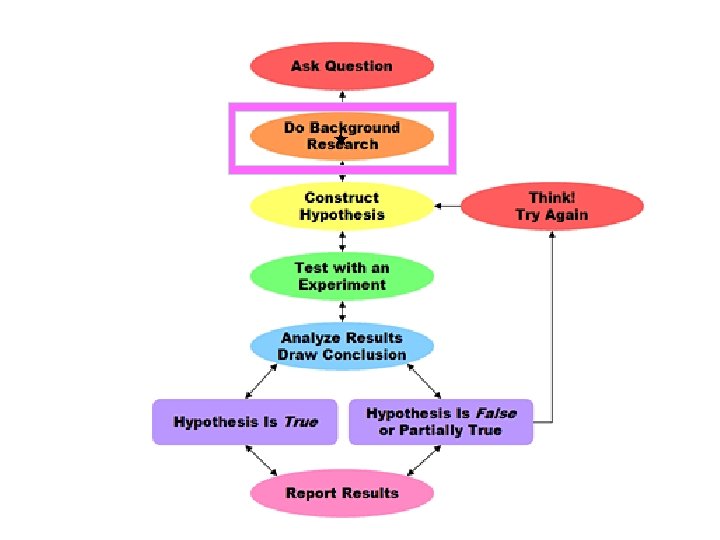
Q What should you do when something you believe in turns out to be wrong? This may be the most important feature of the scientific method: it tells us when we should change our minds.
Hypotheses and Theories q. A hypothesis is a proposed explanation for a phenomenon. q. A theory is a hypothesis that is exceptionally well-supported by the data, and withstood the test of time.
Examples of scientific theories • Cell theory • Theory of gravity • Theory of relativity “Is Evolution a Scientific theory”?
Think about this…. • If new experimental results are in disagreement with a theory, can it be discarded? • Example: – – earth centered description; Sun is the center, concentric circular orbits Elliptical orbits http: //video. answers. com/the-aim-of-agood-scientist-291035149
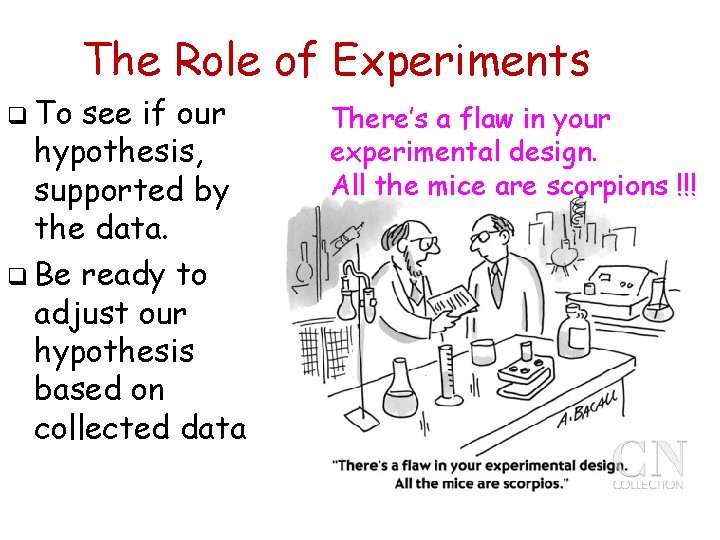
The Role of Experiments q To see if our hypothesis, supported by the data. q Be ready to adjust our hypothesis based on collected data There’s a flaw in your experimental design. All the mice are scorpions !!!
Experimental Design Why is experimental design important? • • Sample size Treatment/experimental group Control group Variables: Dependent and independent Blind or double blind strategies Randomization Repeatable
Current News: What does this tell you about the link between MMR and autism? The following is from a published study about MMR vaccines and Autism 12 children with a history of developmental disorder were investigated. In 8 children, the onset of behavioral problems were linked either by the parents or by the child’s physician with MMR vaccination……
Well Designed Experiments Treatment • any experimental condition applied to individuals 1. Experimental group • a group of individuals who are exposed to a particular treatment 2. Control group • a group of individuals who are treated identically to the experimental group with the one exception: they are not exposed to the treatment 3. Variables (characteristics of an experimental system that are subject to change) • Dependent variable: characteristics of your experimental system that are subject to change • Independent variable: is the treatment that you are testing in the experiment
Well-designed Experiment 4. Blind strategies: The experimental subjects do not know which treatment (if any) they are receiving. Double-blind strategies: Neither the experimental subjects nor the experimenter knows which treatment the subject is receiving. 5. Randomized The subjects are randomly assigned into experimental and control group 6. Repeatable
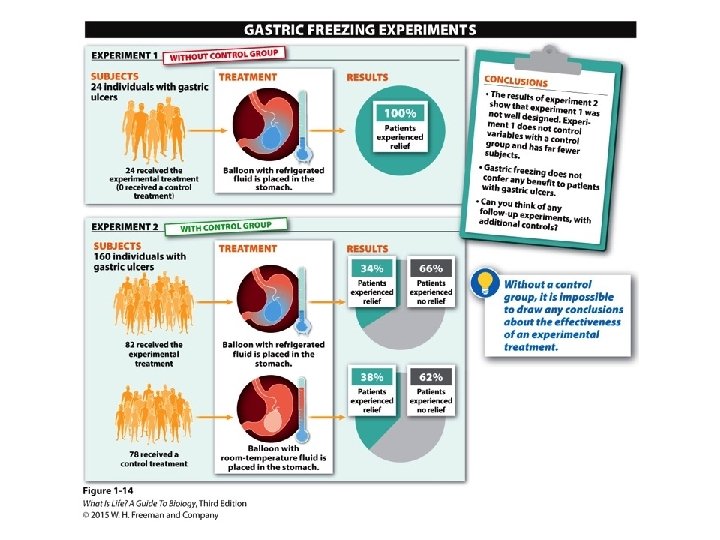
Second Experiment: Better experiment q Treatment group q Control group q 160 ulcer patients • Why did the patients in control group improve?
The Placebo Effect q The phenomenon in which people respond favorably to any treatment q Example: Placebo effect in arthroscopic surgery for arthritis q The placebo effect highlights the need for comparison of treatment effects with a control group.
Control group is needed to confirm the effect of the treatment. Two types of control groups. 1. Compare the treatment to an untreated sample. Negative control 2. Compare the treatment to a known/expected Positive control outcome. Can an experiment have both a negative and a positive control? ? ?
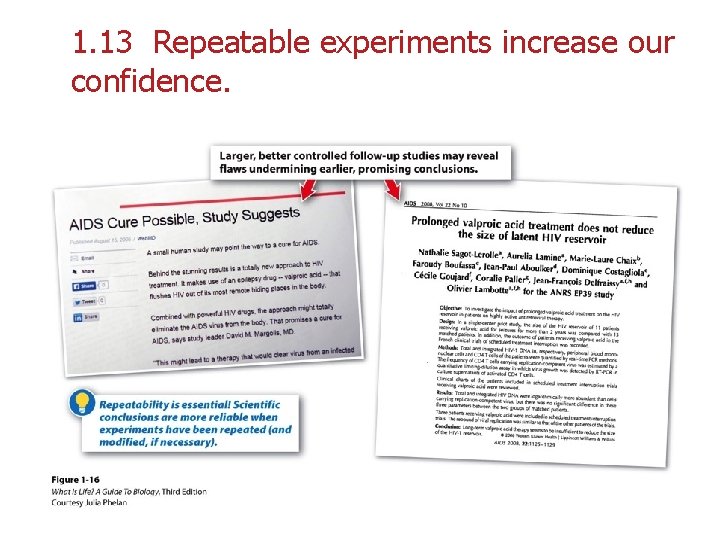
1. 13 Repeatable experiments increase our confidence.
Do megadoses of vitamin C reduce cancer risk? An experiment must be reproducible and repeatable.
Experimental errors Random errors: Instrumental errors Non-random errors: Human bias http: //video. answers. com/the-mistakesscientists-make-in-their-work-291035127
Statistics It can help us make decisions A set of analytical and mathematical tools to help researchers gain understanding from the data they gather. Significance at 5% probability level means 95 out of 100 times the result is due to the treatment and only 5% due to chance
Statistics continued Statistics can also help us to identify relationships (or the lack of relationships) between variables. Positive correlation: meaning that when one variable increases, so does the other Negative correlation: when one variable increases the other decreases • Data suggests that as hours of sleep per night decline, reaction times to various stimuli also decrease. Is this an example of a positive or negative correlation?
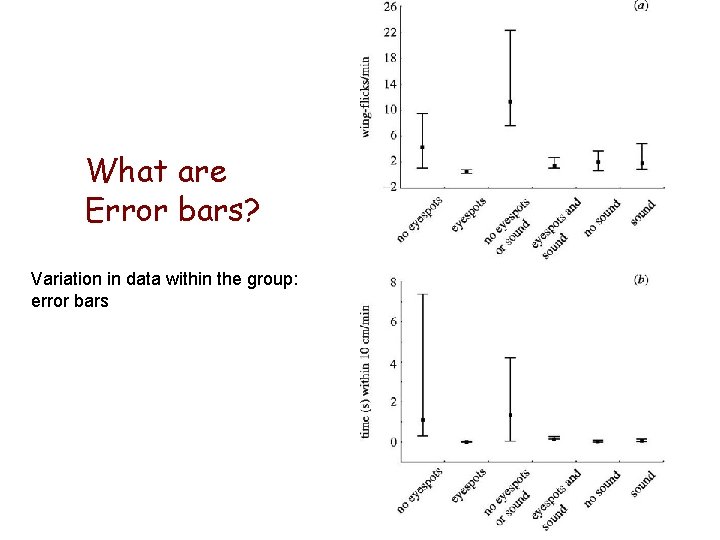
What are Error bars? Variation in data within the group: error bars
Discovery Science • Discovery science describes life at its many levels. Large number of observations and measurements lead to discovery science
Discovery or Hypothesis based? ? • Human Genome project: Scientists determined the DNA sequences in a human being and put them in a database for the whole world to use. • Human Microbiome Project: To determine the bacterial species living within our body • Study of poison ivy: Scientists suspect that climate change will change plant activities. They test poison ivy under different conditions and discover that at higher CO 2 levels, poison ivy produces higher levels of toxins. They publish their results.
Limits of Science • Scientific method is one of several approaches to acquire knowledge • Cannot : – Generate moral statements – Give us insight into ethical problems – Give us value judgements
- Slides: 31