
Chapter 1 Science in Our World Preview Section
- Slides: 51
Chapter 1 Science in Our World Preview Section 2 Scientific Methods Section 3 Scientific Models Section 4 Science and Engineering Section 5 Tools, Measurement, and Safety Concept Mapping
Chapter 1 Section 2 Scientific Methods Objectives • Identify the steps used in scientific methods. • Formulate testable hypotheses. • Explain how scientific methods are used to answer questions and solve problems.
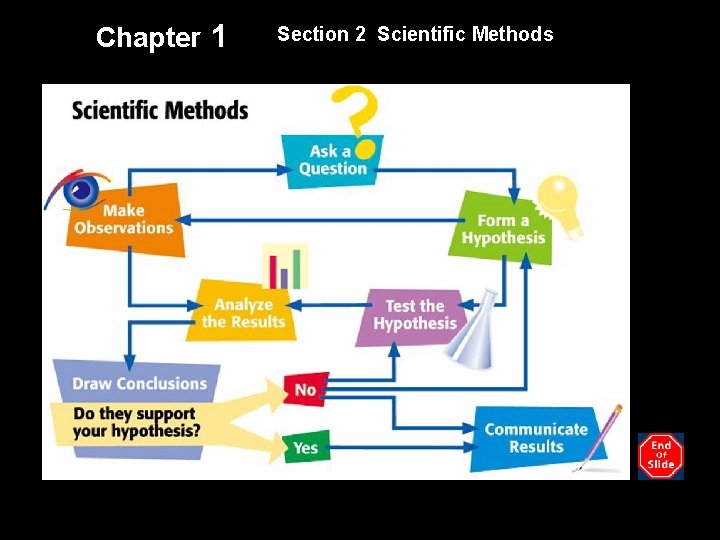
Chapter 1 Section 2 Scientific Methods What Are Scientific Methods? • The ways in which scientists answer questions and solve problems are called __________. • As scientists look for answers, they often use the same steps. But there is more than one way to use the steps. Scientists may repeat some steps or do them in a different order.
Chapter 1 Section 2 Scientific Methods
Chapter 1 Section 2 Scientific Methods Ask a Question • Asking a question helps focus the purpose of an investigation. Scientists often ask a question after making observations. • An ____________ is any use of the senses to gather information. • Observations should be accurately recorded so that scientists can use the information in future investigations.
Chapter 1 Section 2 Scientific Methods Ask a Question, continued • A Real-World Question Engineers are scientists who put scientific knowledge to practical human use. • Engineers create technology. Technology is the application of science for practical purposes. • For example, engineers Czarnowski and Triantafyllou studied the efficiency of boat propulsion systems.
Chapter 1 Section 2 Scientific Methods Ask a Question, continued • The Importance of Boat Efficiency compares the energy used to move the boat forward with the energy supplied by the engine. Making boats more efficient would save fuel and money. • Based on their observations, Czarnowski and Triantafyllou asked the question: How can boat propulsion systems be made more efficient?
Chapter 1 Section 2 Scientific Methods Form a Hypothesis • Once you have asked a question and made observations, you are ready to form a hypothesis. • A hypothesis an explanation that is based on ___________________________________________.
Chapter 1 Section 2 Scientific Methods Form a Hypothesis, continued • Nature Provides a Possible Answer Czarnowski studied penguins swimming and formed the hypothesis: A propulsion system that mimics the way a penguin swims will be more efficient than a propulsion system that uses propellers. • Make Predictions Before scientists test a hypothesis, they often make predictions that state what they think will happen during the actual test of the hypothesis.
Chapter 1 Section 2 Scientific Methods Hypothesis Click below to watch the Visual Concept
Chapter 1 Section 2 Scientific Methods Test the Hypothesis • After you form a hypothesis, you must test it. Testing helps you find out if your hypothesis is correct or not. • Keep It Under Control One way to test a hypothesis is to do a controlled experiment. A controlled experiment tests _____________________. By changing only the variable, scientists can see the results of just that one change.
Chapter 1 Section 2 Scientific Methods Test the Hypothesis, continued • Testing Proteus Czarnowski and Triantafyllou built a model penguin boat called Proteus to test their hypothesis. • The engineers took Proteus into open water to collect data. Data are ___________________________________________.
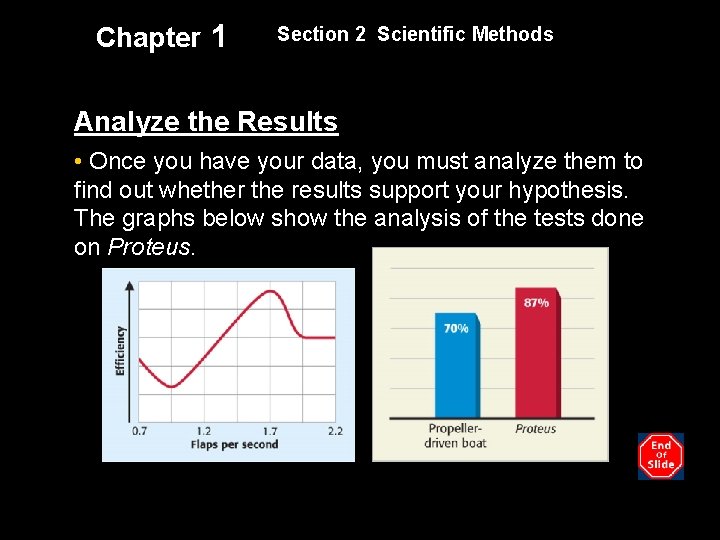
Chapter 1 Section 2 Scientific Methods Analyze the Results • Once you have your data, you must analyze them to find out whether the results support your hypothesis. The graphs below show the analysis of the tests done on Proteus.
Chapter 1 Section 2 Scientific Methods Draw Conclusions • At the end of an investigation, you must draw a conclusion. Your conclusion can help you decide what you do next. • The Proteus Conclusion Czarnowski and Triantafyllou found that the penguin propulsion system was more efficient than a propeller system. So, they concluded that their hypothesis was supported.
Chapter 1 Section 2 Scientific Methods Communicate Results • One of the most important steps in an investigation is to communicate your results accurately and honestly. • Communicating About Proteus Czarnowski and Triantafyllou published their results in academic papers. They also displayed their project and its results on the Internet.
Chapter 1 Section 3 Scientific Models Bellringer To teach cardiopulmonary resuscitation (CPR), instructors often use a mannequin to model a human upper torso and head. Why do you think CPR is taught with a model instead of a real human? Would the class be as effective if a model were not used? Explain your answer.
Chapter 1 Section 3 Scientific Models Objectives • Describe how models are used to represent the natural world. • Identify three types of scientific models. • Describe theories and laws.
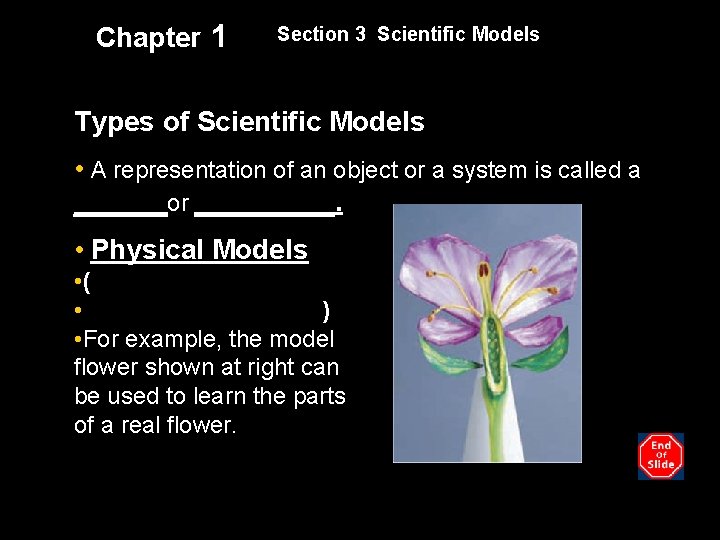
Chapter 1 Section 3 Scientific Models Types of Scientific Models • A representation of an object or a system is called a ______or _____. • Physical Models • ( • ) • For example, the model flower shown at right can be used to learn the parts of a real flower.
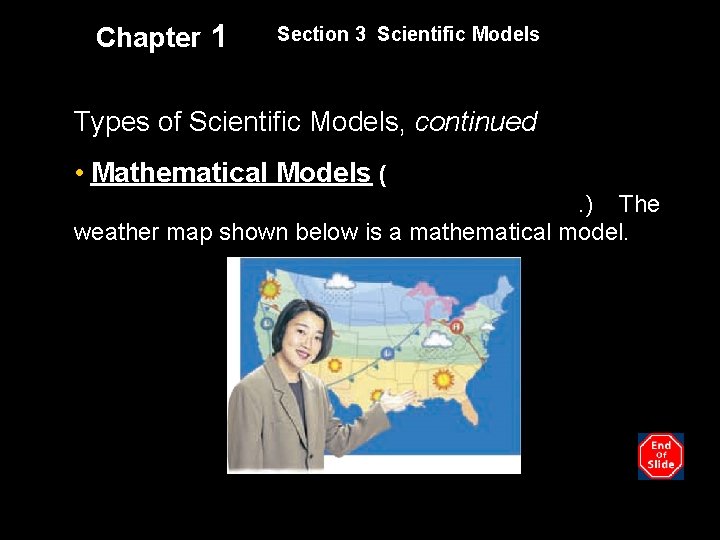
Chapter 1 Section 3 Scientific Models Types of Scientific Models, continued • Mathematical Models (. ) The weather map shown below is a mathematical model.
Chapter 1 Section 3 Scientific Models Types of Scientific Models, continued • Conceptual Models [ ] • The big bang theory explains the origin of the universe. This theory is an example of a conceptual model.
Chapter 1 Section 3 Scientific Models Are Just the Right Size • Models are often used to represent things that are very small or very large. • Models are useful for studying cells and particles of matter that are too small to see with the unaided eye. • Models are also useful for studying objects that are too large to see completely, such as the Earth or the solar system.
Chapter 1 Section 3 Scientific Models Build Scientific Knowledge • Models are often used to help illustrate and explain scientific theories. • In science, a [ ] is a unifying explanation for a broad range of hypotheses and observations that have been supported by testing. • [ observations are made. ] can change as new
Chapter 1 Section 3 Scientific Models Build Scientific Knowledge, continued • Scientific Laws When a theory and its models correctly predict the results of many different experiments, a could be formed. • In science, a is a summary of many experimental results and observations. • Laws are not the same as theories. Laws tell you only happens, not it happens.
Chapter 1 Section 4 Science and Engineering Bellringer Imagine the following: You have been asked to investigate what is the most nutritional lunch for middle school students. Briefly describe the process you would follow to determine the most nutritional lunch. After you have completed your plan, make a list of biases or personal preferences that could cause errors in the investigation. How would you avoid these Write your answers in your science journal.
Chapter 1 Section 4 Science and Engineering Objectives • Explain how science, technology, engineering, and mathematics are related. • Identify ways that technology responds to social, political, and economic needs. • Explain the engineering design process for developing new technologies. • Describe technology in terms of its intended benefits and unintended consequences.
Chapter 1 Section 4 Science and Engineering What Is Technology • Technology refers to. • Technology also refers to the . • Technology applies to any product, process, or knowledge that is developed to meet a need.
Chapter 1 Section 4 Science and Engineering How Does Science Relate to Technology? • Engineering uses scientific knowledge to develop technologies. • Engineers use science and mathematics to create new technologies that serve human needs. • There are many different types of engineers who develop a variety of very different products.
Chapter 1 Section 4 Science and Engineering How Does Science Relate to Technology? continued • Engineering is . • Scientists, inventors, business owners, artists, and even students have also engineered new technologies. • Anyone can follow the engineering design process to solve a problem or address a need.
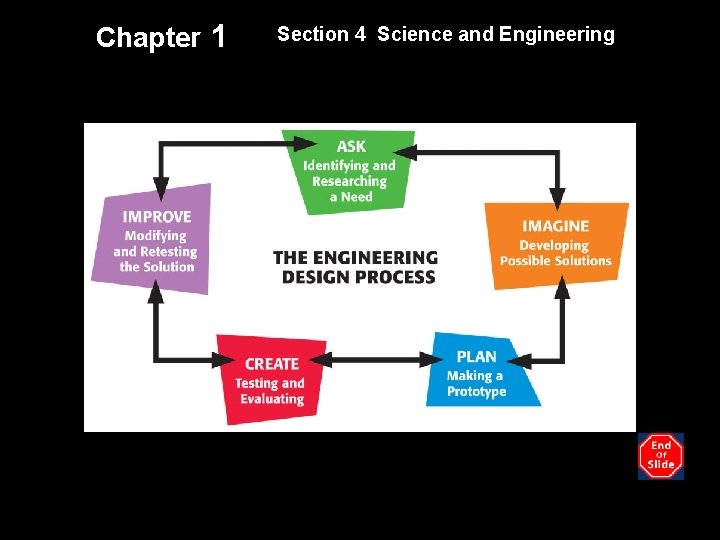
Chapter 1 Section 4 Science and Engineering What is the Engineering Design Process? • The engineering design process has similarities to the scientific process. • Like the scientific process, some steps may require repeating or modifying to fit different needs.
Chapter 1 Section 4 Science and Engineering What is the Engineering Design Process? continued Step 1 Ask: • Engineers define and describe the need or problem they are trying to solve. • Research provides engineers with information for problem solving.
Chapter 1 Section 4 Science and Engineering What is the Engineering Design Process? continued Step 2 Imagine: • Brainstorming is the process in which a group of people share ideas quickly to promote additional ideas. • Sometimes a possible solution to the problem comes from these ideas or it may take more time and thought.
Chapter 1 Section 4 Science and Engineering What is the Engineering Design Process? continued Step 3 Plan: • A prototype is a • Prototypes allow engineers to see if their design works the way they expect it to. .
Chapter 1 Section 4 Science and Engineering What is the Engineering Design Process? continued Step 4 Create: • Prototypes are tested and evaluated. • Engineers complete a cost-benefit analysis to . • For example, it may only makes sense to produce a new product if it is not too expensive to produce.
Chapter 1 Section 4 Science and Engineering What is the Engineering Design Process? continued Step 5 Improve: • If a prototype was not successful or did not work well, engineers would either modify their prototype or try a new solution. • It is important that the engineers consider what was learned from the first prototype before they begin the design process again.
Chapter 1 Section 4 Science and Engineering
Chapter 1 Section 4 Science and Engineering What is the Engineering Design Process? continued • Engineers often need to share their successes, failures, and reasoning with others. • Engineers may explain and promote the technology to customers, or they may communicate with the public through news releases, advertisements, or journals.
Chapter 1 Section 4 Science and Engineering Technology and Society • Technology provides solutions for many types of social, political, and economic needs. • Intended Benefit An intended benefit is the. • Unintended Consequences Unintended consequences are uses or results that .
Chapter 1 Section 4 Science and Engineering Bioengineering • Bioengineering The application of engineering to .
Chapter 1 Section 4 Science and Engineering Bioengineering, continued • Assistive Bioengineering Bioengineered technologies can be classified as either or. • technologies are developed to help organisms with changing them. • bioengineered products change the living organism.
Chapter 1 Section 5 Tools, Measurement, and Safety Bellringer How would a standard system of weights and measures, agreed to and used around the world, make life easier? Give examples. Write your answers in your science journal.
Chapter 1 Section 5 Tools, Measurement, and Safety Objectives • Identify tools used to collect and analyze data. • Explain the importance of the International System of Units. • Identify the appropriate units to use for particular measurements. • Identify safety symbols.
Chapter 1 Section 5 Tools, Measurement, and Safety Tools for Measuring • To get the best measurements, you need the proper tools. Stopwatches, metersticks, thermometers, and balances are examples of tools for measuring. Tools for Analyzing • Calculators, computers, and even pencils and paper, are tools you can use to analyze your data.
Chapter 1 Section 5 Tools, Measurement, and Safety Measurement • The International System of Units (SI) is the. It is used by most scientists and almost all countries. All SI units are based on the number 10. • Length The basic SI unit of length is the (m). Other SI units of length are larger or smaller than the meter by multiples of 10.
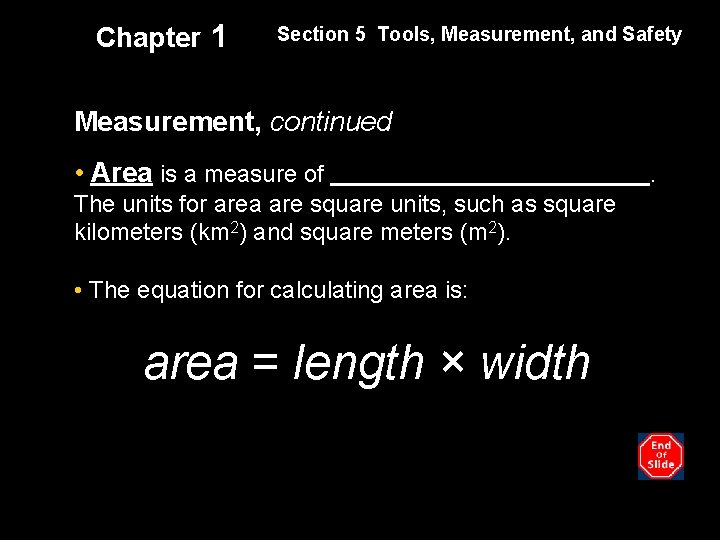
Chapter 1 Section 5 Tools, Measurement, and Safety Measurement, continued • Area is a measure of The units for area are square units, such as square kilometers (km 2) and square meters (m 2). • The equation for calculating area is: area = length × width .
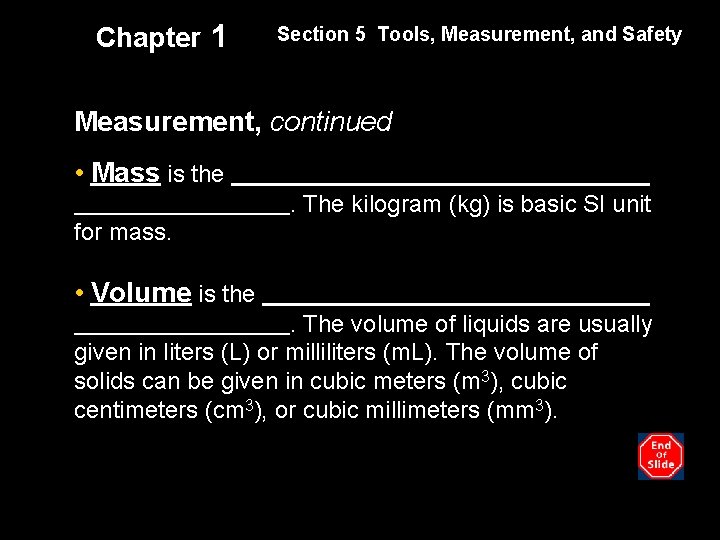
Chapter 1 Section 5 Tools, Measurement, and Safety Measurement, continued • Mass is the. The kilogram (kg) is basic SI unit for mass. • Volume is the. The volume of liquids are usually given in liters (L) or milliliters (m. L). The volume of solids can be given in cubic meters (m 3), cubic centimeters (cm 3), or cubic millimeters (mm 3).
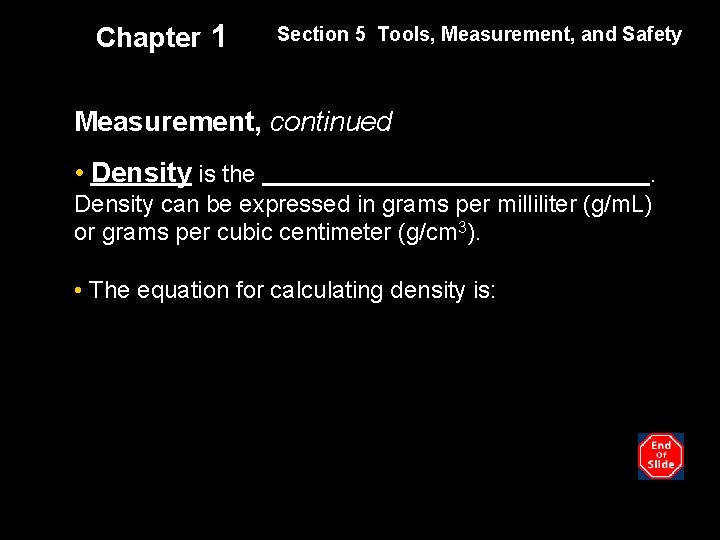
Chapter 1 Section 5 Tools, Measurement, and Safety Measurement, continued • Density is the . Density can be expressed in grams per milliliter (g/m. L) or grams per cubic centimeter (g/cm 3). • The equation for calculating density is:
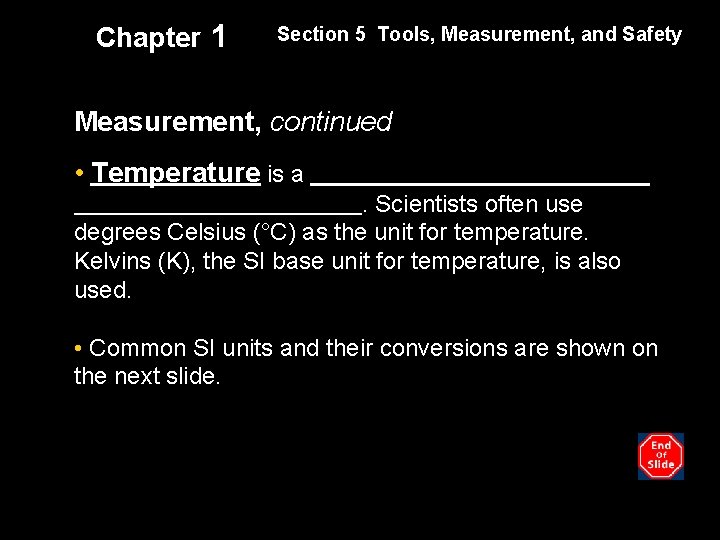
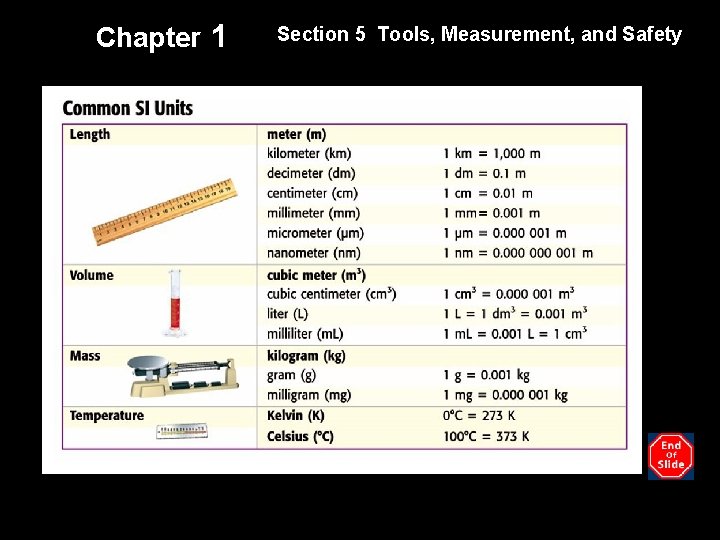
Chapter 1 Section 5 Tools, Measurement, and Safety Measurement, continued • Temperature is a. Scientists often use degrees Celsius (°C) as the unit for temperature. Kelvins (K), the SI base unit for temperature, is also used. • Common SI units and their conversions are shown on the next slide.
Chapter 1 Section 5 Tools, Measurement, and Safety
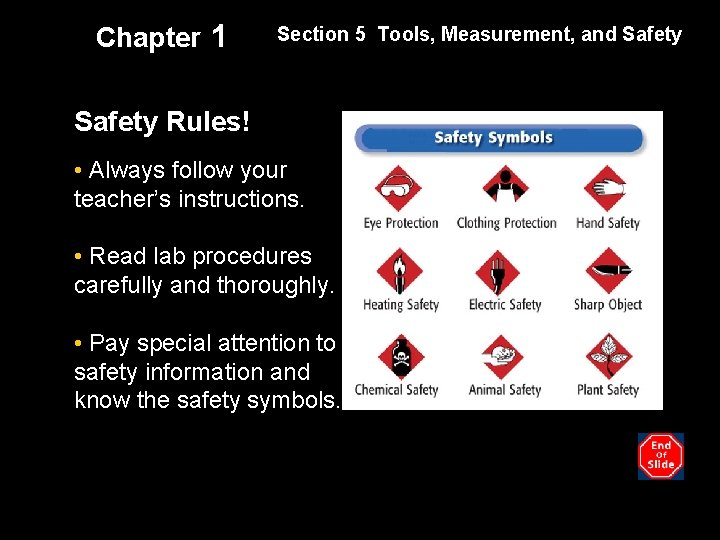
Chapter 1 Section 5 Tools, Measurement, and Safety Rules! • Always follow your teacher’s instructions. • Read lab procedures carefully and thoroughly. • Pay special attention to safety information and know the safety symbols.
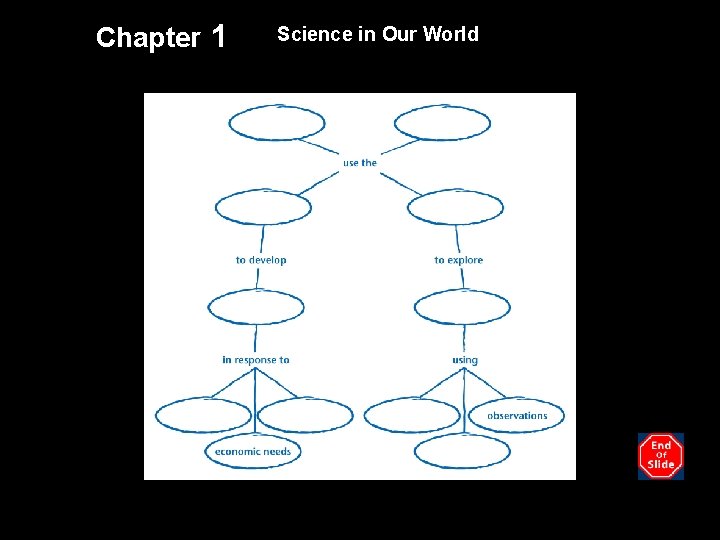
Chapter 1 Science in Our World Concept Mapping Use the terms below to complete the concept map on the next slide. hypotheses social needs engineers experiments scientific method political needs technology questions scientists engineering design process
Chapter 1 Science in Our World