
Chapter 1 Ready Set Go Introduction to Veterinary







- Slides: 23
Chapter 1 Ready, Set, Go Introduction to Veterinary Medical Terminology
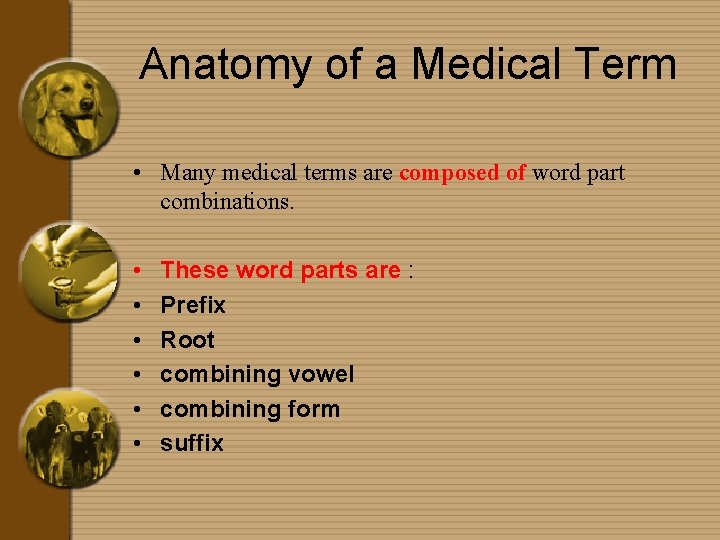
Anatomy of a Medical Term • Many medical terms are composed of word part combinations. • • • These word parts are : Prefix Root combining vowel combining form suffix
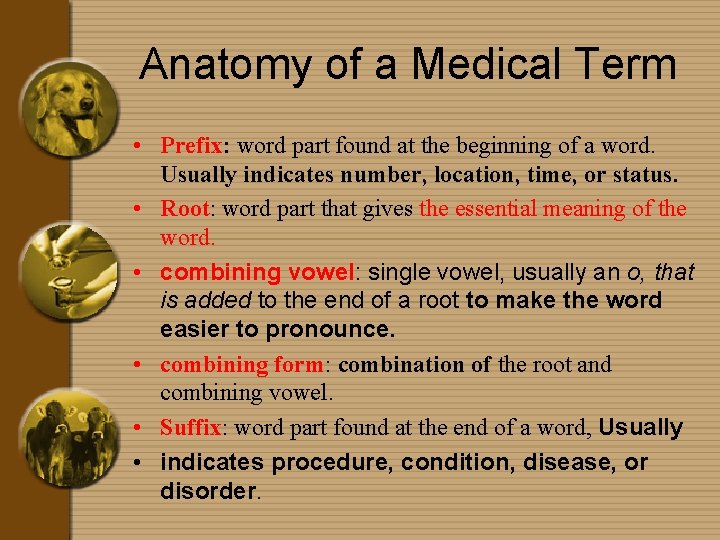
Anatomy of a Medical Term • Prefix: word part found at the beginning of a word. Usually indicates number, location, time, or status. • Root: word part that gives the essential meaning of the word. • combining vowel: single vowel, usually an o, that is added to the end of a root to make the word easier to pronounce. • combining form: combination of the root and combining vowel. • Suffix: word part found at the end of a word, Usually • indicates procedure, condition, disease, or disorder.
• Recognizing word parts • and understanding their meaning allows the dissection of medical terms in a logical way and help in understanding medical terms. • Learning veterinary medical terminology is much easier once you breaking down unfamiliar terms into recognizable word parts By this way the veterinary professional can greatly increase his or her medical vocabulary.
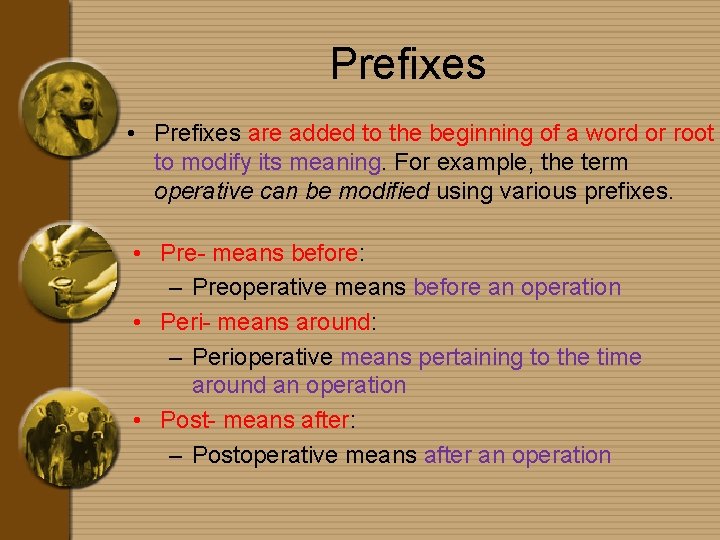
Prefixes • Prefixes are added to the beginning of a word or root to modify its meaning. For example, the term operative can be modified using various prefixes. • Pre- means before: – Preoperative means before an operation • Peri- means around: – Perioperative means pertaining to the time around an operation • Post- means after: – Postoperative means after an operation
Learning Prefixes • Many prefixes have another prefix whose meaning is opposite of its own. • Initially, when learning prefixes, it is helpful to learn them in these pairs or in similar groups • A- and an- both mean without or no • Ab- means away from; ad- means towards
Table 1– 1 Contrasting Prefixes Root Traumatic Uria meaning Perfix meaning pertaining to injury A- (ah or ā) without or no Atraumatic means without injury. urination An- (ahn) without or no Anuria means absence of urine. Ab- (ahb) away from Abduction means to take away from the midline Ad- (ahd) toward Adduction means move toward the midline Opposite Emetic pertaining to vomiting Anti(ahn-tī or ahn-tih) Opposite Dys(dihs) against difficult, painful, or bad Example Antiemetics means work against or prevent vomiting Dysphagia means difficulty eating or swallowing. Eu- (yoo) good, easy, or normal Euthyroid means having a normally functioning thyroid Endo(ehn-dō) Endocrine means to secrete internally within or inside Ex- or exo- without, out of, (ehcks) or outside, or away from (ehcks-ō). Endo- within or inside Ecto- (ehck-tō) outside Exocrine means to secrete externally (via a duct). Endoparasite is an organism that lives within the body of the host Ectoparasite is an organism that lives on the outer surface of the host
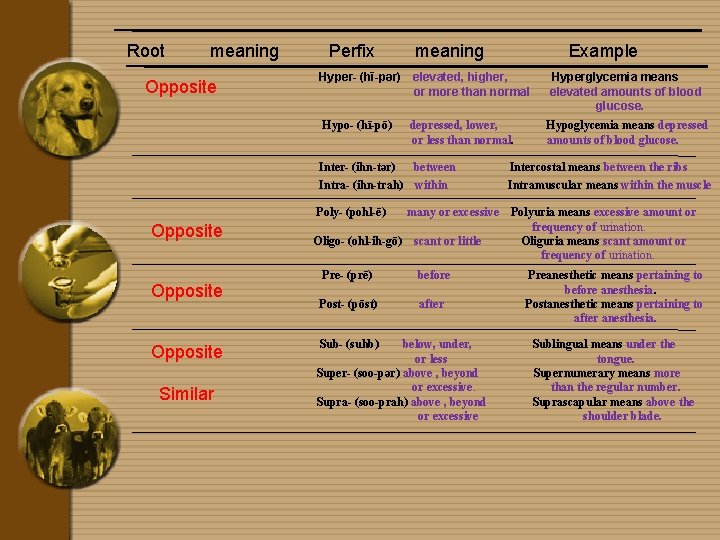
Root meaning Opposite Perfix Hyper- (hī-pər) Hypo- (hī-pō) Opposite Similar meaning Example elevated, higher, or more than normal depressed, lower, or less than normal. Hyperglycemia means elevated amounts of blood glucose. Hypoglycemia means depressed amounts of blood glucose. Inter- (ihn-tər) between Intra- (ihn-trah) within Intercostal means between the ribs Intramuscular means within the muscle Poly- (pohl-ē) Polyuria means excessive amount or frequency of urination. Oliguria means scant amount or frequency of urination. Oligo- (ohl-ih-gō) many or excessive scant or little Pre- (prē) before Post- (pōst) after Sub- (suhb) below, under, or less Super- (soo-pər) above , beyond or excessive. Supra- (soo-prah) above , beyond or excessive Preanesthetic means pertaining to before anesthesia. Postanesthetic means pertaining to after anesthesia. Sublingual means under the tongue. Supernumerary means more than the regular number. Suprascapular means above the shoulder blade.
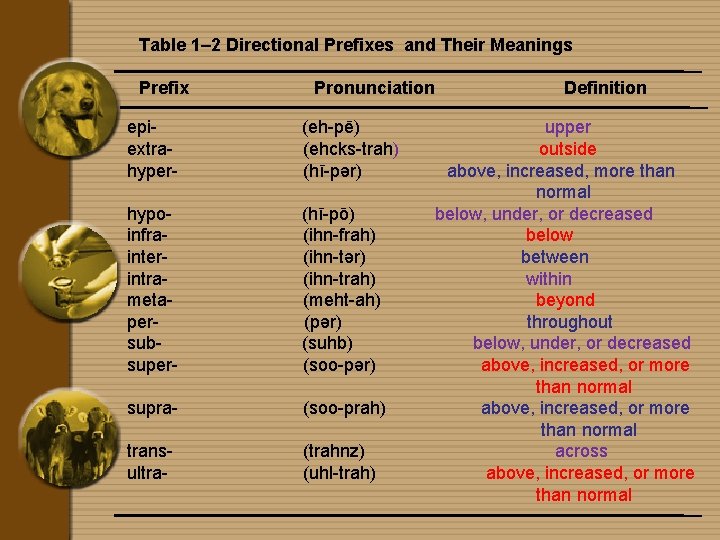
Table 1– 2 Directional Prefixes and Their Meanings Prefix Pronunciation epiextrahyper- (eh-pē) (ehcks-trah) (hī-pər) hypoinfrainterintrametapersubsuper- (hī-pō) (ihn-frah) (ihn-tər) (ihn-trah) (meht-ah) (pər) (suhb) (soo-pər) supra- (soo-prah) transultra- (trahnz) (uhl-trah) Definition upper outside above, increased, more than normal below, under, or decreased below between within beyond throughout below, under, or decreased above, increased, or more than normal across above, increased, or more than normal
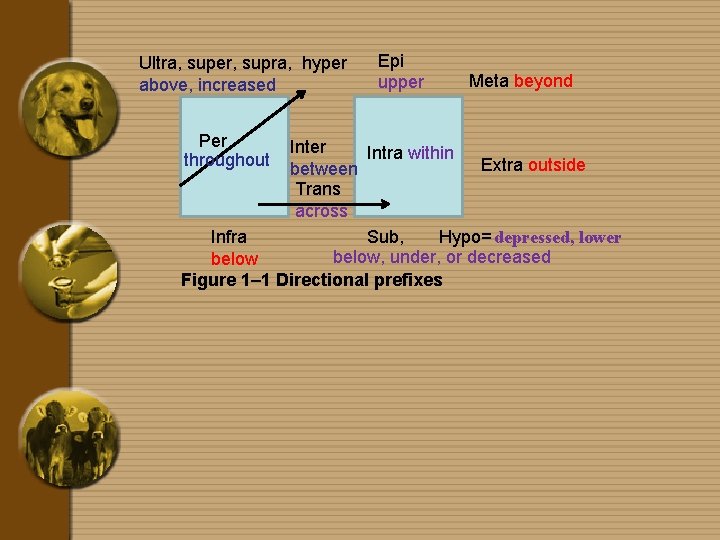
Ultra, super, supra, hyper above, increased Per throughout Epi upper Meta beyond Inter Intra within Extra outside between Trans across Infra Sub, Hypo= depressed, lower below, under, or decreased below Figure 1– 1 Directional prefixes
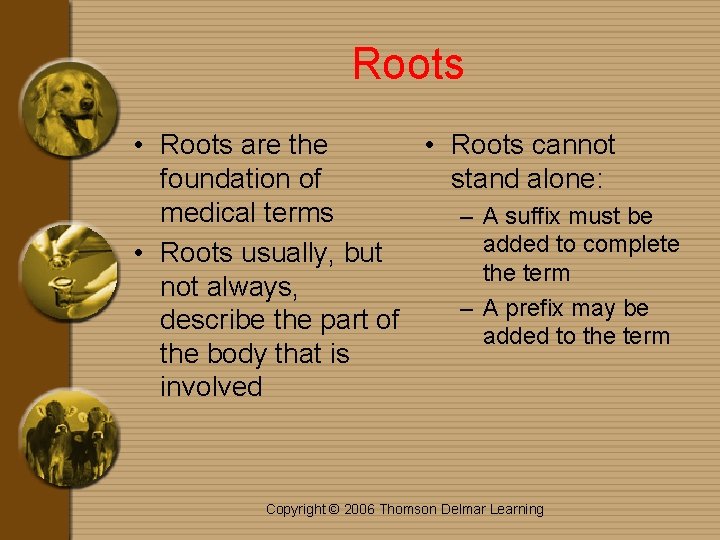
Roots • Roots are the • Roots cannot foundation of stand alone: medical terms – A suffix must be added to complete • Roots usually, but the term not always, – A prefix may be describe the part of added to the term the body that is involved Copyright © 2006 Thomson Delmar Learning
Combining Vowels • A combining vowel may be used to make the medical term easier to pronounce • A combining vowel is not used when the suffix begins with a vowel • A combining vowel is used when the suffix begins with a consonant • A combining vowel is used when two or more word roots are joined • A prefix does not need a combining vowel Copyright © 2006 Thomson Delmar Learning
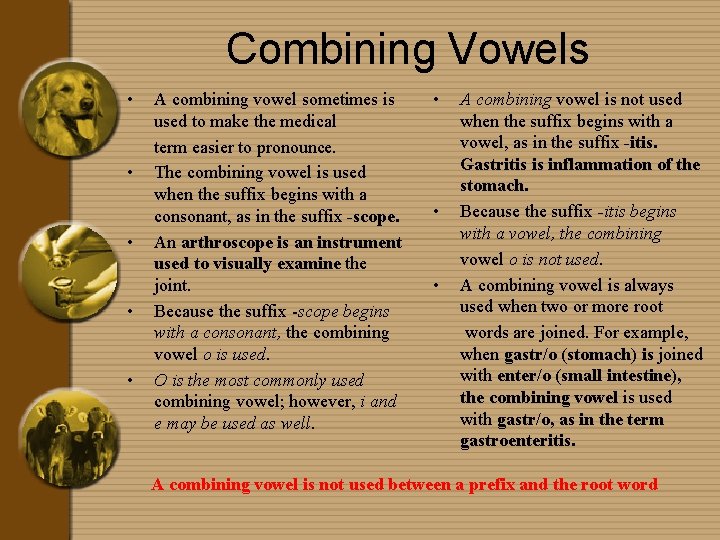
Combining Vowels • • • A combining vowel sometimes is used to make the medical term easier to pronounce. The combining vowel is used when the suffix begins with a consonant, as in the suffix -scope. An arthroscope is an instrument used to visually examine the joint. Because the suffix -scope begins with a consonant, the combining vowel o is used. O is the most commonly used combining vowel; however, i and e may be used as well. • • • A combining vowel is not used when the suffix begins with a vowel, as in the suffix -itis. Gastritis is inflammation of the stomach. Because the suffix -itis begins with a vowel, the combining vowel o is not used. A combining vowel is always used when two or more root words are joined. For example, when gastr/o (stomach) is joined with enter/o (small intestine), the combining vowel is used with gastr/o, as in the term gastroenteritis. A combining vowel is not used between a prefix and the root word
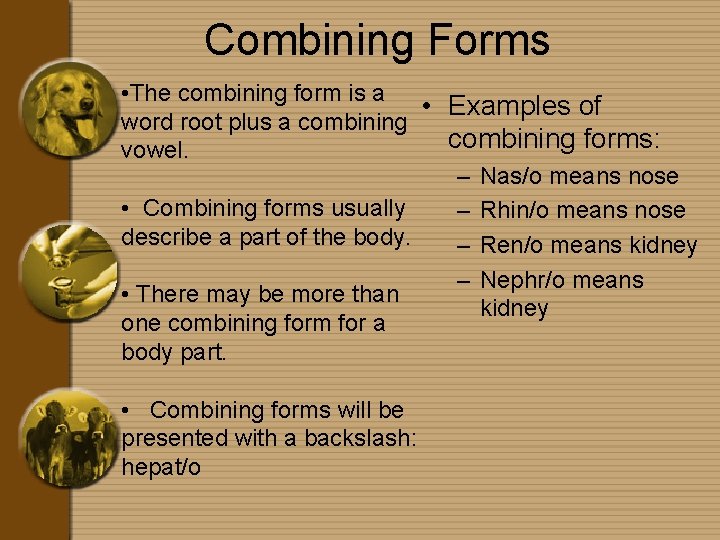
Combining Forms • The combining form is a • Examples of word root plus a combining forms: vowel. – Nas/o means nose • Combining forms usually – Rhin/o means nose describe a part of the body. – Ren/o means kidney – Nephr/o means • There may be more than kidney one combining form for a body part. • Combining forms will be presented with a backslash: hepat/o
• New words are created when combining forms are added to prefixes, other combining forms, and suffixes. For example, the term panleukopenia is composed of the following word parts: ■ pan- (pahn), a prefix meaning all ■ leuk/o (loo-kō), a combining form meaning white ■ -penia (pē-nē-ah), a suffix meaning deficiency or reduction in number Panleukopenia is a defi ciency of all types of white blood cells.
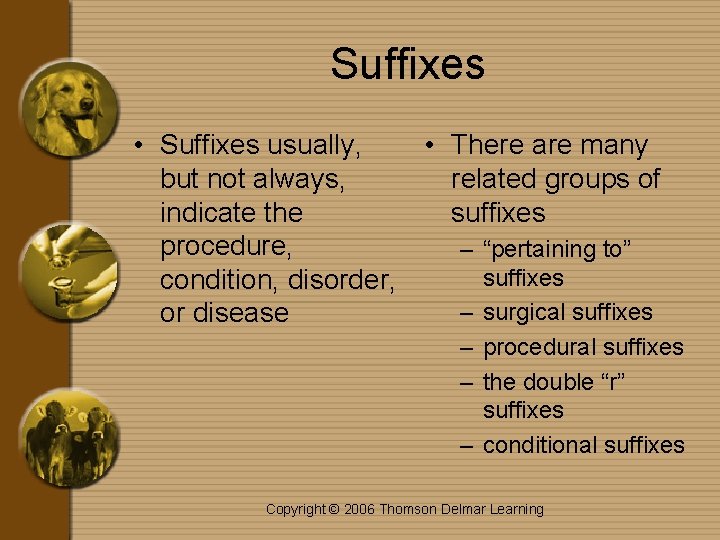
Suffixes • Suffixes usually, • There are many but not always, related groups of indicate the suffixes procedure, – “pertaining to” suffixes condition, disorder, – surgical suffixes or disease – procedural suffixes – the double “r” suffixes – conditional suffixes Copyright © 2006 Thomson Delmar Learning
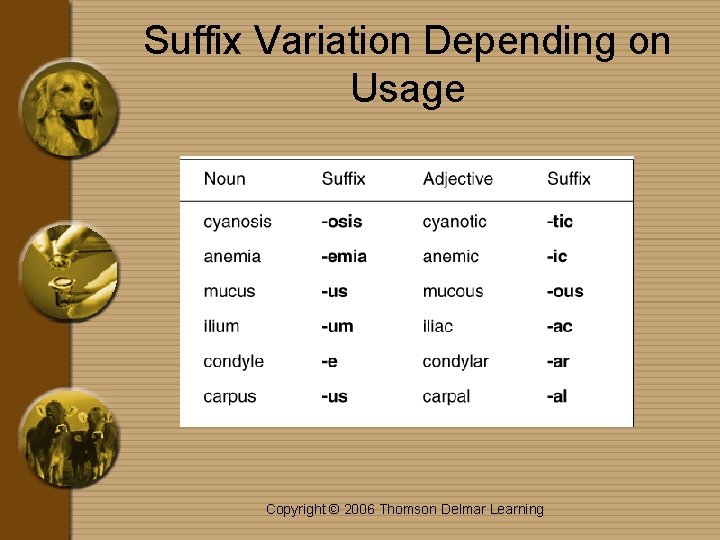
Suffixes • Suffixes may change the part of speech of a word • Different suffixes may change the word from a noun to an adjective • -osis (noun) versus -tic (adjective) • -emia (noun) versus -ic (adjective) • -us (noun) versus -ous (adjective) • -um (noun) versus -ac (adjective) Copyright © 2006 Thomson Delmar Learning
Suffix Variation Depending on Usage Insert Figure 1 -2 Copyright © 2006 Thomson Delmar Learning
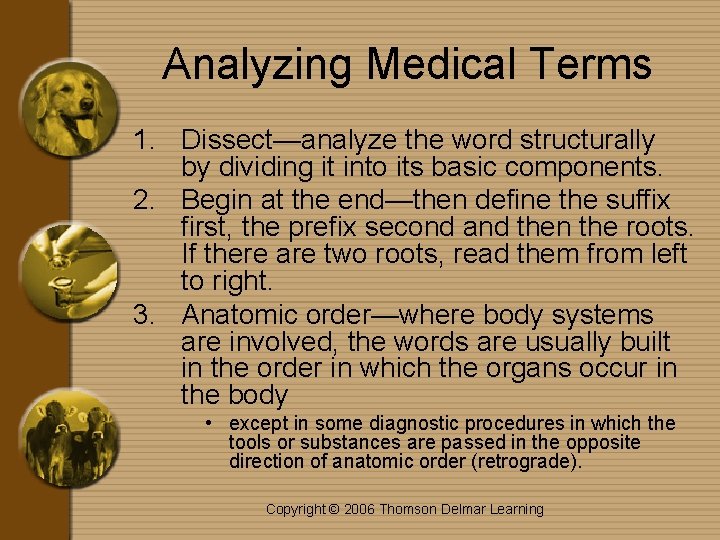
Analyzing Medical Terms 1. Dissect—analyze the word structurally by dividing it into its basic components. 2. Begin at the end—then define the suffix first, the prefix second and then the roots. If there are two roots, read them from left to right. 3. Anatomic order—where body systems are involved, the words are usually built in the order in which the organs occur in the body • except in some diagnostic procedures in which the tools or substances are passed in the opposite direction of anatomic order (retrograde). Copyright © 2006 Thomson Delmar Learning
Analyzing Medical Terms • Example: ovariohysterectomy • Divide the term: – ovari/o/hyster/ectomy • Start at the end: – -ectomy is surgical removal – ovari/o means ovary – hysteri/o means uterus • Anatomic order: body parts are in order • Ovariohysterectomy means surgical removal of the ovaries and uterus Copyright © 2006 Thomson Delmar Learning
General Pronunciation Guidelines • A medical term is easier to understand remember when you pronounce it correctly • In general, – all vowels in scientific words are pronounced – consonants are pronounced as in other English words • Use Table 1 -2 as a pronunciation guide • Remember, there may be more than one correct way to pronounce a word Copyright © 2006 Thomson Delmar Learning
Spelling Is Always Important • Accuracy in spelling medical words is extremely important – Changing one or two letters may completely change the meaning of a word: • hepatoma versus hematoma • urethra versus ureters – Some words sound alike, but are spelled differently and have very different meanings: • ileum versus ilium Copyright © 2006 Thomson Delmar Learning
Using a Medical Dictionary • Alphabetically look for words as you think they would be spelled starting with the first and second letters of the word • If the term is not spelled the way it sounds, consider the following: – – – F sounds may begin with f or ph J sounds may begin with g or j K sounds may begin with c, ch, k, or qu S sounds may begin with c, ps, or s Z sounds may begin with x or z Copyright © 2006 Thomson Delmar Learning