
Chapter 1 Principles of Zoology Copyright 2010 Delmar
- Slides: 24
Chapter 1 Principles of Zoology Copyright © 2010 Delmar, Cengage Learning. ALL RIGHTS RESERVED.
Biology • Science that deals with life processes and characteristics of plants and animals • Studies origin, history, and habits of many forms of plant and animal life • Two main branches: – Botany (plants) – Zoology (animal life) Copyright © 2010 Delmar, Cengage Learning. ALL RIGHTS RESERVED.
Zoology Studies • Distinguishing characteristics of one member of a species from others within that family • Fauna or animals found in a particular region • Structural or anatomical changes occurring in a species Copyright © 2010 Delmar, Cengage Learning. ALL RIGHTS RESERVED.
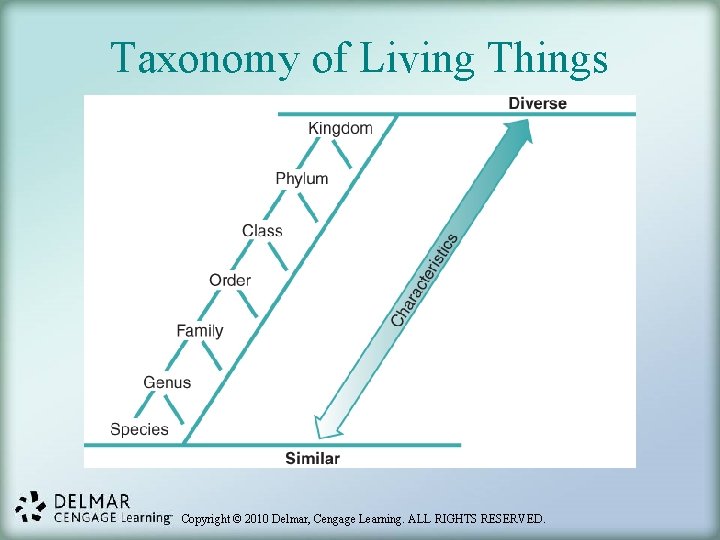
Taxonomy • Organizes animals into groups based on genetic and structural similarities to other animals • Animal kingdom – animals • Plant kingdom – plants Copyright © 2010 Delmar, Cengage Learning. ALL RIGHTS RESERVED.
Taxonomy of Living Things Copyright © 2010 Delmar, Cengage Learning. ALL RIGHTS RESERVED.
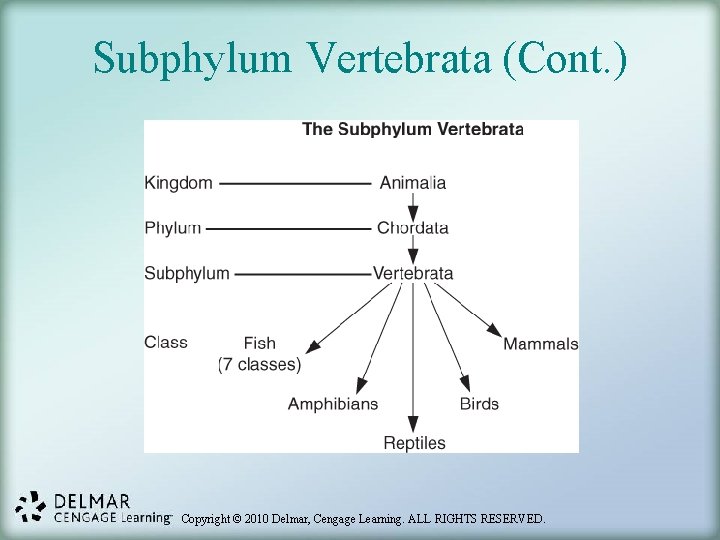
Subphylum Vertebrata • All animals with backbones: mammals, birds, fishes, reptiles, amphibians • All have a skeleton with segmented backbone composed of bone segments surrounding a spinal cord that extends from the tail to the skull Copyright © 2010 Delmar, Cengage Learning. ALL RIGHTS RESERVED.
Subphylum Vertebrata (Cont. ) Copyright © 2010 Delmar, Cengage Learning. ALL RIGHTS RESERVED.
Animal Behaviors and Habits • Distinct to the animal • Enable species to: – – – Find/consume food Obtain energy Grow physically Adapt to the environment Reproduce Copyright © 2010 Delmar, Cengage Learning. ALL RIGHTS RESERVED.
Behavioral Differences Among Species • Make it possible for them to live in a wide variety of environments • Allow an animal to occupy a specific niche in an environment • Make some species more adaptable than others Copyright © 2010 Delmar, Cengage Learning. ALL RIGHTS RESERVED.
Instinctive Behavior • Evident at birth • Natural to an animal • Characteristic of other animals of the same species Copyright © 2010 Delmar, Cengage Learning. ALL RIGHTS RESERVED.
Learned Behavior • Acquired through life experiences • Examples include finding food, water, safety from natural enemies Copyright © 2010 Delmar, Cengage Learning. ALL RIGHTS RESERVED.
Animal Structure/Anatomy • Enables animal to survive in its environment • Closely related to method of obtaining food • Each animal class has unique differences in anatomy or structure from other animal classes Copyright © 2010 Delmar, Cengage Learning. ALL RIGHTS RESERVED.
Animal Structure/Anatomy Includes • Arrangement of skeletal bones • Attachment of muscles on the bones • Unique features like feathers, hair, scales Copyright © 2010 Delmar, Cengage Learning. ALL RIGHTS RESERVED.
Animal Structure/Anatomy Includes (Cont. ) • How internal organs are designed and arranged • Way the animal moves Copyright © 2010 Delmar, Cengage Learning. ALL RIGHTS RESERVED.
Animal Nutrition • Food necessary to supply energy for life functions: – Growth and repair of living cells – Formation of chemical bonds – Maintenance of body temperature (warm-blooded animals) Copyright © 2010 Delmar, Cengage Learning. ALL RIGHTS RESERVED.
Animal Digestive Systems • Single compartment stomach: – – Simple stomach Location for food storage and start of digestive process Found in most mammals Ideal for processing food with high concentrations of nutrients, like grains and meat Copyright © 2010 Delmar, Cengage Learning. ALL RIGHTS RESERVED.
Animal Digestive Systems (Cont. ) • Four compartment stomach – Found in ruminants (sheep, deer, goats) – Rumen largest compartment where plant materials break down and ferment – Ideal for high-fiber foods (grass, twigs, leaves) that are low in nutrient concentration Copyright © 2010 Delmar, Cengage Learning. ALL RIGHTS RESERVED.
Animal Digestive Systems (Cont. ) • Crop and gizzard – Found in birds – Crop stores and softens food – Gizzard uses swallowed stones/grit to grind food Copyright © 2010 Delmar, Cengage Learning. ALL RIGHTS RESERVED.
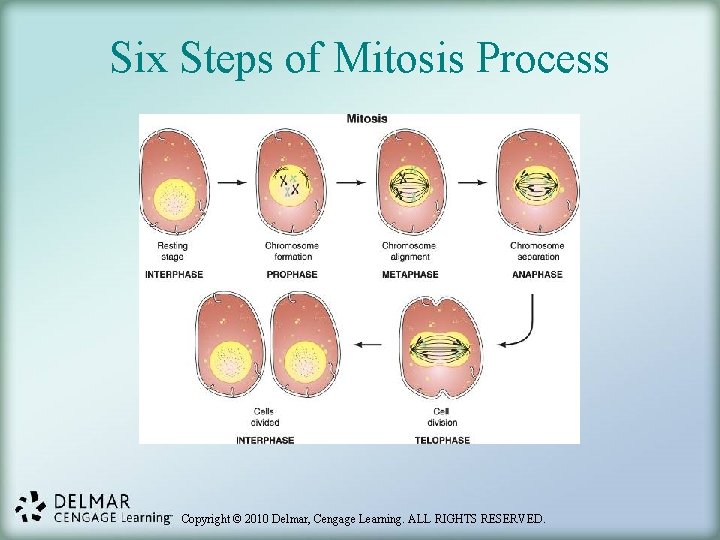
Mitosis • Cell division that causes growth of body’s tissues and organs • Occurs when body cells divide at a faster rate than they die • Controls rate of growth Copyright © 2010 Delmar, Cengage Learning. ALL RIGHTS RESERVED.
Six Steps of Mitosis Process Copyright © 2010 Delmar, Cengage Learning. ALL RIGHTS RESERVED.
Meiosis • • Reproductive cell division Creates gametes (reproductive cells) Occurs in two divisions Process for gamete formation the same for all animals Copyright © 2010 Delmar, Cengage Learning. ALL RIGHTS RESERVED.
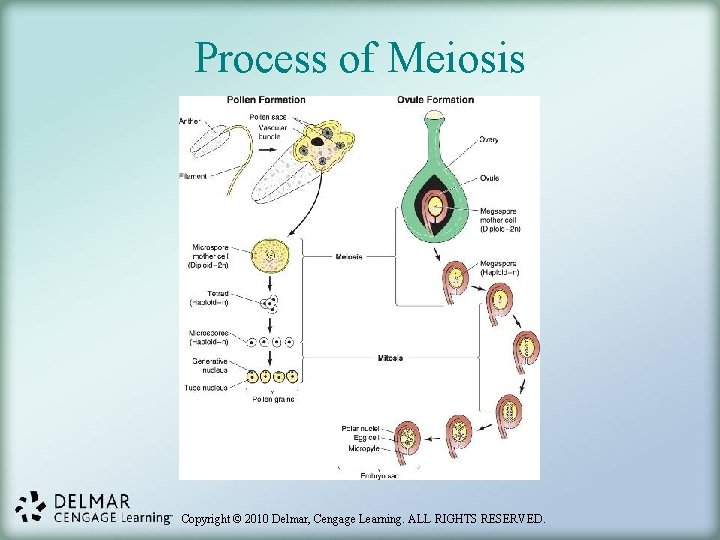
Process of Meiosis Copyright © 2010 Delmar, Cengage Learning. ALL RIGHTS RESERVED.
Terminology • Gametes – reproductive cells • Sperm – male reproductive cells • Eggs – a reproductive cell or ovum produced by a female organism • Haploid Cell – cells that contain a single chromosome from each homologous pair • Diploid Cell – cells containing both homologues from each chromosome • Zygote – a fertilized egg Copyright © 2010 Delmar, Cengage Learning. ALL RIGHTS RESERVED.
Reproduction Differences • Eggs fertilized inside the body (birds, reptiles) • Eggs fertilized outside the body (frogs, toads, salamanders, fish) • Live young developed from eggs fertilized inside female’s body (mammals) Copyright © 2010 Delmar, Cengage Learning. ALL RIGHTS RESERVED.