
Chapter 1 Principles of Electric Circuits Floyd Copyright
- Slides: 29
Chapter 1 Principles of Electric Circuits - Floyd © Copyright 2006 Prentice-Hall
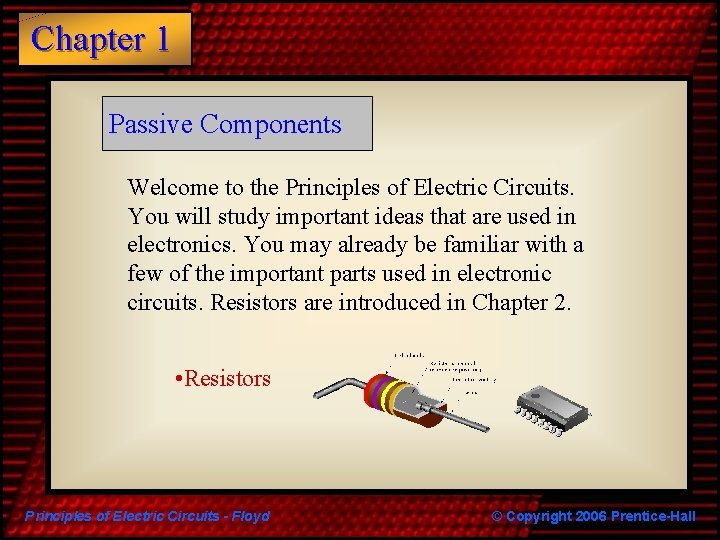
Chapter 1 Passive Components Welcome to the Principles of Electric Circuits. You will study important ideas that are used in electronics. You may already be familiar with a few of the important parts used in electronic circuits. Resistors are introduced in Chapter 2. • Resistors Principles of Electric Circuits - Floyd © Copyright 2006 Prentice-Hall
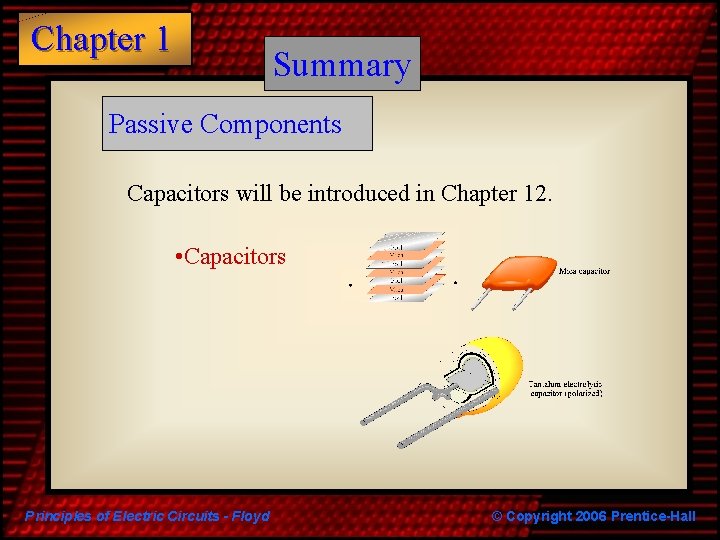
Chapter 1 Summary Passive Components Capacitors will be introduced in Chapter 12. • Capacitors Principles of Electric Circuits - Floyd © Copyright 2006 Prentice-Hall
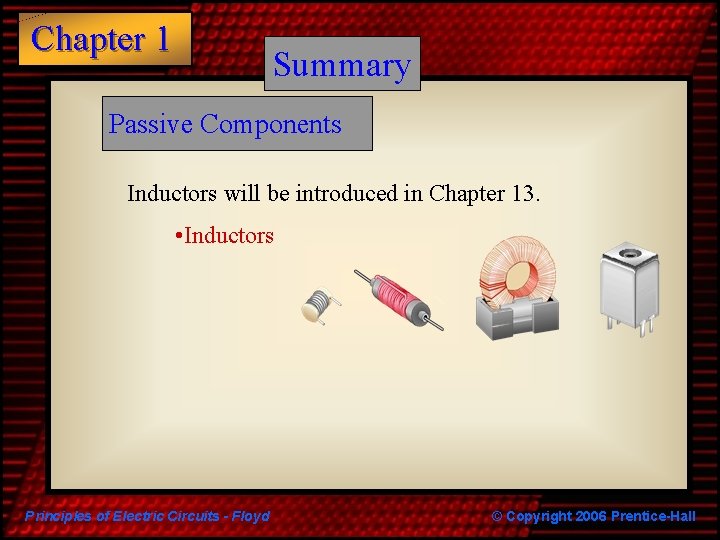
Chapter 1 Summary Passive Components Inductors will be introduced in Chapter 13. • Inductors Principles of Electric Circuits - Floyd © Copyright 2006 Prentice-Hall
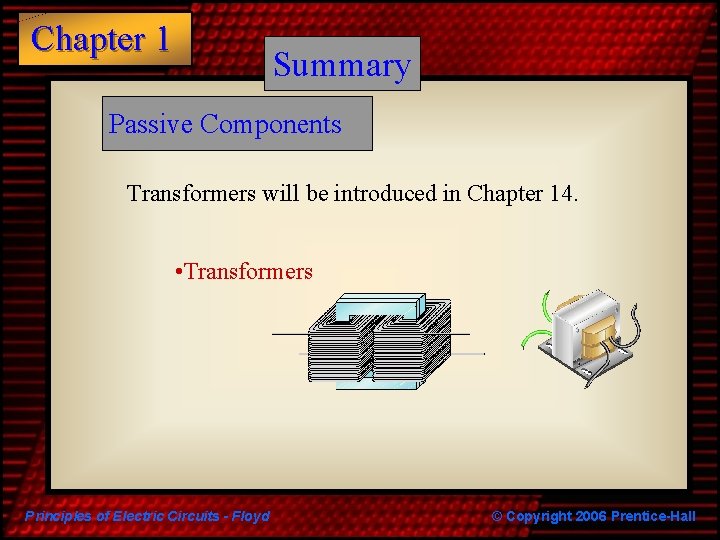
Chapter 1 Summary Passive Components Transformers will be introduced in Chapter 14. • Transformers Principles of Electric Circuits - Floyd © Copyright 2006 Prentice-Hall
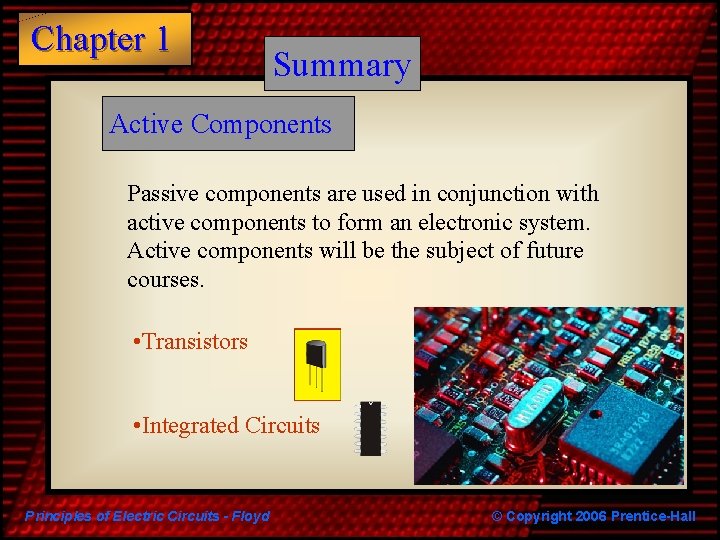
Chapter 1 Summary Active Components Passive components are used in conjunction with active components to form an electronic system. Active components will be the subject of future courses. • Transistors • Integrated Circuits Principles of Electric Circuits - Floyd © Copyright 2006 Prentice-Hall
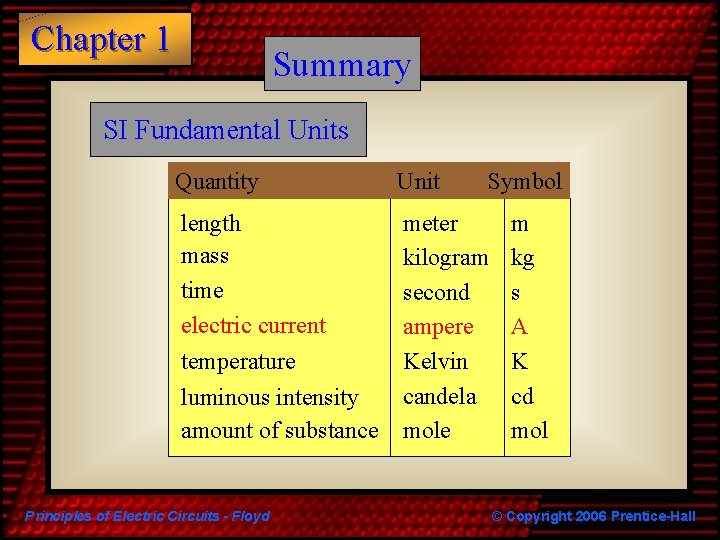
Chapter 1 Summary SI Fundamental Units Quantity Unit length mass time electric current temperature luminous intensity amount of substance meter kilogram second ampere Kelvin candela mole Principles of Electric Circuits - Floyd Symbol m kg s A K cd mol © Copyright 2006 Prentice-Hall
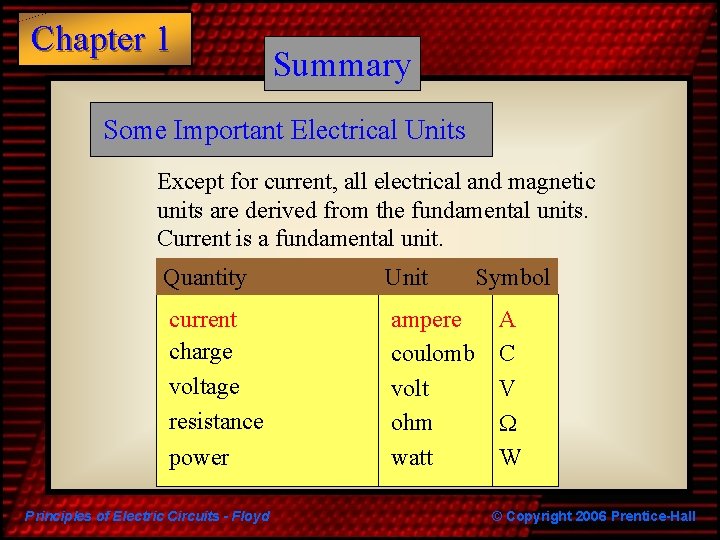
Chapter 1 Summary Some Important Electrical Units Except for current, all electrical and magnetic units are derived from the fundamental units. Current is a fundamental unit. Quantity Unit current charge voltage resistance power ampere coulomb volt ohm watt Principles of Electric Circuits - Floyd Symbol A C V W W © Copyright 2006 Prentice-Hall
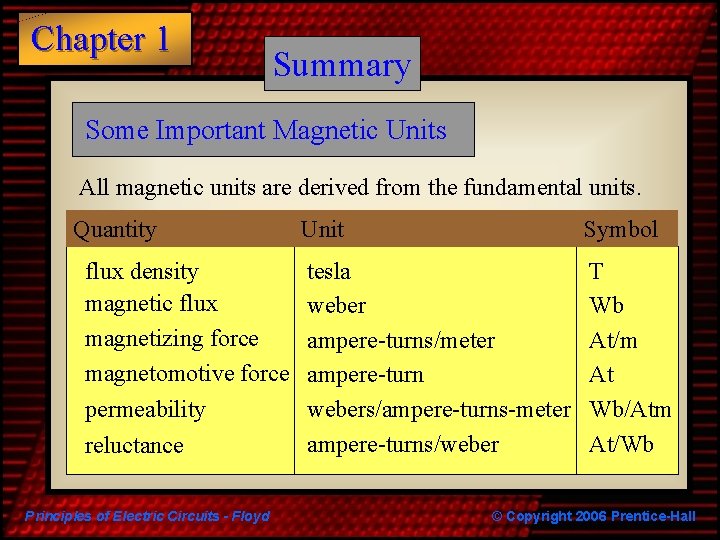
Chapter 1 Summary Some Important Magnetic Units All magnetic units are derived from the fundamental units. Quantity flux density magnetic flux magnetizing force magnetomotive force permeability reluctance Principles of Electric Circuits - Floyd Unit Symbol tesla weber ampere-turns/meter ampere-turn webers/ampere-turns-meter ampere-turns/weber T Wb At/m At Wb/Atm At/Wb © Copyright 2006 Prentice-Hall
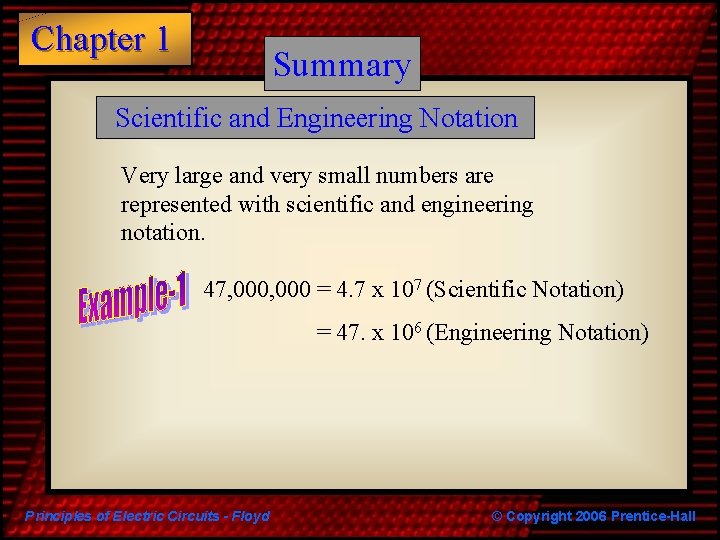
Chapter 1 Summary Scientific and Engineering Notation Very large and very small numbers are represented with scientific and engineering notation. 47, 000 = 4. 7 x 10⁷ (Scientific Notation) = 47. x 106 (Engineering Notation) Principles of Electric Circuits - Floyd © Copyright 2006 Prentice-Hall
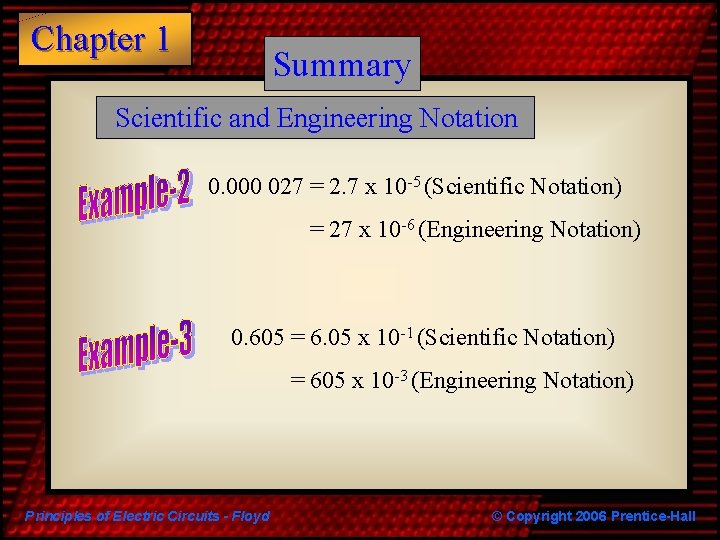
Chapter 1 Summary Scientific and Engineering Notation 0. 000 027 = 2. 7 x 10 -5 (Scientific Notation) = 27 x 10 -6 (Engineering Notation) 0. 605 = 6. 05 x 10 -1 (Scientific Notation) = 605 x 10 -3 (Engineering Notation) Principles of Electric Circuits - Floyd © Copyright 2006 Prentice-Hall
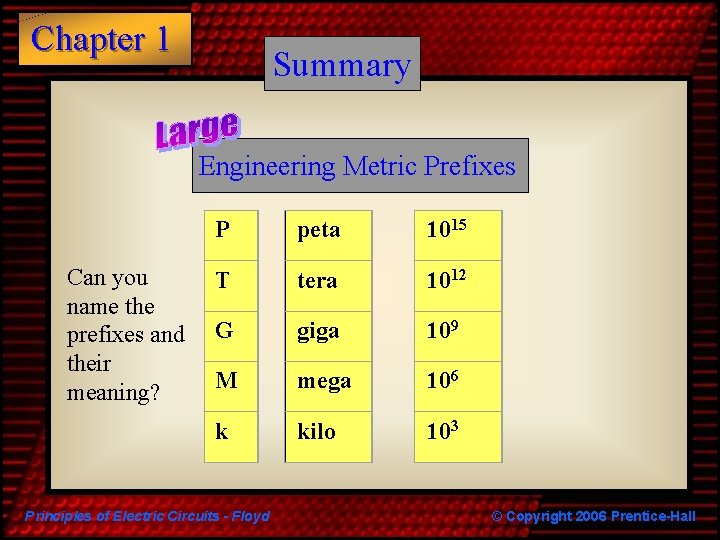
Chapter 1 Summary Engineering Metric Prefixes Can you name the prefixes and their meaning? P peta 1015 T tera 1012 G giga 109 M mega 106 k kilo 103 Principles of Electric Circuits - Floyd © Copyright 2006 Prentice-Hall
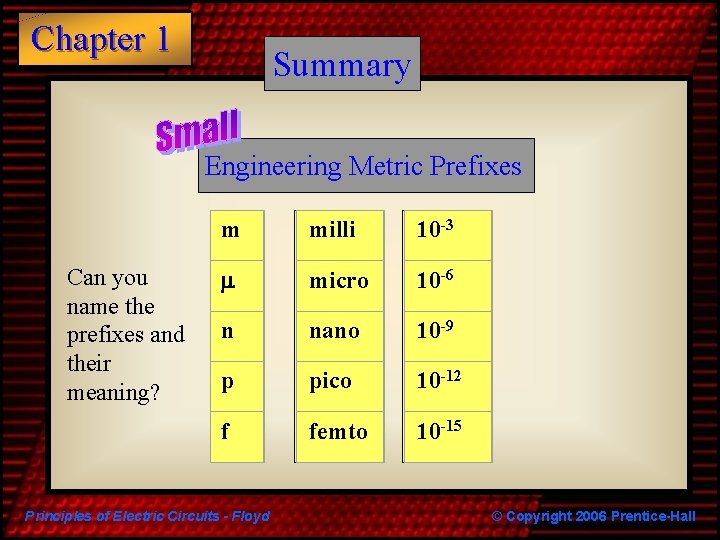
Chapter 1 Summary Engineering Metric Prefixes Can you name the prefixes and their meaning? m milli 10 -3 m micro 10 -6 n nano 10 -9 p pico 10 -12 f femto 10 -15 Principles of Electric Circuits - Floyd © Copyright 2006 Prentice-Hall
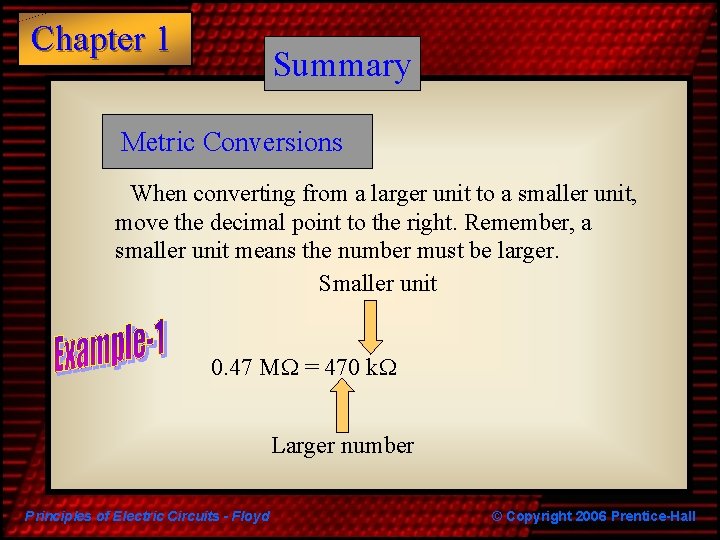
Chapter 1 Summary Metric Conversions When converting from a larger unit to a smaller unit, move the decimal point to the right. Remember, a smaller unit means the number must be larger. Smaller unit 0. 47 MW = 470 k. W Larger number Principles of Electric Circuits - Floyd © Copyright 2006 Prentice-Hall
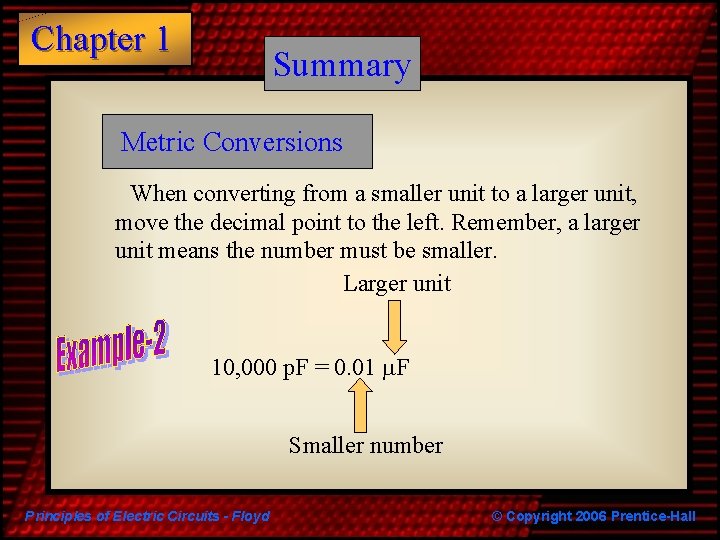
Chapter 1 Summary Metric Conversions When converting from a smaller unit to a larger unit, move the decimal point to the left. Remember, a larger unit means the number must be smaller. Larger unit 10, 000 p. F = 0. 01 m. F Smaller number Principles of Electric Circuits - Floyd © Copyright 2006 Prentice-Hall
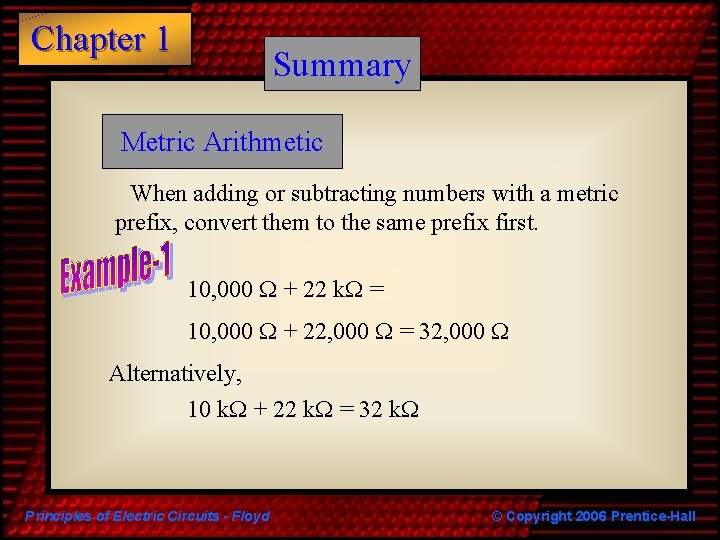
Chapter 1 Summary Metric Arithmetic When adding or subtracting numbers with a metric prefix, convert them to the same prefix first. 10, 000 W + 22 k. W = 10, 000 W + 22, 000 W = 32, 000 W Alternatively, 10 k. W + 22 k. W = 32 k. W Principles of Electric Circuits - Floyd © Copyright 2006 Prentice-Hall
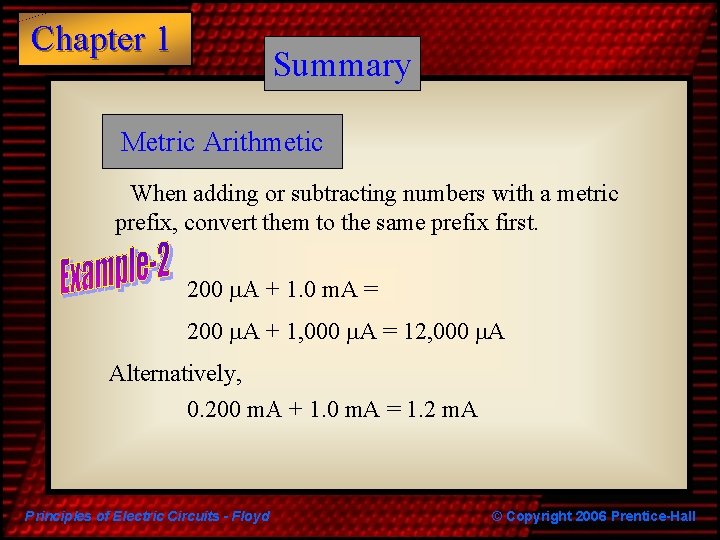
Chapter 1 Summary Metric Arithmetic When adding or subtracting numbers with a metric prefix, convert them to the same prefix first. 200 m. A + 1. 0 m. A = 200 m. A + 1, 000 m. A = 12, 000 m. A Alternatively, 0. 200 m. A + 1. 0 m. A = 1. 2 m. A Principles of Electric Circuits - Floyd © Copyright 2006 Prentice-Hall
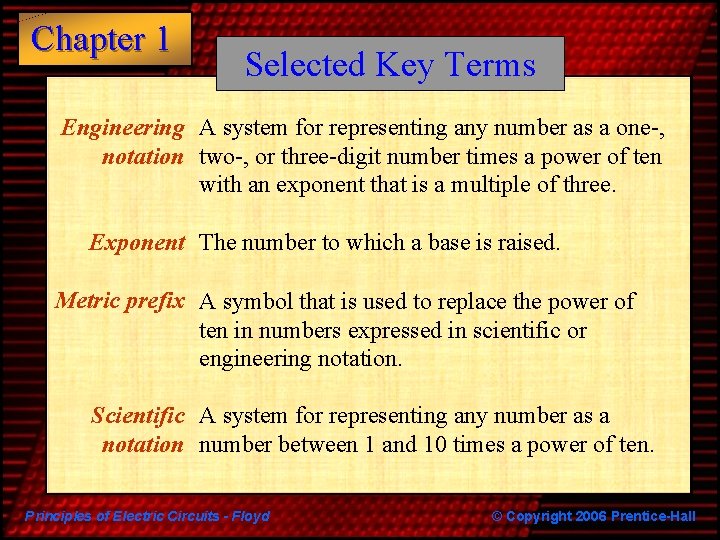
Chapter 1 Selected Key Terms Engineering A system for representing any number as a one-, notation two-, or three-digit number times a power of ten with an exponent that is a multiple of three. Exponent The number to which a base is raised. Metric prefix A symbol that is used to replace the power of ten in numbers expressed in scientific or engineering notation. Scientific A system for representing any number as a notation number between 1 and 10 times a power of ten. Principles of Electric Circuits - Floyd © Copyright 2006 Prentice-Hall
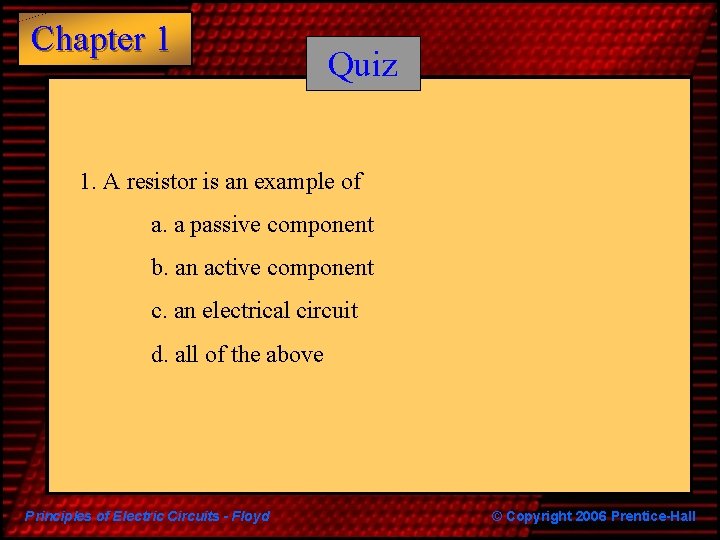
Chapter 1 Quiz 1. A resistor is an example of a. a passive component b. an active component c. an electrical circuit d. all of the above Principles of Electric Circuits - Floyd © Copyright 2006 Prentice-Hall
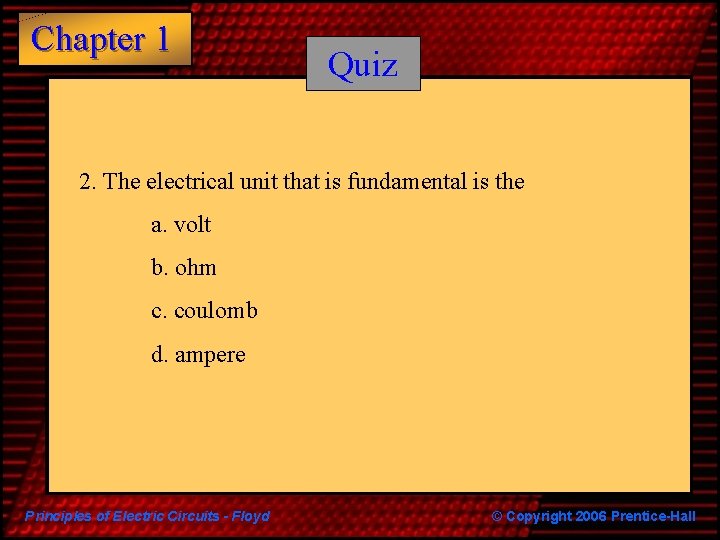
Chapter 1 Quiz 2. The electrical unit that is fundamental is the a. volt b. ohm c. coulomb d. ampere Principles of Electric Circuits - Floyd © Copyright 2006 Prentice-Hall
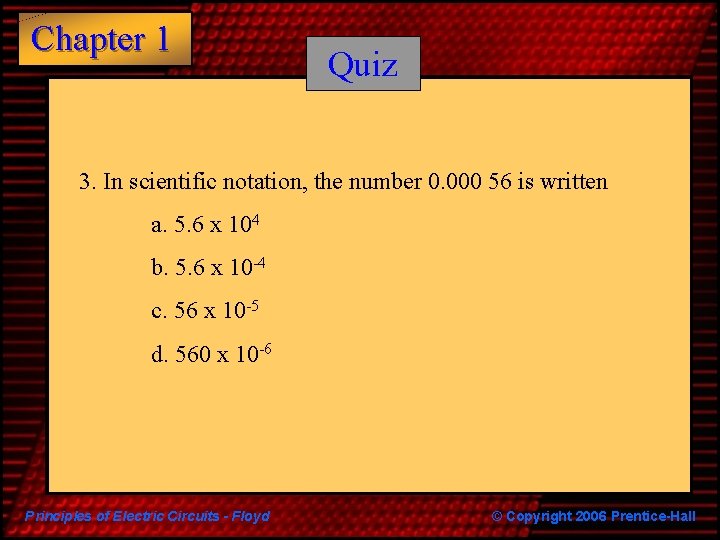
Chapter 1 Quiz 3. In scientific notation, the number 0. 000 56 is written a. 5. 6 x 10⁴ b. 5. 6 x 10 -4 c. 56 x 10 -5 d. 560 x 10 -6 Principles of Electric Circuits - Floyd © Copyright 2006 Prentice-Hall
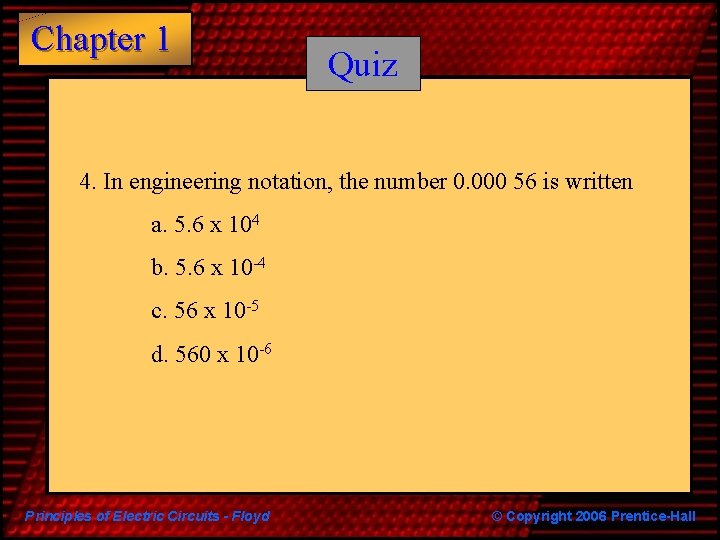
Chapter 1 Quiz 4. In engineering notation, the number 0. 000 56 is written a. 5. 6 x 10⁴ b. 5. 6 x 10 -4 c. 56 x 10 -5 d. 560 x 10 -6 Principles of Electric Circuits - Floyd © Copyright 2006 Prentice-Hall
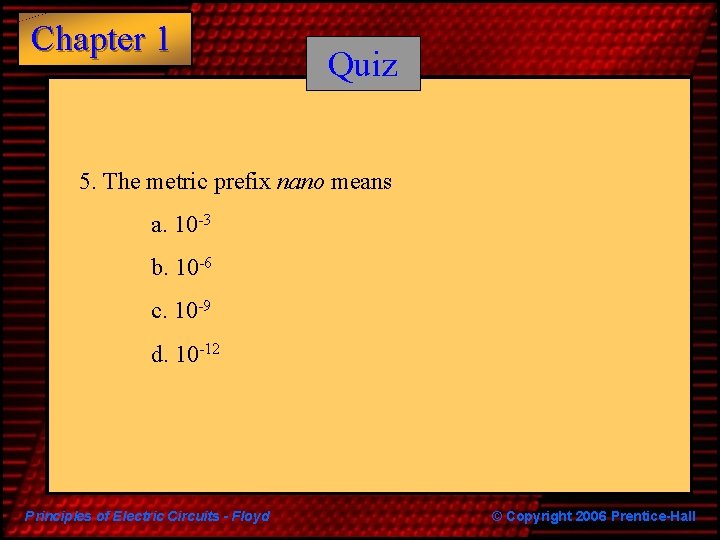
Chapter 1 Quiz 5. The metric prefix nano means a. 10 -3 b. 10 -6 c. 10 -9 d. 10 -12 Principles of Electric Circuits - Floyd © Copyright 2006 Prentice-Hall
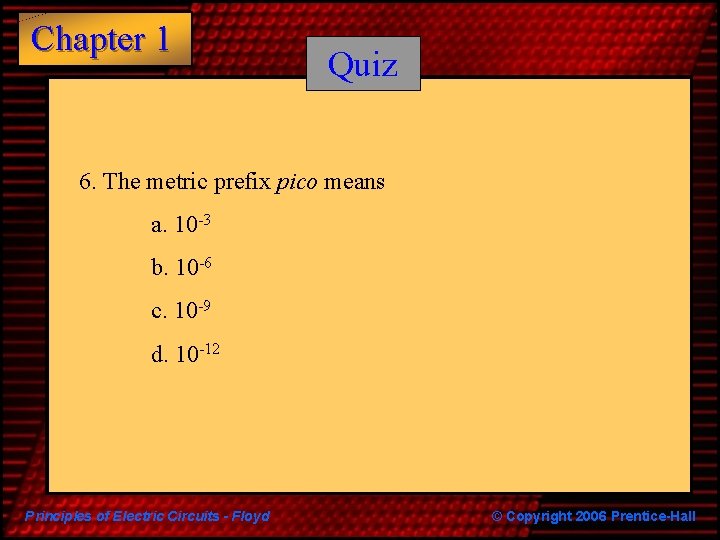
Chapter 1 Quiz 6. The metric prefix pico means a. 10 -3 b. 10 -6 c. 10 -9 d. 10 -12 Principles of Electric Circuits - Floyd © Copyright 2006 Prentice-Hall
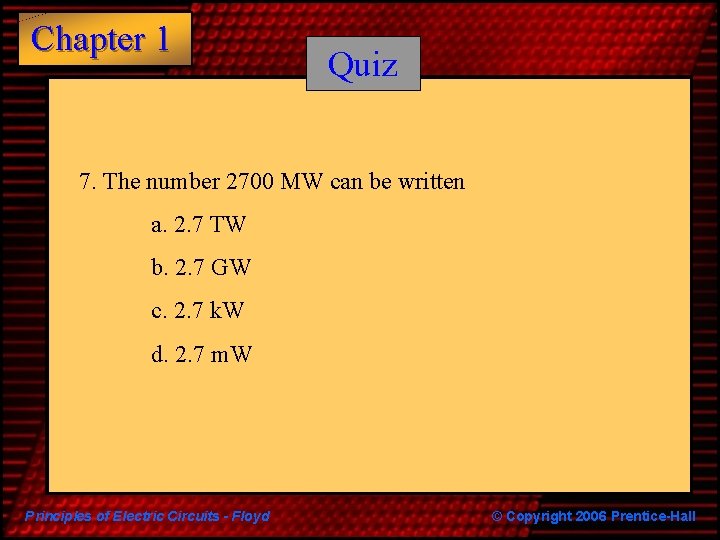
Chapter 1 Quiz 7. The number 2700 MW can be written a. 2. 7 TW b. 2. 7 GW c. 2. 7 k. W d. 2. 7 m. W Principles of Electric Circuits - Floyd © Copyright 2006 Prentice-Hall
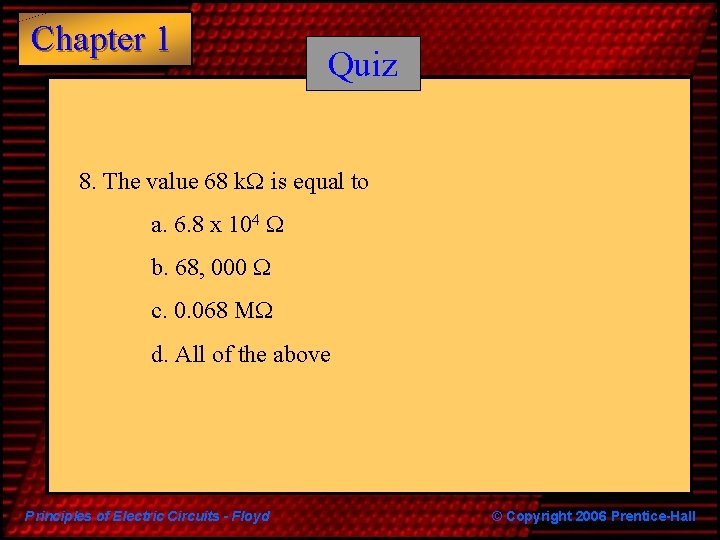
Chapter 1 Quiz 8. The value 68 k. W is equal to a. 6. 8 x 10⁴ W b. 68, 000 W c. 0. 068 MW d. All of the above Principles of Electric Circuits - Floyd © Copyright 2006 Prentice-Hall
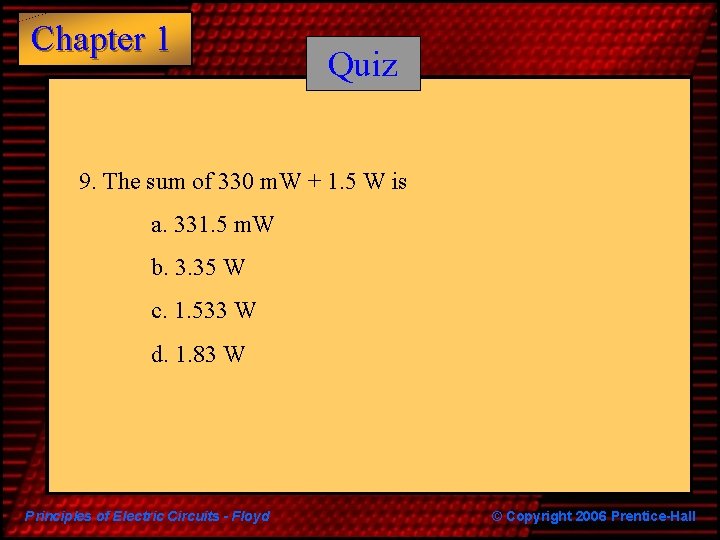
Chapter 1 Quiz 9. The sum of 330 m. W + 1. 5 W is a. 331. 5 m. W b. 3. 35 W c. 1. 533 W d. 1. 83 W Principles of Electric Circuits - Floyd © Copyright 2006 Prentice-Hall
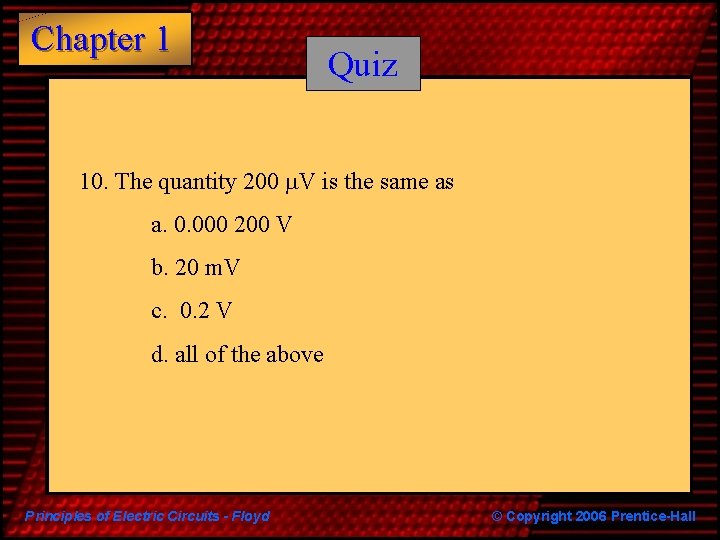
Chapter 1 Quiz 10. The quantity 200 m. V is the same as a. 0. 000 200 V b. 20 m. V c. 0. 2 V d. all of the above Principles of Electric Circuits - Floyd © Copyright 2006 Prentice-Hall
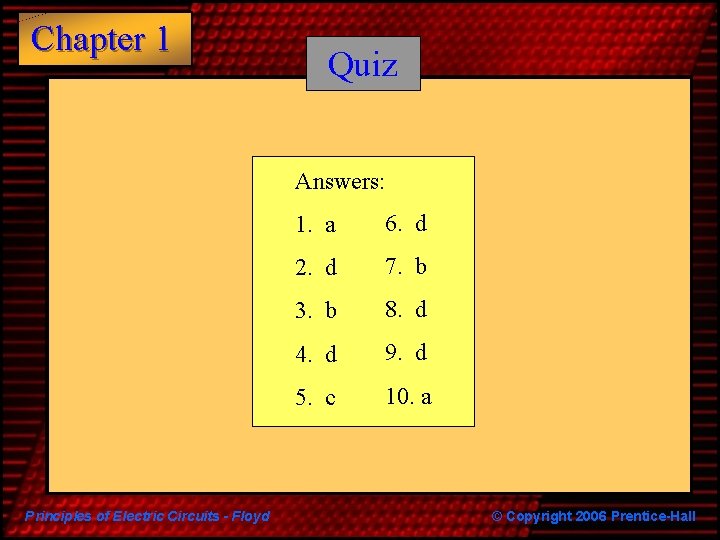
Chapter 1 Quiz Answers: Principles of Electric Circuits - Floyd 1. a 6. d 2. d 7. b 3. b 8. d 4. d 9. d 5. c 10. a © Copyright 2006 Prentice-Hall