
CHAPTER 1 PRINCIPLES OF DESIGN Engineering Design and



- Slides: 26
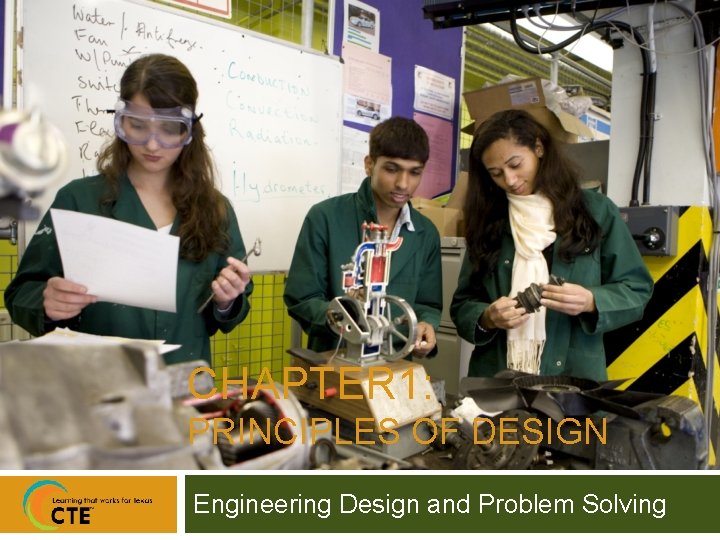
CHAPTER 1: PRINCIPLES OF DESIGN Engineering Design and Problem Solving
Introduction/Description 2 The Intro-Mini Project will introduce the engineering design process through a problem solving scenario, as well as the concept of Coefficient of Restitution (COR), and sketching and technical drawing. You will work in project teams and present your data and solutions to the class. Copyright © Texas Education Agency 2012. All rights reserved.
Chapter 1: Outline 3 1. Engineering Careers 2. History of Engineering and Innovation 3. Importance of Innovation 4. Future Challenges of Innovation Copyright © Texas Education Agency 2012. All rights reserved.
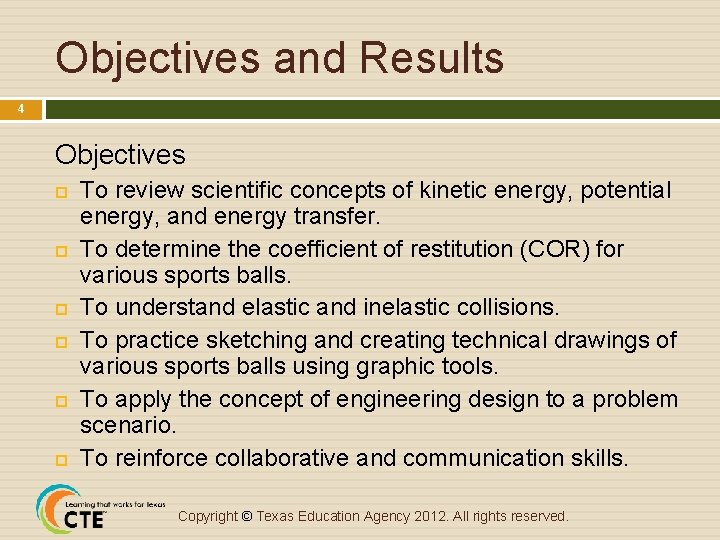
Objectives and Results 4 Objectives To review scientific concepts of kinetic energy, potential energy, and energy transfer. To determine the coefficient of restitution (COR) for various sports balls. To understand elastic and inelastic collisions. To practice sketching and creating technical drawings of various sports balls using graphic tools. To apply the concept of engineering design to a problem scenario. To reinforce collaborative and communication skills. Copyright © Texas Education Agency 2012. All rights reserved.
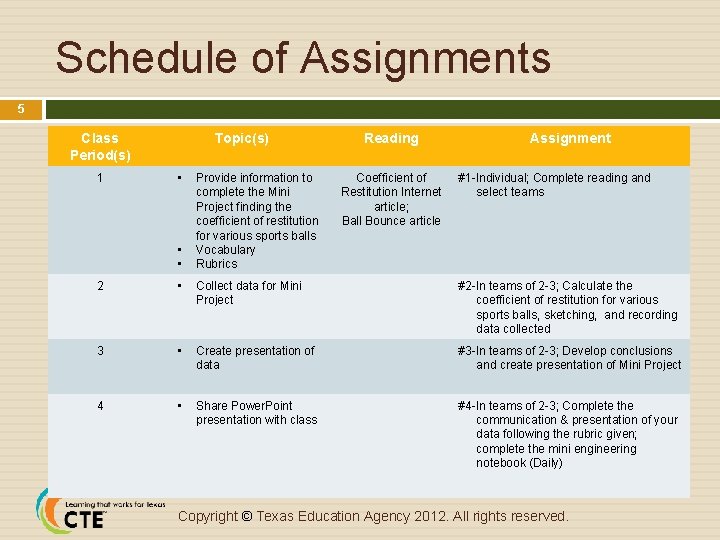
Schedule of Assignments 5 Class Period(s) 1 Topic(s) • • • Provide information to complete the Mini Project finding the coefficient of restitution for various sports balls Vocabulary Rubrics Reading Coefficient of Restitution Internet article; Ball Bounce article Assignment #1 -Individual; Complete reading and select teams 2 • Collect data for Mini Project #2 -In teams of 2 -3; Calculate the coefficient of restitution for various sports balls, sketching, and recording data collected 3 • Create presentation of data #3 -In teams of 2 -3; Develop conclusions and create presentation of Mini Project 4 • Share Power. Point presentation with class #4 -In teams of 2 -3; Complete the communication & presentation of your data following the rubric given; complete the mini engineering notebook (Daily) Copyright © Texas Education Agency 2012. All rights reserved.
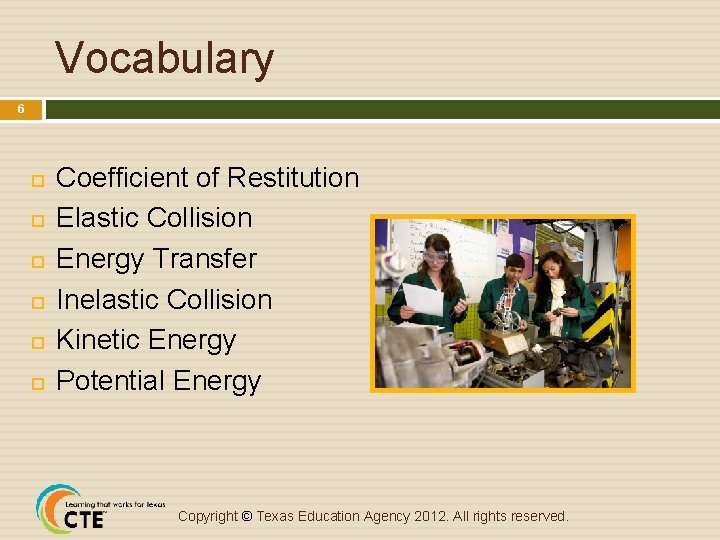
Vocabulary 6 Coefficient of Restitution Elastic Collision Energy Transfer Inelastic Collision Kinetic Energy Potential Energy Copyright © Texas Education Agency 2012. All rights reserved.
Team Building 7 What is a team? “A team is a small group of people with complementary skills who are committed to a common purpose, performance goals, and approach for which they hold themselves mutually accountable. ” Katzenbach, Jon R. , and Smith, Douglas K. , The wisdom of teams: creating the high-performance organization; Jon R. Katzenbach, Douglas K. Smith Harvard Business School Press, Boston, Mass. : 1993 Copyright © Texas Education Agency 2012. All rights reserved.
What Does a Team Leader Do? 8 A team leader probes, questions, listens, watches for nonverbal cues, and stimulates problem solving. The intended results include a team that is open to new alternatives, who is aware of their resources, has the ability to think and act independently, and is willing to explore the consequences of their current or proposed actions. Copyright © Texas Education Agency 2012. All rights reserved.
Team Building Assignment 9 In your team, discuss leadership responsibilities of team members. roles and Individually, wright 6 qualities a good leader should have. Get in groups of 3 and write down the top 6, collectively. Each group will present why their chosen 6 qualities is important when working on an engineering team. Each group. Copyright will ©give themselves a name. Texas Education Agency 2012. All rights reserved.
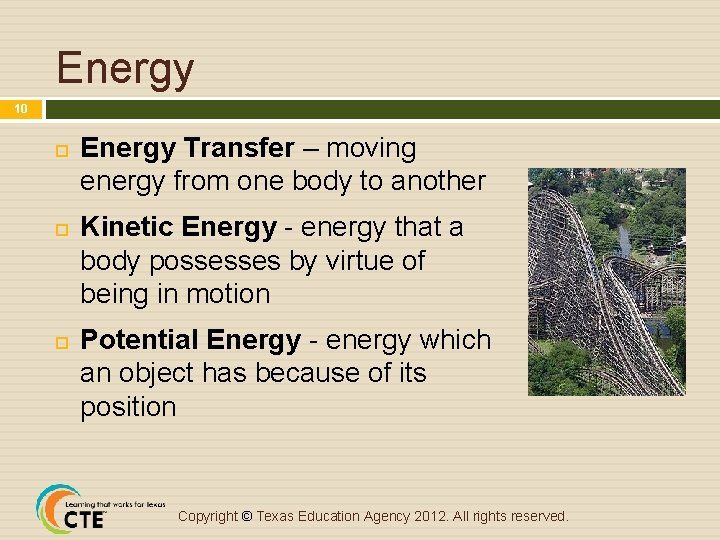
Energy 10 Energy Transfer – moving energy from one body to another Kinetic Energy - energy that a body possesses by virtue of being in motion Potential Energy - energy which an object has because of its position Copyright © Texas Education Agency 2012. All rights reserved.
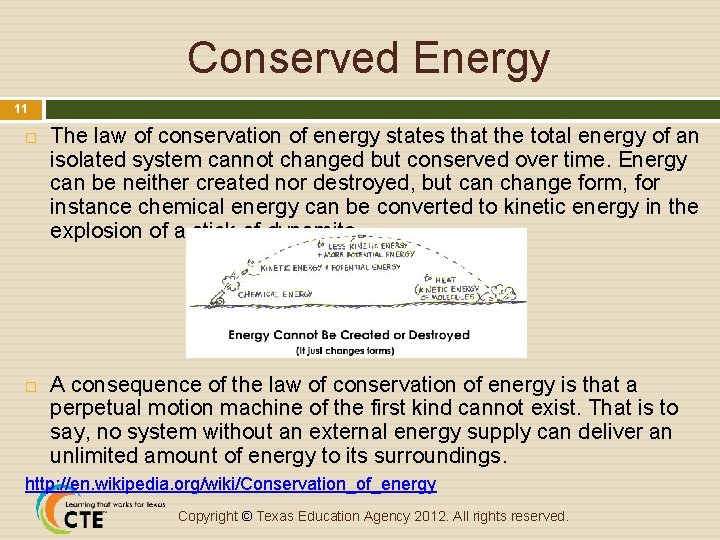
Conserved Energy 11 The law of conservation of energy states that the total energy of an isolated system cannot changed but conserved over time. Energy can be neither created nor destroyed, but can change form, for instance chemical energy can be converted to kinetic energy in the explosion of a stick of dynamite. A consequence of the law of conservation of energy is that a perpetual motion machine of the first kind cannot exist. That is to say, no system without an external energy supply can deliver an unlimited amount of energy to its surroundings. http: //en. wikipedia. org/wiki/Conservation_of_energy Copyright © Texas Education Agency 2012. All rights reserved.
law of momentum conservation 12 For a collision occurring between object 1 and object 2 in an isolated system, the total momentum of the two objects before the collision is equal to the total momentum of the two objects after the collision. That is, the momentum lost by object 1 is equal to the momentum gained by object 2. The above statement tells us that the total momentum of a collection of objects (a system) is conserved - that is, the total amount of momentum is a constant or unchanging value. Copyright © Texas Education Agency 2012. All rights reserved.
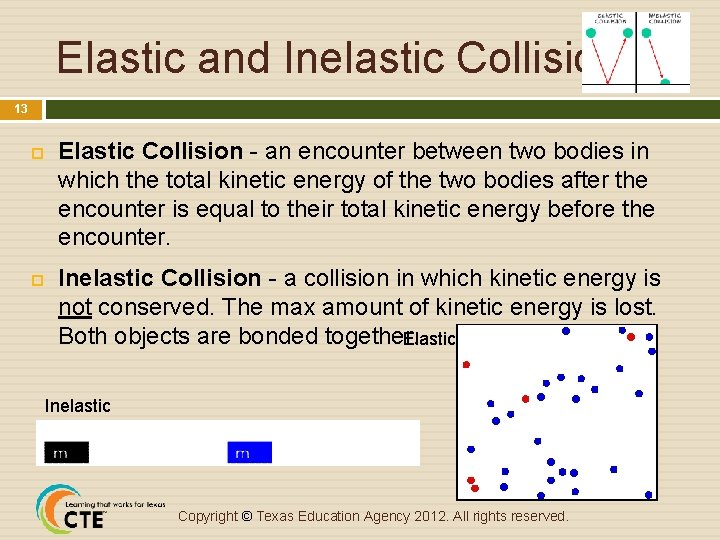
Elastic and Inelastic Collision 13 Elastic Collision - an encounter between two bodies in which the total kinetic energy of the two bodies after the encounter is equal to their total kinetic energy before the encounter. Inelastic Collision - a collision in which kinetic energy is not conserved. The max amount of kinetic energy is lost. Both objects are bonded together. Elastic Inelastic Copyright © Texas Education Agency 2012. All rights reserved.
Loss of Energy 14 Mechanical energy is the sum of the energy of motion: KE (Kinetic Energy) = ½ mv 2 ¤ GPE (Gravitational Potential Energy) = mpg where m = mass, v = velocity (speed), g = gravitational pull, and p = potential energy. ¤ The total energy in a system is conserved, but when a ball bounces, it loses mechanical energy because the collision between the ball and the surface is inelastic. Copyright © Texas Education Agency 2012. All rights reserved.
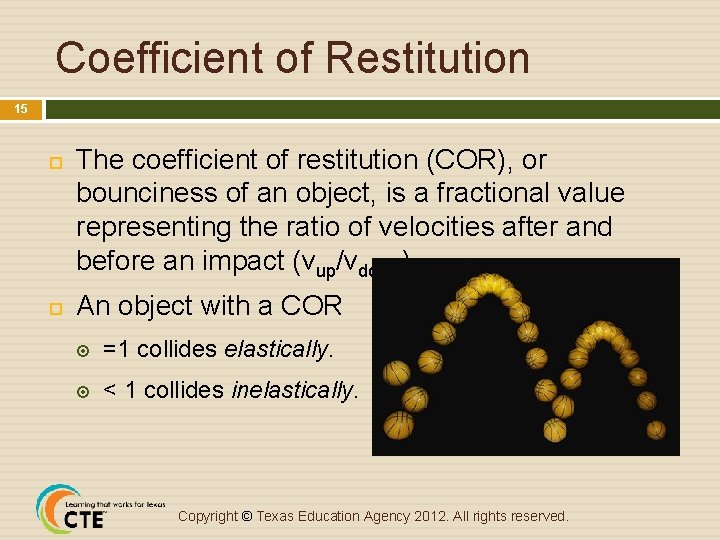
Coefficient of Restitution 15 The coefficient of restitution (COR), or bounciness of an object, is a fractional value representing the ratio of velocities after and before an impact (vup/vdown). An object with a COR ¤ =1 collides elastically. ¤ < 1 collides inelastically. Copyright © Texas Education Agency 2012. All rights reserved.
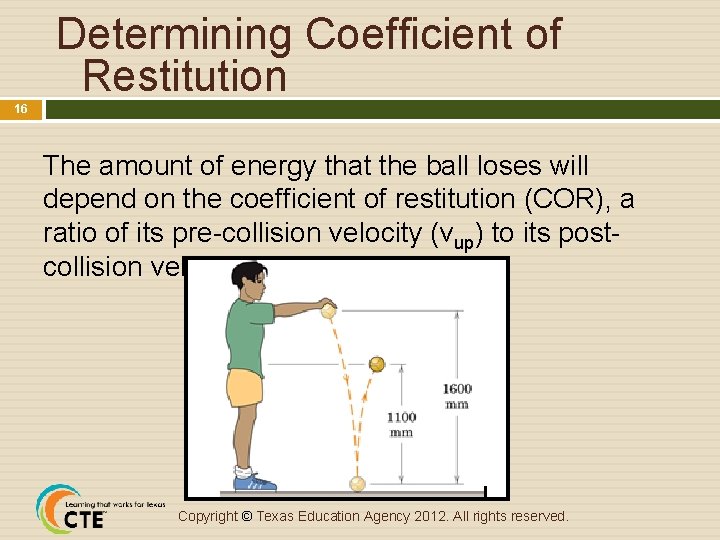
Determining Coefficient of Restitution 16 The amount of energy that the ball loses will depend on the coefficient of restitution (COR), a ratio of its pre-collision velocity (vup) to its postcollision velocity (vdown). Copyright © Texas Education Agency 2012. All rights reserved.
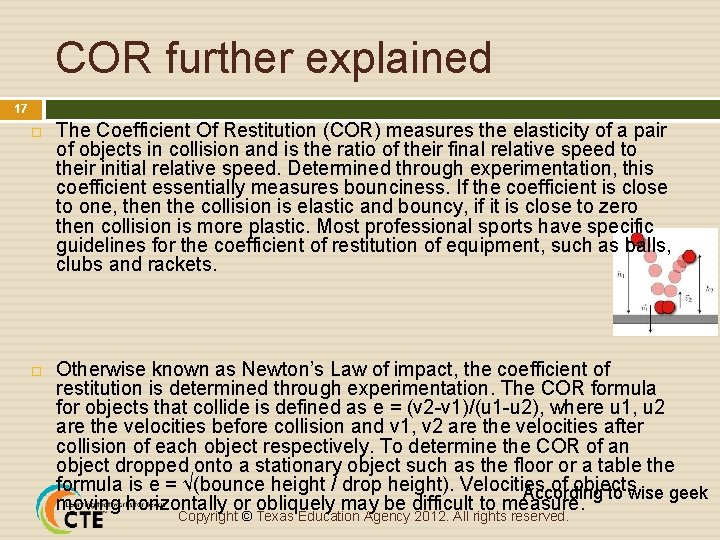
COR further explained 17 The Coefficient Of Restitution (COR) measures the elasticity of a pair of objects in collision and is the ratio of their final relative speed to their initial relative speed. Determined through experimentation, this coefficient essentially measures bounciness. If the coefficient is close to one, then the collision is elastic and bouncy, if it is close to zero then collision is more plastic. Most professional sports have specific guidelines for the coefficient of restitution of equipment, such as balls, clubs and rackets. Otherwise known as Newton’s Law of impact, the coefficient of restitution is determined through experimentation. The COR formula for objects that collide is defined as e = (v 2 -v 1)/(u 1 -u 2), where u 1, u 2 are the velocities before collision and v 1, v 2 are the velocities after collision of each object respectively. To determine the COR of an object dropped onto a stationary object such as the floor or a table the formula is e = √(bounce height / drop height). Velocities of objects According to wise geek moving horizontally or obliquely may be difficult to measure. Copyright © Texas Education Agency 2012. All rights reserved.
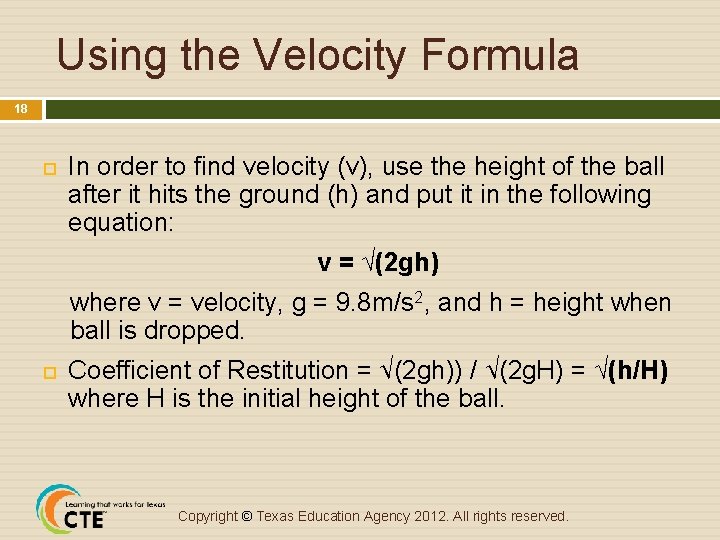
Using the Velocity Formula 18 In order to find velocity (v), use the height of the ball after it hits the ground (h) and put it in the following equation: v = √(2 gh) where v = velocity, g = 9. 8 m/s 2, and h = height when ball is dropped. Coefficient of Restitution = √(2 gh)) / √(2 g. H) = √(h/H) where H is the initial height of the ball. Copyright © Texas Education Agency 2012. All rights reserved.
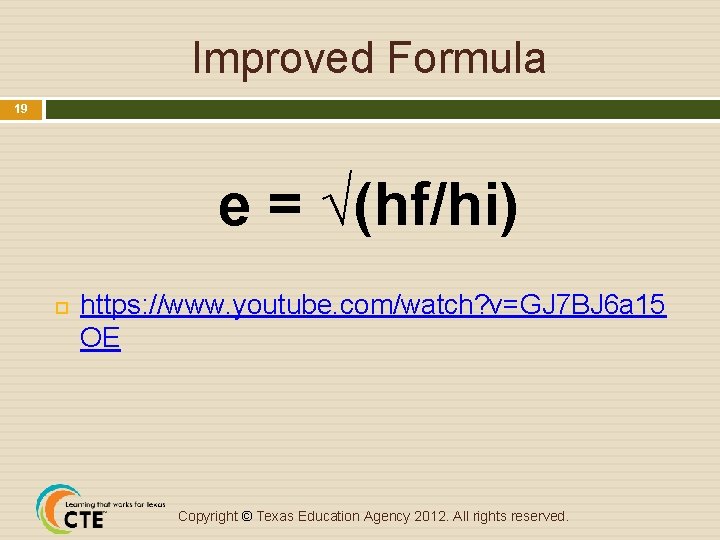
Improved Formula 19 e = √(hf/hi) https: //www. youtube. com/watch? v=GJ 7 BJ 6 a 15 OE Copyright © Texas Education Agency 2012. All rights reserved.
Student Scenario 20 It’s the beginning of the school year. Students are interested in joining an extracurricular sporting team. There are several female and male sporting teams to choose from at the high school. What are the sporting teams at your high school? Research and list the various types of extracurricular sporting teams available for both female and male students. Gather the types of balls used for each extracurricular sporting team. Copyright © Texas Education Agency 2012. All rights reserved.
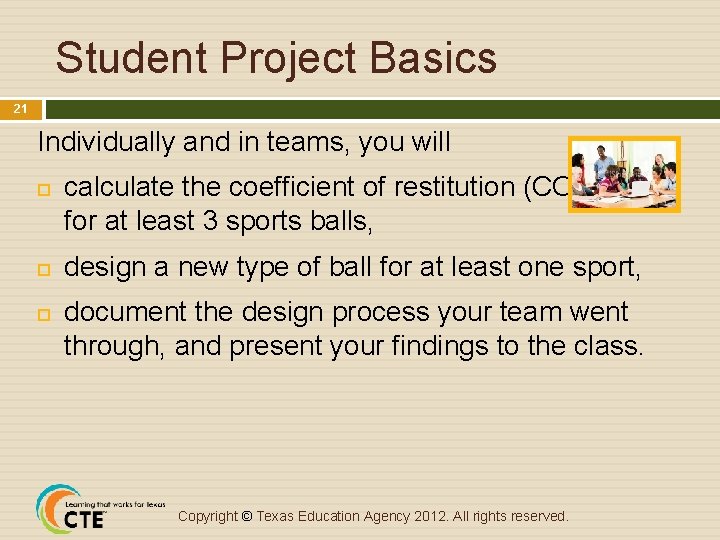
Student Project Basics 21 Individually and in teams, you will calculate the coefficient of restitution (COR) for at least 3 sports balls, design a new type of ball for at least one sport, document the design process your team went through, and present your findings to the class. Copyright © Texas Education Agency 2012. All rights reserved.
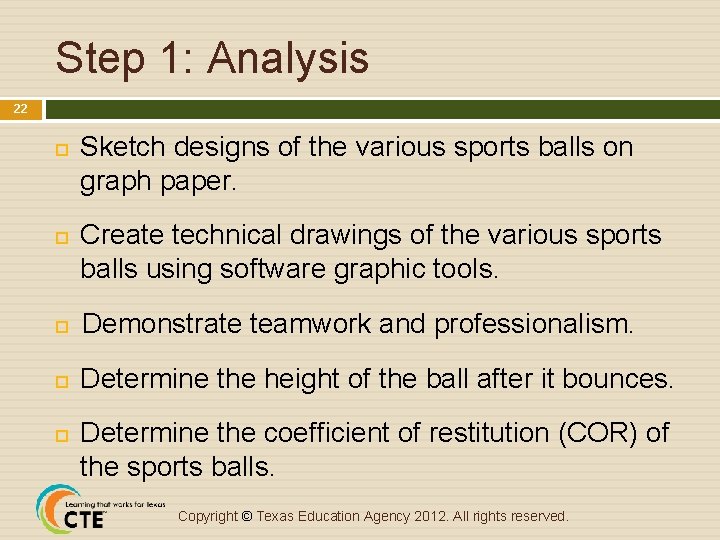
Step 1: Analysis 22 Sketch designs of the various sports balls on graph paper. Create technical drawings of the various sports balls using software graphic tools. Demonstrate teamwork and professionalism. Determine the height of the ball after it bounces. Determine the coefficient of restitution (COR) of the sports balls. Copyright © Texas Education Agency 2012. All rights reserved.
Step 2: Engineering Design 23 Considering your data and what you learned about the behavior of each ball, would any of the balls perform better in another sport? Explain. Design a new type of ball for at least one sport. There is not necessarily a right or wrong answer. Copyright © Texas Education Agency 2012. All rights reserved.
Step 3: Presentation 24 Prepare a Microsoft Power. Point team presentation of your work (rationale and results). Reflect on the concepts of energy and collisions. Explain what you have learned and why different balls might be used for different sports. Describe the new type of ball your team designed for at least one sport. In as much detail as possible, explain the steps of the process your team went through in order to come up with the new ball design. Copyright © Texas Education Agency 2012. All rights reserved.
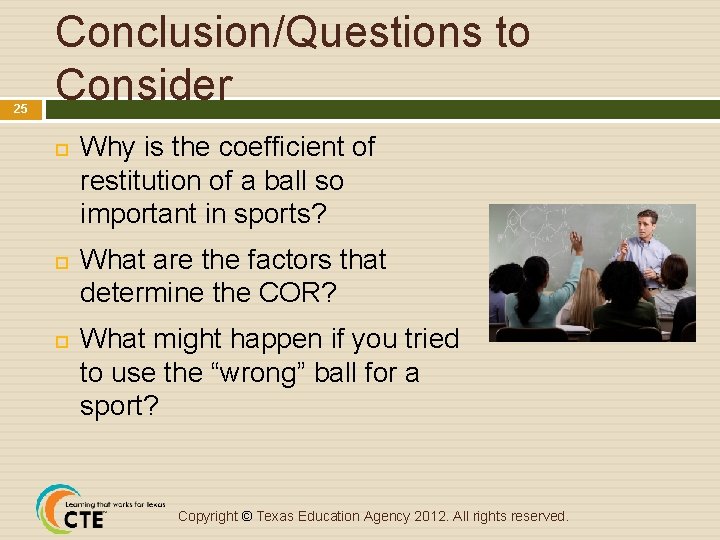
25 Conclusion/Questions to Consider Why is the coefficient of restitution of a ball so important in sports? What are the factors that determine the COR? What might happen if you tried to use the “wrong” ball for a sport? Copyright © Texas Education Agency 2012. All rights reserved.
Credits 26 Clip. Art; http: //www. clipart. com/en/ Images; http: //commons. wikimedia. org/wiki/Main_Pag e Slide 19 Coefficient of Restitution video; from You. Tube user; Gaby Salguero http: //www. youtube. com/watch? v=0 bis 1 c. A 842 c Copyright © Texas Education Agency 2012. All rights reserved.