
Chapter 1 Principles of Control in a Foodservice
- Slides: 41
Chapter 1 Principles of Control in a Foodservice Operation
Learning Outcomes • Summarize the four basic functions of management. • Understand the role of cost control in the success of an operation. • Recall five areas in which basic math skills are used in a foodservice operation. © Goodheart-Willcox Co. , Inc. Permission granted to reproduce for educational use only.
Introduction • The management function of control is essential to running a successful foodservice operation • Control refers to the effective management of resources © Goodheart-Willcox Co. , Inc. Permission granted to reproduce for educational use only.
Functions of Management • There are four basic functions of management – Planning – Organizing – Leading – Controlling • All four functions are essential to running any type of business or operation continued © Goodheart-Willcox Co. , Inc. Permission granted to reproduce for educational use only.
Functions of Management • Planning is the process of determining what an operation will be • Planning involves defining an operation’s goals and objectives and the steps that will be necessary to achieve them continued © Goodheart-Willcox Co. , Inc. Permission granted to reproduce for educational use only.
Functions of Management • Organizing is the process of deciding – what tasks need to be completed – who will perform those tasks – how the tasks will be coordinated continued © Goodheart-Willcox Co. , Inc. Permission granted to reproduce for educational use only.
Functions of Management • Leading is the process of directing people to meet the goals and objectives set in the planning phase • Leadership includes – motivating people – communicating effectively – providing feedback on employee performance – listening and responding to employee needs continued © Goodheart-Willcox Co. , Inc. Permission granted to reproduce for educational use only.
Functions of Management • Controlling is the process of monitoring the performance of the operation against its plans • Controlling is accomplished by – setting measurable goals – measuring the results – comparing those results against the goals continued © Goodheart-Willcox Co. , Inc. Permission granted to reproduce for educational use only.
Functions of Management • If results are not in line with goals, the reason should be determined and corrective action taken continued © Goodheart-Willcox Co. , Inc. Permission granted to reproduce for educational use only.
Functions of Management • Control is an ongoing process in which the operation must – define its expected results – have a plan in place to achieve those results – provide the resources that enable it to meet its goals – modify its structure, methods, or tools to meet its plan and measure the results © Goodheart-Willcox Co. , Inc. Permission granted to reproduce for educational use only.
Cost Control • Cost control is the process an operation uses to ensure that its forecasted sales and expenses conform to its plans, goals, and objectives • The successful foodservice manager balances quality with financial control to yield a profit for the business and secure its continued success continued © Goodheart-Willcox Co. , Inc. Permission granted to reproduce for educational use only.
Cost Control • Cost control is a critical function that should be required of every foodservice operator • Many foodservice operations lack strong cost controls • To control costs and enhance profits, a manager needs to understand the relationship among cost, sales, and profit (or loss) continued © Goodheart-Willcox Co. , Inc. Permission granted to reproduce for educational use only.
Cost Control • Cost, or expense, is the dollar amount spent to create the good or service being sold • Sales, or revenues, result from the exchange of goods or services for payment or promise to pay continued © Goodheart-Willcox Co. , Inc. Permission granted to reproduce for educational use only.
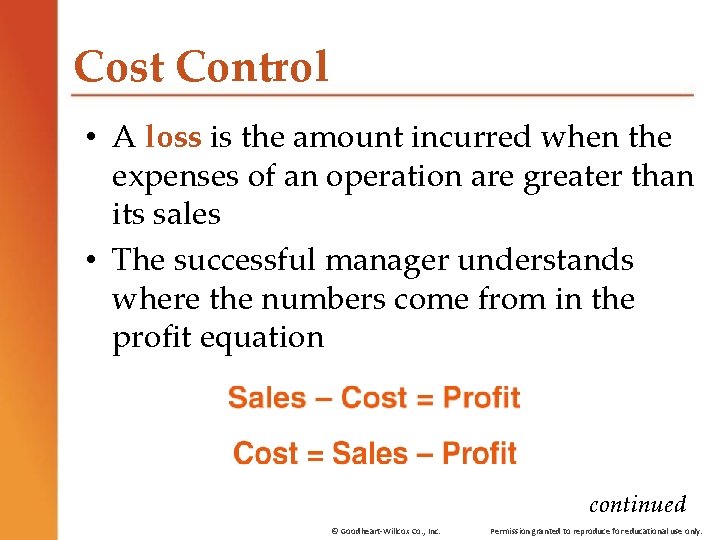
Cost Control • Cost is subtracted from sales to determine whether the operation had a profit or a loss • Profit is the dollar amount remaining after all expenses have been paid continued © Goodheart-Willcox Co. , Inc. Permission granted to reproduce for educational use only.
Cost Control • A loss is the amount incurred when the expenses of an operation are greater than its sales • The successful manager understands where the numbers come from in the profit equation continued © Goodheart-Willcox Co. , Inc. Permission granted to reproduce for educational use only.
Cost Control • Operations need to make enough money from sales to cover the costs of doing business • This is true for both for-profit and not-for-profit businesses • An operation can increase its profits in two ways – by increasing sales – by decreasing expenses continued © Goodheart-Willcox Co. , Inc. Permission granted to reproduce for educational use only.
Cost Control • Math skills are used in – standardizing and converting recipes – purchasing food and supplies – determining staffing needs – determining selling prices continued © Goodheart-Willcox Co. , Inc. Permission granted to reproduce for educational use only.
Cost Control • Math skills are used in – forecasting how much food to produce – controlling inventory – preparing budgets – analyzing customer satisfaction – evaluating sales results © Goodheart-Willcox Co. , Inc. Permission granted to reproduce for educational use only.
Basic Math Review • A manager needs basic math skills to effectively run a foodservice operation through a strong cost-control system • These skills include the use of – fractions – decimals – percentages – ratios continued © Goodheart-Willcox Co. , Inc. Permission granted to reproduce for educational use only.
Basic Math Review • Fractions, percentages, and decimals can be considered one in the same • They all deal with parts of a whole • A fraction is made up of – a numerator (the top number) – a denominator (the bottom number) • The numerator is the part and the denominator represents the whole continued © Goodheart-Willcox Co. , Inc. Permission granted to reproduce for educational use only.
Basic Math Review • A percentage is another way of expressing a part of the whole • The word percent is from the Latin words per centum meaning “per hundred” • A percentage is another way of expressing a fraction in which the denominator is 100 • The percent symbol is used after a number when writing percentages (50%) continued © Goodheart-Willcox Co. , Inc. Permission granted to reproduce for educational use only.
Basic Math Review • Decimals are another way of expressing a part of the whole • A decimal represents a fraction based on the number 10 • A decimal point separates the whole from the part • The number 5. 67 represents five wholes and 67 parts continued © Goodheart-Willcox Co. , Inc. Permission granted to reproduce for educational use only.
Basic Math Review • To express a decimal as a percentage – move the decimal point two places to the right – add the percent symbol • Decimals and percentages show the same relationship continued © Goodheart-Willcox Co. , Inc. Permission granted to reproduce for educational use only.
Basic Math Review • To convert a percentage to a decimal, move the decimal point two places to the left • Both percentages and decimals can also be expressed as fractions continued © Goodheart-Willcox Co. , Inc. Permission granted to reproduce for educational use only.
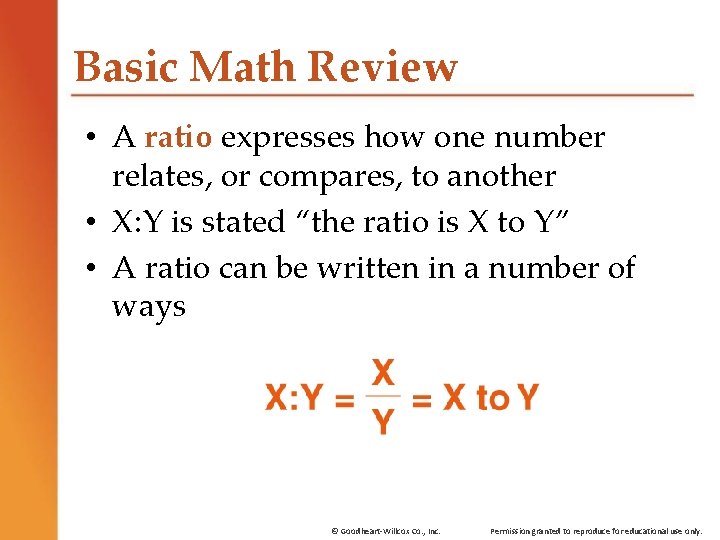
Basic Math Review • A ratio expresses how one number relates, or compares, to another • X: Y is stated “the ratio is X to Y” • A ratio can be written in a number of ways © Goodheart-Willcox Co. , Inc. Permission granted to reproduce for educational use only.
Practical Foodservice Applications • Percentages, ratios, fractions, and decimals are used every day in foodservice operations to control costs • A ratio expresses how one number relates, or compares, to another • For example, the ratio 2: 7 can express that a baker sells two sugar cookies for every seven chocolate chip cookies continued © Goodheart-Willcox Co. , Inc. Permission granted to reproduce for educational use only.
Practical Foodservice Applications • Many foodservice operations base the selling price of a menu item on the cost of the food used to make it • They want to limit the food cost to a certain percentage of the selling price— a food cost percentage • A common food cost percentage used by foodservice operations is 30 percent continued © Goodheart-Willcox Co. , Inc. Permission granted to reproduce for educational use only.
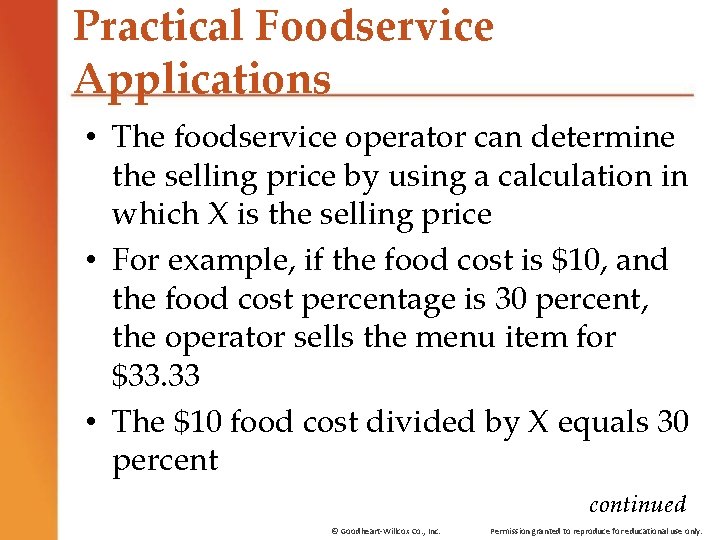
Practical Foodservice Applications • The foodservice operator can determine the selling price by using a calculation in which X is the selling price • For example, if the food cost is $10, and the food cost percentage is 30 percent, the operator sells the menu item for $33. 33 • The $10 food cost divided by X equals 30 percent continued © Goodheart-Willcox Co. , Inc. Permission granted to reproduce for educational use only.
Practical Foodservice Applications • When making decisions about which food products to purchase, a manager often compares the prices of two or more products • Factors such as pack size and product yield must be taken into consideration when comparing product prices • The manager must determine the best price per unit continued © Goodheart-Willcox Co. , Inc. Permission granted to reproduce for educational use only.
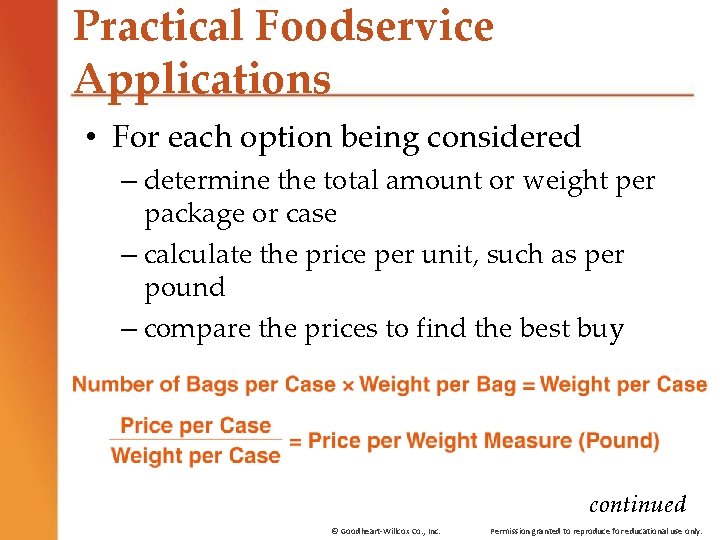
Practical Foodservice Applications • For each option being considered – determine the total amount or weight per package or case – calculate the price per unit, such as per pound – compare the prices to find the best buy continued © Goodheart-Willcox Co. , Inc. Permission granted to reproduce for educational use only.
Practical Foodservice Applications • To compare prices between a processed and a raw product, managers must consider the yield • Product yield is the amount of a product that is usable after cooking or other processing continued © Goodheart-Willcox Co. , Inc. Permission granted to reproduce for educational use only.
Practical Foodservice Applications • Ways to find the product yield vary by product • For a fresh roast, for example, the yield would be affected by the amount of fat to be trimmed off continued © Goodheart-Willcox Co. , Inc. Permission granted to reproduce for educational use only.
Practical Foodservice Applications • The manager needs to determine the price per unit, such as per pound, for the amount of the product yield • This is calculated by dividing the purchase price by the product yield • The prices can then be compared • Another common calculation in foodservice management is determining the cost to produce a meal continued © Goodheart-Willcox Co. , Inc. Permission granted to reproduce for educational use only.
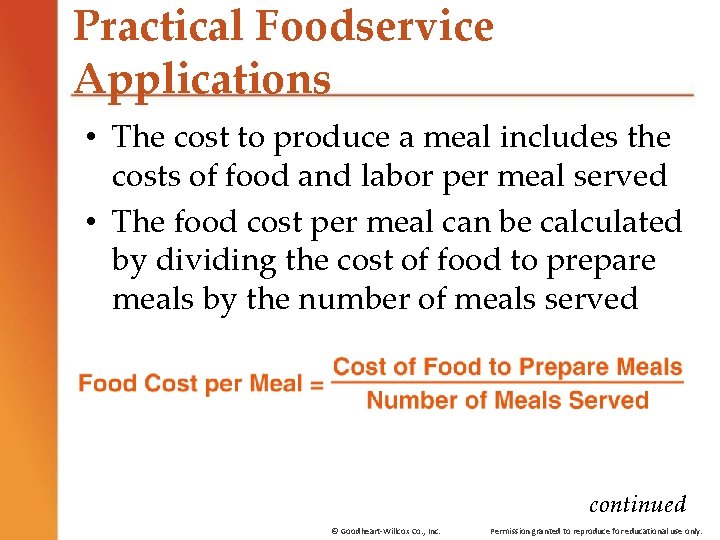
Practical Foodservice Applications • The cost to produce a meal includes the costs of food and labor per meal served • The food cost per meal can be calculated by dividing the cost of food to prepare meals by the number of meals served continued © Goodheart-Willcox Co. , Inc. Permission granted to reproduce for educational use only.
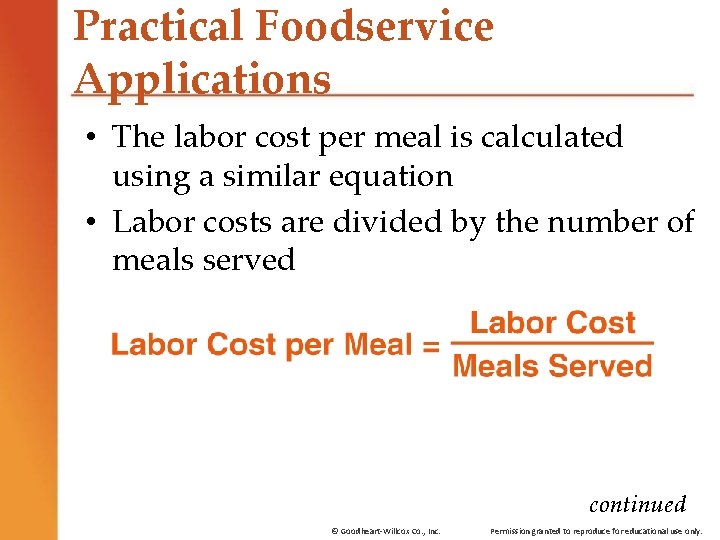
Practical Foodservice Applications • The labor cost per meal is calculated using a similar equation • Labor costs are divided by the number of meals served continued © Goodheart-Willcox Co. , Inc. Permission granted to reproduce for educational use only.
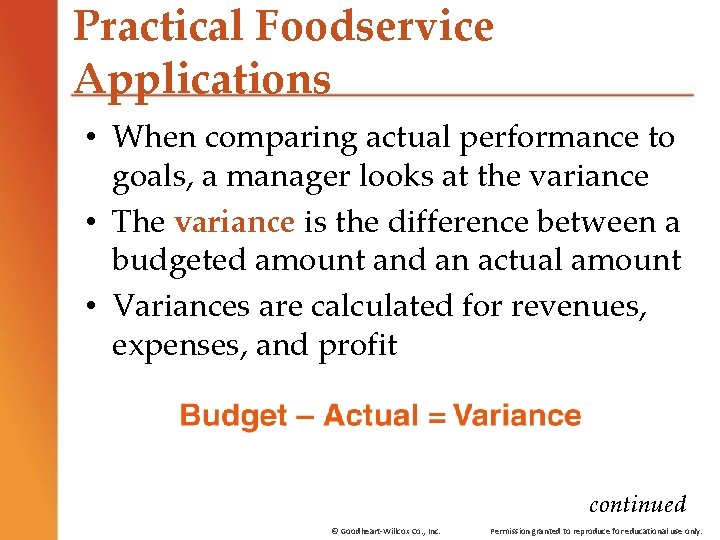
Practical Foodservice Applications • When comparing actual performance to goals, a manager looks at the variance • The variance is the difference between a budgeted amount and an actual amount • Variances are calculated for revenues, expenses, and profit continued © Goodheart-Willcox Co. , Inc. Permission granted to reproduce for educational use only.
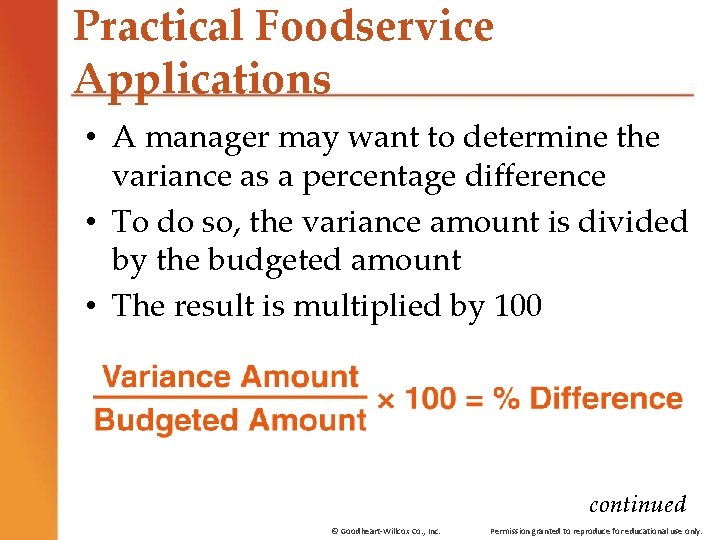
Practical Foodservice Applications • A manager may want to determine the variance as a percentage difference • To do so, the variance amount is divided by the budgeted amount • The result is multiplied by 100 continued © Goodheart-Willcox Co. , Inc. Permission granted to reproduce for educational use only.
Practical Foodservice Applications • A manager is also responsible for evaluating quality • A quality measure rates the level of perceived value placed on the parameter being evaluated • One quality measure, or parameter, is customer satisfaction • An operation often surveys its customers to learn their views on its performance continued © Goodheart-Willcox Co. , Inc. Permission granted to reproduce for educational use only.
Practical Foodservice Applications • Customer satisfaction is often expressed as a percentage • For example, the number of “excellent” service ratings may be stated as a percentage of the total ratings • A manager records and compares the results of quality measures over time to monitor the success of the operation © Goodheart-Willcox Co. , Inc. Permission granted to reproduce for educational use only.
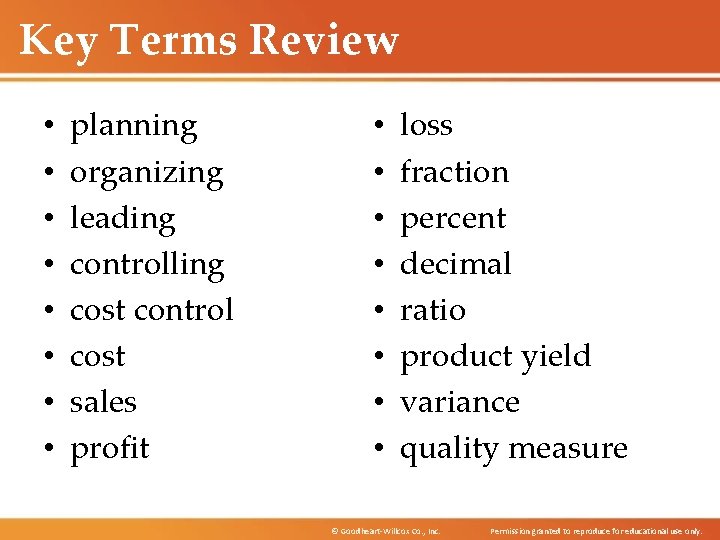
Key Terms Review • • planning organizing leading controlling cost control cost sales profit • • loss fraction percent decimal ratio product yield variance quality measure © Goodheart-Willcox Co. , Inc. Permission granted to reproduce for educational use only.