
Chapter 1 Preliminaries Chapter 1 Preliminaries 1 Topics

- Slides: 47
Chapter 1 Preliminaries Chapter 1: Preliminaries 1
Topics to be Discussed n Themes of Microeconomics n What Is a Market? n Real Versus Nominal Prices n Why Study Microeconomics? Chapter 1: Preliminaries 2
Preliminaries n Microeconomics deals with: l Behavior of individual units u. When • Consuming How we choose what to buy Chapter 1: Preliminaries 3
Preliminaries n Microeconomics deals with: l Behavior of individual units u. When • Producing How we choose what to produce Chapter 1: Preliminaries 4
Preliminaries n Microeconomics deals with: l Markets: The interaction of consumers and producers Chapter 1: Preliminaries 5
Preliminaries n Macroeconomics deals with: l Analysis of aggregate issues: u. Economic growth u. Inflation u. Unemployment Chapter 1: Preliminaries 6
Preliminaries n The Linkage Between Micro and Macroeconomics l Microeconomics is the foundation of macroeconomic analysis Chapter 1: Preliminaries 7
The Themes of Microeconomics n According to Mick Jagger* & the Rolling Stones l “You can’t always get what you want” *Economics degree from London School of Economics Chapter 1: Preliminaries 8
The Themes of Microeconomics n Why Not? l Limited Resources Chapter 1: Preliminaries 9
The Themes of Microeconomics n Microeconomics l Allocation of Scarce Resources and Trade -offs u In a planned economy u In a market economy Chapter 1: Preliminaries 10
The Themes of Microeconomics n Microeconomics and Optimal Trade-offs 1. Consumer Theory 2. Workers 3. Theory of the Firm Chapter 1: Preliminaries 11
The Themes of Microeconomics n Microeconomics and Prices l The role of prices in a market economy l How prices are determined Chapter 1: Preliminaries 12
Theories and Models n Microeconomic Analysis l Theories are used to explain observed phenomena in terms of a set of basic rules and assumptions. l For example u Theory of the Firm u Theory of Consumer Behavior Chapter 1: Preliminaries 13
Theories and Models n Microeconomic Analysis l Models: a mathematical representation of a theory used to make a prediction. u Chapter 1: Preliminaries 14
Theories and Models n Microeconomic Analysis l Validating a Theory u The validity of a theory is determined by the quality of its prediction, given the assumptions. Chapter 1: Preliminaries 15
Theories and Models n Microeconomic Analysis l Evolving the Theory u Testing and refining theories is central to the development of the science of economics. Chapter 1: Preliminaries 16
Positive Versus Normative Analysis n Positive Analysis l Positive analysis is the use of theories and models to predict the impact of a choice. l For example: u u What will be the impact of an import quota on foreign cars? What will be the impact of an increase in the gasoline excise tax? Chapter 1: Preliminaries 17
Positive versus Normative Analysis n Normative Analysis l Normative analysis addresses issues from the perspective of “What ought to be? ” l For example: u Consider the equity and efficiency tradeoff of an increase in the gasoline excise tax versus import restriction on foreign oil. Chapter 1: Preliminaries 18
What is a Market? n Markets l A geographically defined area where buyers and sellers interact to determine the price of a product or a set of products. Chapter 1: Preliminaries 19
What is a Market? n Markets vs. Industries l Industries are the supply side of the market. Chapter 1: Preliminaries 20
What is a Market? n Defining the Market l The market parameters must be set before an analysis of the market can take place. Chapter 1: Preliminaries 21
What is a Market? n Arbitrage l Buying a product at a low price in one location and selling at a high price in another Chapter 1: Preliminaries 22
What is a Market? n Competitive vs. Noncompetitive Markets l Competitive Markets u u Because of the large number of buyers and sellers, no individual buyer or seller can influence the price. Example: Most agricultural markets Chapter 1: Preliminaries 23
What is a Market? n Competitive vs. Noncompetitive Markets l Noncompetitive Markets u u Markets where individual producers can influence the price. Example: OPEC Chapter 1: Preliminaries 24
What is a Market? n Market Price l Competitive markets establish one price. l Noncompetitive markets may set many prices for the same product. Chapter 1: Preliminaries 25
What is a Market? n Market Definition & The Extent of a Market l Market u Definition Which buyers and sellers should be included in a given market Chapter 1: Preliminaries 26
What is a Market? n Market Definition - The Extent of a Market l Market u Extent Defines the boundaries of the market • • Geographic Range of products Chapter 1: Preliminaries 27
What is a Market? n Examples l Geographic u u boundaries Gasoline: US vs California Housing: Chicago vs a Chicago neighborhood Chapter 1: Preliminaries 28
What is a Market? n Examples l Range of Products u Gasoline: regular, super, & diesel u Cameras: SLR’s, point & shoot, digital Chapter 1: Preliminaries 29
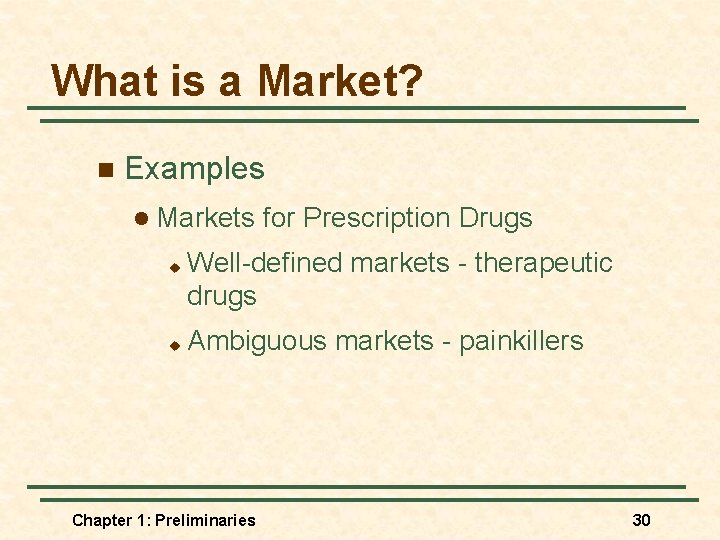
What is a Market? n Examples l Markets u u for Prescription Drugs Well-defined markets - therapeutic drugs Ambiguous markets - painkillers Chapter 1: Preliminaries 30
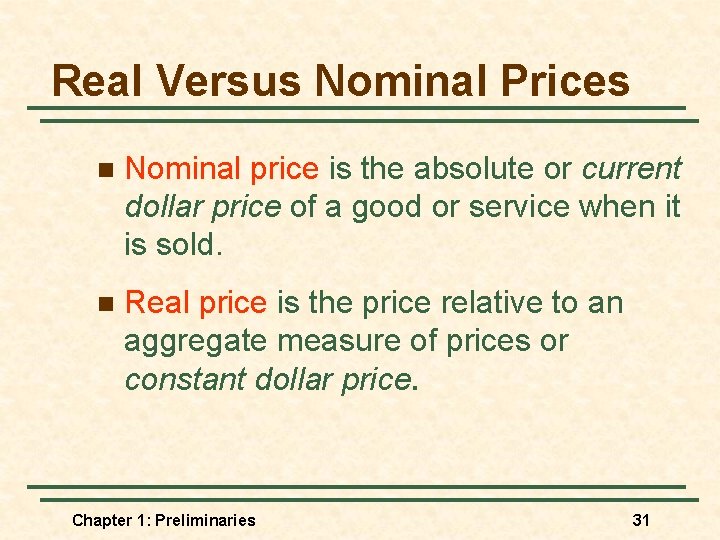
Real Versus Nominal Prices n Nominal price is the absolute or current dollar price of a good or service when it is sold. n Real price is the price relative to an aggregate measure of prices or constant dollar price. Chapter 1: Preliminaries 31
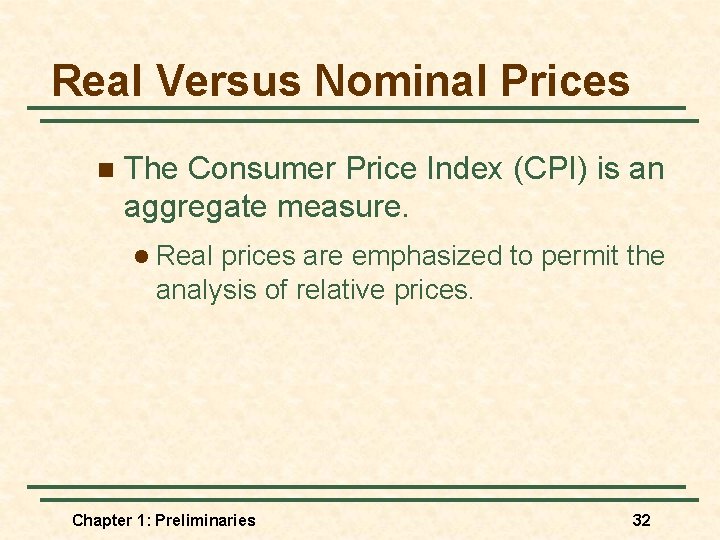
Real Versus Nominal Prices n The Consumer Price Index (CPI) is an aggregate measure. l Real prices are emphasized to permit the analysis of relative prices. Chapter 1: Preliminaries 32
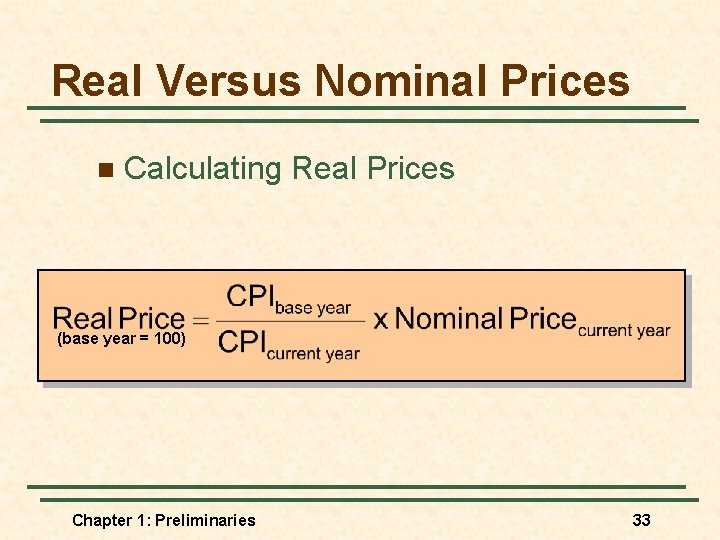
Real Versus Nominal Prices n Calculating Real Prices (base year = 100) Chapter 1: Preliminaries 33
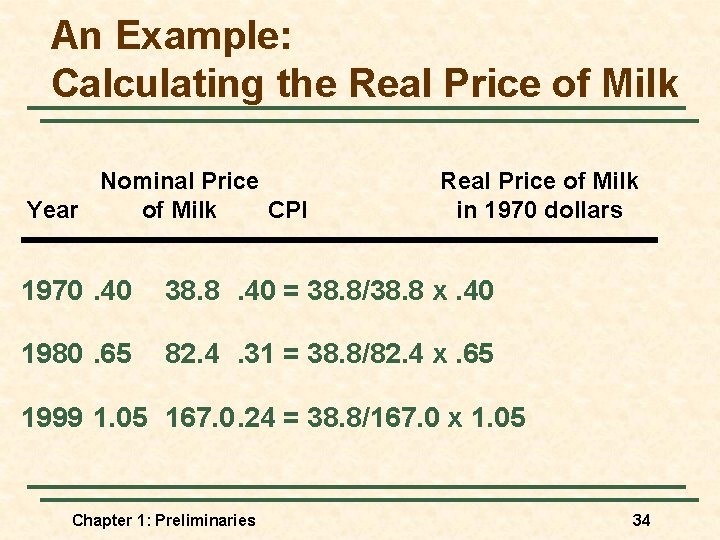
An Example: Calculating the Real Price of Milk Nominal Price Year of Milk CPI Real Price of Milk in 1970 dollars 1970. 40 38. 8. 40 = 38. 8/38. 8 x. 40 1980. 65 82. 4. 31 = 38. 8/82. 4 x. 65 1999 1. 05 167. 0. 24 = 38. 8/167. 0 x 1. 05 Chapter 1: Preliminaries 34
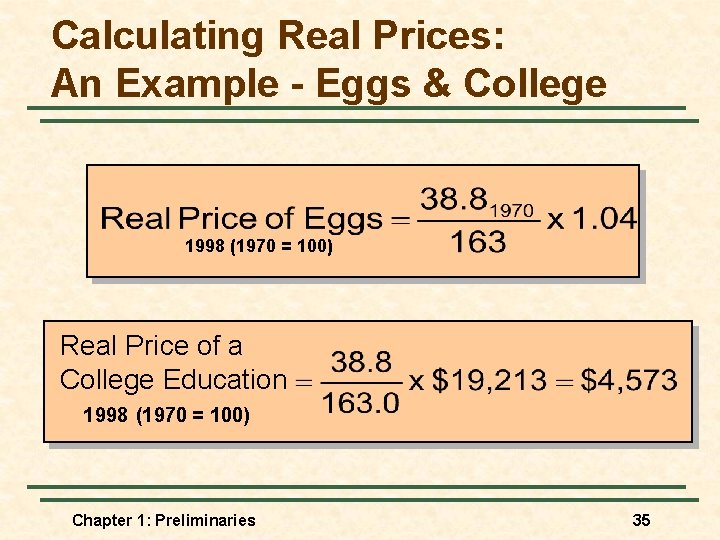
Calculating Real Prices: An Example - Eggs & College 1998 (1970 = 100) Real Price of a College Education 1998 (1970 = 100) Chapter 1: Preliminaries 35
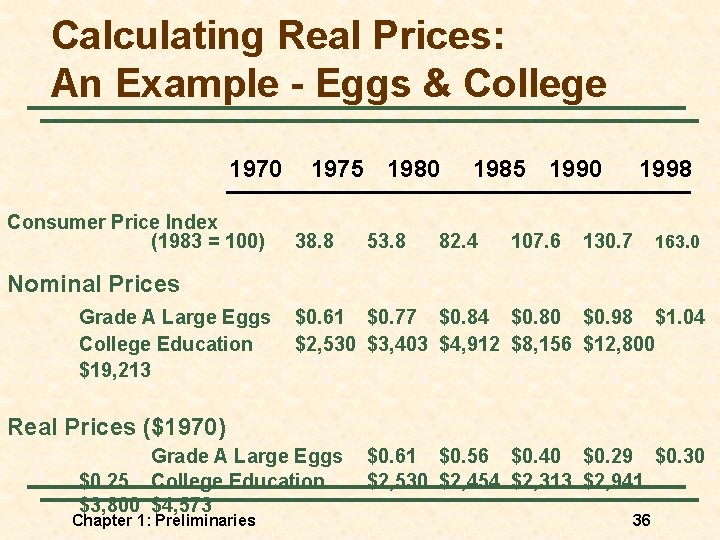
Calculating Real Prices: An Example - Eggs & College 1970 Consumer Price Index (1983 = 100) 1975 1980 38. 8 53. 8 1985 1990 82. 4 107. 6 1998 130. 7 163. 0 Nominal Prices Grade A Large Eggs College Education $19, 213 $0. 61 $0. 77 $0. 84 $0. 80 $0. 98 $1. 04 $2, 530 $3, 403 $4, 912 $8, 156 $12, 800 Real Prices ($1970) Grade A Large Eggs $0. 25 College Education $3, 800 $4, 573 Chapter 1: Preliminaries $0. 61 $0. 56 $0. 40 $0. 29 $0. 30 $2, 530 $2, 454 $2, 313 $2, 941 36
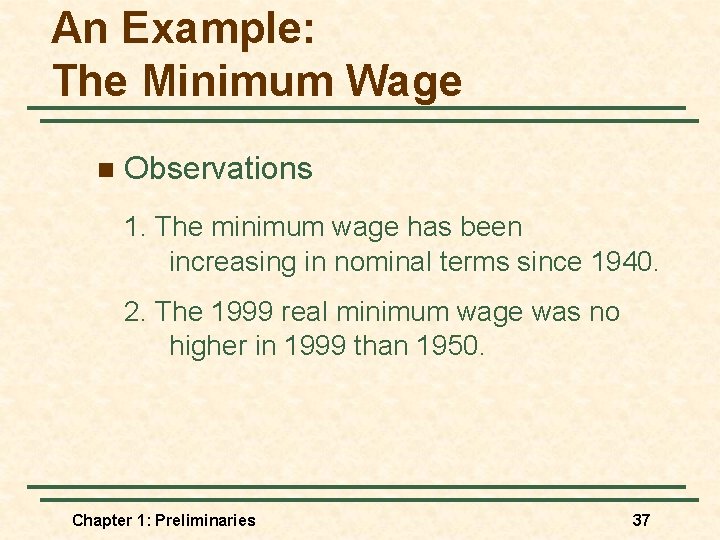
An Example: The Minimum Wage n Observations 1. The minimum wage has been increasing in nominal terms since 1940. 2. The 1999 real minimum wage was no higher in 1999 than 1950. Chapter 1: Preliminaries 37
An Example: The Minimum Wage n What Do You Think? l What are the positive and normative issues of raising the minimum wage? Chapter 1: Preliminaries 38
Why Study Microeconomics? n Microeconomic concepts are used by everyone to assist them in making choices as consumers and producers. Chapter 1: Preliminaries 39
Why Study Microeconomics? n Two Examples l Ford and the development of its SUV’s l Public u Policy Design Automobile emission standards for the 21 st century Chapter 1: Preliminaries 40
Why Study Microeconomics? n Ford and the development of its SUV’s l Questions u Consumer acceptance and demand u Production cost u Pricing strategy Chapter 1: Preliminaries 41
Why Study Microeconomics? n Ford and the development of its SUV’s l Questions u Risk analysis u Organizational decisions u Government regulation Chapter 1: Preliminaries 42
Why Study Microeconomics? n Auto emission standards for the 21 st century l Questions u Impact on consumers u Impact on producers u How to enforce the standards u What are the benefits and costs? Chapter 1: Preliminaries 43
Summary n Microeconomics is concerned with the decisions made by small economic units. n Microeconomics relies heavily on the use of theory and models. Chapter 1: Preliminaries 44
Summary n Microeconomics is concerned with positive questions and normative analysis. n A market refers to a collection of buyers and sellers who interact and to the possibility for sales and purchases that results from that interaction. Chapter 1: Preliminaries 45
Summary n The market price is established by the interaction of buyers and sellers. n A market’s geographic boundaries and range of products must be defined. n To eliminate the effects of inflation we measure real prices, rather than nominal prices. Chapter 1: Preliminaries 46
End of Chapter 1 Preliminaries Chapter 1: Preliminaries 47