
CHAPTER 1 PHYSICAL MAGNITUDES TEMA 1 MAGNITUDES FSICAS
- Slides: 18
CHAPTER 1. PHYSICAL MAGNITUDES TEMA 1. MAGNITUDES FÍSICAS 1. What is a physical magnitude? 2. How can we measure a physical magnitude? 3. The International System. Magnitudes and units 1. ¿Qué es una magnitud física? 2. ¿Cómo podemos medir una magnitud física? 3. El Sistema Internacional. Magnitudes y unidades. 4. Definiciones de las unidades fundamentales o patrones. 4. Definitions of fundamental units or standards 5. Powers of ten 6. Multiples and submultiples 7. Changes of units 8. Instruments of measurement 5. Potencias de diez. 6. Múltiplos y submúltiplos. 7. Cambios de unidades. 8. Instrumentos de medida.
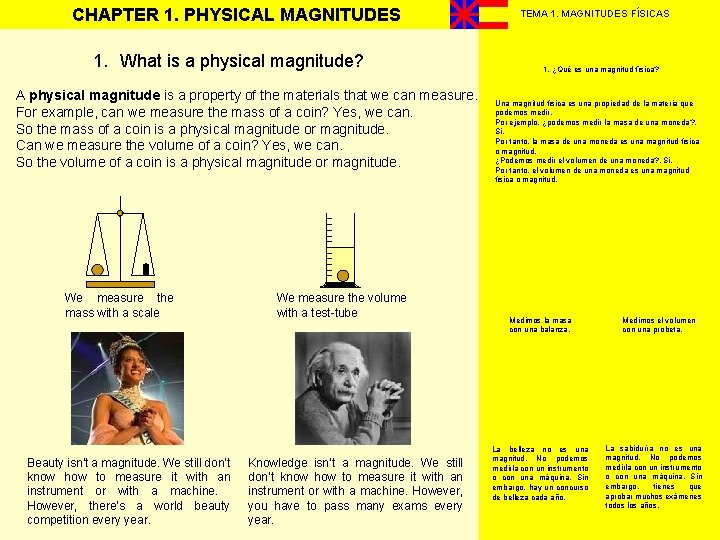
CHAPTER 1. PHYSICAL MAGNITUDES 1. What is a physical magnitude? A physical magnitude is a property of the materials that we can measure. For example, can we measure the mass of a coin? Yes, we can. So the mass of a coin is a physical magnitude or magnitude. Can we measure the volume of a coin? Yes, we can. So the volume of a coin is a physical magnitude or magnitude. We measure the mass with a scale Beauty isn’t a magnitude. We still don’t know how to measure it with an instrument or with a machine. However, there’s a world beauty competition every year. We measure the volume with a test-tube Knowledge isn’t a magnitude. We still don’t know how to measure it with an instrument or with a machine. However, you have to pass many exams every year. TEMA 1. MAGNITUDES FÍSICAS 1. ¿Qué es una magnitud física? Una magnitud física es una propiedad de la materia que podemos medir. Por ejemplo, ¿podemos medir la masa de una moneda? . Si. Por tanto, la masa de una moneda es una magnitud física o magnitud. ¿Podemos medir el volumen de una moneda? . Si. Por tanto, el volumen de una moneda es una magnitud física o magnitud. Medimos la masa con una balanza. La belleza no es una magnitud. No podemos medirla con un instrumento o con una máquina. Sin embargo, hay un concurso de belleza cada año. Medimos el volumen con una probeta. La sabiduría no es una magnitud. No podemos medirla con un instrumento o con una máquina. Sin embargo, tienes que aprobar muchos exámenes todos los años.
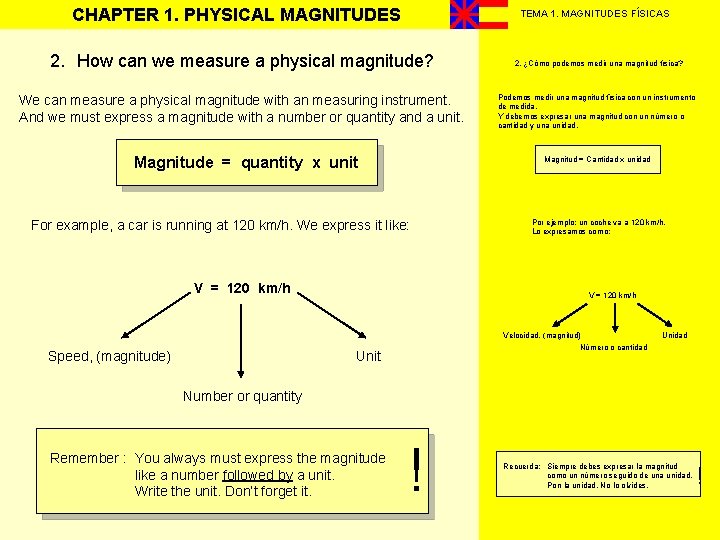
CHAPTER 1. PHYSICAL MAGNITUDES TEMA 1. MAGNITUDES FÍSICAS 2. How can we measure a physical magnitude? 2. ¿Cómo podemos medir una magnitud física? We can measure a physical magnitude with an measuring instrument. And we must express a magnitude with a number or quantity and a unit. Podemos medir una magnitud física con un instrumento de medida. Y debemos expresar una magnitud con un número o cantidad y una unidad. Magnitude = quantity x unit Magnitud = Cantidad x unidad For example, a car is running at 120 km/h. We express it like: V = 120 km/h Speed, (magnitude) Por ejemplo; un coche va a 120 km/h. Lo expresamos como: V = 120 km/h Velocidad, (magnitud) Número o cantidad Unit Unidad Number or quantity Remember : You always must express the magnitude like a number followed by a unit. Write the unit. Don’t forget it. ! Recuerda: Siempre debes expresar la magnitud como un número seguido de una unidad. Pon la unidad. No lo olvides. !
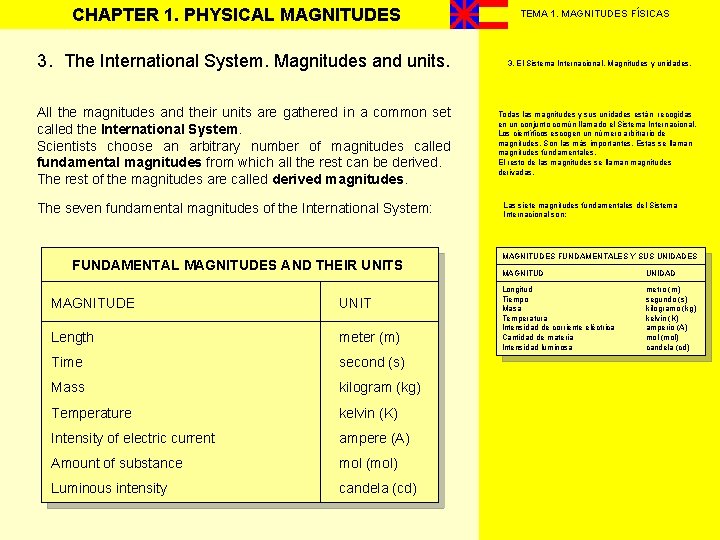
CHAPTER 1. PHYSICAL MAGNITUDES 3. The International System. Magnitudes and units. All the magnitudes and their units are gathered in a common set called the International System. Scientists choose an arbitrary number of magnitudes called fundamental magnitudes from which all the rest can be derived. The rest of the magnitudes are called derived magnitudes. The seven fundamental magnitudes of the International System: FUNDAMENTAL MAGNITUDES AND THEIR UNITS MAGNITUDE UNIT Length meter (m) Time second (s) Mass kilogram (kg) Temperature kelvin (K) Intensity of electric current ampere (A) Amount of substance mol (mol) Luminous intensity candela (cd) TEMA 1. MAGNITUDES FÍSICAS 3. El Sistema Internacional. Magnitudes y unidades. Todas las magnitudes y sus unidades están recogidas en un conjunto común llamado el Sistema Internacional. Los científicos escogen un número arbitrario de magnitudes. Son las más importantes. Estas se llaman magnitudes fundamentales. El resto de las magnitudes se llaman magnitudes derivadas. Las siete magnitudes fundamentales del Sistema Internacional son: MAGNITUDES FUNDAMENTALES Y SUS UNIDADES MAGNITUD UNIDAD Longitud Tiempo Masa Temperatura Intensidad de corriente eléctrica Cantidad de materia Intensidad luminosa metro (m) segundo (s) kilogramo (kg) kelvin (K) amperio (A) mol (mol) candela (cd)
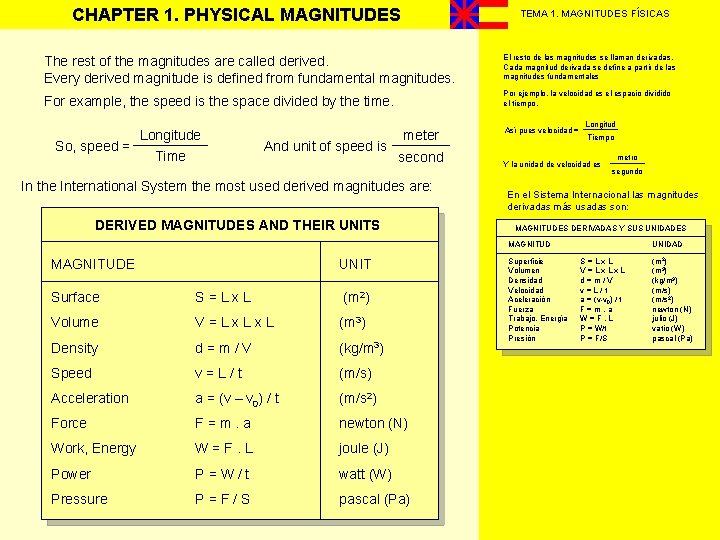
CHAPTER 1. PHYSICAL MAGNITUDES TEMA 1. MAGNITUDES FÍSICAS The rest of the magnitudes are called derived. Every derived magnitude is defined from fundamental magnitudes. El resto de las magnitudes se llaman derivadas. Cada magnitud derivada se define a partir de las magnitudes fundamentales For example, the speed is the space divided by the time. Por ejemplo, la velocidad es el espacio dividido el tiempo. So, speed = Longitude Time And unit of speed is meter second In the International System the most used derived magnitudes are: DERIVED MAGNITUDES AND THEIR UNITS Así pues velocidad = Longitud Tiempo Y la unidad de velocidad es metro segundo En el Sistema Internacional las magnitudes derivadas más usadas son: MAGNITUDES DERIVADAS Y SUS UNIDADES MAGNITUDE UNIT Surface S=Lx. L (m 2) Volume V=Lx. L (m 3) Density d=m/V (kg/m 3) Speed v=L/t (m/s) Acceleration a = (v – v 0) / t (m/s 2) Force F=m. a newton (N) Work, Energy W=F. L joule (J) Power P=W/t watt (W) Pressure P=F/S pascal (Pa) Superficie Volumen Densidad Velocidad Aceleración Fuerza Trabajo, Energía Potencia Presión UNIDAD S=Lx. L V=Lx. L d=m/V v=L/t a = (v-v 0) / t F=m. a W=F. L P = W/t P = F/S (m 2) (m 3) (kg/m 3) (m/s 2) newton (N) julio (J) vatio (W) pascal (Pa)
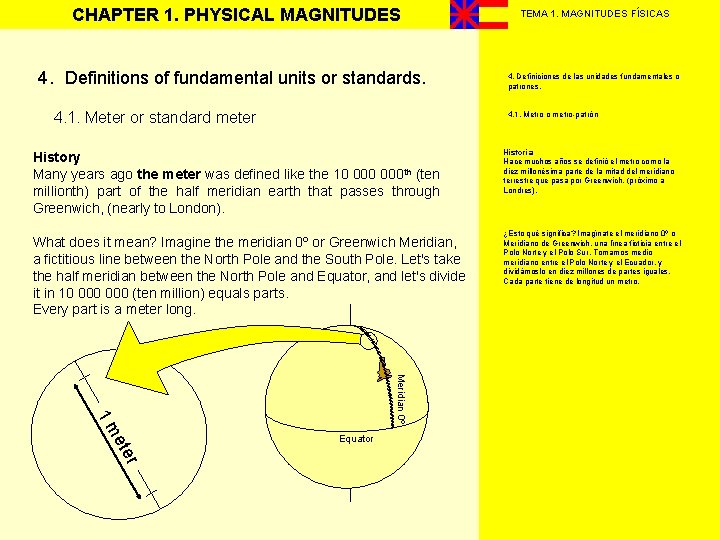
CHAPTER 1. PHYSICAL MAGNITUDES 4. Definitions of fundamental units or standards. 4. 1. Meter or standard meter TEMA 1. MAGNITUDES FÍSICAS 4. Definiciones de las unidades fundamentales o patrones. 4. 1. Metro o metro-patrón History Many years ago the meter was defined like the 10 000 th (ten millionth) part of the half meridian earth that passes through Greenwich, (nearly to London). What does it mean? Imagine the meridian 0º or Greenwich Meridian, a fictitious line between the North Pole and the South Pole. Let's take the half meridian between the North Pole and Equator, and let's divide it in 10 000 (ten million) equals parts. Every part is a meter long. Meridian 0º 1 m r ete Equator Historia Hace muchos años se definió el metro como la diez millonésima parte de la mitad del meridiano terrestre que pasa por Greenwich, (próximo a Londres). ¿Esto qué significa? Imagínate el meridiano 0º o Meridiano de Greenwich, una línea ficticia entre el Polo Norte y el Polo Sur. Tomamos medio meridiano entre el Polo Norte y el Ecuador, y dividámoslo en diez millones de partes iguales. Cada parte tiene de longitud un metro.
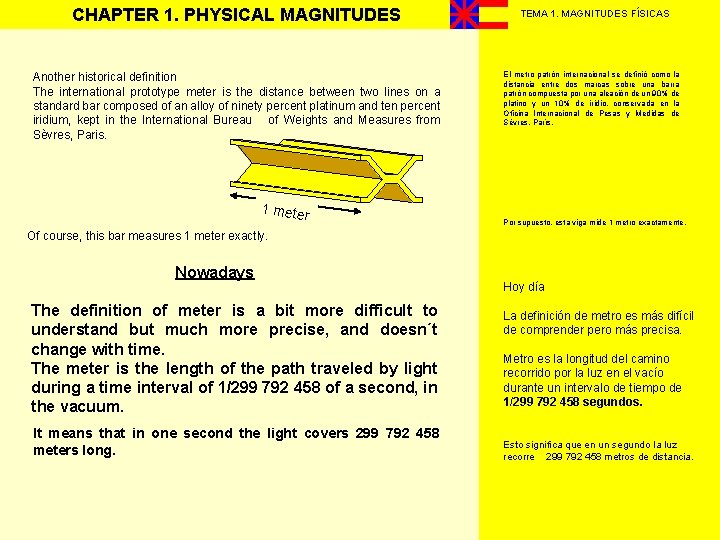
CHAPTER 1. PHYSICAL MAGNITUDES Another historical definition The international prototype meter is the distance between two lines on a standard bar composed of an alloy of ninety percent platinum and ten percent iridium, kept in the International Bureau of Weights and Measures from Sèvres, Paris. 1 meter TEMA 1. MAGNITUDES FÍSICAS El metro patrón internacional se definió como la distancia entre dos marcas sobre una barra patrón compuesta por una aleación de un 90% de platino y un 10% de iridio, conservada en la Oficina Internacional de Pesas y Medidas de Sèvres, París. Por supuesto, esta viga mide 1 metro exactamente. Of course, this bar measures 1 meter exactly. Nowadays The definition of meter is a bit more difficult to understand but much more precise, and doesn´t change with time. The meter is the length of the path traveled by light during a time interval of 1/299 792 458 of a second, in the vacuum. It means that in one second the light covers 299 792 458 meters long. Hoy día La definición de metro es más difícil de comprender pero más precisa. Metro es la longitud del camino recorrido por la luz en el vacío durante un intervalo de tiempo de 1/299 792 458 segundos. Esto significa que en un segundo la luz recorre 299 792 458 metros de distancia.
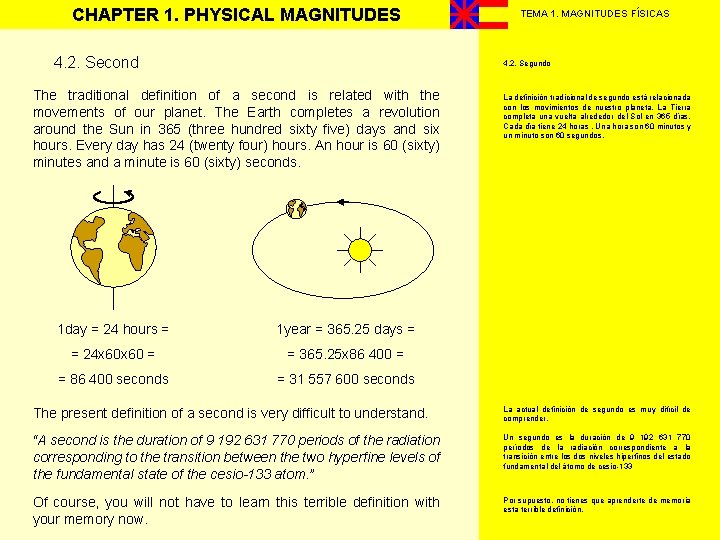
CHAPTER 1. PHYSICAL MAGNITUDES 4. 2. Second TEMA 1. MAGNITUDES FÍSICAS 4. 2. Segundo The traditional definition of a second is related with the movements of our planet. The Earth completes a revolution around the Sun in 365 (three hundred sixty five) days and six hours. Every day has 24 (twenty four) hours. An hour is 60 (sixty) minutes and a minute is 60 (sixty) seconds. 1 day = 24 hours = 1 year = 365. 25 days = = 24 x 60 = = 365. 25 x 86 400 = = 86 400 seconds = 31 557 600 seconds La definición tradicional de segundo está relacionada con los movimientos de nuestro planeta. La Tierra completa una vuelta alrededor del Sol en 365 días. Cada día tiene 24 horas. Una hora son 60 minutos y un minuto son 60 segundos. The present definition of a second is very difficult to understand. La actual definición de segundo es muy difícil de comprender. “A second is the duration of 9 192 631 770 periods of the radiation corresponding to the transition between the two hyperfine levels of the fundamental state of the cesio-133 atom. ” Un segundo es la duración de 9 192 631 770 períodos de la radiación correspondiente a la transición entre los dos niveles hiperfinos del estado fundamental del átomo de cesio-133 Of course, you will not have to learn this terrible definition with your memory now. Por supuesto, no tienes que aprenderte de memoria esta terrible definición.
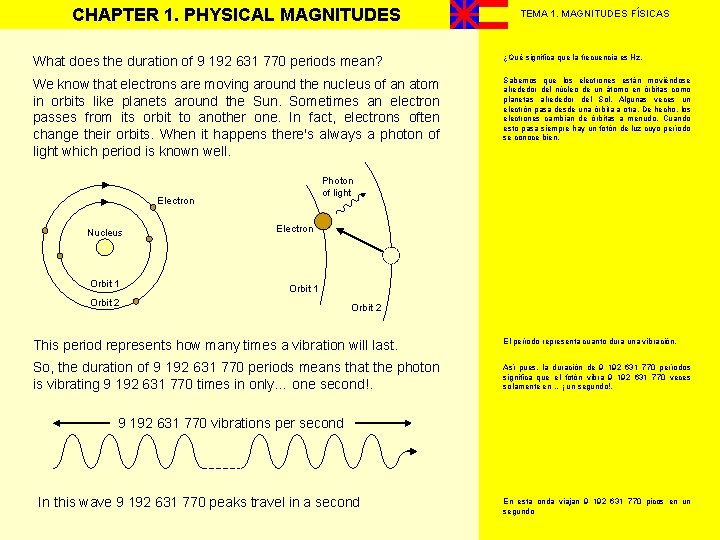
CHAPTER 1. PHYSICAL MAGNITUDES TEMA 1. MAGNITUDES FÍSICAS What does the duration of 9 192 631 770 periods mean? ¿Qué significa que la frecuencia es Hz. We know that electrons are moving around the nucleus of an atom in orbits like planets around the Sun. Sometimes an electron passes from its orbit to another one. In fact, electrons often change their orbits. When it happens there's always a photon of light which period is known well. Sabemos que los electrones están moviéndose alrededor del núcleo de un átomo en órbitas como planetas alrededor del Sol. Algunas veces un electrón pasa desde una órbita a otra. De hecho, los electrones cambian de órbitas a menudo. Cuando esto pasa siempre hay un fotón de luz cuyo período se conoce bien. Photon of light Electron Nucleus Orbit 1 Electron Orbit 1 Orbit 2 This period represents how many times a vibration will last. El período representa cuanto dura una vibración. So, the duration of 9 192 631 770 periods means that the photon is vibrating 9 192 631 770 times in only… one second!. Así pues, la duración de 9 192 631 770 períodos significa que el fotón vibra 9 192 631 770 veces solamente en …¡ un segundo!. 9 192 631 770 vibrations per second In this wave 9 192 631 770 peaks travel in a second En esta onda viajan 9 192 631 770 picos en un segundo
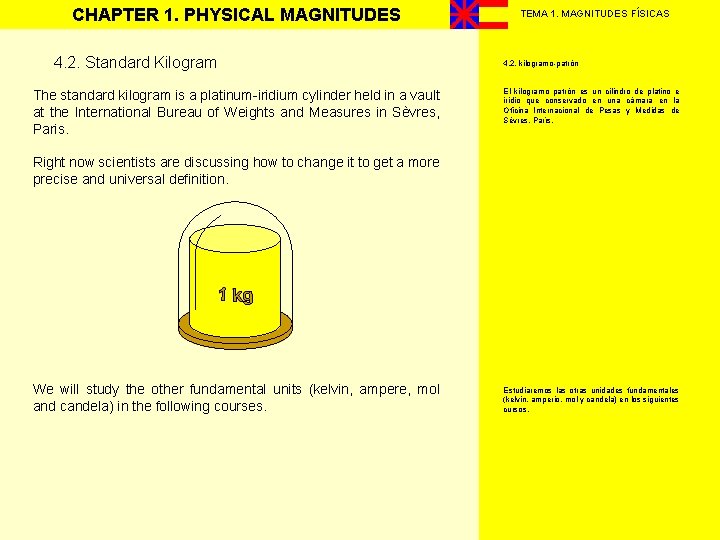
CHAPTER 1. PHYSICAL MAGNITUDES 4. 2. Standard Kilogram The standard kilogram is a platinum-iridium cylinder held in a vault at the International Bureau of Weights and Measures in Sèvres, Paris. TEMA 1. MAGNITUDES FÍSICAS 4. 2. kilogramo-patrón El kilogramo patrón es un cilindro de platino e iridio que conservado en una cámara en la Oficina Internacional de Pesas y Medidas de Sèvres, París. Right now scientists are discussing how to change it to get a more precise and universal definition. We will study the other fundamental units (kelvin, ampere, mol and candela) in the following courses. Estudiaremos las otras unidades fundamentales (kelvin, amperio, mol y candela) en los siguientes cursos.
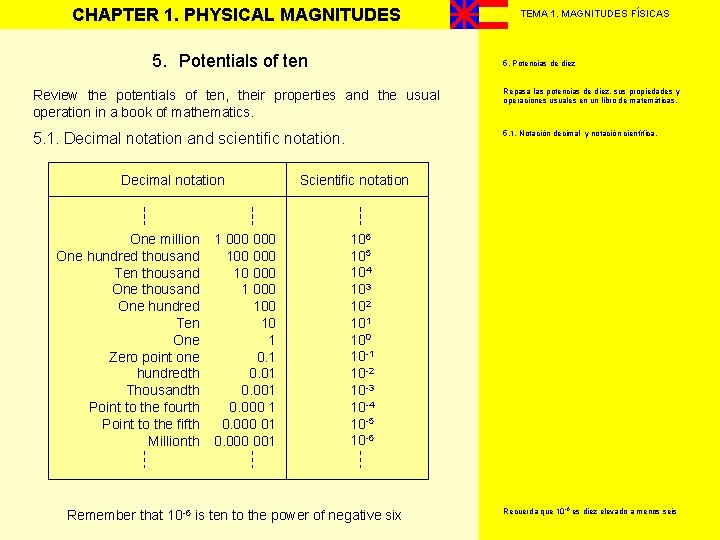
CHAPTER 1. PHYSICAL MAGNITUDES 5. Potentials of ten TEMA 1. MAGNITUDES FÍSICAS 5. Potencias de diez Review the potentials of ten, their properties and the usual operation in a book of mathematics. Repasa las potencias de diez, sus propiedades y operaciones usuales en un libro de matemáticas. 5. 1. Decimal notation and scientific notation. 5. 1. Notación decimal y notación científica. Decimal notation One million One hundred thousand Ten thousand One hundred Ten One Zero point one hundredth Thousandth Point to the fourth Point to the fifth Millionth 1 000 100 000 10 1 0. 01 0. 000 001 Scientific notation 106 105 104 103 102 101 100 10 -1 10 -2 10 -3 10 -4 10 -5 10 -6 Remember that 10 -6 is ten to the power of negative six Recuerda que 10 -6 es diez elevado a menos seis
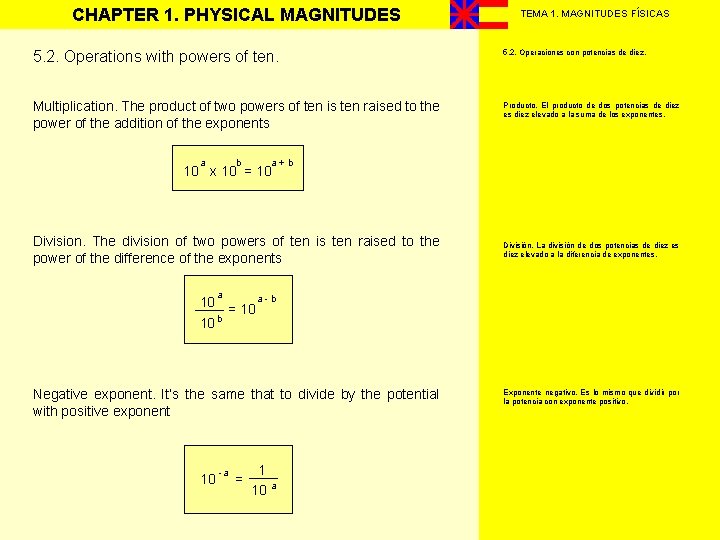
CHAPTER 1. PHYSICAL MAGNITUDES TEMA 1. MAGNITUDES FÍSICAS 5. 2. Operations with powers of ten. 5. 2. Operaciones con potencias de diez. Multiplication. The product of two powers of ten is ten raised to the power of the addition of the exponents Producto. El producto de dos potencias de diez es diez elevado a la suma de los exponentes. a b a+b 10 x 10 = 10 Division. The division of two powers of ten is ten raised to the power of the difference of the exponents División. La división de dos potencias de diez es diez elevado a la diferencia de exponentes. a 10 = 10 a - b 10 b Negative exponent. It’s the same that to divide by the potential with positive exponent 10 -a = 1 10 a Exponente negativo. Es lo mismo que dividir por la potencia con exponente positivo.
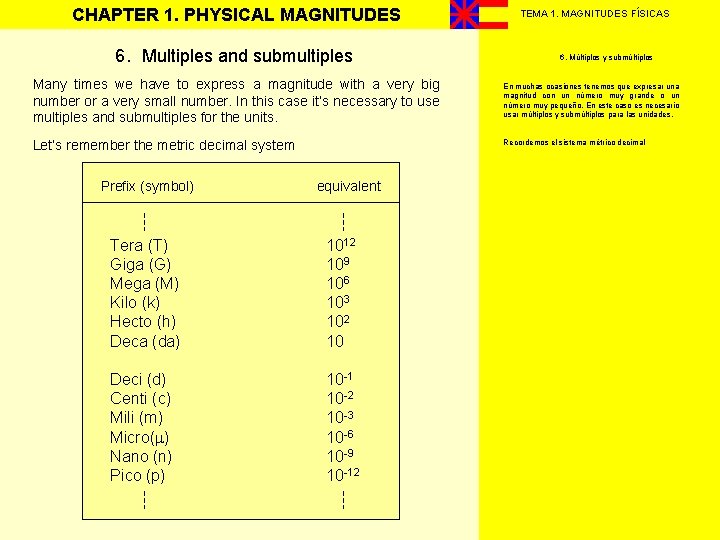
CHAPTER 1. PHYSICAL MAGNITUDES 6. Multiples and submultiples TEMA 1. MAGNITUDES FÍSICAS 6. Múltiplos y submúltiplos Many times we have to express a magnitude with a very big number or a very small number. In this case it’s necessary to use multiples and submultiples for the units. En muchas ocasiones tenemos que expresar una magnitud con un número muy grande o un número muy pequeño. En este caso es necesario usar múltiplos y submúltiplos para las unidades. Let’s remember the metric decimal system Recordemos el sistema métrico decimal Prefix (symbol) equivalent Tera (T) Giga (G) Mega (M) Kilo (k) Hecto (h) Deca (da) 1012 109 106 103 102 10 Deci (d) Centi (c) Mili (m) Micro( ) Nano (n) Pico (p) 10 -1 10 -2 10 -3 10 -6 10 -9 10 -12
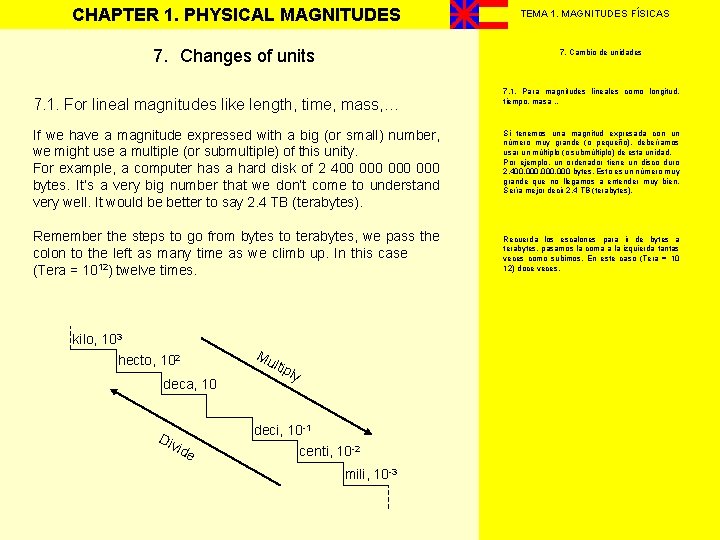
CHAPTER 1. PHYSICAL MAGNITUDES 7. Changes of units 7. Cambio de unidades 7. 1. For lineal magnitudes like length, time, mass, … If we have a magnitude expressed with a big (or small) number, we might use a multiple (or submultiple) of this unity. For example, a computer has a hard disk of 2 400 000 000 bytes. It’s a very big number that we don’t come to understand very well. It would be better to say 2. 4 TB (terabytes). Remember the steps to go from bytes to terabytes, we pass the colon to the left as many time as we climb up. In this case (Tera = 1012) twelve times. kilo, 103 hecto, 102 deca, 10 Div Mu ltip ly deci, 10 -1 ide TEMA 1. MAGNITUDES FÍSICAS centi, 10 -2 mili, 10 -3 7. 1. Para magnitudes lineales como longitud, tiempo, masa … Si tenemos una magnitud expresada con un número muy grande (o pequeño), deberíamos usar un múltiplo (o submúltiplo) de esta unidad. Por ejemplo, un ordenador tiene un disco duro 2. 400. 000 bytes. Esto es un número muy grande que no llegamos a entender muy bien. Sería mejor decir 2. 4 TB (terabytes). Recuerda los escalones para ir de bytes a terabytes, pasamos la coma a la izquierda tantas veces como subimos. En este caso (Tera = 10 12) doce veces.
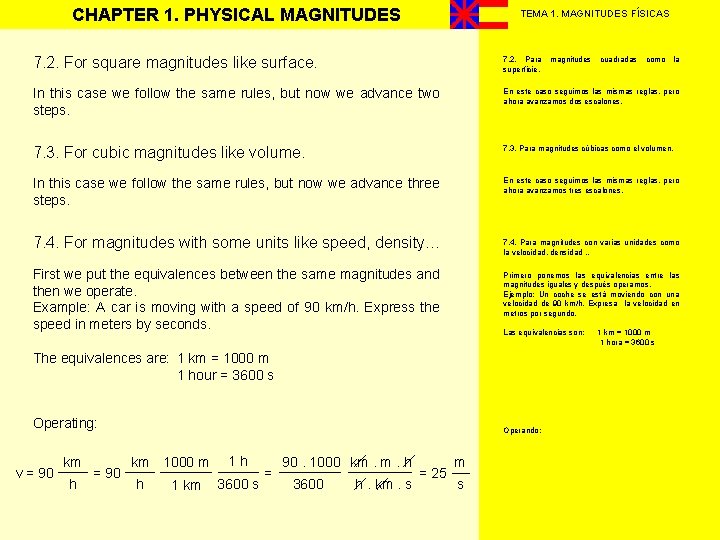
CHAPTER 1. PHYSICAL MAGNITUDES TEMA 1. MAGNITUDES FÍSICAS 7. 2. For square magnitudes like surface. 7. 2. Para superficie. In this case we follow the same rules, but now we advance two steps. En este caso seguimos las mismas reglas, pero ahora avanzamos dos escalones. 7. 3. For cubic magnitudes like volume. 7. 3. Para magnitudes cúbicas como el volumen. In this case we follow the same rules, but now we advance three steps. En este caso seguimos las mismas reglas, pero ahora avanzamos tres escalones. 7. 4. For magnitudes with some units like speed, density… Las equivalencias son: Operating: h = 90 Operando: km 1000 m h 1 km 1 h 3600 s = 90. 1000 km. m. h 3600 h. km. s = 25 como la Primero ponemos las equivalencias entre las magnitudes iguales y después operamos. Ejemplo: Un coche se está moviendo con una velocidad de 90 km/h. Expresa la velocidad en metros por segundo. The equivalences are: 1 km = 1000 m 1 hour = 3600 s km cuadradas 7. 4. Para magnitudes con varias unidades como la velocidad, densidad … First we put the equivalences between the same magnitudes and then we operate. Example: A car is moving with a speed of 90 km/h. Express the speed in meters by seconds. v = 90 magnitudes m s 1 km = 1000 m 1 hora = 3600 s
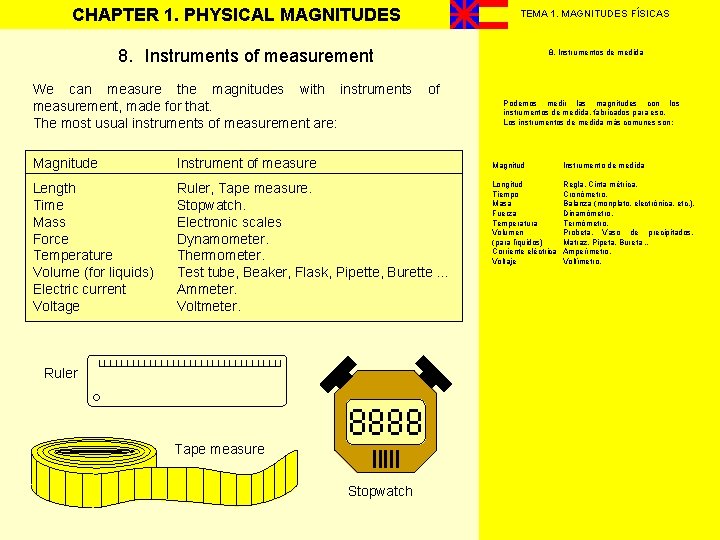
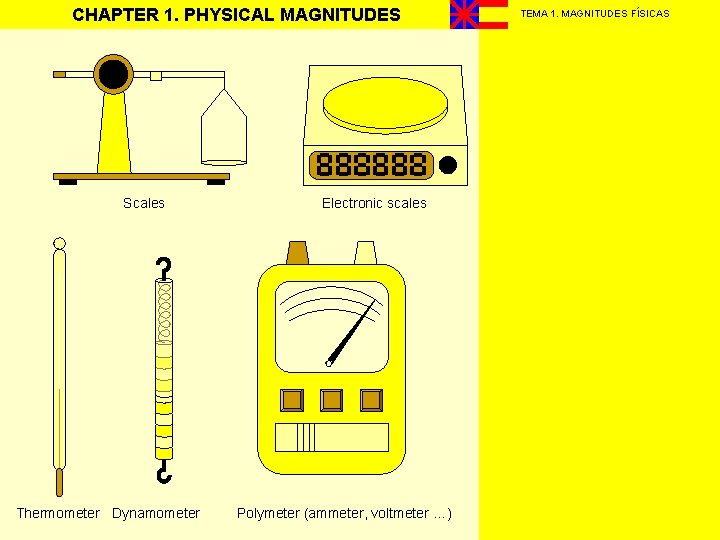
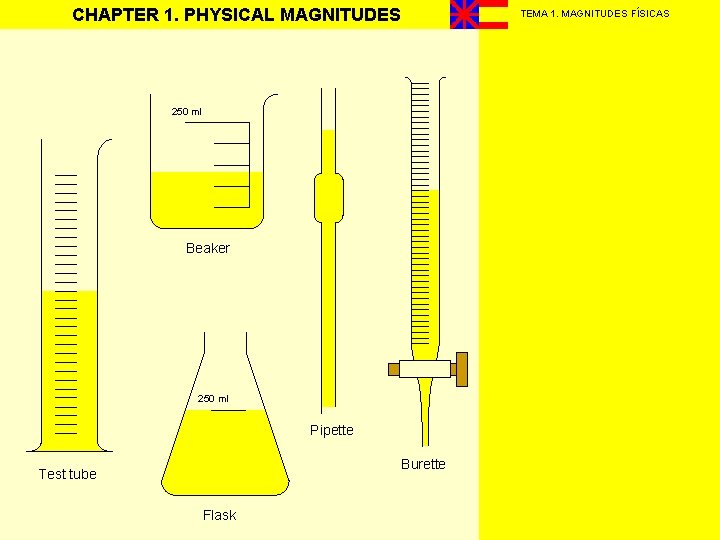
CHAPTER 1. PHYSICAL MAGNITUDES TEMA 1. MAGNITUDES FÍSICAS 8. Instruments of measurement We can measure the magnitudes with instruments measurement, made for that. The most usual instruments of measurement are: 8. Instrumentos de medida of Magnitude Instrument of measure Length Time Mass Force Temperature Volume (for liquids) Electric current Voltage Ruler, Tape measure. Stopwatch. Electronic scales Dynamometer. Thermometer. Test tube, Beaker, Flask, Pipette, Burette … Ammeter. Voltmeter. Ruler Tape measure Stopwatch Podemos medir las magnitudes con los instrumentos de medida, fabricados para eso. Los instrumentos de medida más comunes son: Magnitud Instrumento de medida Longitud Tiempo Masa Fuerza Temperatura Volumen (para líquidos) Corriente eléctrica Voltaje Regla, Cinta métrica. Cronómetro. Balanza (monplato, electrónica, etc. ). Dinamómetro. Termómetro. Probeta, Vaso de precipitados, Matraz, Pipeta, Bureta … Amperímetro. Voltímetro.
CHAPTER 1. PHYSICAL MAGNITUDES Scales Thermometer Dynamometer Electronic scales Polymeter (ammeter, voltmeter …) TEMA 1. MAGNITUDES FÍSICAS
CHAPTER 1. PHYSICAL MAGNITUDES TEMA 1. MAGNITUDES FÍSICAS 250 ml Beaker 250 ml Pipette Burette Test tube Flask