
Chapter 1 Overview Conceptualizing and Measuring Motivation and

- Slides: 27
Chapter 1 Overview: Conceptualizing and Measuring Motivation and the Role of Evolution in Motivation
Introduction • Motivation is the concept we use when we describe the forces acting on or within an organism to initiate and direct behavior. • More intense and persistent behavior is considered to be the results of higher levels of motivation. • Measurement of motivation • Stimulus • Intervening Variable (mediating mechanism) • Response • Performance Variable
Characteristics of Motivation 1. Activation • Persistence • Vigor 2. Direction • Directionality • Preference Test
Class Activity • Nature vs. Nurture Debate
Study of Motivation • Nomothetic (general; role of hypothalamus) vs. Idiographic (specific) • Innate vs. Acquired (internal vs. external motives) • Internal vs. External (needs vs. goals) • Mechanistic vs. Cognitive • Mechanistic approach assumes that change activates circuits which in turn produces behavior) • Cognitive: The way in which information is interpreted influences behavior
Levels of Analysis • Physiological Analysis • Brain’s control of motivated states • Individual Analysis • Insights about human behavior • Social Analysis • Contextual factors: Asch’s studies • Philosophical Analysis
Case Study: Angie’s Problem • Angie is constantly anxious. As a young child she used to get stomach aches before she performed on stage at dance recitals. As a teenager she was moody and anxious about how others saw her. Her self esteem could be crushed by minor comments made by her friends and family about her looks. In college she developed panic attacks that came suddenly out of the blue. She became fearful that she would have an attack when she had to give presentations in the class. As a result she avoided classes that required presentations in class.
Analysis of Angie’s Problem • Physiological Level • Genetic • Individual Level • Personality differences • Social Level • Experience with family and friends • Philosophical Level • Psychoanalysis vs Humanistic Psychology
Major Constructs in Motivation 1. Energy • General vs. Specific Energy 2. Physiological Mechanisms • Genetically programmed or wired in. • Evolution • Activation of circuits 3. Learning • Classical Conditioning • Operant Conditioning • Modeling
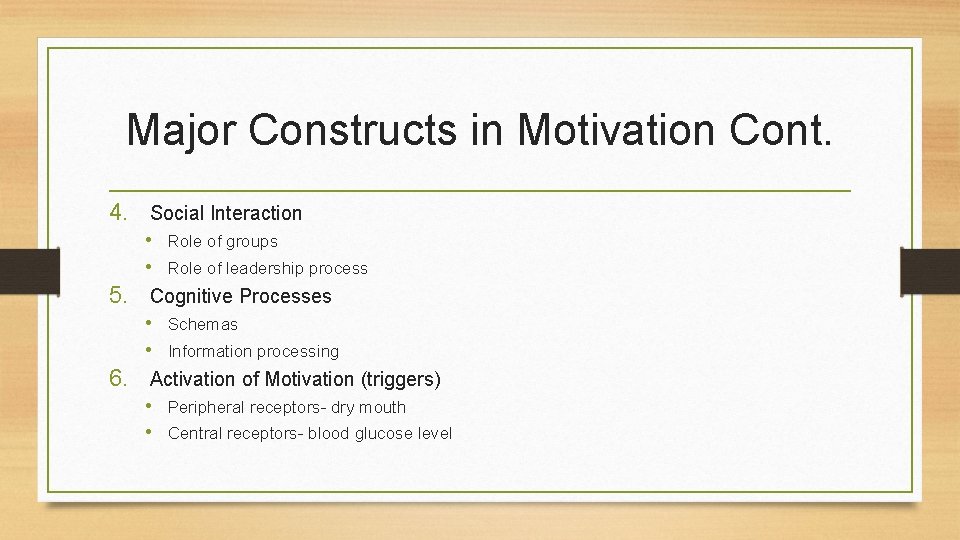
Major Constructs in Motivation Cont. 4. Social Interaction • Role of groups • Role of leadership process 5. Cognitive Processes • Schemas • Information processing 6. Activation of Motivation (triggers) • Peripheral receptors- dry mouth • Central receptors- blood glucose level
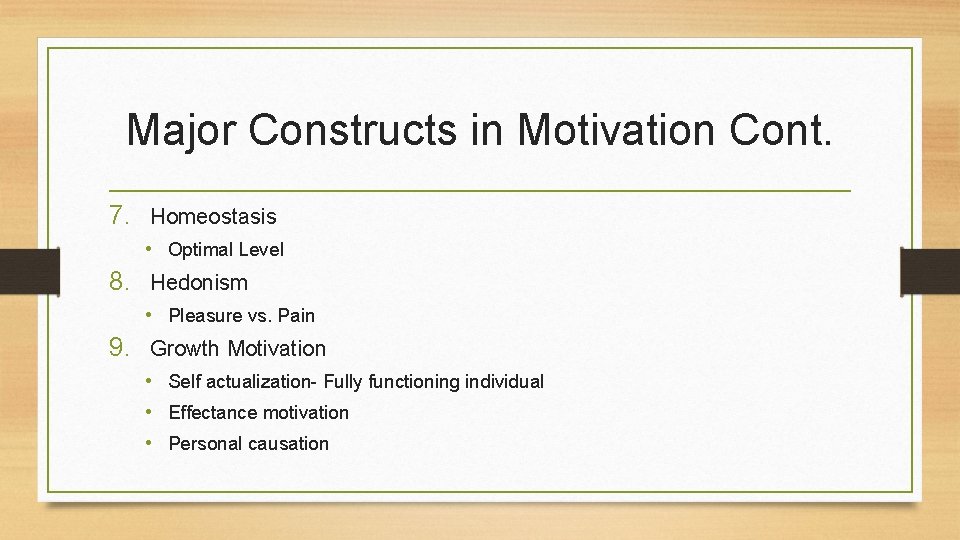
Major Constructs in Motivation Cont. 7. Homeostasis • Optimal Level 8. Hedonism • Pleasure vs. Pain 9. Growth Motivation • Self actualization- Fully functioning individual • Effectance motivation • Personal causation
Class Activity • List Motives (anything that energizes and directs behavior)
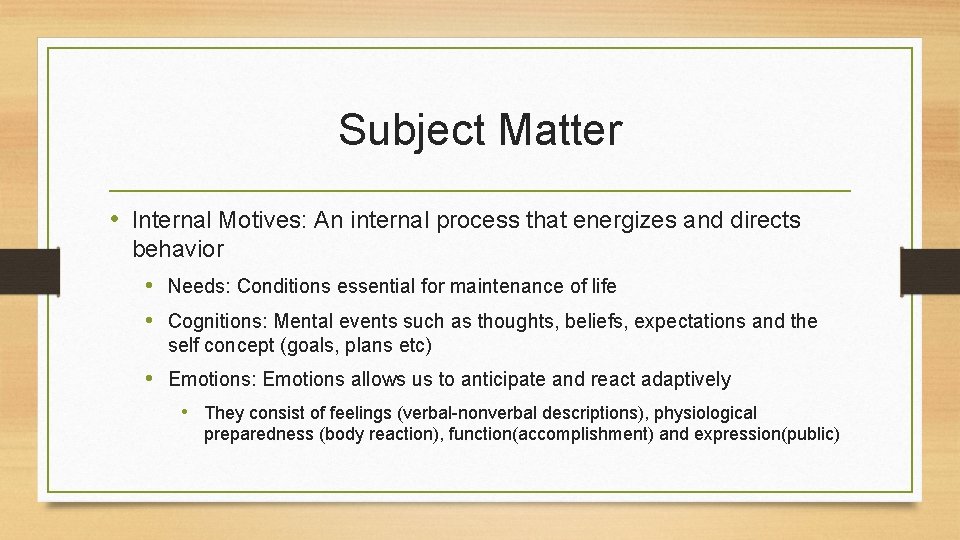
Subject Matter • Internal Motives: An internal process that energizes and directs behavior • Needs: Conditions essential for maintenance of life • Cognitions: Mental events such as thoughts, beliefs, expectations and the self concept (goals, plans etc) • Emotions: Emotions allows us to anticipate and react adaptively • They consist of feelings (verbal-nonverbal descriptions), physiological preparedness (body reaction), function(accomplishment) and expression(public)
Subject Matter • External Motives • External motives are environmental, social and cultural sources of motivation • Tangibles (money or praise)
Philosophical Antecedents • Aristotle • • • Free will Blank slate Nature vs. Nurture • Descartes • • • Dualism (partly free will and partly instincts) Instinct innateness • Locke • • Role of Experience (sensation and perception) Reflection Identify Nature and Nurture Position
Grand Theories • Will (or mind; Descartes): Volition act of choosing. • How people form intentions to act? • Instincts (William James, 1890; James Mc. Dougall, 1908) • Biological Determinism (evolution; genes make people behave in a specific way) • Drive (Freud, 1915; Hull, 1943) • Drive emerges from body needs; drive energized behavior and drive reduction was reinforcing and producing learning • Neglect of external and non-biological needs • Learning occurred despite drive reduction
Mini Theories • • Motivational Phenomenon (flow of experience) Contextual factors Groups of people (individual differences) Theoretical question (Relationship between emotion and motivation)
Examples of Mini Theories • Achievement Motivation (Atkinson, 1964; how people respond to standards of excellence) • Expectancy Theory (Vroom) • Intrinsic Motivation Theories (Deci, 1975) • Goal Setting Theory (Locke, 1968)
Three Trends • Active Nature of the Person • Active oriented portrayals of individuals active and growth seeking • Cognitive Revolution • Power of thoughts, beliefs and judgment • Applied Social Research (research beyond labs; applied research) • Social Psychology • Industrial/Organizational Psychology
Physiological Antecedents • Sensory and Motor Nerves • Specific Nerve Energies • Coded Messages • Electrical Nature of the Nerve Impulse • Helmholtz • Localization of Function • Role of Hypothalamus
Evolution and Motivation • Life • Reproduction (replication) • Metabolism (conversion of energy) • Mitosis • Single cell divides into two daughter cells • Asexual Reproduction • Meiosis • Two specialized cells each with half number of chromosomes are later combined to create a new cell that includes genetic information from each of the two cells. • Sexual Reproduction
Questions? • What is the primary motive? • Is it all important • What are secondary motives? • What are higher motives?
Evolution • Natural Selection • Genes that helps to adapt to survive. Natural Selection influences: • Viability (Certain behavior will increase the likelihood of the individual who possesses that gene living long enough to reproduce) Example- Baby crying • Fertility (Mating success) • Fecundity (Number of offspring produced; any gene that increases fecundity will be retained) • Sexual Selection • Competition for mates • Selection pressure (lioness preference for male with dark manes)
Evolution Cont. • Female vs. Male Sexual Strategies • Reproduction limitations • Raising the offspring • Mate Selection in Humans • Parental investment model (women will be attracted to men who possess resources to support women and their offspring) • Display of resources (to obtain mates men display resources; gift giving) • Reproductive value (both the sexes compete for mates with resources by engaging in behaviors e. g. women maintaining youthfulness, enhancing appearance)
Components in Human Behavior • Instinct • Emotion • Thoughts
Themes in the study of motivation 1. 2. 3. 4. 5. 6. Motivation benefits adaptation Motives direct attention and prepare action Motives vary over time and influences the ongoing behavior Types of motivation exists Motivation includes approach and avoid tendencies Motivation reveals what people want
Final Thoughts • • Is motivation multiply determined? Is there a comprehensive theory of motivation? Does motivation evolve or change? Is motivation multidisciplinary?