
Chapter 1 Organizational Behavior as a Way of
Chapter 1: Organizational Behavior as a Way of Thinking and Acting
Goals of the Text • Examine the factors affecting human behavior • Analyze management problems from the individual’s perspective • Explore contemporary management • Understand core behavioral principles • Foster competency in critical skills • Provide exercises to enable you to learn cognitively and experientially 2
Chapter Objectives • Importance of organizational behavior • Lenses through which to view OB • Skills critical to public and nonprofit management • Roots of OB in multiple disciplines • Values and assumptions of OB in the public and nonprofit sectors • Themes and purpose of the textbook 3
Human Behavior • Studying human behavior in public and nonprofit organizations enhances our understanding of − Our own behavior and ability to influence others − How we interact with others within the organization and the public 4
Serving the Public Interest • To be effective, managers and administrators must − Lead and motivate − Work effectively in groups − Communicate clearly − Think creatively − Navigate change − Manage conflict 5
View Through Multiple Lenses • Individual − Motivation − Communication − Understanding organizational goals/purpose 6
View Through Multiple Lenses • Group − Team membership − Team culture − Team goals/purpose 7
View Through Multiple Lenses • Organization − Structure − Management systems − Strategic plan − Decision making capabilities − Resources available 8
View Through Multiple Lenses • System − Funding − Legislators − Relations with public/constituencies 9
Public Organization Concerns • • • Motivating employees Being an effective team leader Leading and inspiring others Communicating Making effective decisions Using power & politics appropriately Having shared values Managing conflict Using diversity Helping people be innovative and creative 10
Organizational Behavior Is… • Study of how people behave in public organizations • Concerned with − How people act − Their motivation − How people interact with others • Distinct from organizational theory • Emphasizes human behavior and individual values 11
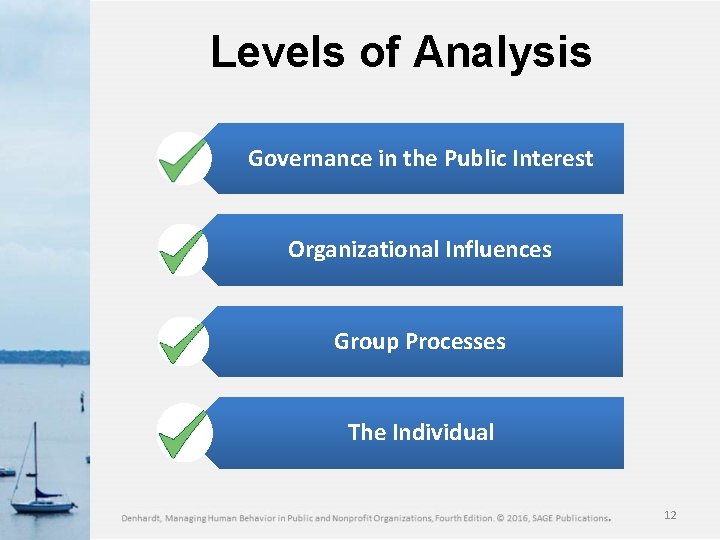
Levels of Analysis Governance in the Public Interest Organizational Influences Group Processes The Individual 12
The “What” of Management 1. External awareness 2. Interpretation 3. Representation 4. Co-ordination 5. Planning 6. Guidance 7. Budgeting 8. Managing material 9. Personnel management 10. Supervision 11. Monitoring 12. Evaluating Source: Flanders & Utterback (1985). 13
The “How” of Management 1. Broad perspective 2. Strategic view 3. Environmental sensitivity 4. Leadership 5. Flexibility 6. Action orientation 7. Results focus 8. Communication 9. Interpersonal sensitivity 10. Technical competence Source: Flanders & Utterback (1985). 14
Framework • First-line managers − Technical competence, interpersonal sensitivity, communication • Middle-level managers − Leadership, action orientation, results focus • Executives − Broad perspective, environmental sensitivity, strategic view Source: Flanders & Utterback (1985). 15
Roots • Early 1900 s − Focus on controlling workers and manipulating environment − People viewed as extensions of their tools and machines − Motivation based on rewards or punishment 16
Roots • Frederick Taylor (1911) − Father of “scientific management” − A “best way” to perform a task with money as a motivator through a “piece rate” − Make workers (naturally lazy and stupid) more productive and would obey orders without questions 17
Roots • Hugo Munsterberg − More humanistic − Greater attention to psychology of workers • Mary Parker Follett − Need to understand motivating desires of individuals and groups 18
Roots • Hawthorne studies − Studied relationship between work conditions and fatigue/monotony among workers − People change behavior when they know they are being observed (Hawthorne effect) − Human relationships influenced the behavior of workers − Behavior and motivation is complex 19
Roots • Chester Barnard − Need to build co-operation function of the manager • Herbert Simon − Rational decision making and incentives • Kurt Lewin − Include workers in problem solving 20
Roots • Douglas Mc. Gregor − Unity of purpose; Theory X v. Theory Y • Abraham Maslow − Hierarchy of needs • Vroom & Lawler − Expectancy theory and expanded expectancy model for motivation • Likert, Argyris, and Blake & Mouton − Importance of groups and teams 21
Multidisciplinary Influences • • • Sociology Anthropology Political science Management theorists Psychology 22
Good Management Difference • Employee engagement makes a difference in productivity, quality, and customer service • Positive leadership factors − Strength-based approach − Positive perspective − Frequent recognition and encouragement • People don’t quit jobs, they quit their bosses 23
Themes • Understand the behavior, motivations, and actions of individuals in the public service • Focus on the distinctiveness of public organizations • Learn not only from reading but also from experience 24
Values and Assumptions • Human behavior is purposeful • Behavior is not random • Behavior can be changed through learning • People should be valued as humans • Public service is about serving others 25
- Slides: 25