
Chapter 1 Operations and Competitiveness Lecture Outline w



- Slides: 32
Chapter 1 Operations and Competitiveness
Lecture Outline w w w w What Do Operations Managers Do? Operations Function Evolution of Operations Management and E–business Globalization and Competitiveness Primary Topics in Operations Management Learning Objectives for this Course 1 -2
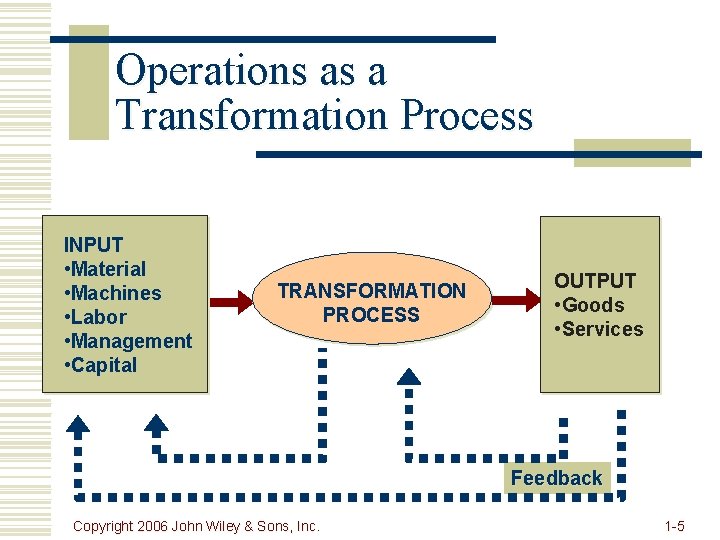
What Do Operations Managers Do? w What is Operations? n a function or system that transforms inputs into outputs of greater value w What is a Transformation Process? n n a series of activities along a value chain extending from supplier to customer. activities that do not add value are superfluous and should be eliminated w What is Operations Management? n design, operation, and improvement of productive systems Copyright 2006 John Wiley & Sons, Inc. 1 -3
Transformation Process w w w Physical: as in manufacturing operations Locational: as in transportation operations Exchange: as in retail operations Physiological: as in health care Psychological: as in entertainment Informational: as in communication Copyright 2006 John Wiley & Sons, Inc. 1 -4
Operations as a Transformation Process INPUT • Material • Machines • Labor • Management • Capital TRANSFORMATION PROCESS OUTPUT • Goods • Services Feedback Copyright 2006 John Wiley & Sons, Inc. 1 -5
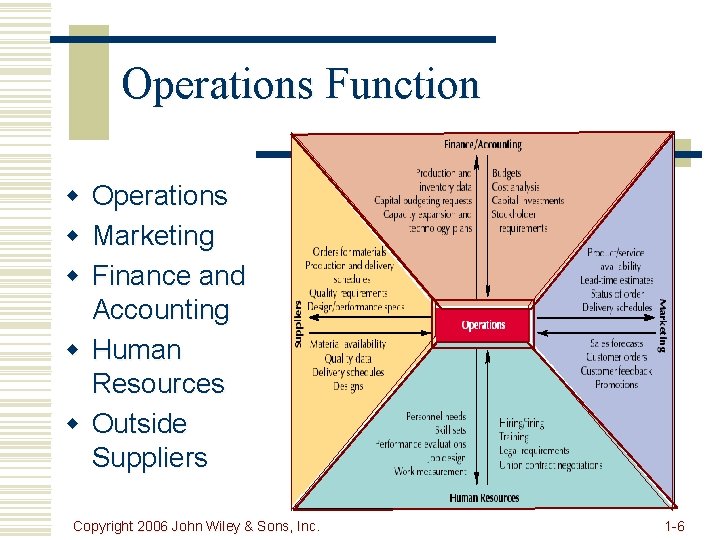
Operations Function w Operations w Marketing w Finance and Accounting w Human Resources w Outside Suppliers Copyright 2006 John Wiley & Sons, Inc. 1 -6
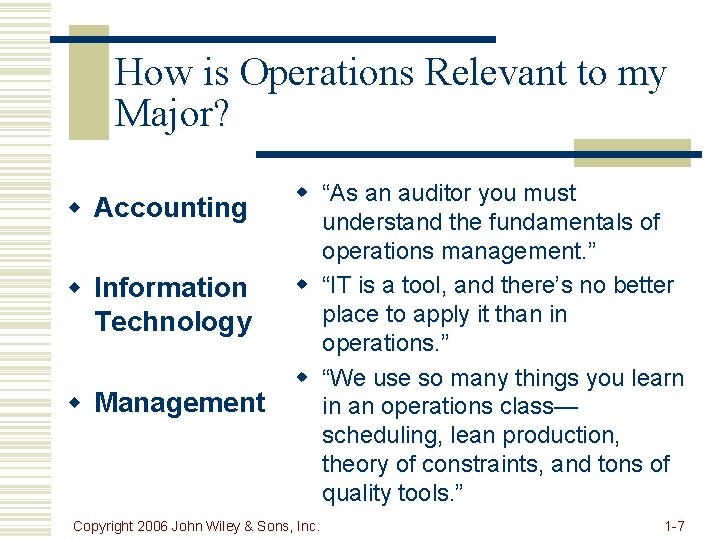
How is Operations Relevant to my Major? w Accounting w Information Technology w Management w “As an auditor you must understand the fundamentals of operations management. ” w “IT is a tool, and there’s no better place to apply it than in operations. ” w “We use so many things you learn in an operations class— scheduling, lean production, theory of constraints, and tons of quality tools. ” Copyright 2006 John Wiley & Sons, Inc. 1 -7
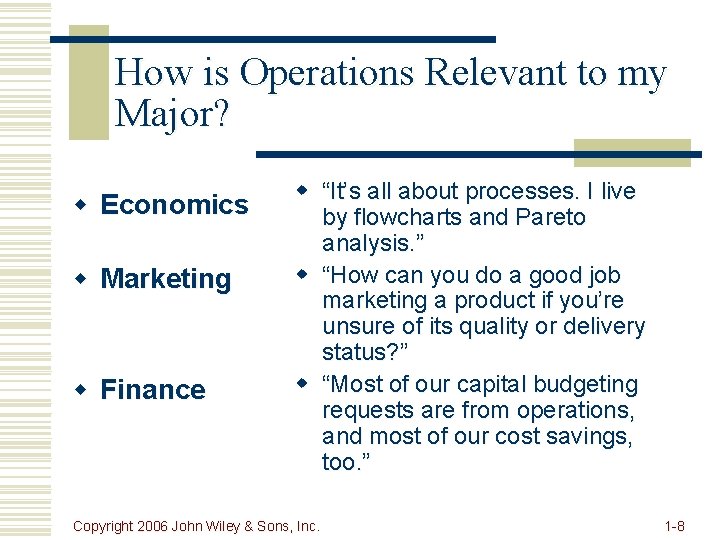
How is Operations Relevant to my Major? w Economics w Marketing w Finance w “It’s all about processes. I live by flowcharts and Pareto analysis. ” w “How can you do a good job marketing a product if you’re unsure of its quality or delivery status? ” w “Most of our capital budgeting requests are from operations, and most of our cost savings, too. ” Copyright 2006 John Wiley & Sons, Inc. 1 -8
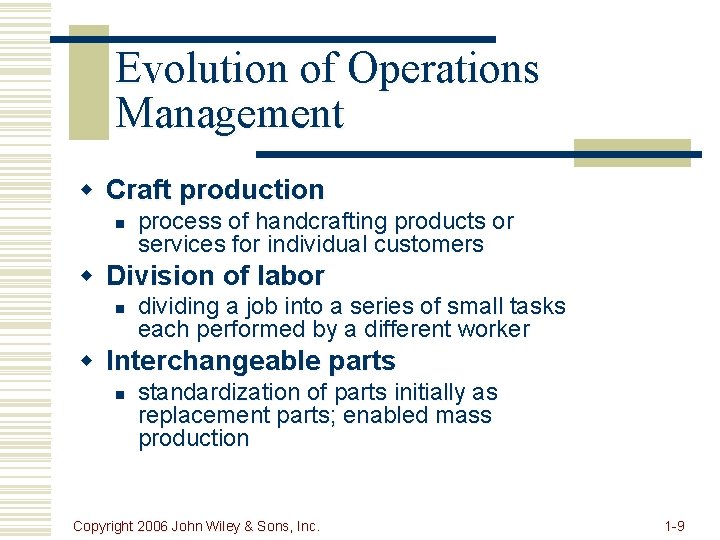
Evolution of Operations Management w Craft production n process of handcrafting products or services for individual customers w Division of labor n dividing a job into a series of small tasks each performed by a different worker w Interchangeable parts n standardization of parts initially as replacement parts; enabled mass production Copyright 2006 John Wiley & Sons, Inc. 1 -9
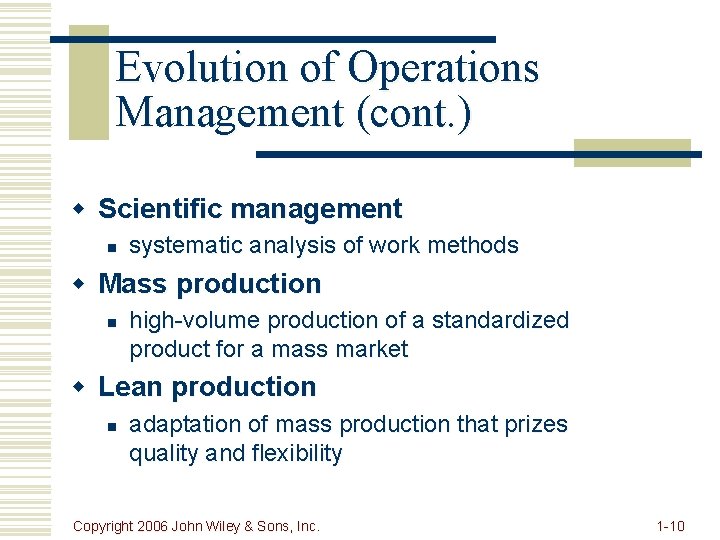
Evolution of Operations Management (cont. ) w Scientific management n systematic analysis of work methods w Mass production n high-volume production of a standardized product for a mass market w Lean production n adaptation of mass production that prizes quality and flexibility Copyright 2006 John Wiley & Sons, Inc. 1 -10
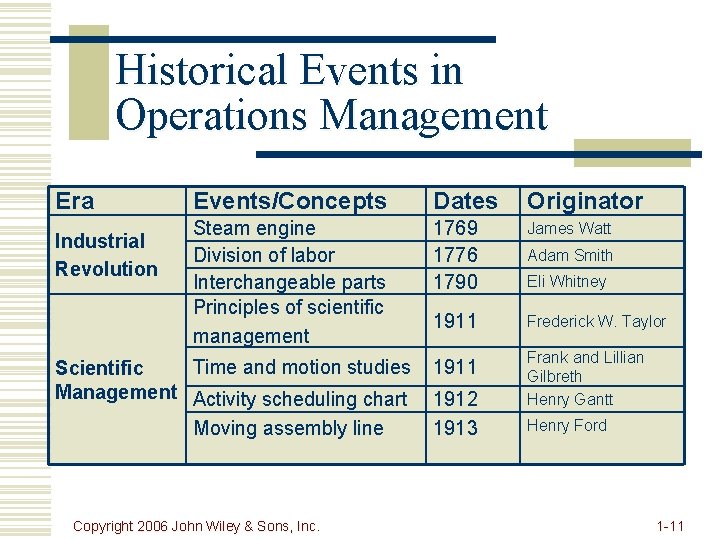
Historical Events in Operations Management Era Industrial Revolution Events/Concepts Dates Originator Steam engine Division of labor Interchangeable parts Principles of scientific management 1769 1776 1790 James Watt 1911 Frederick W. Taylor 1911 Frank and Lillian Gilbreth Henry Gantt Time and motion studies Scientific Management Activity scheduling chart Moving assembly line Copyright 2006 John Wiley & Sons, Inc. 1912 1913 Adam Smith Eli Whitney Henry Ford 1 -11
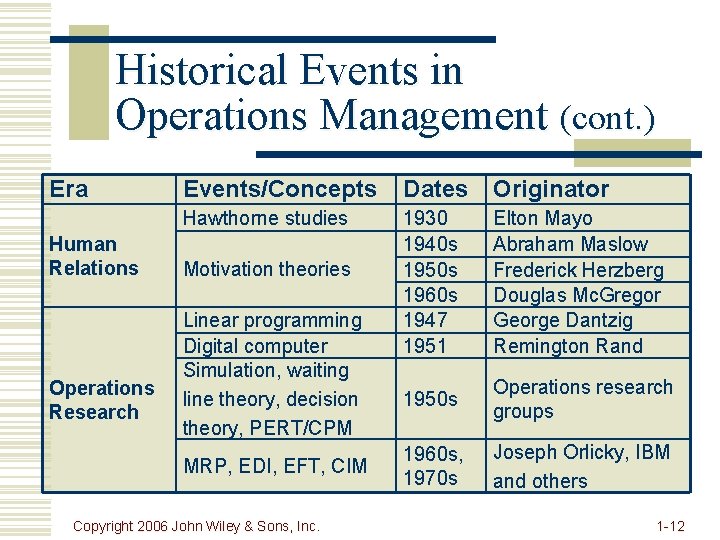
Historical Events in Operations Management (cont. ) Era Human Relations Operations Research Events/Concepts Dates Originator Hawthorne studies 1930 1940 s 1950 s 1960 s 1947 1951 Elton Mayo Abraham Maslow Frederick Herzberg Douglas Mc. Gregor George Dantzig Remington Rand 1950 s Operations research groups 1960 s, 1970 s Joseph Orlicky, IBM and others Motivation theories Linear programming Digital computer Simulation, waiting line theory, decision theory, PERT/CPM MRP, EDI, EFT, CIM Copyright 2006 John Wiley & Sons, Inc. 1 -12
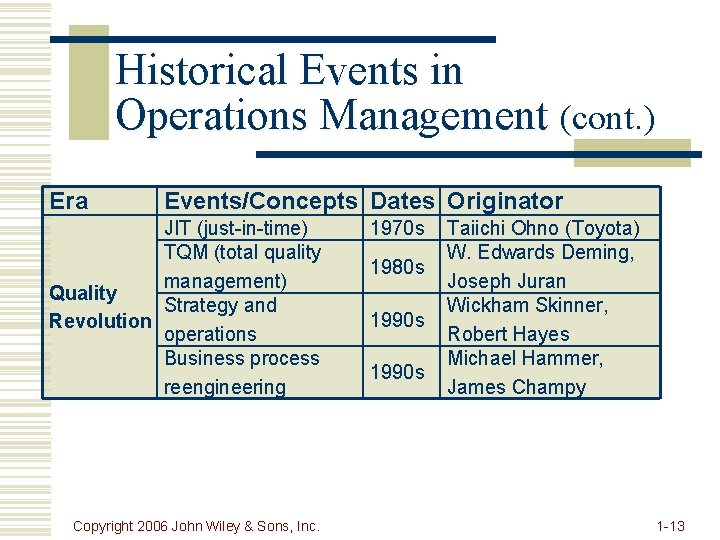
Historical Events in Operations Management (cont. ) Era Events/Concepts Dates Originator JIT (just-in-time) TQM (total quality management) Quality Strategy and Revolution operations Business process reengineering Copyright 2006 John Wiley & Sons, Inc. 1970 s 1980 s 1990 s Taiichi Ohno (Toyota) W. Edwards Deming, Joseph Juran Wickham Skinner, Robert Hayes Michael Hammer, James Champy 1 -13
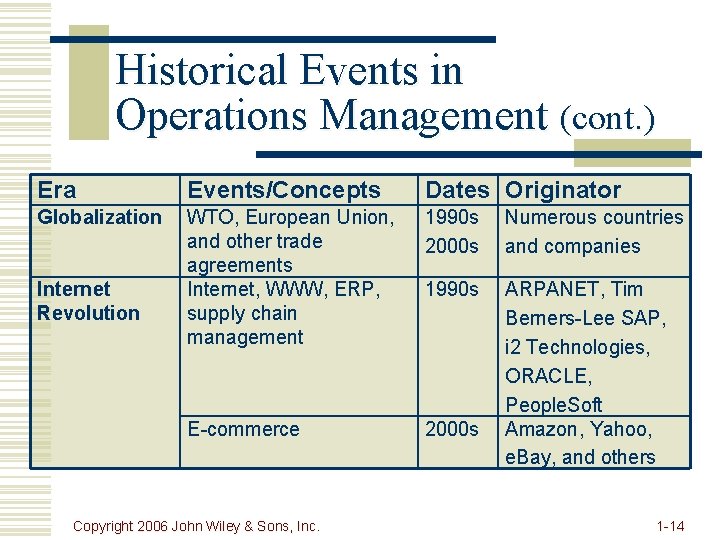
Historical Events in Operations Management (cont. ) Era Events/Concepts Dates Originator Globalization WTO, European Union, and other trade agreements Internet, WWW, ERP, supply chain management 1990 s 2000 s Numerous countries and companies 1990 s E-commerce 2000 s ARPANET, Tim Berners-Lee SAP, i 2 Technologies, ORACLE, People. Soft Amazon, Yahoo, e. Bay, and others Internet Revolution Copyright 2006 John Wiley & Sons, Inc. 1 -14
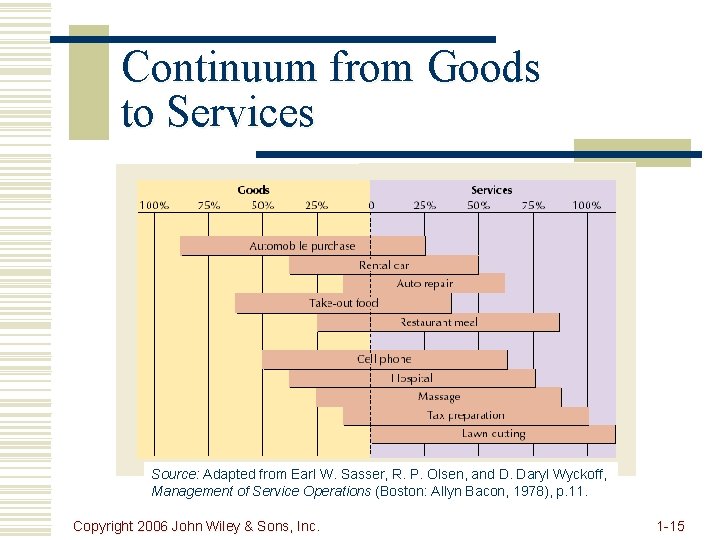
Continuum from Goods to Services Source: Adapted from Earl W. Sasser, R. P. Olsen, and D. Daryl Wyckoff, Management of Service Operations (Boston: Allyn Bacon, 1978), p. 11. Copyright 2006 John Wiley & Sons, Inc. 1 -15
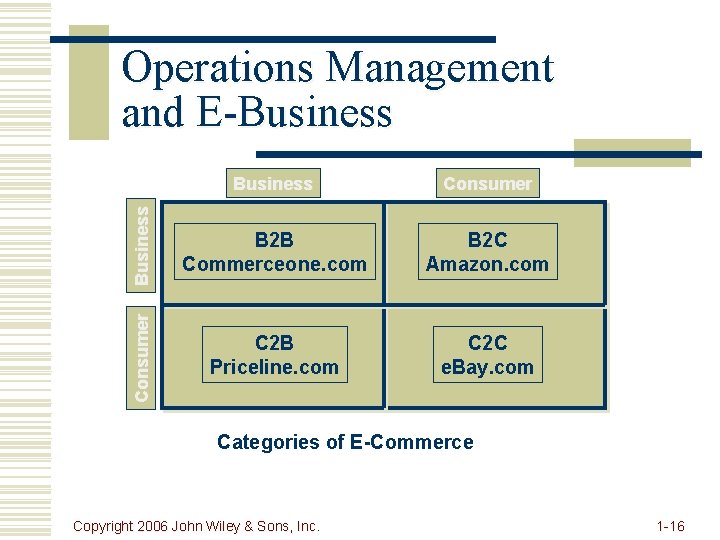
Business Consumer Business B 2 B Commerceone. com B 2 C Amazon. com Consumer Operations Management and E-Business C 2 B Priceline. com C 2 C e. Bay. com Categories of E-Commerce Copyright 2006 John Wiley & Sons, Inc. 1 -16
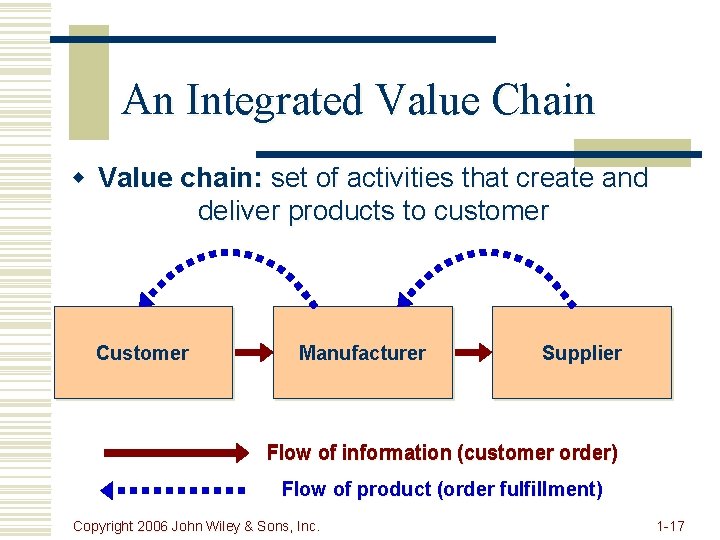
An Integrated Value Chain w Value chain: set of activities that create and deliver products to customer Customer Manufacturer Supplier Flow of information (customer order) Flow of product (order fulfillment) Copyright 2006 John Wiley & Sons, Inc. 1 -17
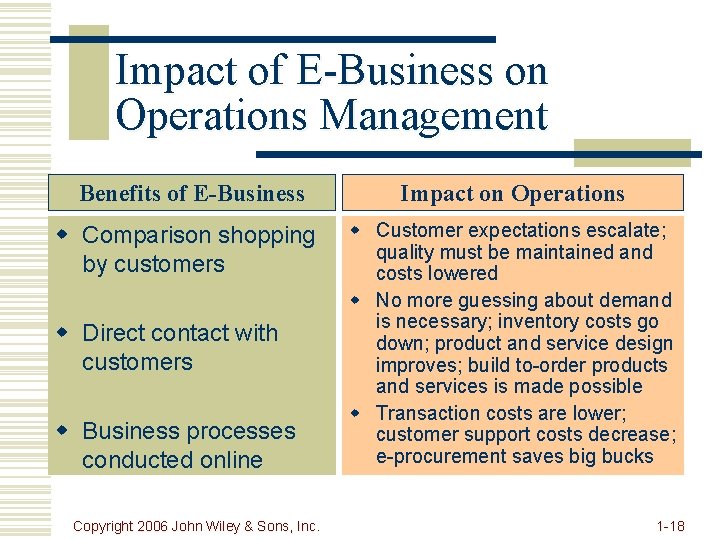
Impact of E-Business on Operations Management Benefits of E-Business w Comparison shopping by customers w Direct contact with customers w Business processes conducted online Copyright 2006 John Wiley & Sons, Inc. Impact on Operations w Customer expectations escalate; quality must be maintained and costs lowered w No more guessing about demand is necessary; inventory costs go down; product and service design improves; build to-order products and services is made possible w Transaction costs are lower; customer support costs decrease; e-procurement saves big bucks 1 -18
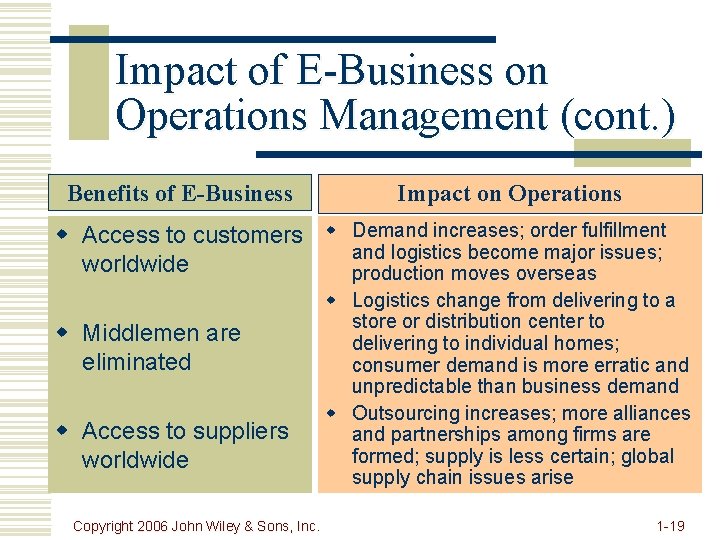
Impact of E-Business on Operations Management (cont. ) Benefits of E-Business Impact on Operations w Access to customers w Demand increases; order fulfillment and logistics become major issues; worldwide production moves overseas w Middlemen are eliminated w Access to suppliers worldwide Copyright 2006 John Wiley & Sons, Inc. w Logistics change from delivering to a store or distribution center to delivering to individual homes; consumer demand is more erratic and unpredictable than business demand w Outsourcing increases; more alliances and partnerships among firms are formed; supply is less certain; global supply chain issues arise 1 -19
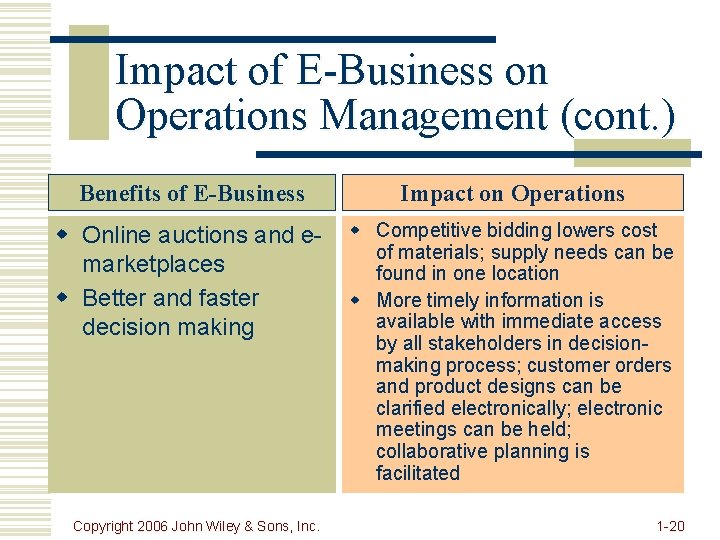
Impact of E-Business on Operations Management (cont. ) Benefits of E-Business Impact on Operations w Online auctions and emarketplaces w Better and faster decision making w Competitive bidding lowers cost of materials; supply needs can be found in one location w More timely information is available with immediate access by all stakeholders in decisionmaking process; customer orders and product designs can be clarified electronically; electronic meetings can be held; collaborative planning is facilitated Copyright 2006 John Wiley & Sons, Inc. 1 -20
Impact of E-Business on Operations Management (cont. ) Benefits of E-Business w IT synergy w Expanded supply chains Copyright 2006 John Wiley & Sons, Inc. Impact on Operations w Productivity increases as information can be shared more efficiently internally and between trading partners w Order fulfillment, logistics, warehousing, transportation and delivery become focus of operations management; risk is spread out; trade barriers fall 1 -21
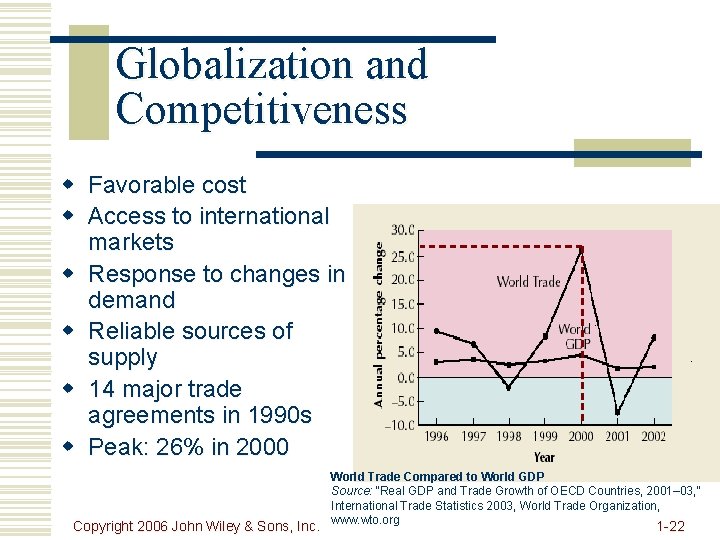
Globalization and Competitiveness w Favorable cost w Access to international markets w Response to changes in demand w Reliable sources of supply w 14 major trade agreements in 1990 s w Peak: 26% in 2000 Copyright 2006 John Wiley & Sons, Inc. World Trade Compared to World GDP Source: “Real GDP and Trade Growth of OECD Countries, 2001– 03, ” International Trade Statistics 2003, World Trade Organization, www. wto. org 1 -22
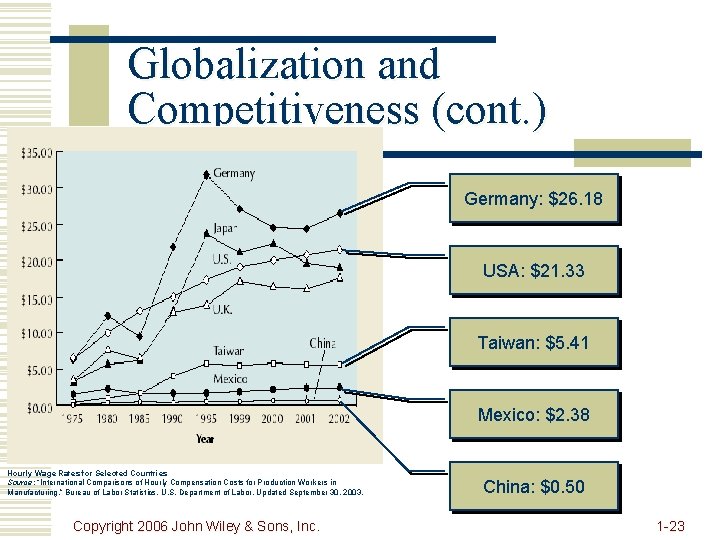
Globalization and Competitiveness (cont. ) Germany: $26. 18 USA: $21. 33 Taiwan: $5. 41 Mexico: $2. 38 Hourly Wage Rates for Selected Countries Source: “International Comparisons of Hourly Compensation Costs for Production Workers in Manufacturing, ” Bureau of Labor Statistics, U. S. Department of Labor, Updated September 30, 2003. Copyright 2006 John Wiley & Sons, Inc. China: $0. 50 1 -23
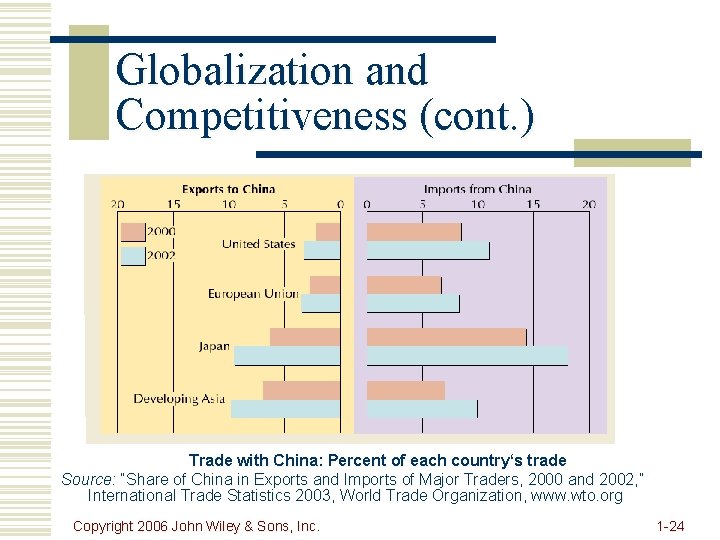
Globalization and Competitiveness (cont. ) Trade with China: Percent of each country‘s trade Source: “Share of China in Exports and Imports of Major Traders, 2000 and 2002, ” International Trade Statistics 2003, World Trade Organization, www. wto. org Copyright 2006 John Wiley & Sons, Inc. 1 -24
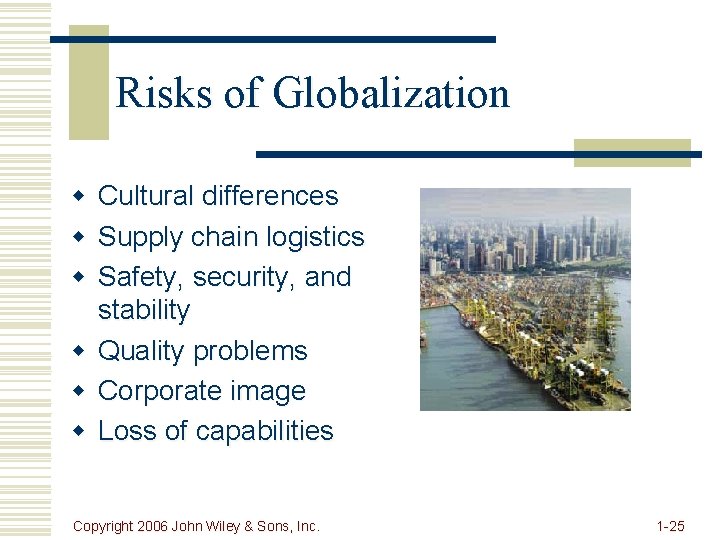
Risks of Globalization w Cultural differences w Supply chain logistics w Safety, security, and stability w Quality problems w Corporate image w Loss of capabilities Copyright 2006 John Wiley & Sons, Inc. 1 -25
Competitiveness and Productivity w Competitiveness n degree to which a nation can produce goods and services that meet the test of international markets w Productivity n ratio of output to input w Output n sales made, products produced, customers served, meals delivered, or calls answered w Input n labor hours, investment in equipment, material usage, or square footage Copyright 2006 John Wiley & Sons, Inc. 1 -26
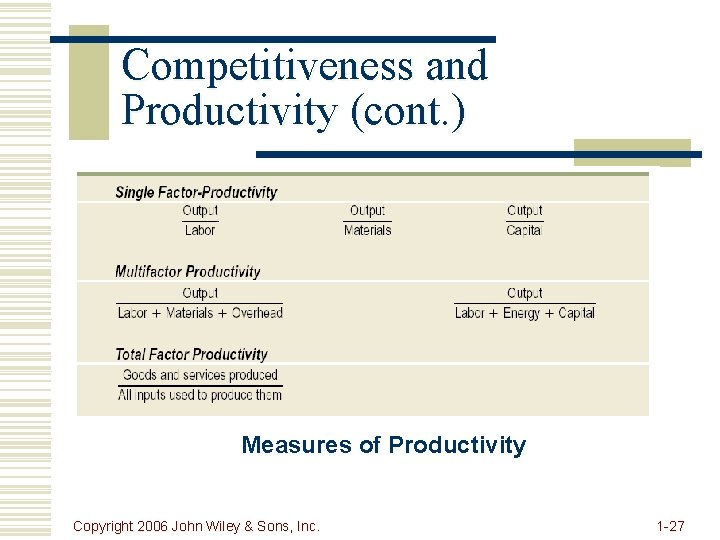
Competitiveness and Productivity (cont. ) Measures of Productivity Copyright 2006 John Wiley & Sons, Inc. 1 -27
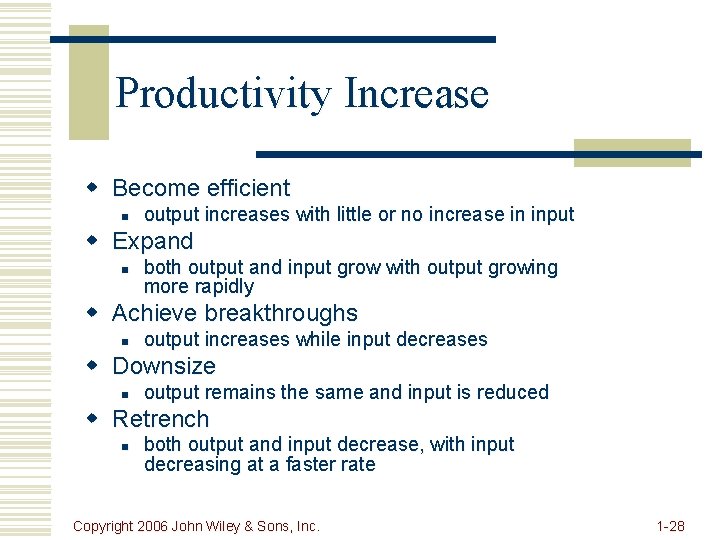
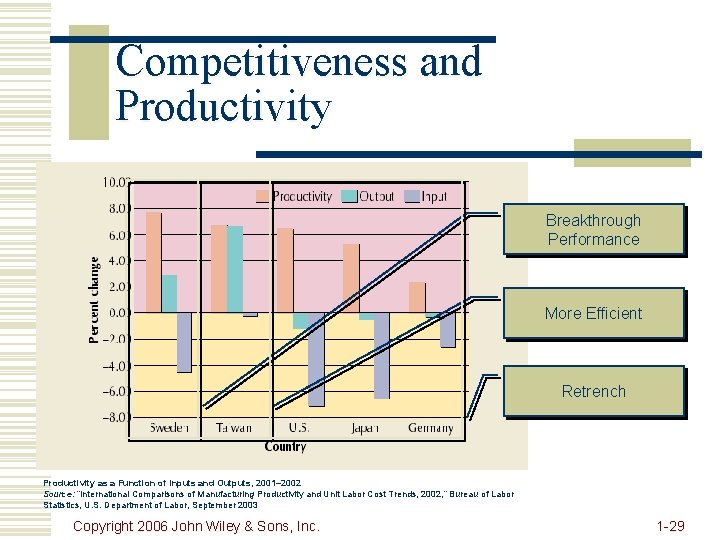
Productivity Increase w Become efficient n output increases with little or no increase in input w Expand n both output and input grow with output growing more rapidly w Achieve breakthroughs n output increases while input decreases w Downsize n output remains the same and input is reduced w Retrench n both output and input decrease, with input decreasing at a faster rate Copyright 2006 John Wiley & Sons, Inc. 1 -28
Competitiveness and Productivity Breakthrough Performance More Efficient Retrench Productivity as a Function of Inputs and Outputs, 2001– 2002 Source: “International Comparisons of Manufacturing Productivity and Unit Labor Cost Trends, 2002, ” Bureau of Labor Statistics, U. S. Department of Labor, September 2003 Copyright 2006 John Wiley & Sons, Inc. 1 -29
Operations–oriented Barriers to Entry w Economies of Scale w Capital Investment w Access to Supply and Distribution Channels w Learning Curve Copyright 2006 John Wiley & Sons, Inc. 1 -30
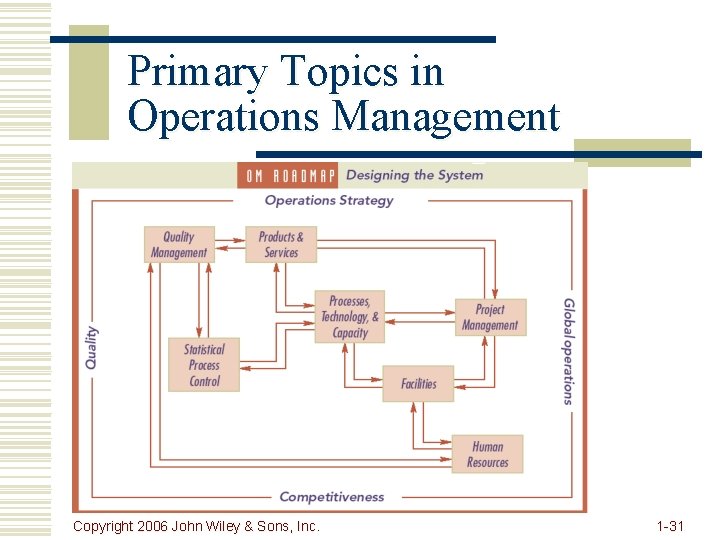
Primary Topics in Operations Management Copyright 2006 John Wiley & Sons, Inc. 1 -31
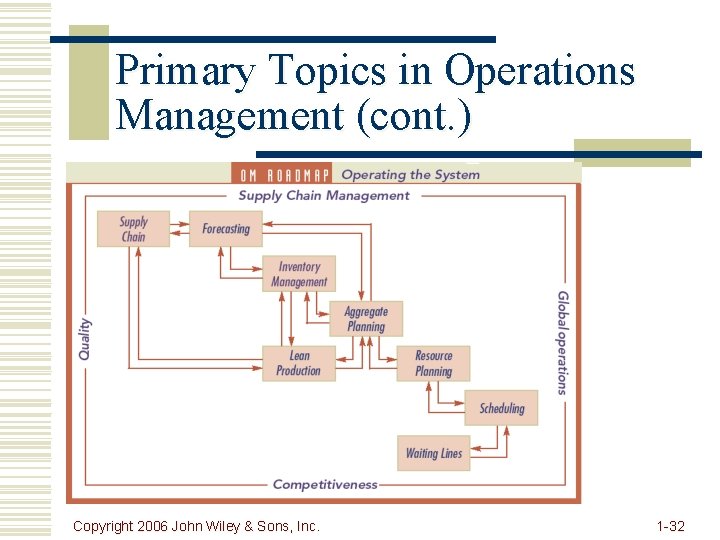
Primary Topics in Operations Management (cont. ) Copyright 2006 John Wiley & Sons, Inc. 1 -32