
Chapter 1 of a different textbook What Is
Chapter 1 (of a different textbook) What Is Science? Copyright © The Mc. Graw-Hill Companies, Inc. Permission required for reproduction or display.
Overview Quantitative description The nature of science • • The Scientific Method • Explanations and investigations • Laws and Principles • Models and theories Objects and properties Quantifying properties Measurement systems Standard metric units Metric prefixes Understanding from measurement
Objects and properties • Objects - things that can be seen or touched • Properties - qualities or attributes characteristic of an object • Referents - comparative properties in other, more familiar objects (Examples: “sky blue, ” “lemon yellow”) • Problem - language can be subjective, ambiguous and ultimately circular!
Quantifying properties Measurement: uses quantitative referents - “units” Three steps: 1. 2. 3. Comparing the referent unit to the property being described Following a procedure specifying how the comparison is done Counting how many standard units describe the property under consideration Essential - a number and name for the referent unit

Measurement systems (based upon standardized units) English system • Many units based upon parts of the human body • Different units are not systematically related Metric (SI) system • Established in 1791 • 7 base units: • • meter (m) kilogram (kg) second (s) ampere (A) kelvin (K) mole (mol) candela (cd) • All other units derive from these
Standard metric units for the 4 fundamental properties Length • Distance light travels in 1/299, 792, 458 s Mass • Referenced to standard metal cylinder Time • Referred to oscillation of cesium atom Charge (See electricity lecture) All other properties (e. g. volume) derived from these
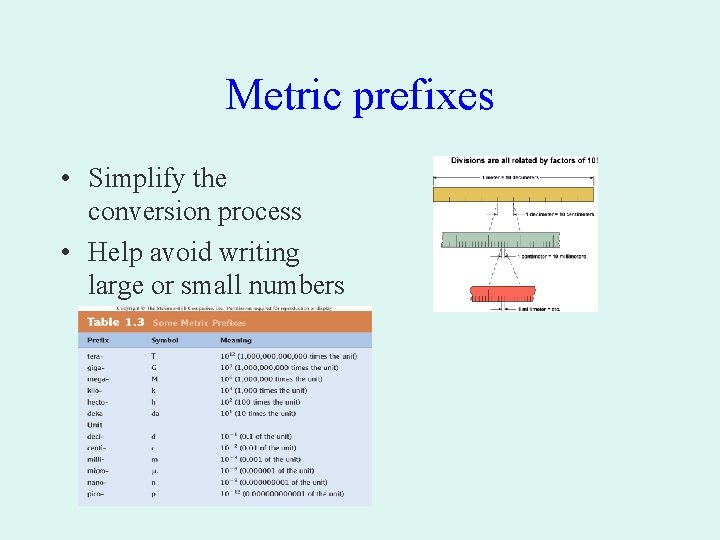
Metric prefixes • Simplify the conversion process • Help avoid writing large or small numbers
Understanding from measurement • • • Data Ratios and generalizations The density ratio Symbols and equations Problem solving made easy
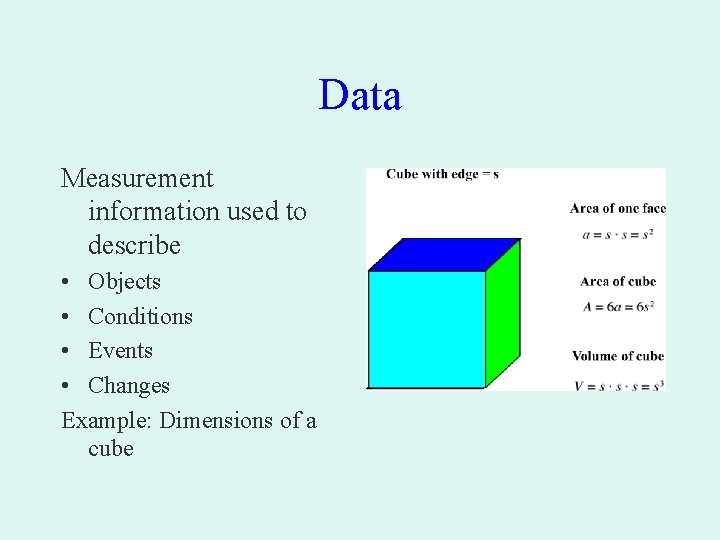
Data Measurement information used to describe • Objects • Conditions • Events • Changes Example: Dimensions of a cube
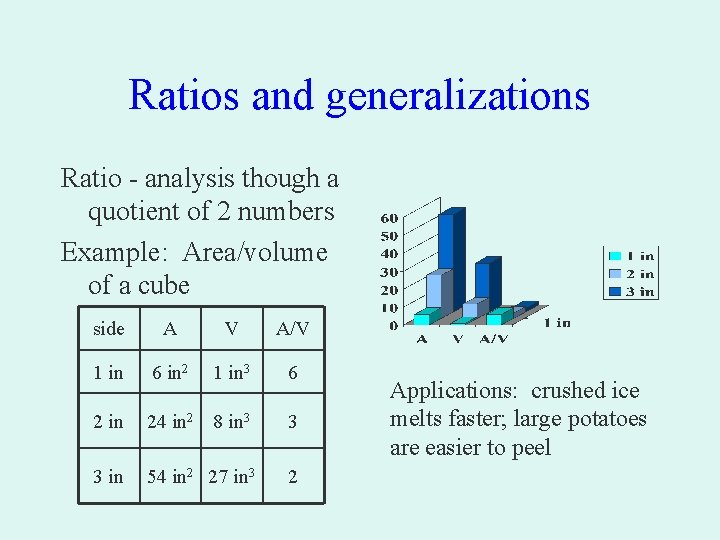
Ratios and generalizations Ratio - analysis though a quotient of 2 numbers Example: Area/volume of a cube side A V A/V 1 in 6 in 2 1 in 3 6 2 in 24 in 2 8 in 3 3 3 in 54 in 2 27 in 3 2 Applications: crushed ice melts faster; large potatoes are easier to peel
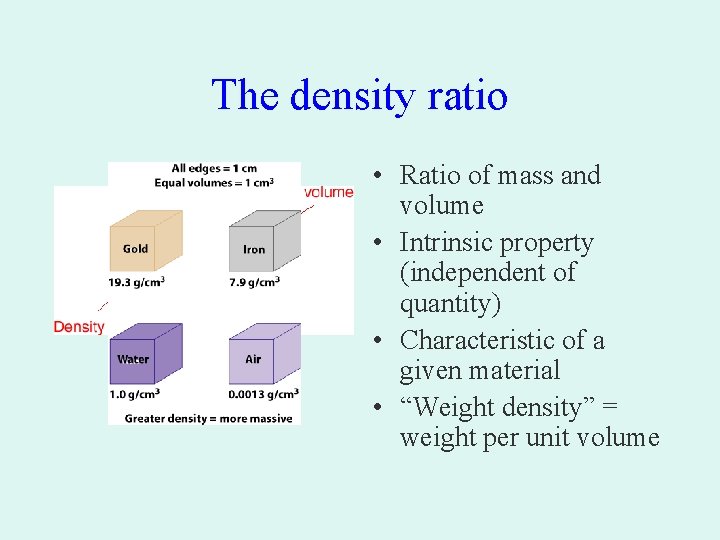
The density ratio • Ratio of mass and volume • Intrinsic property (independent of quantity) • Characteristic of a given material • “Weight density” = weight per unit volume
Symbols and equations Symbols • Represent quantities, measured properties Equations • Mathematical relationships between properties • Describe properties; define concepts; specify relationships
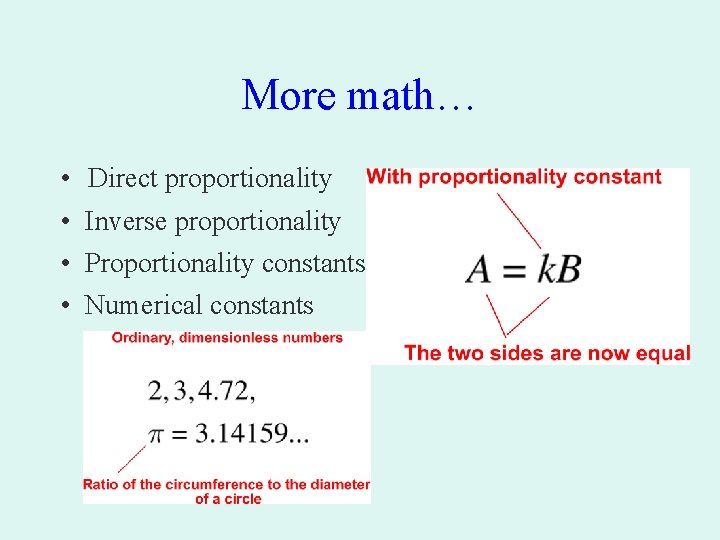
More math… • Direct proportionality • Inverse proportionality • Proportionality constants • Numerical constants
The nature of science Beginnings ~300 years ago • Associated with Galileo and Newton • Ancient natural philosophers - “thinking only” • Additional component here - understanding based upon experimental evidence
The Scientific Method 1. 2. 3. 4. Observe some aspect of nature Propose an explanation for something observed Use the explanation to make predictions Test the predictions with experiments or more observations 5. Modify explanation as needed 6. Return to 3.
The Scientific Method - Example 1. What are atoms made of? 2. Negative electrons orbiting positive nuclei 3. Colliding two atoms will produce free electrons and nuclei 4. Colliding two atoms yielded electrons, protons and neutrons 5. Atoms are made of electrons orbiting nuclei made of protons and neutrons 6. Collide two atoms at higher energy
General scientific activities • Collecting observations • Developing explanations • Testing explanations
Explanations and investigations Hypothesis - a tentative explanation for some observation Experiment - recreation of an event or occurrence to test a hypothesis Controlled experiment - comparing two situations with all factors alike except one • Control group - fixed set for comparison • Experimental group - differs from control group by one influencing factor
Laws, Models and Theories Laws – Important relationship observed to occur time after time – Descriptive in nature • Example: Charles’s Law - relationship between temperature and pressure in gases Models – Description of a theory or idea that accounts for all known properties – Can be physical, mathematical, based on a sketch or an analogy – Useful for regimes too small or too vast for direct observation Theories – Broadly based set of working hypotheses – Based upon considerable experimental support – Form the framework of thought and experiment
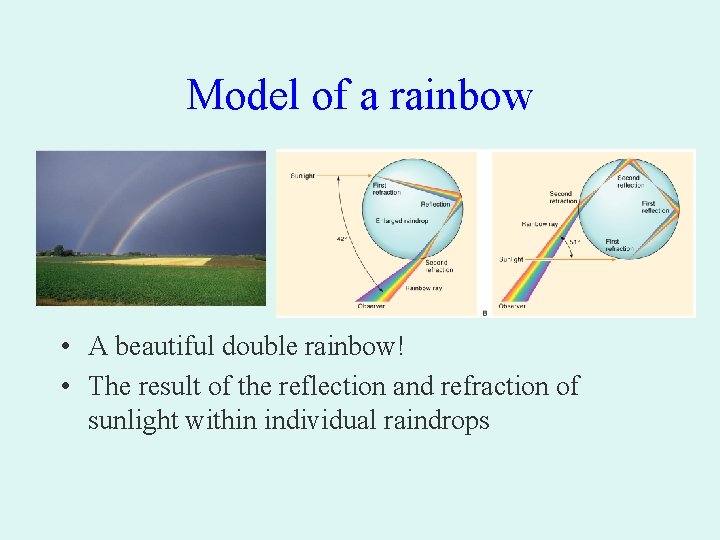
Model of a rainbow • A beautiful double rainbow! • The result of the reflection and refraction of sunlight within individual raindrops
Pseudoscience Misleading and often absurd claims of scientific results Tests: 1. Academic and scientific background of claimant 2. History of review by scientific peers 3. Participation in scientific institutions and organizations 4. Claim published in peer-reviewed journal and independently validated by others 5. Does the claimant have something to gain
- Slides: 21