
Chapter 1 n Foundations of Language and Literacy
- Slides: 29
Chapter 1 n Foundations of Language and Literacy Copyright 2012 Pearson Education. Vukelich, Helping Young Children Learn Language and Literacy: Birth Through Kindergarten 3/e
Think about: Your beliefs about how young children first learn to read and write Your beliefs about effective language and literacy practices Your memories about how you learned to talk Copyright 2012 Pearson Education. Vukelich, Helping Young Children Learn Language and Literacy: Birth Through Kindergarten 3/e 2
Two Perspectives of Early Literacy Instruction • • Emergent Literacy Perspective Scientifically Based Reading Research Perspective Copyright 2012 Pearson Education. Vukelich, Helping Young Children Learn Language and Literacy: Birth Through Kindergarten 3/e 3
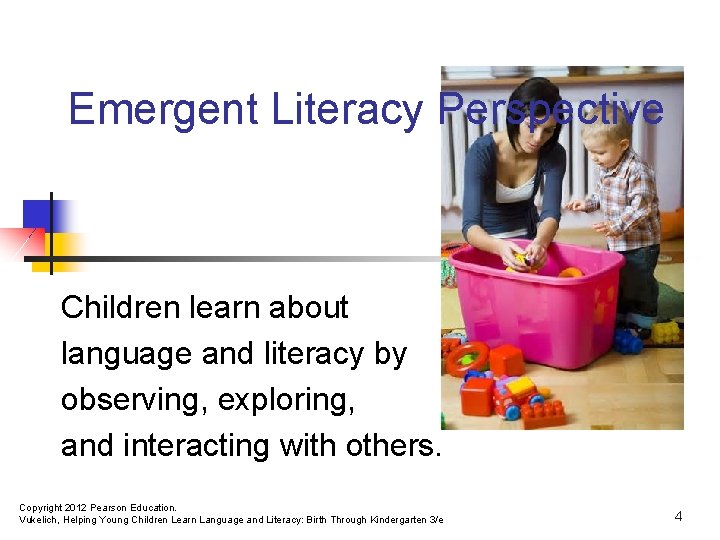
Emergent Literacy Perspective Children learn about language and literacy by observing, exploring, and interacting with others. Copyright 2012 Pearson Education. Vukelich, Helping Young Children Learn Language and Literacy: Birth Through Kindergarten 3/e 4
Emergent literacy defined https: //en. wikipedia. org/wiki/Emergent_literacies According to Wikipedia: “Emergent literacy is a term that is used to explain a child's knowledge of reading and writing skills before they learn how to read and write words. ” Emergent Literacy “signals a belief that, in literate society, young children— even one- and two-year-olds—are in the process of becoming literate. ” “Through the support of parents, caregivers, and educators, a child can successfully progress from emergent to conventional reading. ” Copyright 2012 Pearson Education. Vukelich, Helping Young Children Learn Language and Literacy: Birth Through Kindergarten 3/e 5
Print motivation: being interested in and enjoying books Vocabulary: Knowing the names of things. Print awareness: Noticing print, knowing how to handle a book, and knowing how to follow words on a page. Basic Components of Emergent Literacy Narrative skills: being able to describe things and events, tell stories. Letter knowledge: Understanding letters are different from each other, knowing their names and sounds, and recognizing letters everywhere. Phonological Awareness: Being able to hear and play with the smaller sounds in words. https: //en. wikipedia. org/wiki/Emergent_literacies Copyright 2012 Pearson Education. Vukelich, Helping Young Children Learn Language and Literacy: Birth Through Kindergarten 3/e 6
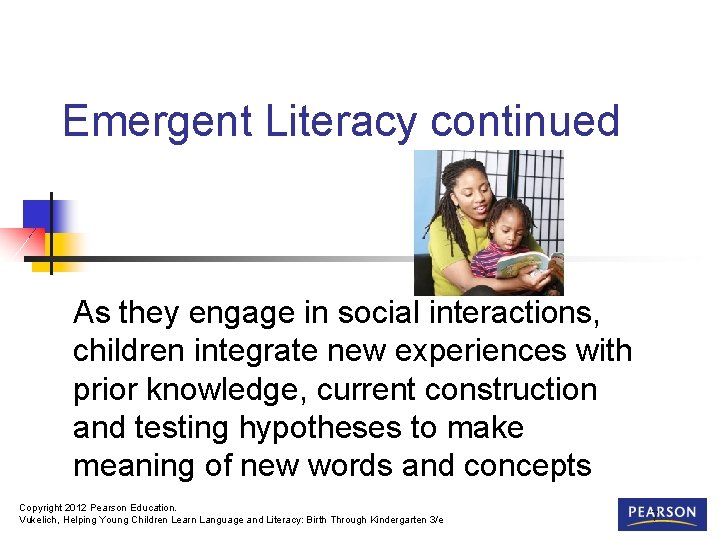
Emergent Literacy continued As they engage in social interactions, children integrate new experiences with prior knowledge, current construction and testing hypotheses to make meaning of new words and concepts Copyright 2012 Pearson Education. Vukelich, Helping Young Children Learn Language and Literacy: Birth Through Kindergarten 3/e 7
Emergent Literacy continued Children assume the role of apprentice —mimicking, absorbing and adapting the words and literacy activities used by more knowledgeable others. Copyright 2012 Pearson Education. Vukelich, Helping Young Children Learn Language and Literacy: Birth Through Kindergarten 3/e 8
Emergent Literacy continued Children store newly constructed knowledge in mental structures called schemas. Copyright 2012 Pearson Education. Vukelich, Helping Young Children Learn Language and Literacy: Birth Through Kindergarten 3/e 9
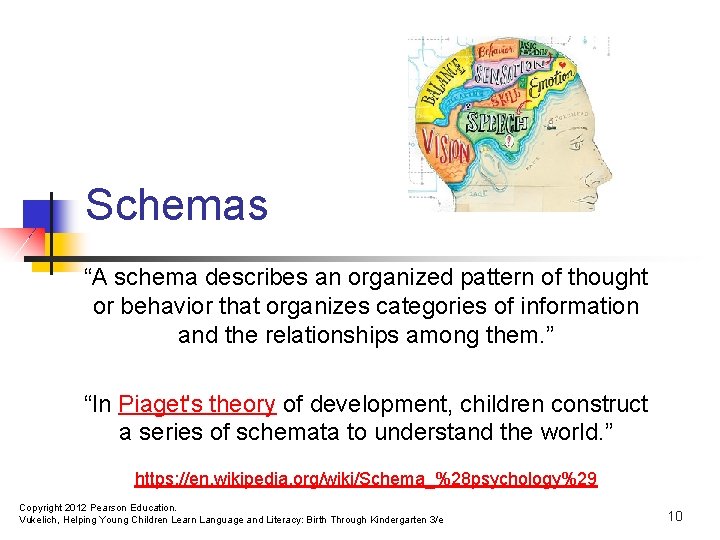
Schemas “A schema describes an organized pattern of thought or behavior that organizes categories of information and the relationships among them. ” “In Piaget's theory of development, children construct a series of schemata to understand the world. ” https: //en. wikipedia. org/wiki/Schema_%28 psychology%29 Copyright 2012 Pearson Education. Vukelich, Helping Young Children Learn Language and Literacy: Birth Through Kindergarten 3/e 10
Piaget Constructivist Learning Theory n n All learners are engaged in a continual process of perceiving information, interpreting their perceptions, making and confirming predictions, and generating hypotheses that help them make sense of their perceptions. Learners organize information into mental structures called schemas. Learners learn though social interaction with more knowledgeable others in their environment. More knowledgeable others scaffold learning and thus help the learners create a richer knowledge base. Copyright 2012 Pearson Education. Vukelich, Helping Young Children Learn Language and Literacy: Birth Through Kindergarten 3/e 11
Scientifically Based Reading Research Approach Children need to be explicitly taught those skills that research literature has identified as predictive of later reading success. Copyright 2012 Pearson Education. Vukelich, Helping Young Children Learn Language and Literacy: Birth Through Kindergarten 3/e 12
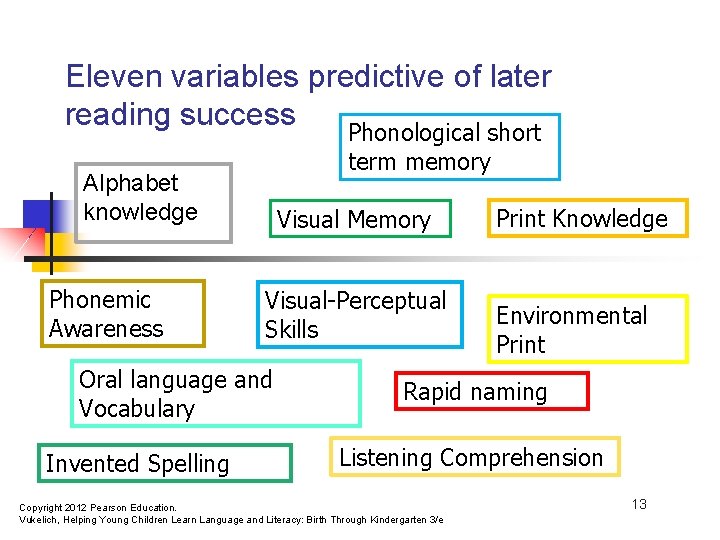
Eleven variables predictive of later reading success Phonological short term memory Alphabet knowledge Phonemic Awareness Visual Memory Visual-Perceptual Skills Oral language and Vocabulary Invented Spelling Print Knowledge Environmental Print Rapid naming Listening Comprehension Copyright 2012 Pearson Education. Vukelich, Helping Young Children Learn Language and Literacy: Birth Through Kindergarten 3/e 13
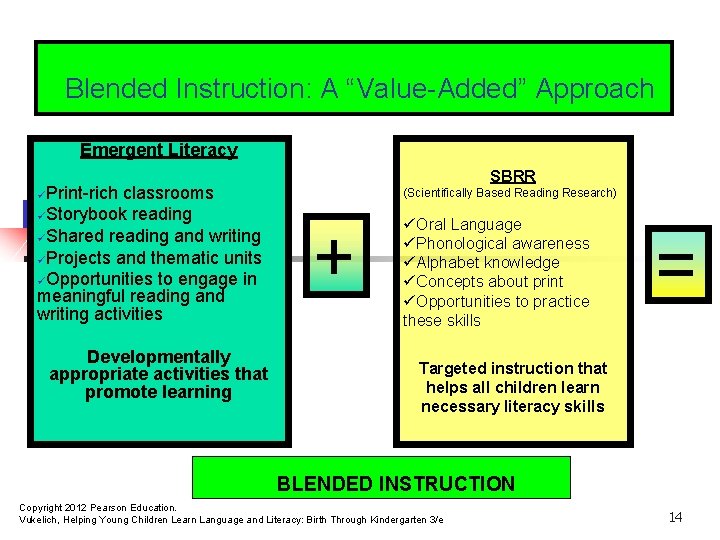
Blended Instruction: A “Value-Added” Approach Emergent Literacy classrooms üStorybook reading üShared reading and writing üProjects and thematic units üOpportunities to engage in meaningful reading and writing activities SBRR üPrint-rich Developmentally appropriate activities that promote learning (Scientifically Based Reading Research) + üOral Language üPhonological awareness üAlphabet knowledge üConcepts about print üOpportunities to practice these skills = Targeted instruction that helps all children learn necessary literacy skills BLENDED INSTRUCTION Copyright 2012 Pearson Education. Vukelich, Helping Young Children Learn Language and Literacy: Birth Through Kindergarten 3/e 14
Blended Literacy Instruction Both approaches: Emergent Literacy and Scientifically Based Reading Research are critical and important to children’s school readiness and elementary school success. Copyright 2012 Pearson Education. Vukelich, Helping Young Children Learn Language and Literacy: Birth Through Kindergarten 3/e 15
Effective Early Childhood Teachers: Provide children with a Print Rich Classroom Environment Copyright 2012 Pearson Education. Vukelich, Helping Young Children Learn Language and Literacy: Birth Through Kindergarten 3/e 16
Effective Early Childhood Teachers: Demonstrate and Model Literacy Events Copyright 2012 Pearson Education. Vukelich, Helping Young Children Learn Language and Literacy: Birth Through Kindergarten 3/e 17
Effective Early Childhood Teachers: Explicitly teach children skills that research supports as key elements of reading, writing and speaking. Copyright 2012 Pearson Education. Vukelich, Helping Young Children Learn Language and Literacy: Birth Through Kindergarten 3/e 18
Effective Early Childhood Teachers: Provide opportunities for children to work and play together in literacy rich environments Copyright 2012 Pearson Education. Vukelich, Helping Young Children Learn Language and Literacy: Birth Through Kindergarten 3/e 19
Effective Early Childhood Teachers: Link Literacy and Play Copyright 2012 Pearson Education. Vukelich, Helping Young Children Learn Language and Literacy: Birth Through Kindergarten 3/e 20
Effective Early Childhood Teachers: Encourage children to experiment with emergent forms of reading and writing Copyright 2012 Pearson Education. Vukelich, Helping Young Children Learn Language and Literacy: Birth Through Kindergarten 3/e 21
Effective Early Childhood Teachers: Provide opportunities for children to use language and literacy for real purposes and audiences Copyright 2012 Pearson Education. Vukelich, Helping Young Children Learn Language and Literacy: Birth Through Kindergarten 3/e 22
Effective Early Childhood Teachers: Make use of everyday activities to demonstrate the many purposes of reading and writing Copyright 2012 Pearson Education. Vukelich, Helping Young Children Learn Language and Literacy: Birth Through Kindergarten 3/e 23
Effective Early Childhood Teachers: Read to children daily and encourage them to read familiar books on their own Copyright 2012 Pearson Education. Vukelich, Helping Young Children Learn Language and Literacy: Birth Through Kindergarten 3/e 24
Effective Early Childhood Teachers: Know kindergarten standards and provide instruction linked to these standards Copyright 2012 Pearson Education. Vukelich, Helping Young Children Learn Language and Literacy: Birth Through Kindergarten 3/e 25
Effective Early Childhood Teachers: Use multiple forms of assessment to find out what children know and can do. Copyright 2012 Pearson Education. Vukelich, Helping Young Children Learn Language and Literacy: Birth Through Kindergarten 3/e 26
Effective Early Childhood Teachers: Make accommodations for children’s developmental, cultural and linguistic diversity Copyright 2012 Pearson Education. Vukelich, Helping Young Children Learn Language and Literacy: Birth Through Kindergarten 3/e 27
Effective Early Childhood Teachers: Recognize the importance of reflecting on their instructional decisions. Copyright 2012 Pearson Education. Vukelich, Helping Young Children Learn Language and Literacy: Birth Through Kindergarten 3/e 28
Effective Early Childhood Teachers: Build partnerships with families Children cannot be asked to leave their family and cultural backgrounds at the classroom door and enter into a “hybrid culture” (Au & Kawakami, 1991) Copyright 2012 Pearson Education. Vukelich, Helping Young Children Learn Language and Literacy: Birth Through Kindergarten 3/e 29