
CHAPTER 1 MODULE 1 Time Value of Money
- Slides: 5
CHAPTER 1 MODULE 1 Time Value of Money Module 5 Introduction to Accounting I Professor Marc Smith
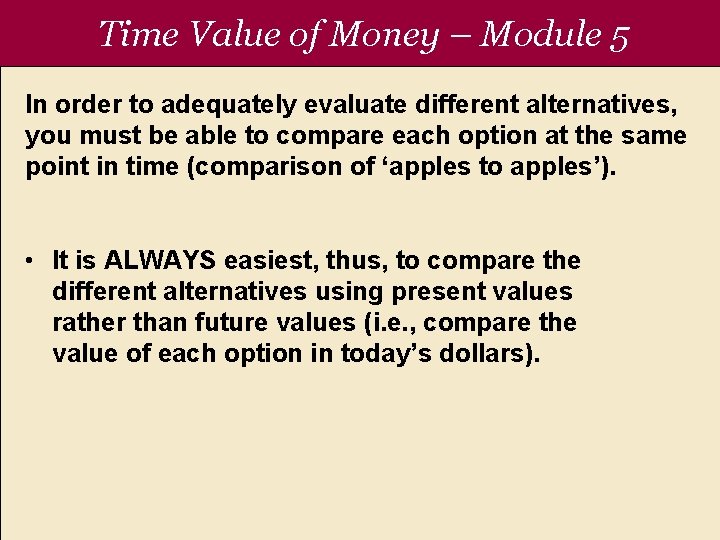
Time Value of Money – Module 5 In order to adequately evaluate different alternatives, you must be able to compare each option at the same point in time (comparison of ‘apples to apples’). • It is ALWAYS easiest, thus, to compare the different alternatives using present values rather than future values (i. e. , compare the value of each option in today’s dollars).
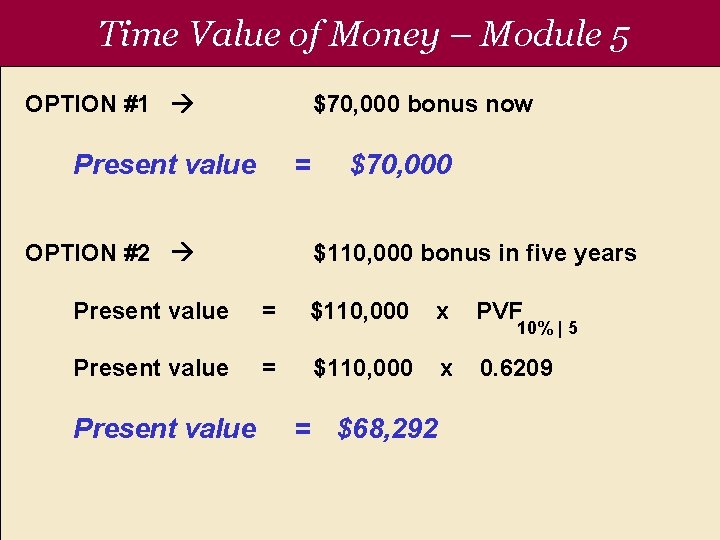
Time Value of Money – Module 5 OPTION #1 $70, 000 bonus now Present value = OPTION #2 $70, 000 $110, 000 bonus in five years Present value = $110, 000 x PVF Present value = $110, 000 x 0. 6209 Present value = $68, 292 10% | 5
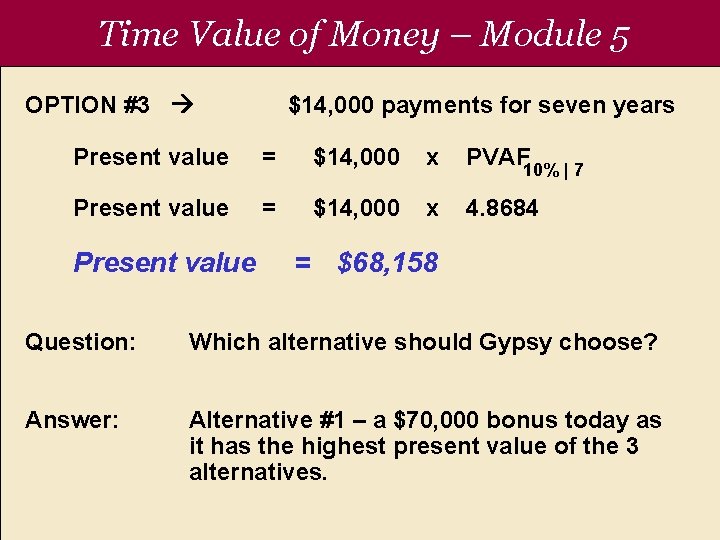
Time Value of Money – Module 5 OPTION #3 $14, 000 payments for seven years Present value = $14, 000 x PVAF 10% | 7 Present value = $14, 000 x 4. 8684 Present value = $68, 158 Question: Which alternative should Gypsy choose? Answer: Alternative #1 – a $70, 000 bonus today as it has the highest present value of the 3 alternatives.
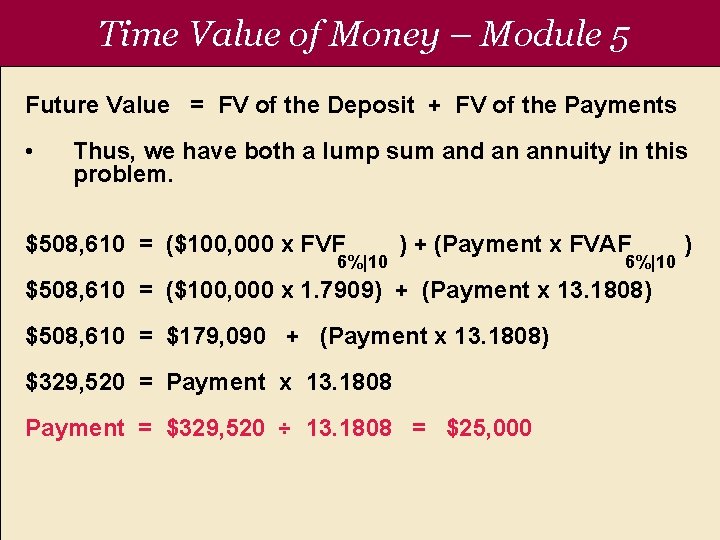
Time Value of Money – Module 5 Future Value = FV of the Deposit + FV of the Payments • Thus, we have both a lump sum and an annuity in this problem. $508, 610 = ($100, 000 x FVF 6%|10 ) + (Payment x FVAF 6%|10 $508, 610 = ($100, 000 x 1. 7909) + (Payment x 13. 1808) $508, 610 = $179, 090 + (Payment x 13. 1808) $329, 520 = Payment x 13. 1808 Payment = $329, 520 ÷ 13. 1808 = $25, 000 )