
Chapter 1 Measurement Math and Graph in Science




- Slides: 27
Chapter 1
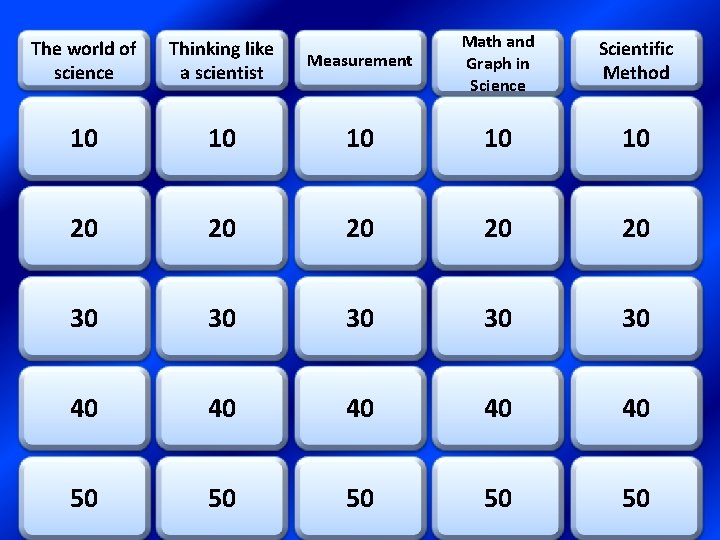
Measurement Math and Graph in Science Scientific Method 10 10 20 20 20 30 30 30 40 40 40 50 50 50 The world of science Thinking like a scientist 10
Topic 1 – 1 Point QUESTION: • What are the 5 senses you observe with? ANSWER: • Sight, sound, taste, smell, and touch
Topic 1 – 2 Points QUESTION: • What is honesty? ANSWER: • Being truthful in what you say and do
Topic 1 – 3 Points QUESTION: • Explaining or interpreting the things you observe from the past or present is? ANSWER: • Inferring
Topic 1 – 4 Points QUESTION: • Grouping together items that are alike in some way is known as? ANSWER: • classifying
Topic 1 – 5 Points QUESTION: • Define evaluating ANSWER: • Comparing observations and data to reach a conclusion about them
Topic 2 – 1 Point QUESTION: • Good scientists have an even balance between ANSWER: • Open-mindedness and skepticism
Topic 2 – 2 Points QUESTION: • Knowing right from wrong is. ANSWER: • Ethics
Topic 2 – 3 Points QUESTION: • using evidence to make decisions. ANSWER: • Objective Reasoning
Topic 2 – 4 Points QUESTION: • Describe deductive reasoning. ANSWER: • explaining things by starting general then getting more specific. Bigger idea to smaller idea(V)
Topic 2 – 5 Points QUESTION: • What is bias? ANSWER: • Knowing that your past experiences and/or beliefs can influence (bias) how you interpret new information.
Topic 3 – 1 Point QUESTION: • What is a meniscus? ANSWER: • The line of liquid in a graduated cylinder. Measured from the bottom.
Topic 3 – 2 Points QUESTION: • What is the SI unit for volume? ANSWER: • meter³
Topic 3 – 3 Points QUESTION: • How do you find the volume of a regular object? ANSWER: • Measure water in a graduated cylinder • Add object. • Measure the water in the graduated cylinder again. • Find the difference between the 2
Topic 3 – 4 Points QUESTION: • What are the 3 different types of measurement scales used for temperature? Where are they used? ANSWER: • SI- Kelvin- science. Fahrenheit- US. Celsius- most countries.
Topic 3 – 5 Points QUESTION: • What is the SI unit for Density? ANSWER: • Kg/m³
Topic 4 – 1 Point QUESTION: • Which type of graph would you use when you are comparing data over a period of time? ANSWER: • A line graph
Topic 4 – 2 Points QUESTION: • What is the range? ANSWER: • The difference between the largest and smallest number in a data set
Topic 4 – 3 Points QUESTION: • How do you determine the scale of a data set ANSWER: • Find the largest and smallest number of the data set.
Topic 4 – 4 Points QUESTION: • What are the steps of finding the median of a data set? ANSWER: • 1 - order the numbers from least to greatest • 2 -find the middle number • 3 -if two numbers are in the middle find the mean of those two numbers.
Topic 4 – 5 Points QUESTION: • What refers to how close a group of measurements are to each other? ANSWER: • precision
Topic 5 – 1 Point QUESTION: • A possible answer to a scientific inquiry is? ANSWER: • A Hypothesis
Topic 5 – 2 Points QUESTION: • What is data? ANSWER: • Facts, figures, pictures, other evidence.
Topic 5 – 3 Points QUESTION: • What are three main ways you can research a problem? ANSWER: • Internet, book, or ask an expert
Topic 5 – 4 Points QUESTION: • What is a controlled experiment? ANSWER: • When all variable except the independent variable are controlled. When only one variable is being manipulated at a time.
Topic 5 – 5 Points QUESTION: • Explain repeated trials ANSWER: • When you perform your experiment multiple times to ensure that your results are accurate.