
Chapter 1 Matter on the Atomic Scale Why
![Temperature T (°C) = [T (°F) – 32] x 100 180 or T (°C)](https://slidetodoc.com/presentation_image_h2/d3e3ae3e93ed0a00ef4631e85b9f96bf/image-9.jpg "Temperature T (°C) = [T (°F) – 32] x 100 180 or T (°C)")
- Slides: 35
Chapter 1 Matter on the Atomic Scale
Why Care about Chemistry? • Chemistry • The science of matter and the transformations it can undergo. Why should you study it? • It helps us understand our surroundings and the way we function. • It plays a central role in medicine, engineering and many sciences. Consider the anticancer drug Taxol®.
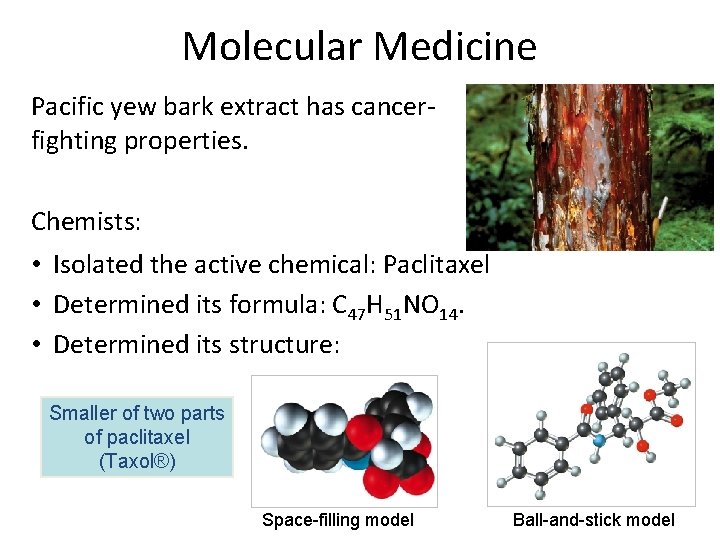
Molecular Medicine Pacific yew bark extract has cancerfighting properties. Chemists: • Isolated the active chemical: Paclitaxel • Determined its formula: C 47 H 51 NO 14. • Determined its structure: Smaller of two parts of paclitaxel (Taxol®) Space-filling model Ball-and-stick model
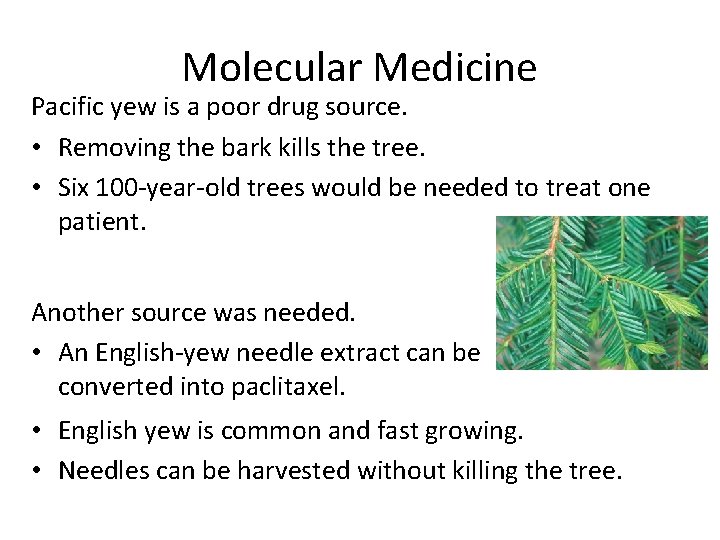
Molecular Medicine Pacific yew is a poor drug source. • Removing the bark kills the tree. • Six 100 -year-old trees would be needed to treat one patient. Another source was needed. • An English-yew needle extract can be converted into paclitaxel. • English yew is common and fast growing. • Needles can be harvested without killing the tree.
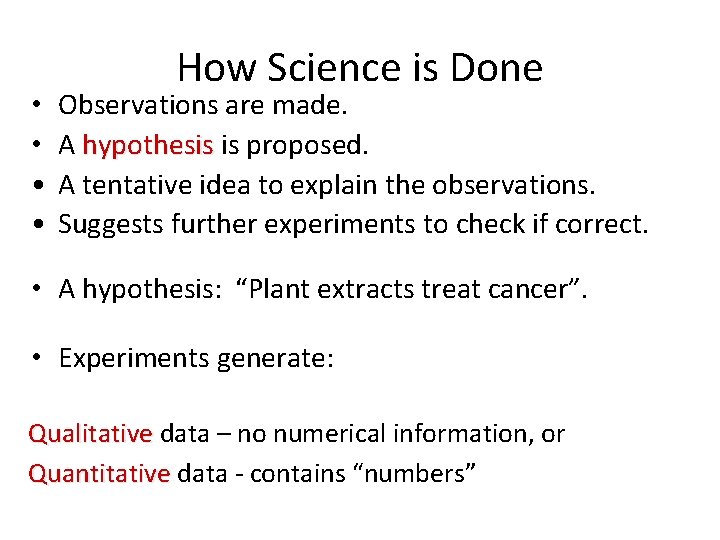
• • How Science is Done Observations are made. A hypothesis is proposed. A tentative idea to explain the observations. Suggests further experiments to check if correct. • A hypothesis: “Plant extracts treat cancer”. • Experiments generate: Qualitative data – no numerical information, or Quantitative data - contains “numbers”
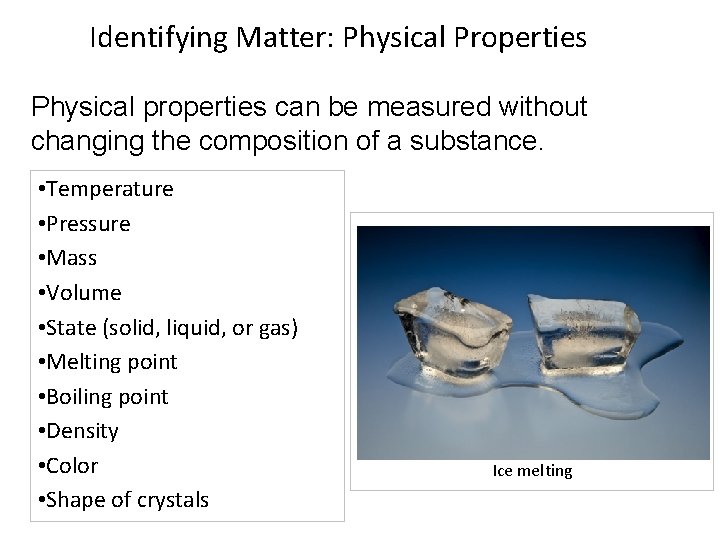
Identifying Matter: Physical Properties Physical properties can be measured without changing the composition of a substance. • Temperature • Pressure • Mass • Volume • State (solid, liquid, or gas) • Melting point • Boiling point • Density • Color • Shape of crystals Ice melting
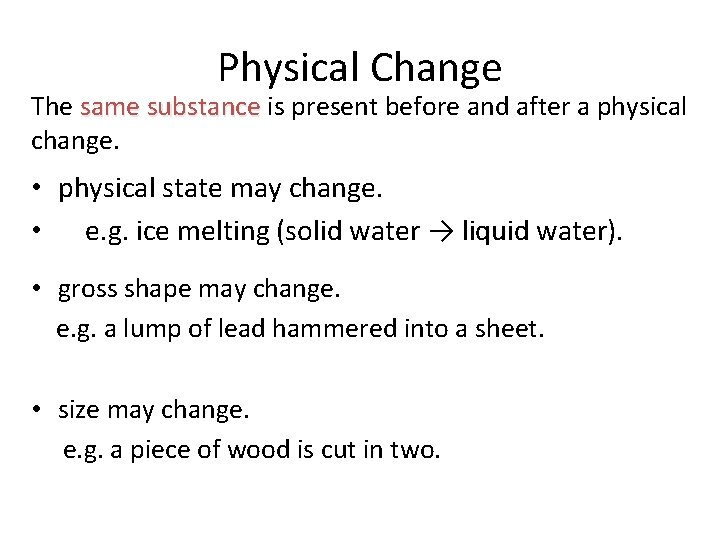
Physical Change The same substance is present before and after a physical change. • physical state may change. • e. g. ice melting (solid water → liquid water). • gross shape may change. e. g. a lump of lead hammered into a sheet. • size may change. e. g. a piece of wood is cut in two.
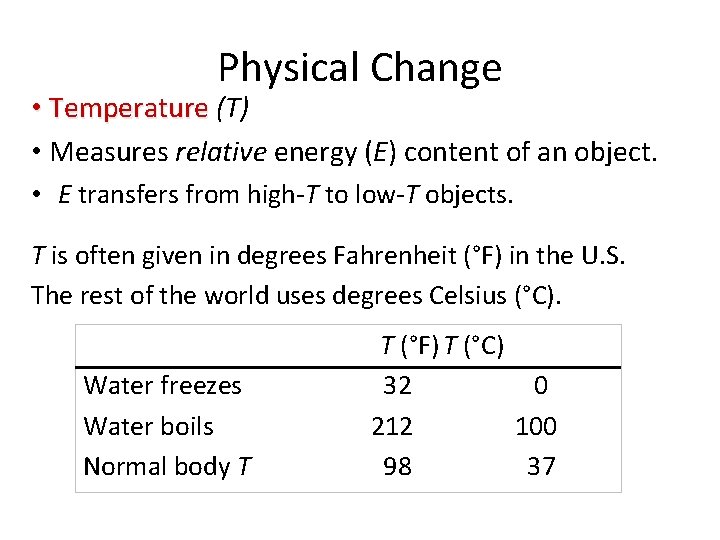
Physical Change • Temperature (T) • Measures relative energy (E) content of an object. • E transfers from high-T to low-T objects. T is often given in degrees Fahrenheit (°F) in the U. S. The rest of the world uses degrees Celsius (°C). Water freezes Water boils Normal body T T (°F) T (°C) 32 0 212 100 98 37
Temperature T (°C) = [T (°F) – 32] x 100 180 or T (°C) = [T (°F) – 32] x 5 9 and T (°F) = 9 [T (°C)] + 32 5 water boils 100°C 212°F 100 steps 180 steps 0°C 32°F water freezes
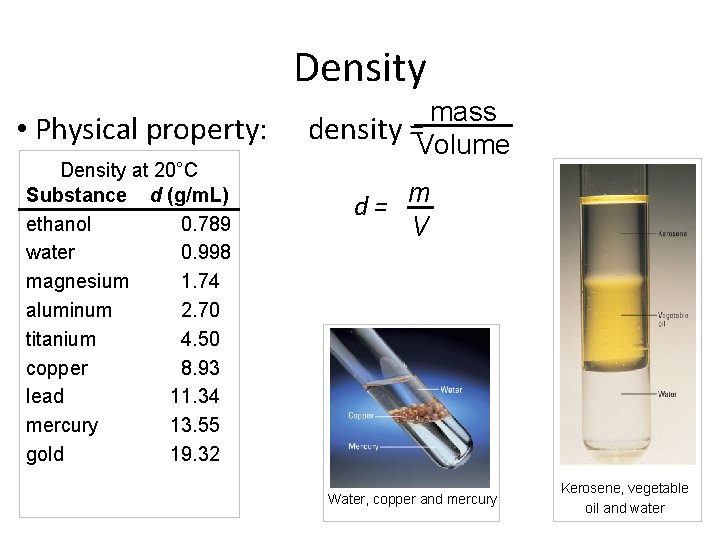
Density • Physical property: Density at 20°C Substance d (g/m. L) ethanol 0. 789 water 0. 998 magnesium 1. 74 aluminum 2. 70 titanium 4. 50 copper 8. 93 lead 11. 34 mercury 13. 55 gold 19. 32 mass density =Volume d= m V Water, copper and mercury Kerosene, vegetable oil and water
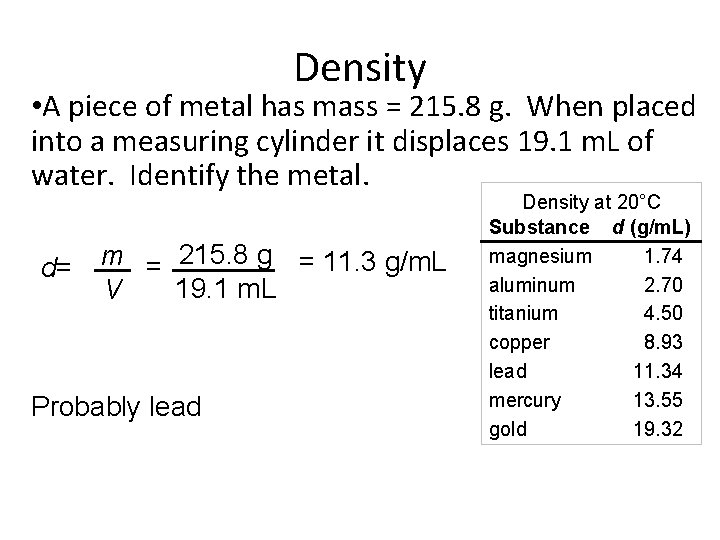
Density • A piece of metal has mass = 215. 8 g. When placed into a measuring cylinder it displaces 19. 1 m. L of water. Identify the metal. d= m = 215. 8 g = 11. 3 g/m. L 19. 1 m. L V Probably lead Density at 20°C Substance d (g/m. L) magnesium 1. 74 aluminum 2. 70 titanium 4. 50 copper 8. 93 lead 11. 34 mercury 13. 55 gold 19. 32
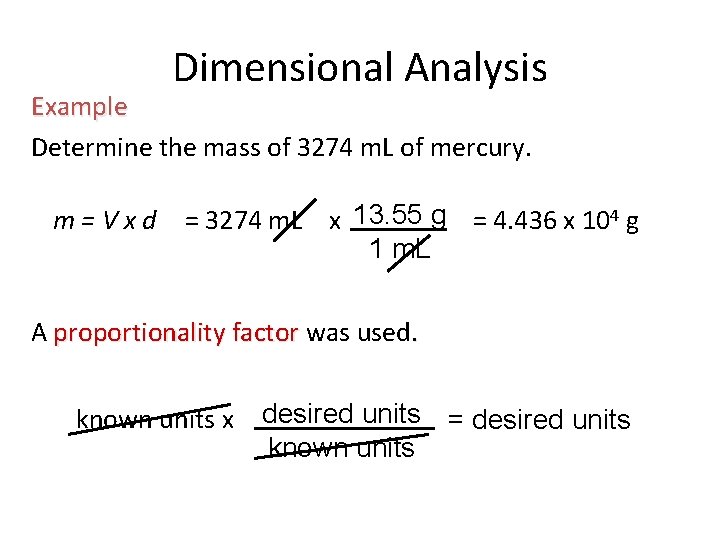
Dimensional Analysis Example Determine the mass of 3274 m. L of mercury. m=Vxd = 3274 m. L x 13. 55 g = 4. 436 x 104 g 1 m. L A proportionality factor was used. known units x desired units = desired units known units
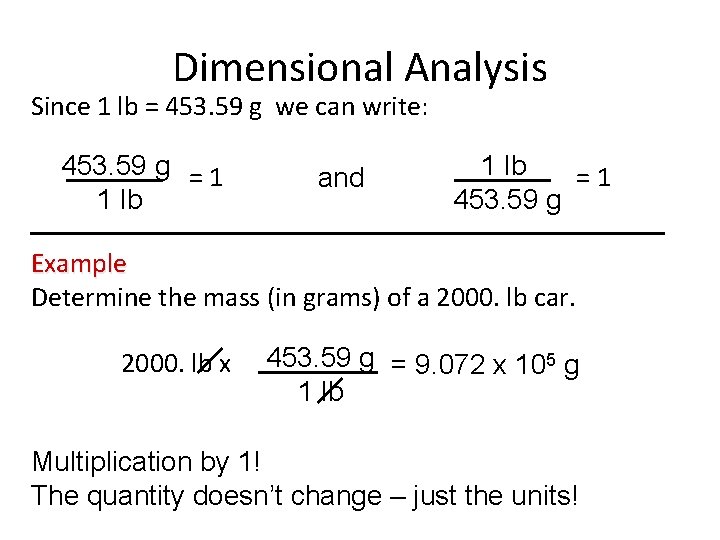
Dimensional Analysis Since 1 lb = 453. 59 g we can write: 453. 59 g = 1 1 lb and 1 lb =1 453. 59 g Example Determine the mass (in grams) of a 2000. lb car. 2000. lb x 453. 59 g = 9. 072 x 105 g 1 lb Multiplication by 1! The quantity doesn’t change – just the units!
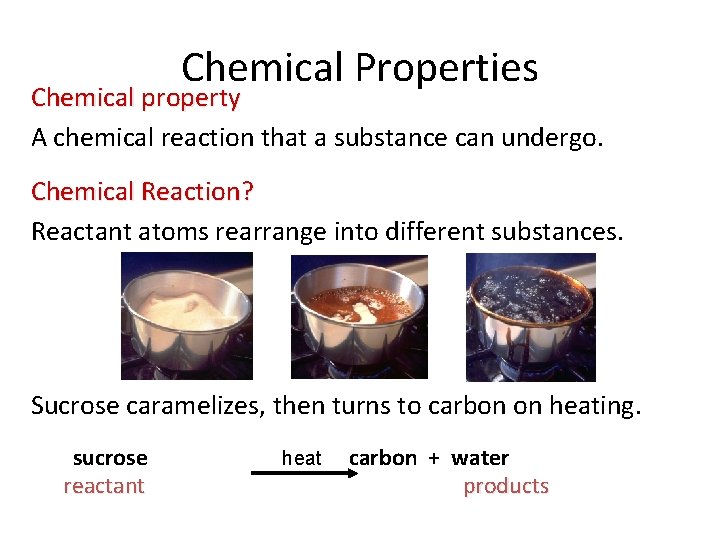
Chemical Properties Chemical property A chemical reaction that a substance can undergo. Chemical Reaction? Reactant atoms rearrange into different substances. Sucrose caramelizes, then turns to carbon on heating. sucrose reactant heat carbon + water products
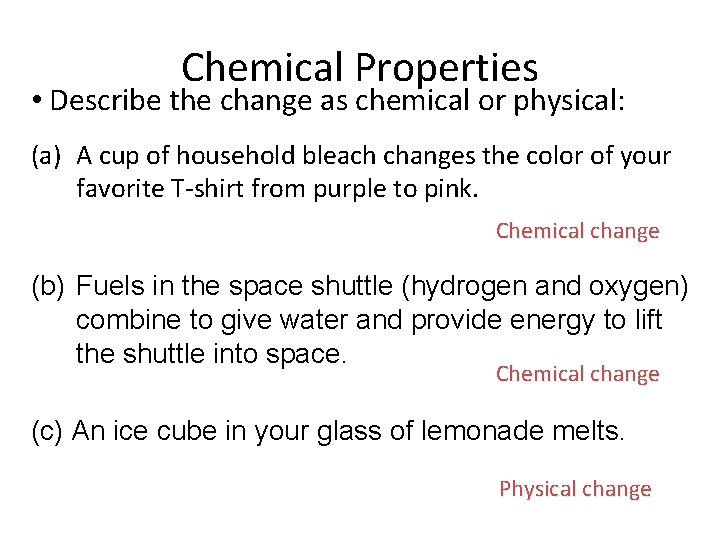
Chemical Properties • Describe the change as chemical or physical: (a) A cup of household bleach changes the color of your favorite T-shirt from purple to pink. Chemical change (b) Fuels in the space shuttle (hydrogen and oxygen) combine to give water and provide energy to lift the shuttle into space. Chemical change (c) An ice cube in your glass of lemonade melts. Physical change
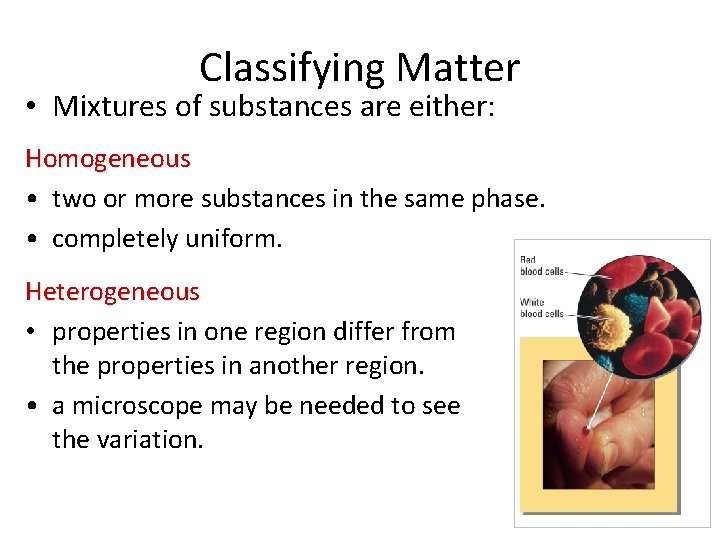
Classifying Matter • Mixtures of substances are either: Homogeneous • two or more substances in the same phase. • completely uniform. Heterogeneous • properties in one region differ from the properties in another region. • a microscope may be needed to see the variation.
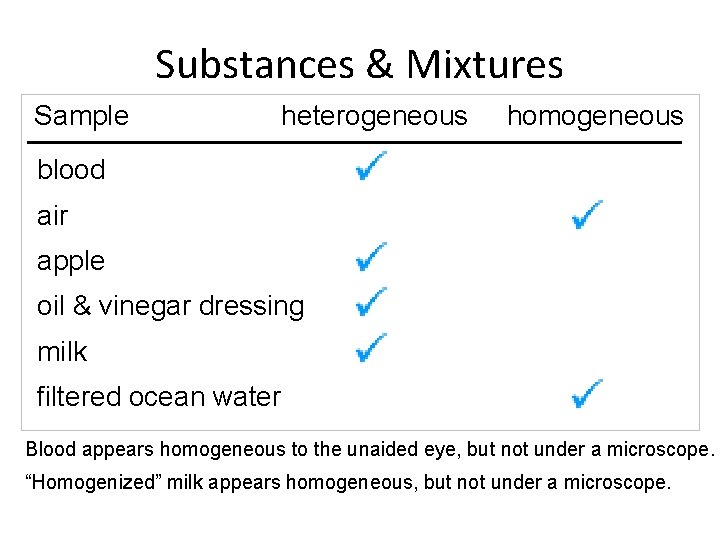
Substances & Mixtures Sample heterogeneous homogeneous blood air apple oil & vinegar dressing milk filtered ocean water Blood appears homogeneous to the unaided eye, but not under a microscope. “Homogenized” milk appears homogeneous, but not under a microscope.
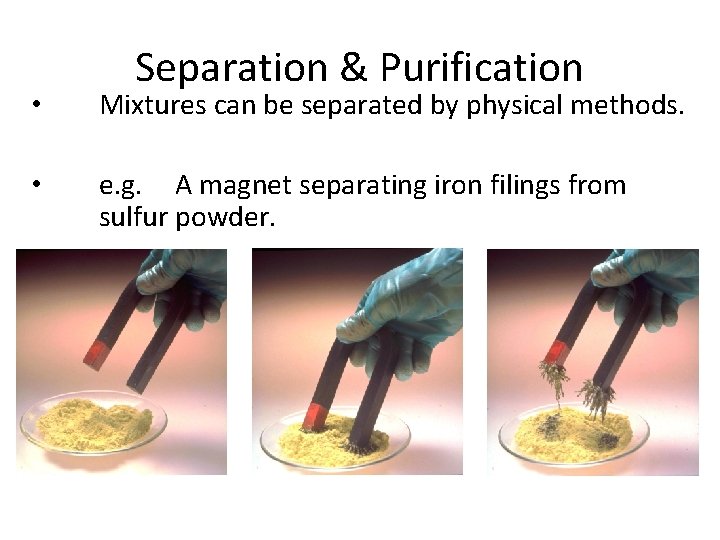
Separation & Purification • Mixtures can be separated by physical methods. • e. g. A magnet separating iron filings from sulfur powder.
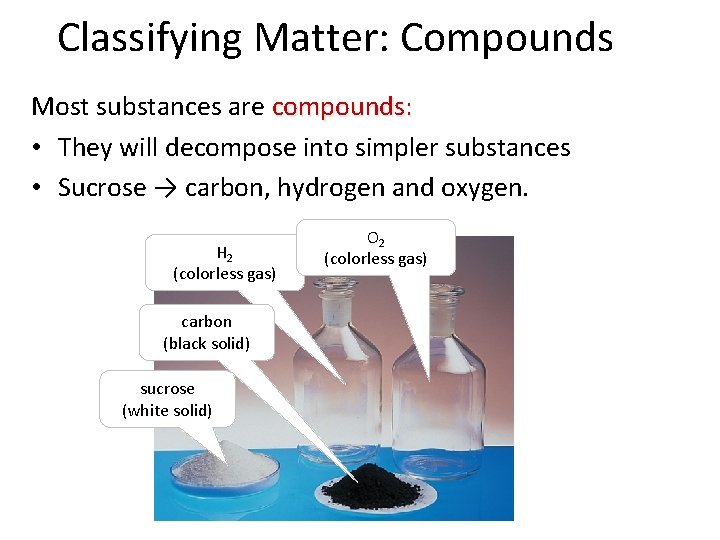
Classifying Matter: Compounds Most substances are compounds: • They will decompose into simpler substances • Sucrose → carbon, hydrogen and oxygen. H 2 (colorless gas) carbon (black solid) sucrose (white solid) O 2 (colorless gas)
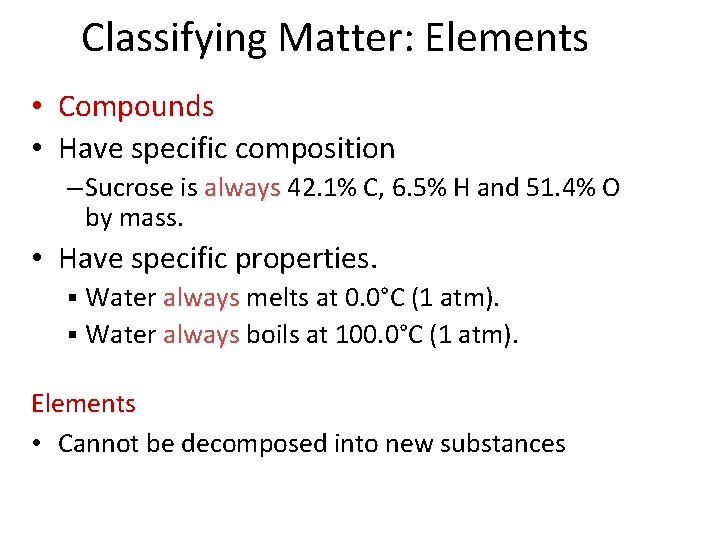
Classifying Matter: Elements • Compounds • Have specific composition – Sucrose is always 42. 1% C, 6. 5% H and 51. 4% O by mass. • Have specific properties. § Water always melts at 0. 0°C (1 atm). § Water always boils at 100. 0°C (1 atm). Elements • Cannot be decomposed into new substances
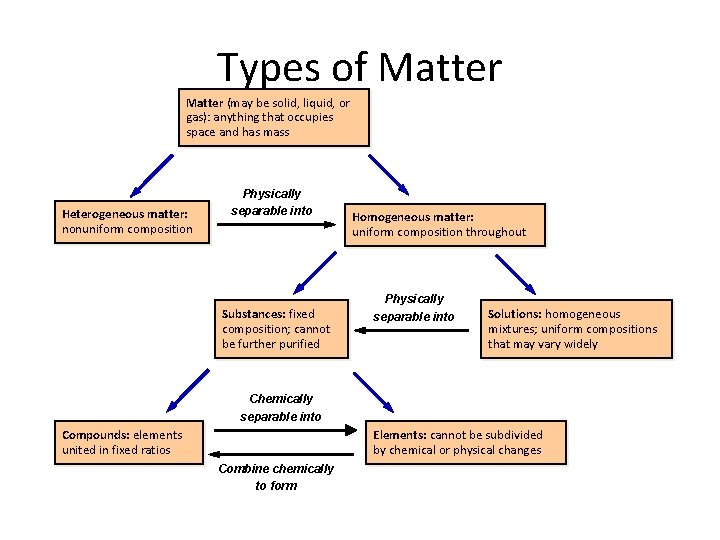
Types of Matter (may be solid, liquid, or gas): anything that occupies space and has mass Heterogeneous matter: nonuniform composition Physically separable into Substances: fixed composition; cannot be further purified Homogeneous matter: uniform composition throughout Physically separable into Solutions: homogeneous mixtures; uniform compositions that may vary widely Chemically separable into Compounds: elements united in fixed ratios Elements: cannot be subdivided by chemical or physical changes Combine chemically to form
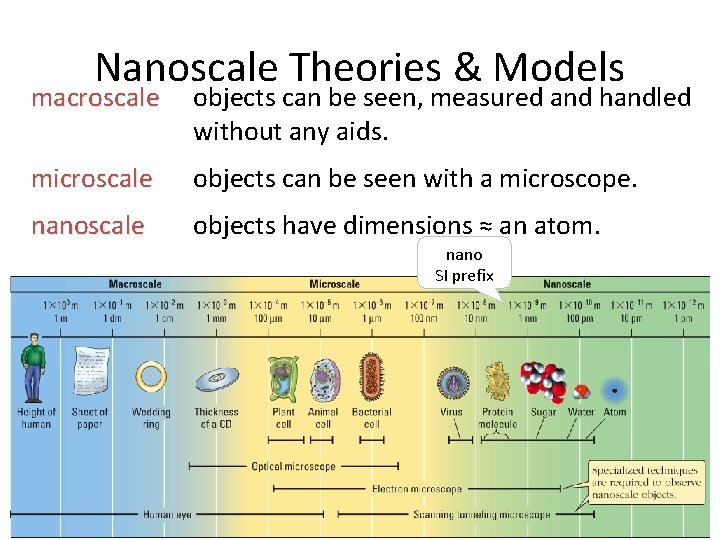
Nanoscale Theories & Models macroscale objects can be seen, measured and handled without any aids. microscale objects can be seen with a microscope. nanoscale objects have dimensions ≈ an atom. nano SI prefix
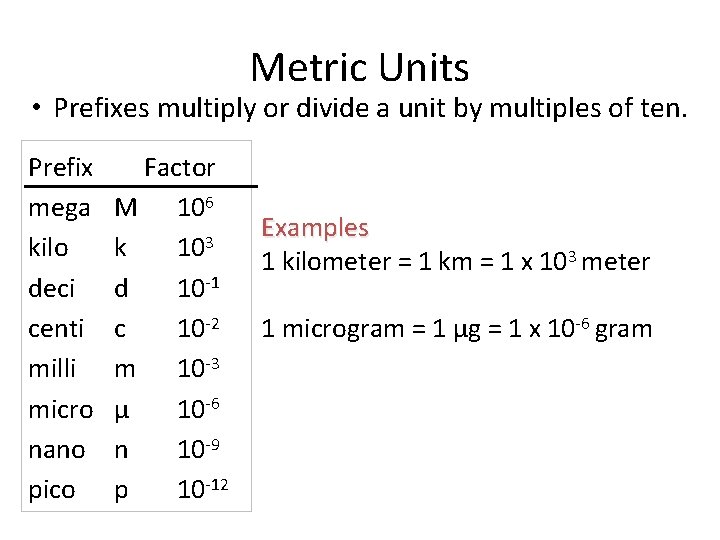
Metric Units • Prefixes multiply or divide a unit by multiples of ten. Prefix mega kilo deci centi milli micro nano pico Factor M 106 k 103 d 10 -1 c 10 -2 m 10 -3 μ 10 -6 n 10 -9 p 10 -12 Examples 1 kilometer = 1 km = 1 x 10³ meter 1 microgram = 1 μg = 1 x 10 -6 gram
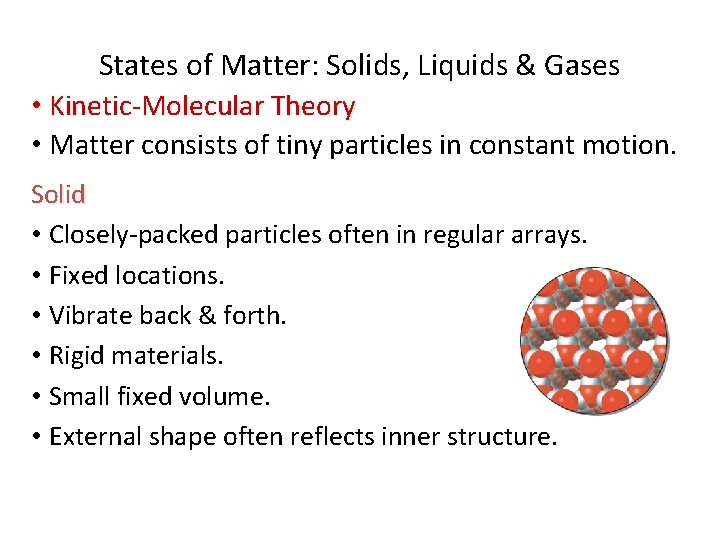
States of Matter: Solids, Liquids & Gases • Kinetic-Molecular Theory • Matter consists of tiny particles in constant motion. Solid • Closely-packed particles often in regular arrays. • Fixed locations. • Vibrate back & forth. • Rigid materials. • Small fixed volume. • External shape often reflects inner structure.
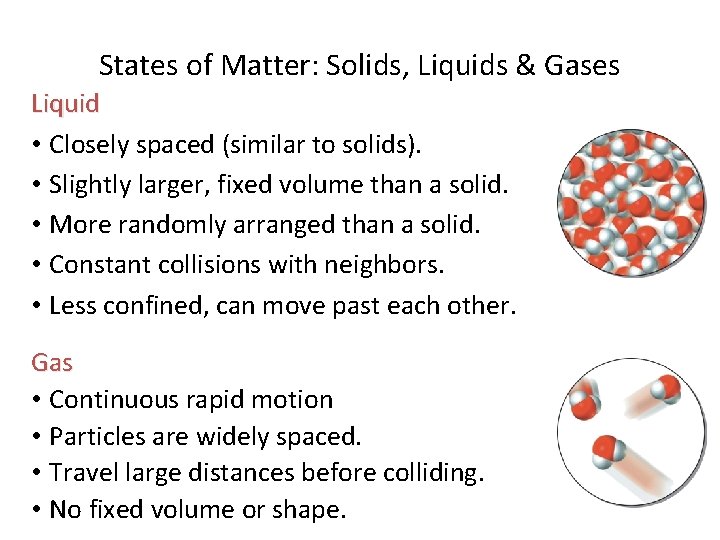
States of Matter: Solids, Liquids & Gases Liquid • Closely spaced (similar to solids). • Slightly larger, fixed volume than a solid. • More randomly arranged than a solid. • Constant collisions with neighbors. • Less confined, can move past each other. Gas • Continuous rapid motion • Particles are widely spaced. • Travel large distances before colliding. • No fixed volume or shape.
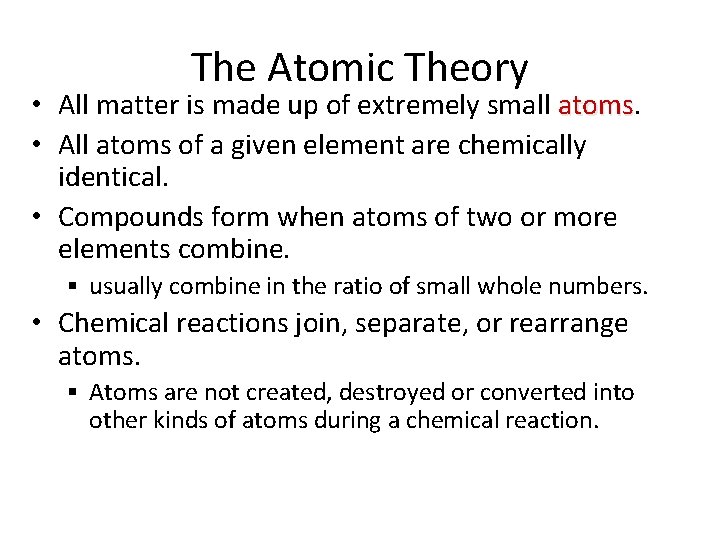
The Atomic Theory • All matter is made up of extremely small atoms • All atoms of a given element are chemically identical. • Compounds form when atoms of two or more elements combine. § usually combine in the ratio of small whole numbers. • Chemical reactions join, separate, or rearrange atoms. § Atoms are not created, destroyed or converted into other kinds of atoms during a chemical reaction.
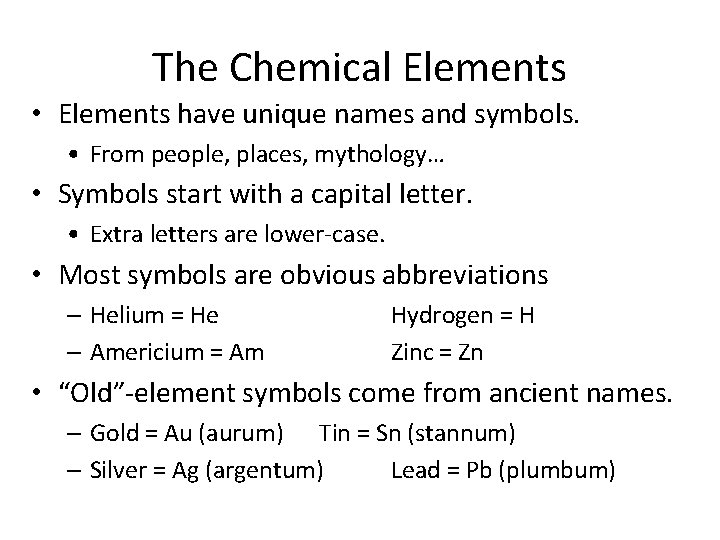
The Chemical Elements • Elements have unique names and symbols. • From people, places, mythology… • Symbols start with a capital letter. • Extra letters are lower-case. • Most symbols are obvious abbreviations – Helium = He – Americium = Am Hydrogen = H Zinc = Zn • “Old”-element symbols come from ancient names. – Gold = Au (aurum) Tin = Sn (stannum) – Silver = Ag (argentum) Lead = Pb (plumbum)
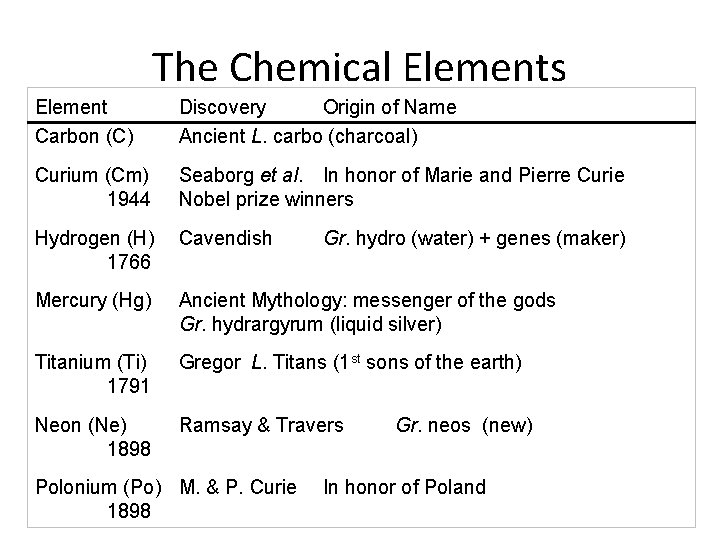
The Chemical Elements Element Carbon (C) Discovery Origin of Name Ancient L. carbo (charcoal) Curium (Cm) 1944 Seaborg et al. In honor of Marie and Pierre Curie Nobel prize winners Hydrogen (H) 1766 Cavendish Mercury (Hg) Ancient Mythology: messenger of the gods Gr. hydrargyrum (liquid silver) Titanium (Ti) 1791 Gregor L. Titans (1 st sons of the earth) Neon (Ne) 1898 Ramsay & Travers Polonium (Po) M. & P. Curie 1898 Gr. hydro (water) + genes (maker) Gr. neos (new) In honor of Poland
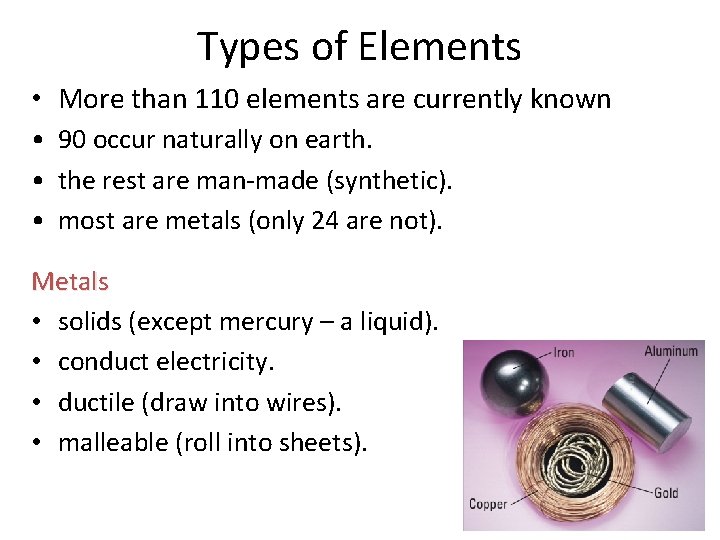
Types of Elements • More than 110 elements are currently known • 90 occur naturally on earth. • the rest are man-made (synthetic). • most are metals (only 24 are not). Metals • solids (except mercury – a liquid). • conduct electricity. • ductile (draw into wires). • malleable (roll into sheets).
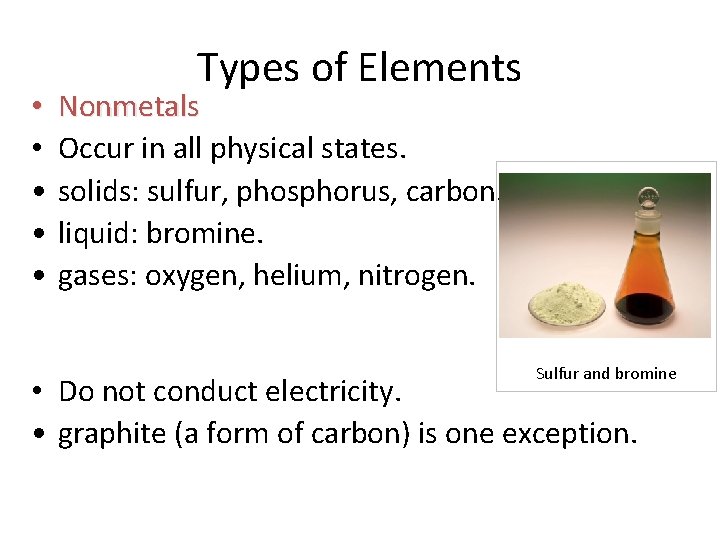
• • • Types of Elements Nonmetals Occur in all physical states. solids: sulfur, phosphorus, carbon. liquid: bromine. gases: oxygen, helium, nitrogen. Sulfur and bromine • Do not conduct electricity. • graphite (a form of carbon) is one exception.
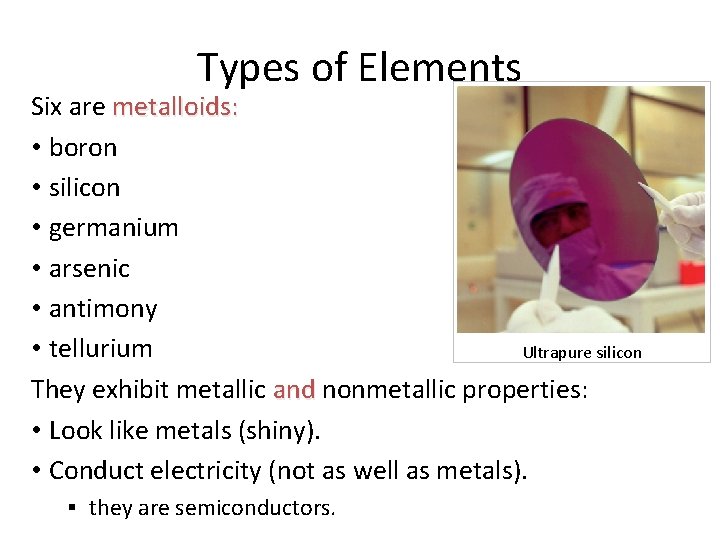
Types of Elements Six are metalloids: • boron • silicon • germanium • arsenic • antimony • tellurium Ultrapure silicon They exhibit metallic and nonmetallic properties: • Look like metals (shiny). • Conduct electricity (not as well as metals). § they are semiconductors.
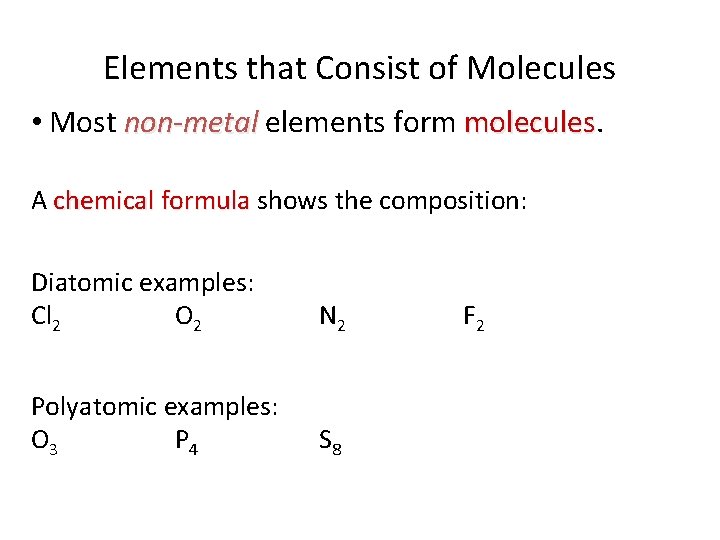
Elements that Consist of Molecules • Most non-metal elements form molecules A chemical formula shows the composition: Diatomic examples: Cl 2 O 2 N 2 Polyatomic examples: O 3 P 4 S 8 F 2
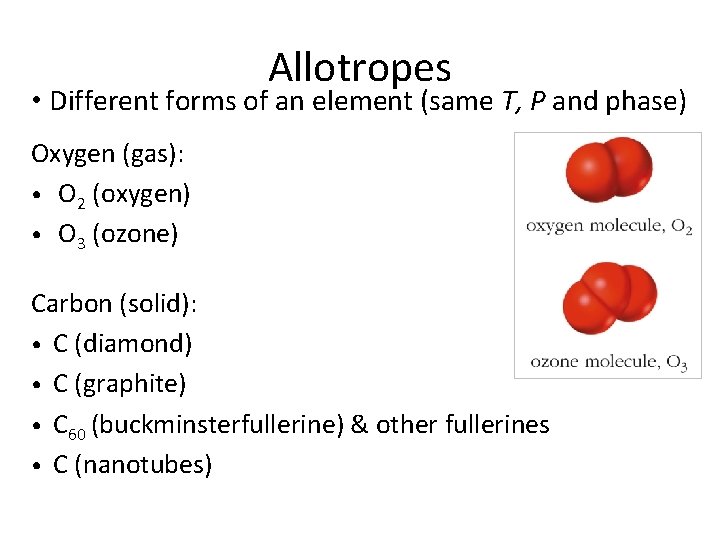
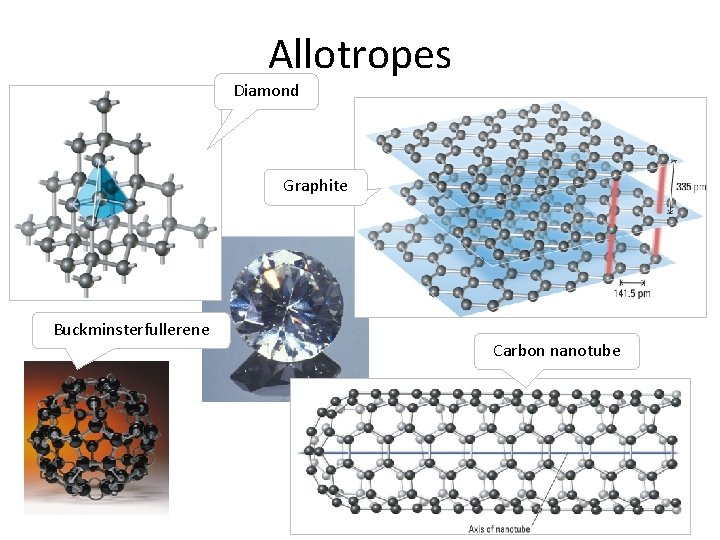
Allotropes • Different forms of an element (same T, P and phase) Oxygen (gas): • O 2 (oxygen) • O 3 (ozone) Carbon (solid): • C (diamond) • C (graphite) • C 60 (buckminsterfullerine) & other fullerines • C (nanotubes)
Allotropes Diamond Graphite Buckminsterfullerene Carbon nanotube
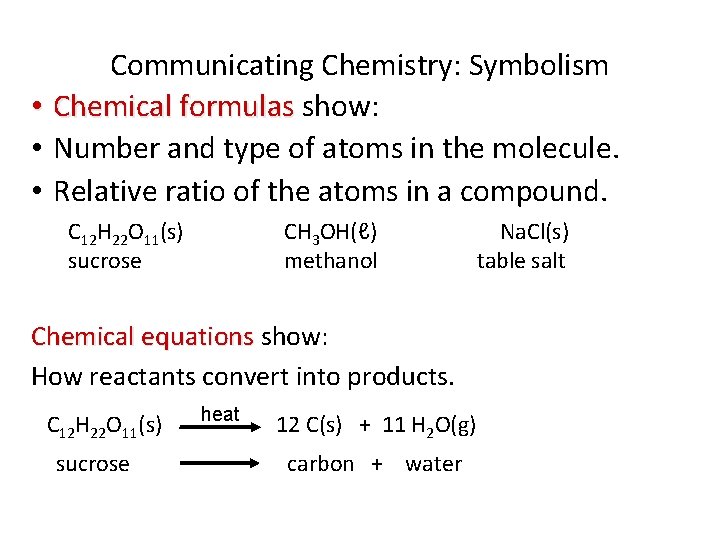
Communicating Chemistry: Symbolism • Chemical formulas show: • Number and type of atoms in the molecule. • Relative ratio of the atoms in a compound. C 12 H 22 O 11(s) sucrose CH 3 OH(ℓ) methanol Chemical equations show: How reactants convert into products. C 12 H 22 O 11(s) sucrose heat 12 C(s) + 11 H 2 O(g) carbon + water Na. Cl(s) table salt