
Chapter 1 Managers and Managing Management n Consists
- Slides: 15
Chapter 1 Managers and Managing
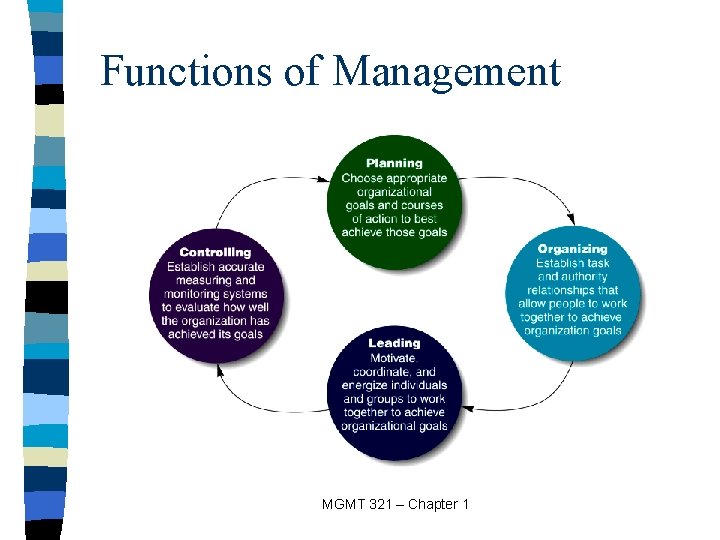
Management n Consists of: – Planning – Organizing – Leading – Controlling n To achieve organizational goals effectively and efficiently MGMT 321 – Chapter 1
Management n Resources include: – People (skills, know-how and experience) – Machinery – Raw materials – Computers and IT – Patents – Financial capital – Loyal customers MGMT 321 – Chapter 1
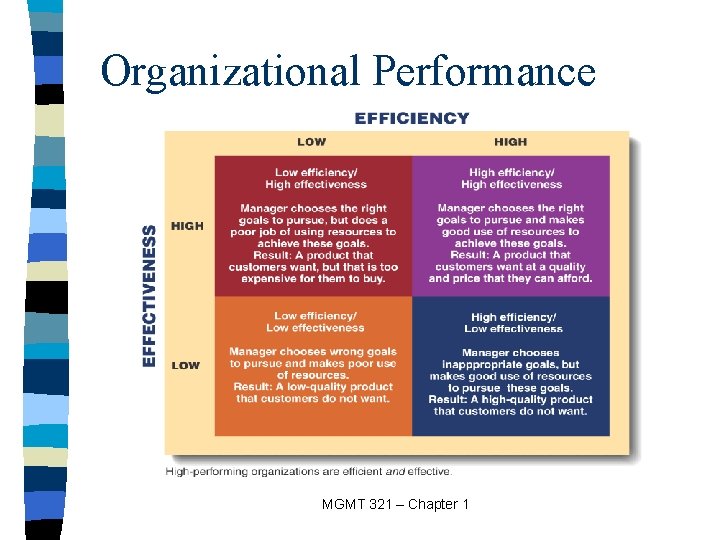
Organizational Performance MGMT 321 – Chapter 1
Why Study Management? n The more efficient and effective use of scarce resources, the greater the relative well-being and prosperity of people in that society n Helps people deal with their bosses and coworkers n Opens a path to a well-paying job and career MGMT 321 – Chapter 1
Functions of Management MGMT 321 – Chapter 1
Decisional Roles n Roles associated with planning strategy and utilizing resources – Entrepreneur – deciding which new projects or programs to initiate and to invest resources in – Disturbance handler – managing crises – Resource allocator – assigning resources and setting the budgets of lower managers – Negotiator – reaching agreements between internal and external stakeholders MGMT 321 – Chapter 1
Interpersonal Roles n Roles associated with providing direction and supervision – Figurehead – symbolizing the organization’s mission and direction – Leader – training, counseling, and mentoring employee performance – Liaison – coordinating the activities of people inside and outside the organization MGMT 321 – Chapter 1
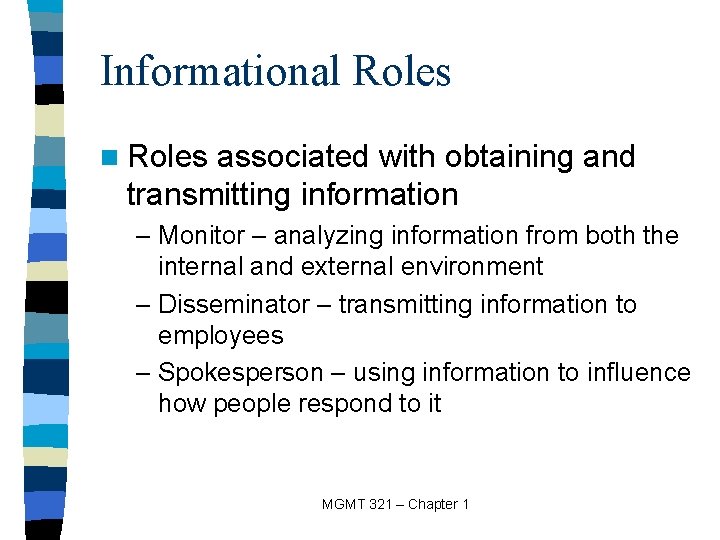
Informational Roles n Roles associated with obtaining and transmitting information – Monitor – analyzing information from both the internal and external environment – Disseminator – transmitting information to employees – Spokesperson – using information to influence how people respond to it MGMT 321 – Chapter 1
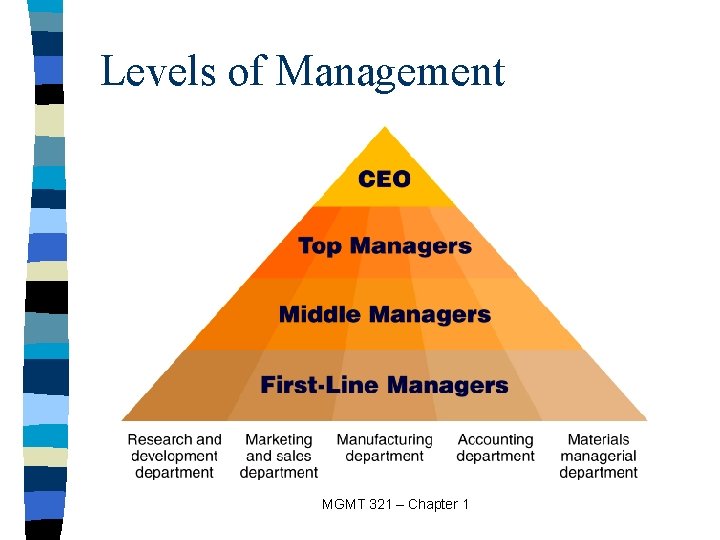
Levels of Management MGMT 321 – Chapter 1
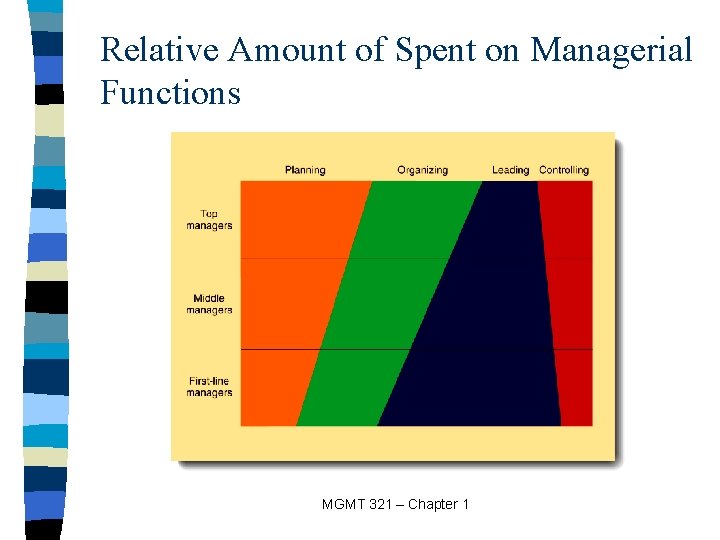
Relative Amount of Spent on Managerial Functions MGMT 321 – Chapter 1
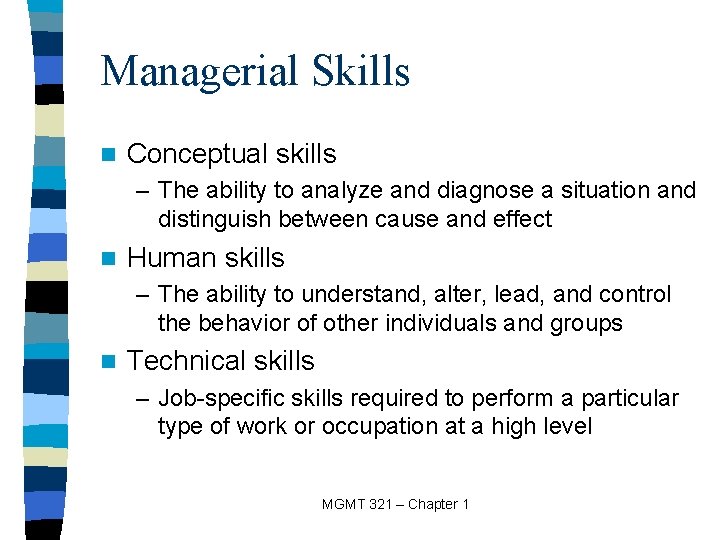
Managerial Skills n Conceptual skills – The ability to analyze and diagnose a situation and distinguish between cause and effect n Human skills – The ability to understand, alter, lead, and control the behavior of other individuals and groups n Technical skills – Job-specific skills required to perform a particular type of work or occupation at a high level MGMT 321 – Chapter 1
Recent Changes in Management Practices n Restructuring – Downsizing to lower costs n Outsourcing – Contracting with another company to perform work previously performed by the company n Empowerment – Giving employees more authority/responsibility n Self-managed teams – Employees who assume collective responsibility for managing their own work MGMT 321 – Chapter 1
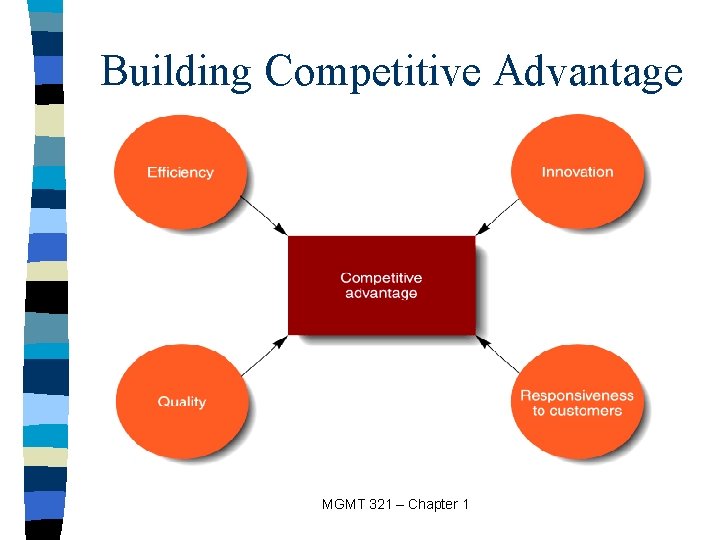
Building Competitive Advantage MGMT 321 – Chapter 1
Challenges for Management in a Global Environment n Rise of global organizations n Building a competitive advantage n Maintaining ethical standards n Managing a diverse workforce n Utilizing information technology n Global crisis management MGMT 321 – Chapter 1