
Chapter 1 Management and Its Evolution Mc GrawHillIrwin
- Slides: 33
Chapter 1 Management and Its Evolution Mc. Graw-Hill/Irwin Copyright © 2008 by The Mc. Graw-Hill Companies, Inc. All rights reserved
Slide 2 Learning Objectives After reading this chapter, you should be able to: • Understand the challenges organizations face in the new millennium. • Specify the functions and roles of successful managers. • Explain the origins of management as an academic discipline. • Describe the bureaucratic and administrative approaches to the study of management. • Explain the behavioral perspective in analyzing management issues. • Interpret recent approaches to the study of management. Mc. Graw-Hill/Irwin Copyright © 2008 by The Mc. Graw-Hill Companies, Inc. All rights reserved
Slide 3 The performance of organizations depends to a large extent on how their resources are allocated and their ability to adapt to changing conditions. Successful organizations know how to manage people and resources efficiently and effectively to accomplish organizational goals and to keep those goals in tune with changes in the external environment. Mc. Graw-Hill/Irwin Copyright © 2008 by The Mc. Graw-Hill Companies, Inc. All rights reserved
Management in the New Millennium Slide 4 • A firm can be efficient by making the best use of people, money, physical plant, and technology. • It is ineffective if its goals do not provide a sustained competitive advantage. • A firm with excellent goals would fail if it hired the wrong people, lost key contributors, relied on outdated technology, and made poor investment decisions. Mc. Graw-Hill/Irwin Copyright © 2008 by The Mc. Graw-Hill Companies, Inc. All rights reserved
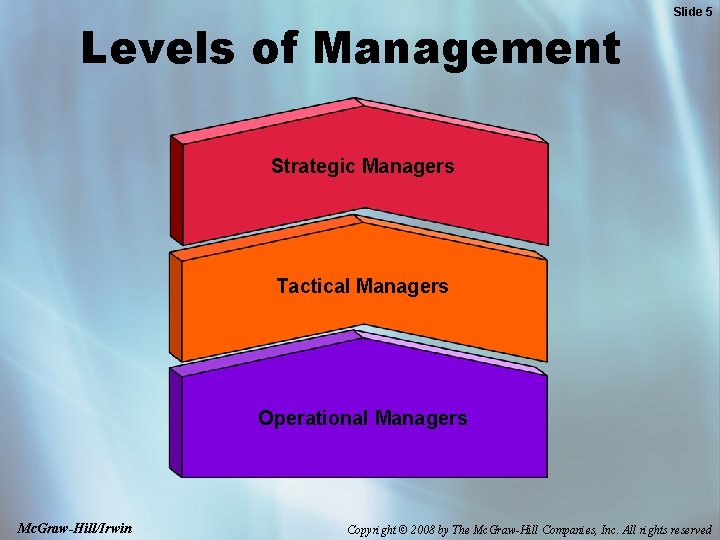
Levels of Management Slide 5 Strategic Managers Tactical Managers Operational Managers Mc. Graw-Hill/Irwin Copyright © 2008 by The Mc. Graw-Hill Companies, Inc. All rights reserved
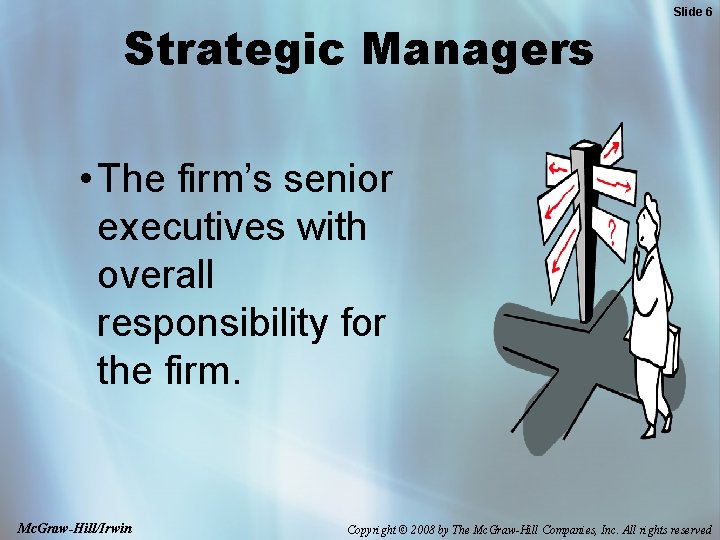
Strategic Managers Slide 6 • The firm’s senior executives with overall responsibility for the firm. Mc. Graw-Hill/Irwin Copyright © 2008 by The Mc. Graw-Hill Companies, Inc. All rights reserved
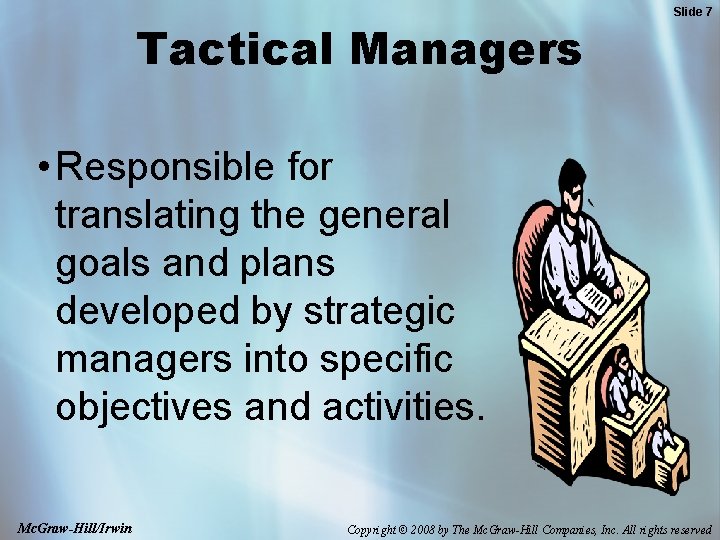
Tactical Managers Slide 7 • Responsible for translating the general goals and plans developed by strategic managers into specific objectives and activities. Mc. Graw-Hill/Irwin Copyright © 2008 by The Mc. Graw-Hill Companies, Inc. All rights reserved
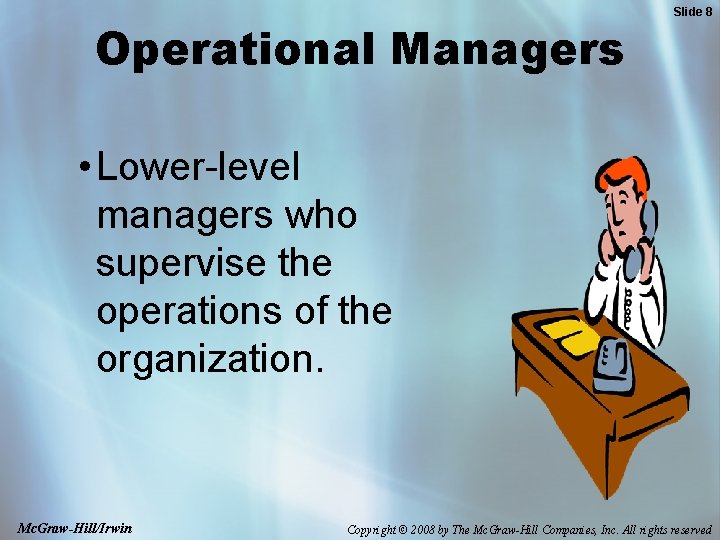
Operational Managers Slide 8 • Lower-level managers who supervise the operations of the organization. Mc. Graw-Hill/Irwin Copyright © 2008 by The Mc. Graw-Hill Companies, Inc. All rights reserved
Today’s Organizations Slide 9 • More decentralization • Employees have more autonomy to define their jobs, prioritize tasks, allocate time, monitor their own work, and set their own objectives. • Empowerment allows employees to be less dependant on superiors to tell them what to do, and are encouraged to use their own ideas. • Department barriers are breaking down by creating more teams. Mc. Graw-Hill/Irwin Copyright © 2008 by The Mc. Graw-Hill Companies, Inc. All rights reserved
Teams Slide 10 Cross-functional teams • Composed of individuals from different parts of the organization Cross-disciplinary • Composed of team members with diverse background • Define the problem, set objectives, establish priorities, proposes new ways of doing things, and assigns members to different tasks. Mc. Graw-Hill/Irwin Copyright © 2008 by The Mc. Graw-Hill Companies, Inc. All rights reserved
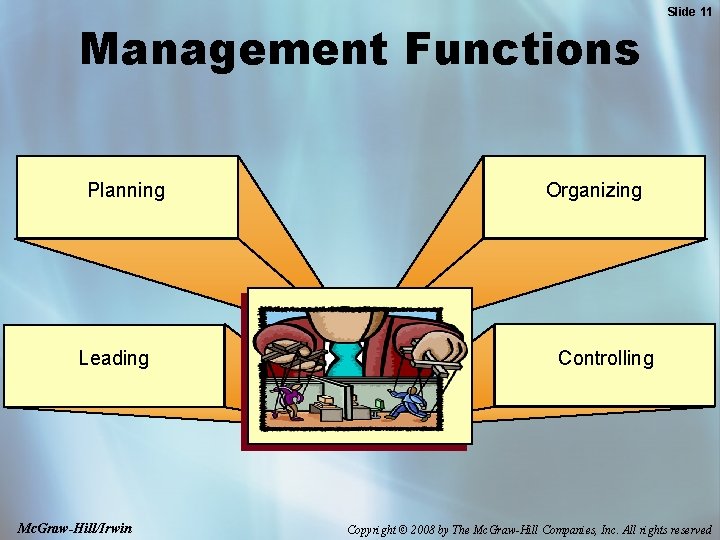
Management Functions Planning Leading Mc. Graw-Hill/Irwin Slide 11 Organizing Controlling Copyright © 2008 by The Mc. Graw-Hill Companies, Inc. All rights reserved
Planning Slide 12 • The management function that assesses the management environment to set future objectives and map out activities necessary to achieve those objectives. • To be effective, the objectives of individuals, teams, and management should be coordinated to support the firm’s mission. Mc. Graw-Hill/Irwin Copyright © 2008 by The Mc. Graw-Hill Companies, Inc. All rights reserved
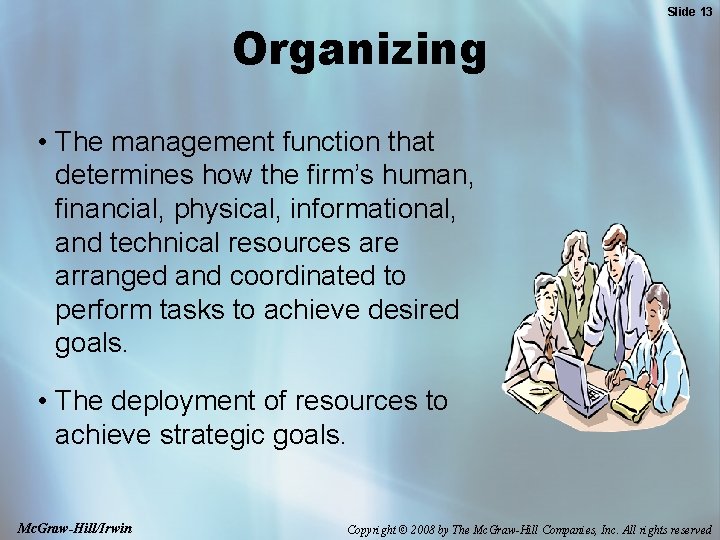
Organizing Slide 13 • The management function that determines how the firm’s human, financial, physical, informational, and technical resources are arranged and coordinated to perform tasks to achieve desired goals. • The deployment of resources to achieve strategic goals. Mc. Graw-Hill/Irwin Copyright © 2008 by The Mc. Graw-Hill Companies, Inc. All rights reserved
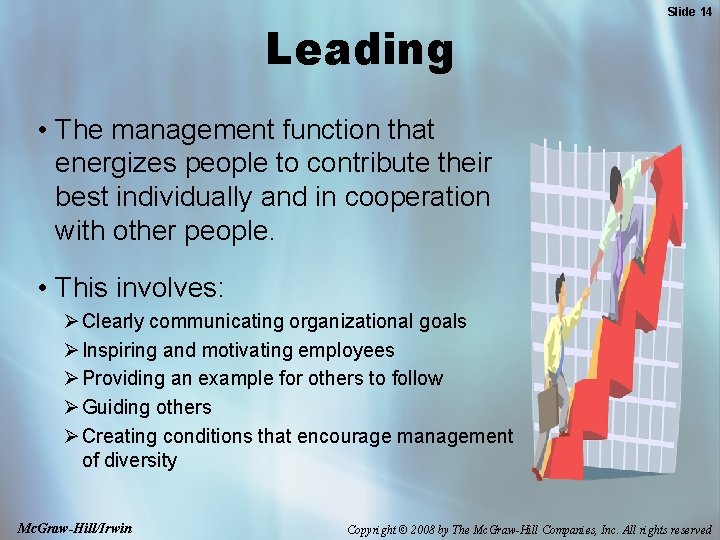
Leading Slide 14 • The management function that energizes people to contribute their best individually and in cooperation with other people. • This involves: Ø Clearly communicating organizational goals Ø Inspiring and motivating employees Ø Providing an example for others to follow Ø Guiding others Ø Creating conditions that encourage management of diversity Mc. Graw-Hill/Irwin Copyright © 2008 by The Mc. Graw-Hill Companies, Inc. All rights reserved
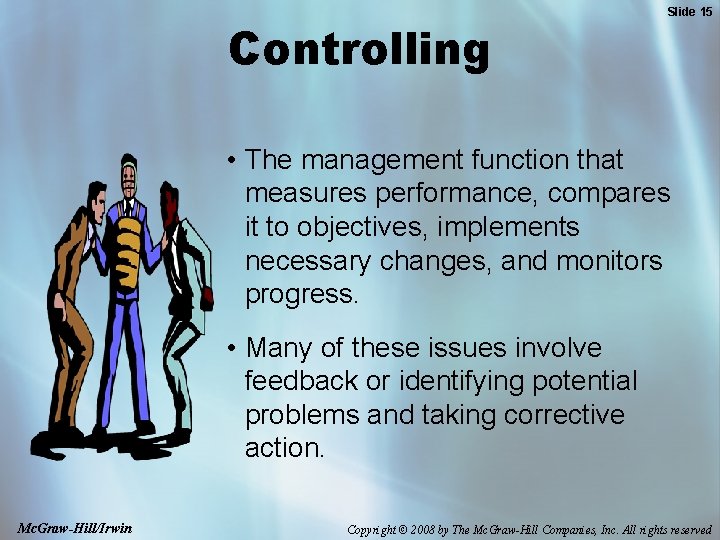
Controlling Slide 15 • The management function that measures performance, compares it to objectives, implements necessary changes, and monitors progress. • Many of these issues involve feedback or identifying potential problems and taking corrective action. Mc. Graw-Hill/Irwin Copyright © 2008 by The Mc. Graw-Hill Companies, Inc. All rights reserved
Slide 16 Management as a Set of Roles • Day-to-day management activities are routine, orderly, and rational. • These include: ØInterpersonal roles - communication with superiors, peers, subordinates, and people from outside the organization. ØInformation Roles - obtaining, interpreting, and giving out information. ØDecisional Roles - choosing among competing alternatives. Mc. Graw-Hill/Irwin Copyright © 2008 by The Mc. Graw-Hill Companies, Inc. All rights reserved
Interpersonal & Informational Roles Slide 17 Interpersonal Roles • Figurehead-visible personality representing an organization, department, or unit • Leader-energizes others to get the job done properly • Liaison-links together the activities of people both inside and outside of the organization. Informational Roles • Include monitor and disseminator Mc. Graw-Hill/Irwin Copyright © 2008 by The Mc. Graw-Hill Companies, Inc. All rights reserved
Decisional Roles Slide 18 • Entrepreneur-introduces changes in the organization • Disturbance handler-takes corrective action, provide damage control, and responds to unexpected situations or crisis • Resource allocator-assigns people and other resources to best meet organizational needs • Negotiator-reaches agreements and makes compromises Mc. Graw-Hill/Irwin Copyright © 2008 by The Mc. Graw-Hill Companies, Inc. All rights reserved
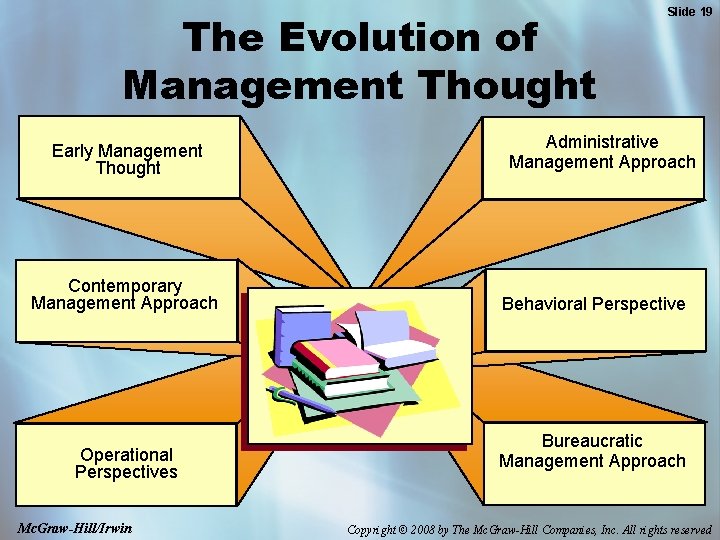
The Evolution of Management Thought Early Management Thought Contemporary Management Approach Operational Perspectives Mc. Graw-Hill/Irwin Slide 19 Administrative Management Approach Behavioral Perspective Bureaucratic Management Approach Copyright © 2008 by The Mc. Graw-Hill Companies, Inc. All rights reserved
Slide 20 Early Management Thought • Early ideas about management strategy ØSun Tzu, The Art of War • Early ideas about leadership ØNicolò Machiavelli, The Prince • Early ideas about the design and organization of work ØAdam Smith, The Wealth of Nations üdivision of labor Mc. Graw-Hill/Irwin Copyright © 2008 by The Mc. Graw-Hill Companies, Inc. All rights reserved
Slide 21 The Operational Perspective • Scientific Management ØFrederick W. Taylor • Quantitative Management ØFord W. Harris • Quality Management ØWalter A. Shewhart Mc. Graw-Hill/Irwin Copyright © 2008 by The Mc. Graw-Hill Companies, Inc. All rights reserved
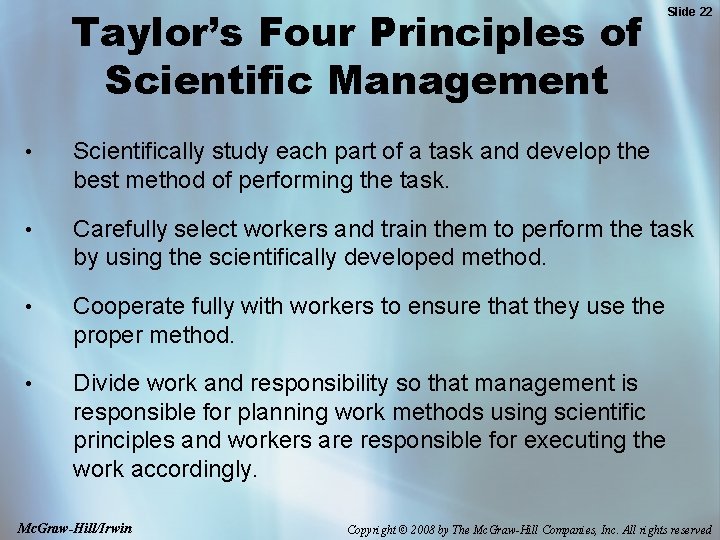
Taylor’s Four Principles of Scientific Management Slide 22 • Scientifically study each part of a task and develop the best method of performing the task. • Carefully select workers and train them to perform the task by using the scientifically developed method. • Cooperate fully with workers to ensure that they use the proper method. • Divide work and responsibility so that management is responsible for planning work methods using scientific principles and workers are responsible for executing the work accordingly. Mc. Graw-Hill/Irwin Copyright © 2008 by The Mc. Graw-Hill Companies, Inc. All rights reserved
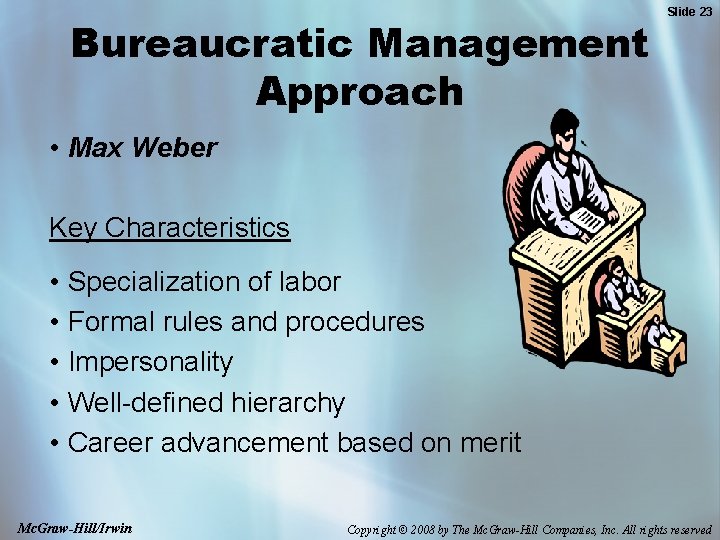
Bureaucratic Management Approach Slide 23 • Max Weber Key Characteristics • Specialization of labor • Formal rules and procedures • Impersonality • Well-defined hierarchy • Career advancement based on merit Mc. Graw-Hill/Irwin Copyright © 2008 by The Mc. Graw-Hill Companies, Inc. All rights reserved
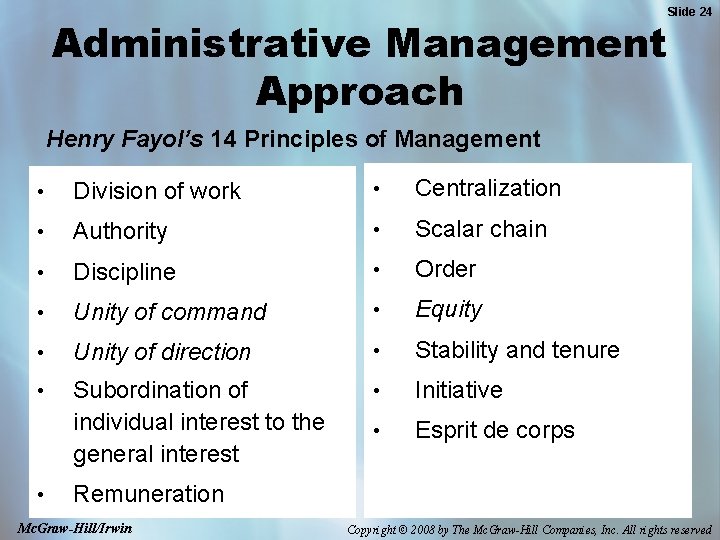
Administrative Management Approach Slide 24 Henry Fayol’s 14 Principles of Management • Division of work • Centralization • Authority • Scalar chain • Discipline • Order • Unity of command • Equity • Unity of direction • Stability and tenure • Subordination of individual interest to the general interest • Initiative • Esprit de corps • Remuneration Mc. Graw-Hill/Irwin Copyright © 2008 by The Mc. Graw-Hill Companies, Inc. All rights reserved
Behavioral Perspective Slide 25 • Mary Parker Follett & the Hawthorne Studies • Mary Follett questioned the wisdom of scientific management because she believed it ignored many ways in which employees could contribute ideas and exercise initiative. – She advocated increased employee participation, autonomy, and organization of teams • It acknowledges that psychological and social processes of human behavior can result in improvements in productivity and work satisfaction. Mc. Graw-Hill/Irwin Copyright © 2008 by The Mc. Graw-Hill Companies, Inc. All rights reserved
Behavioral Perspective Slide 26 ØThe Hawthorne effect - when a manager shows concern for employees, their motivation and productivity levels are likely to improve. ØHuman Relations Approach - the relationship between employees and a supervisor is a vital aspect of management. üEmployee motivation üLeadership style Mc. Graw-Hill/Irwin Copyright © 2008 by The Mc. Graw-Hill Companies, Inc. All rights reserved
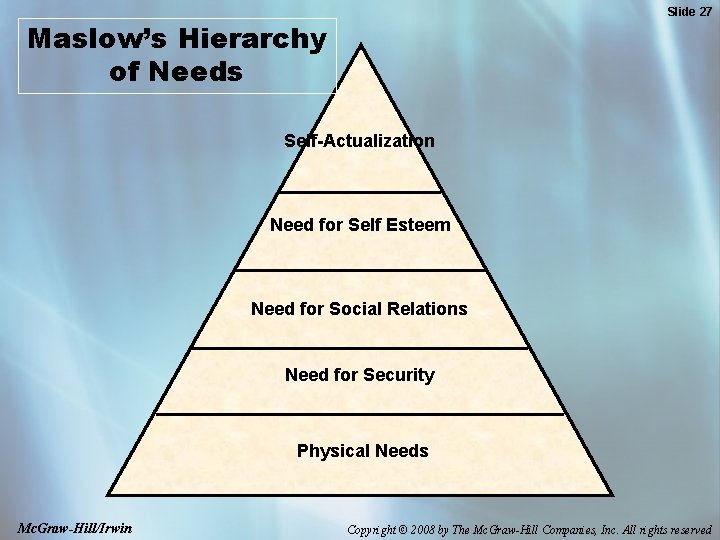
Slide 27 Maslow’s Hierarchy of Needs Self-Actualization Need for Self Esteem Need for Social Relations Need for Security Physical Needs Mc. Graw-Hill/Irwin Copyright © 2008 by The Mc. Graw-Hill Companies, Inc. All rights reserved
Mc. Gregor’s Theory X and Theory Y Slide 28 • Leaders and managers who hold Theory X assumptions believe that employees are inherently lazy and lack ambition. ØA negative perspective on human behavior. • Leaders and managers who hold Theory Y assumptions believe that most employees do not dislike work and want to make useful contributions to the organization. ØA positive perspective on human behavior. Mc. Graw-Hill/Irwin Copyright © 2008 by The Mc. Graw-Hill Companies, Inc. All rights reserved
Contemporary Management Approach Slide 29 • Systems Theory • Contingency Theory • The Learning Organization Perspective Mc. Graw-Hill/Irwin Copyright © 2008 by The Mc. Graw-Hill Companies, Inc. All rights reserved
Systems Theory Slide 30 • Views the organization as a system of interrelated parts that function in a holistic way to achieve a common purpose. • Systems theory concepts that affect management thinking: ØOpen and closed systems ØSubsystems ØSynergy ØEquifinality Mc. Graw-Hill/Irwin Copyright © 2008 by The Mc. Graw-Hill Companies, Inc. All rights reserved
Contingency Theory Slide 31 • States that there is no “one best way” to manage an organization. ØBecause what works for one organization may not work for another ØSituational characteristics (contingencies) differ ØManagers need to understand the key contingencies that determine the most effective management practices in a given situation Mc. Graw-Hill/Irwin Copyright © 2008 by The Mc. Graw-Hill Companies, Inc. All rights reserved
Slide 32 The Learning Organization • The management approach based on an organization anticipating change faster than its counterparts to have an advantage in the market over its competitors. • Rather than reacting to change , which is a normal part of the business landscape, organizations need to anticipate change so they are well positioned to satisfy customer needs. Mc. Graw-Hill/Irwin Copyright © 2008 by The Mc. Graw-Hill Companies, Inc. All rights reserved
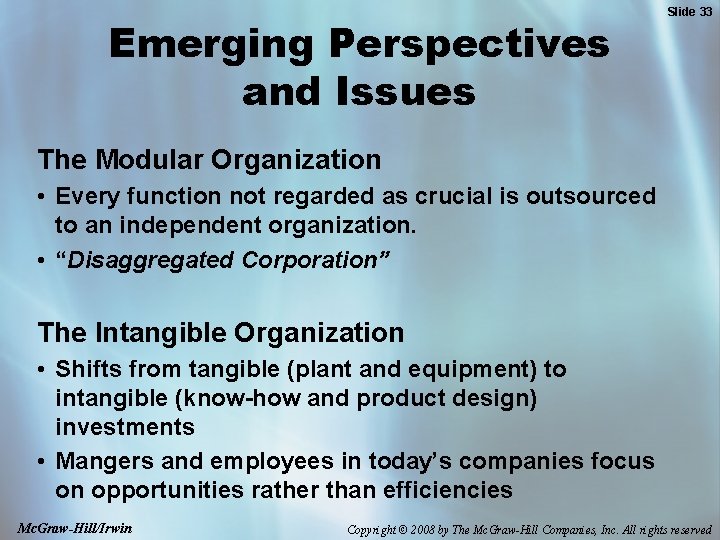
Emerging Perspectives and Issues Slide 33 The Modular Organization • Every function not regarded as crucial is outsourced to an independent organization. • “Disaggregated Corporation” The Intangible Organization • Shifts from tangible (plant and equipment) to intangible (know-how and product design) investments • Mangers and employees in today’s companies focus on opportunities rather than efficiencies Mc. Graw-Hill/Irwin Copyright © 2008 by The Mc. Graw-Hill Companies, Inc. All rights reserved