
Chapter 1 LINEAR FUNCTIONS AND CHANGE Section 1
- Slides: 50
Chapter 1 LINEAR FUNCTIONS AND CHANGE Section 1. 1 Functions and Function Notation Section 1. 2 Rate of Change Section 1. 3 Linear Functions Section 1. 4 Formulas for Linear Functions Section 1. 5 Modeling with Linear Functions Section 1. 6 Fitting Linear Functions to Data Functions Modeling Change: A Preparation for Calculus, 5 th Edition, 2014, Connally 1
1. 1 FUNCTIONS AND FUNCTION NOTATION Functions Modeling Change: A Preparation for Calculus, 5 th Edition, 2014, Connally 2
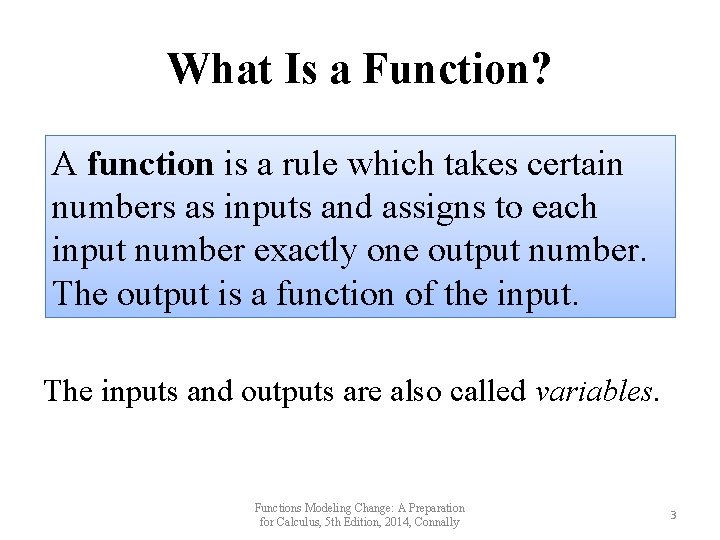
What Is a Function? A function is a rule which takes certain numbers as inputs and assigns to each input number exactly one output number. The output is a function of the input. The inputs and outputs are also called variables. Functions Modeling Change: A Preparation for Calculus, 5 th Edition, 2014, Connally 3
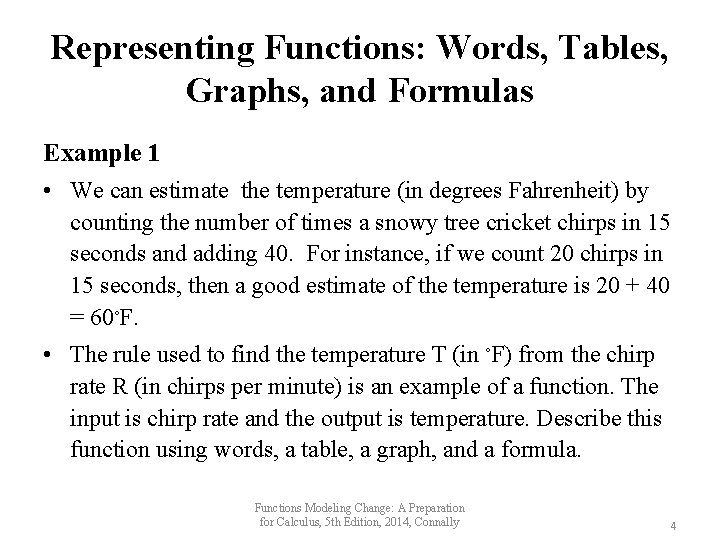
Representing Functions: Words, Tables, Graphs, and Formulas Example 1 • We can estimate the temperature (in degrees Fahrenheit) by counting the number of times a snowy tree cricket chirps in 15 seconds and adding 40. For instance, if we count 20 chirps in 15 seconds, then a good estimate of the temperature is 20 + 40 = 60◦F. • The rule used to find the temperature T (in ◦F) from the chirp rate R (in chirps per minute) is an example of a function. The input is chirp rate and the output is temperature. Describe this function using words, a table, a graph, and a formula. Functions Modeling Change: A Preparation for Calculus, 5 th Edition, 2014, Connally 4
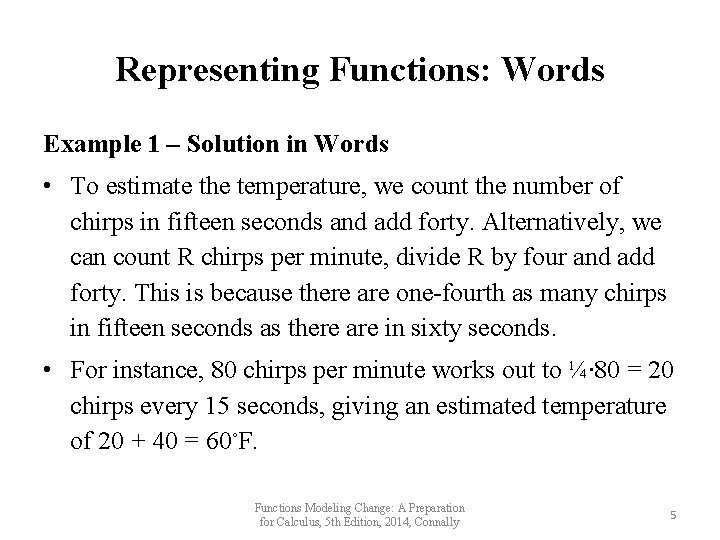
Representing Functions: Words Example 1 – Solution in Words • To estimate the temperature, we count the number of chirps in fifteen seconds and add forty. Alternatively, we can count R chirps per minute, divide R by four and add forty. This is because there are one-fourth as many chirps in fifteen seconds as there are in sixty seconds. • For instance, 80 chirps per minute works out to ¼∙ 80 = 20 chirps every 15 seconds, giving an estimated temperature of 20 + 40 = 60◦F. Functions Modeling Change: A Preparation for Calculus, 5 th Edition, 2014, Connally 5
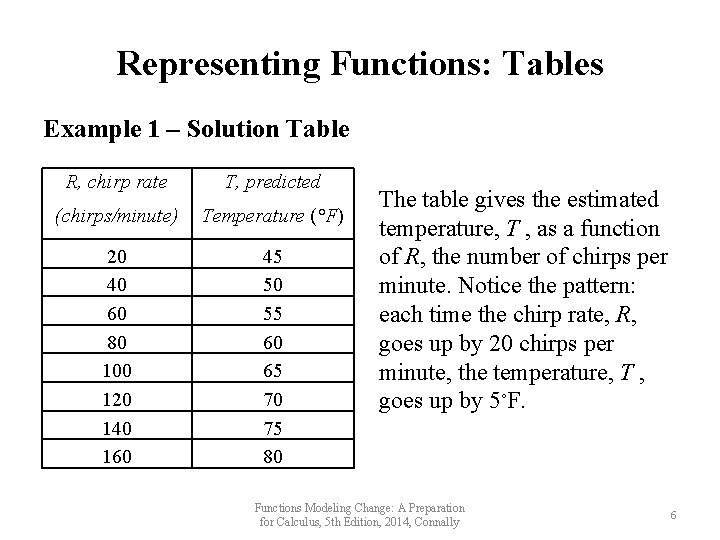
Representing Functions: Tables Example 1 – Solution Table R, chirp rate T, predicted (chirps/minute) Temperature (°F) 20 40 60 80 100 120 140 160 45 50 55 60 65 70 75 80 The table gives the estimated temperature, T , as a function of R, the number of chirps per minute. Notice the pattern: each time the chirp rate, R, goes up by 20 chirps per minute, the temperature, T , goes up by 5◦F. Functions Modeling Change: A Preparation for Calculus, 5 th Edition, 2014, Connally 6
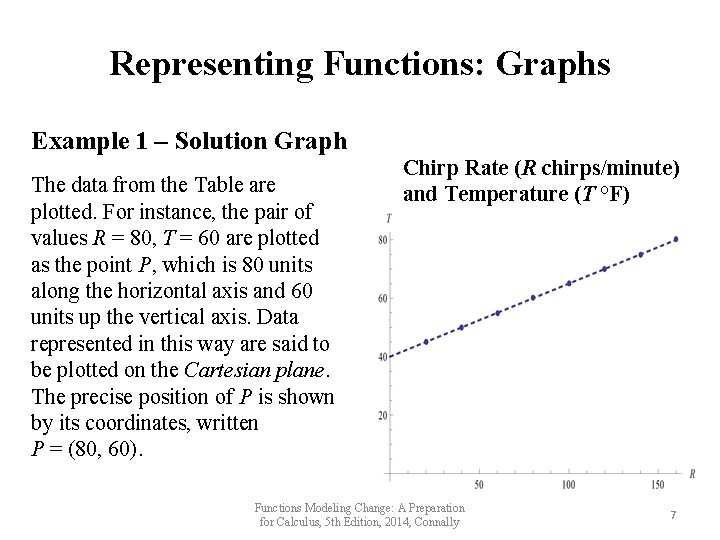
Representing Functions: Graphs Example 1 – Solution Graph The data from the Table are plotted. For instance, the pair of values R = 80, T = 60 are plotted as the point P, which is 80 units along the horizontal axis and 60 units up the vertical axis. Data represented in this way are said to be plotted on the Cartesian plane. The precise position of P is shown by its coordinates, written P = (80, 60). Chirp Rate (R chirps/minute) and Temperature (T °F) Functions Modeling Change: A Preparation for Calculus, 5 th Edition, 2014, Connally 7
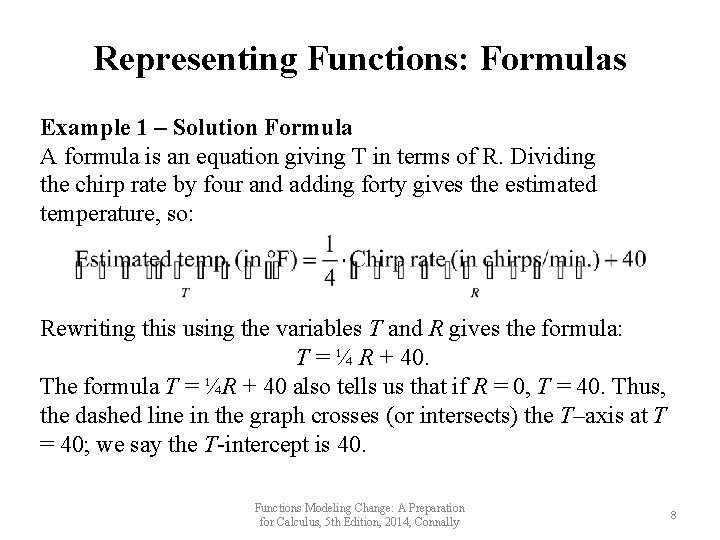
Representing Functions: Formulas Example 1 – Solution Formula A formula is an equation giving T in terms of R. Dividing the chirp rate by four and adding forty gives the estimated temperature, so: Rewriting this using the variables T and R gives the formula: T = ¼ R + 40. The formula T = ¼R + 40 also tells us that if R = 0, T = 40. Thus, the dashed line in the graph crosses (or intersects) the T–axis at T = 40; we say the T-intercept is 40. Functions Modeling Change: A Preparation for Calculus, 5 th Edition, 2014, Connally 8
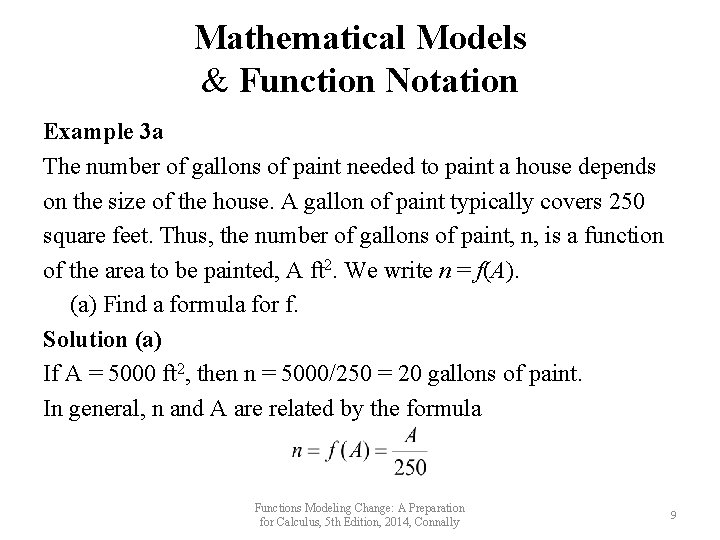
Mathematical Models & Function Notation Example 3 a The number of gallons of paint needed to paint a house depends on the size of the house. A gallon of paint typically covers 250 square feet. Thus, the number of gallons of paint, n, is a function of the area to be painted, A ft 2. We write n = f(A). (a) Find a formula for f. Solution (a) If A = 5000 ft 2, then n = 5000/250 = 20 gallons of paint. In general, n and A are related by the formula Functions Modeling Change: A Preparation for Calculus, 5 th Edition, 2014, Connally 9
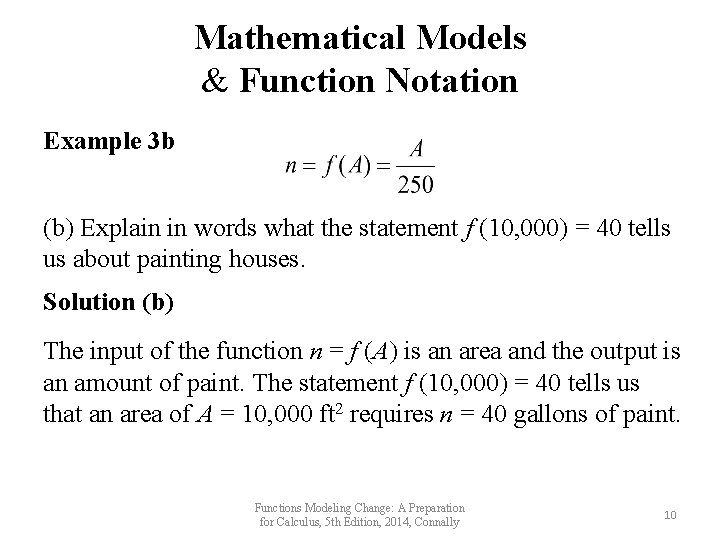
Mathematical Models & Function Notation Example 3 b (b) Explain in words what the statement f (10, 000) = 40 tells us about painting houses. Solution (b) The input of the function n = f (A) is an area and the output is an amount of paint. The statement f (10, 000) = 40 tells us that an area of A = 10, 000 ft 2 requires n = 40 gallons of paint. Functions Modeling Change: A Preparation for Calculus, 5 th Edition, 2014, Connally 10
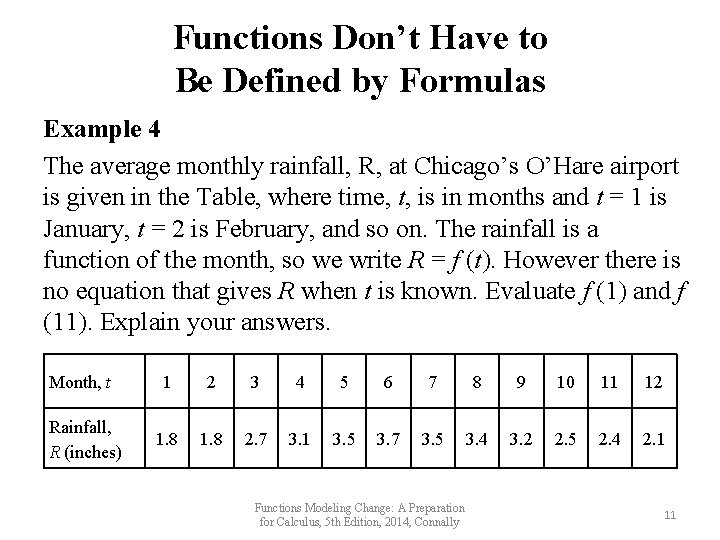
Functions Don’t Have to Be Defined by Formulas Example 4 The average monthly rainfall, R, at Chicago’s O’Hare airport is given in the Table, where time, t, is in months and t = 1 is January, t = 2 is February, and so on. The rainfall is a function of the month, so we write R = f (t). However there is no equation that gives R when t is known. Evaluate f (1) and f (11). Explain your answers. Month, t Rainfall, R (inches) 1 2 3 4 5 6 7 8 9 10 11 12 1. 8 2. 7 3. 1 3. 5 3. 7 3. 5 3. 4 3. 2 2. 5 2. 4 2. 1 Functions Modeling Change: A Preparation for Calculus, 5 th Edition, 2014, Connally 11
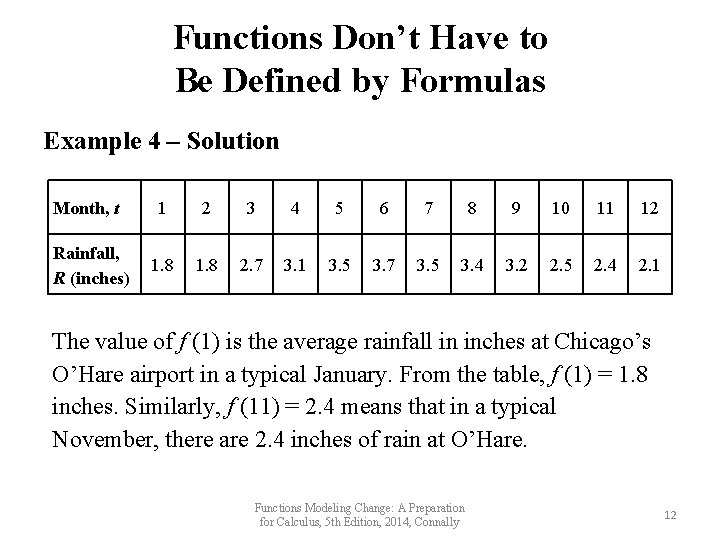
Functions Don’t Have to Be Defined by Formulas Example 4 – Solution Month, t 1 2 3 4 5 6 7 8 9 10 11 12 Rainfall, R (inches) 1. 8 2. 7 3. 1 3. 5 3. 7 3. 5 3. 4 3. 2 2. 5 2. 4 2. 1 The value of f (1) is the average rainfall in inches at Chicago’s O’Hare airport in a typical January. From the table, f (1) = 1. 8 inches. Similarly, f (11) = 2. 4 means that in a typical November, there are 2. 4 inches of rain at O’Hare. Functions Modeling Change: A Preparation for Calculus, 5 th Edition, 2014, Connally 12
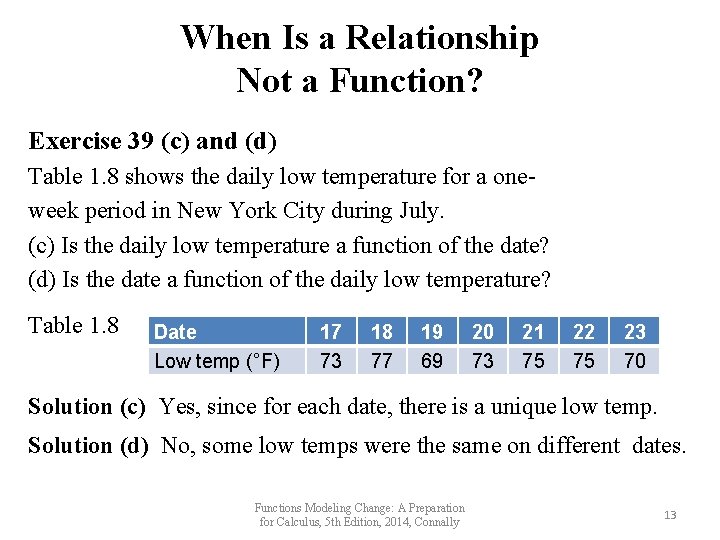
When Is a Relationship Not a Function? Exercise 39 (c) and (d) Table 1. 8 shows the daily low temperature for a oneweek period in New York City during July. (c) Is the daily low temperature a function of the date? (d) Is the date a function of the daily low temperature? Table 1. 8 Date Low temp (°F) 17 73 18 77 19 69 20 73 21 75 22 75 23 70 Solution (c) Yes, since for each date, there is a unique low temp. Solution (d) No, some low temps were the same on different dates. Functions Modeling Change: A Preparation for Calculus, 5 th Edition, 2014, Connally 13
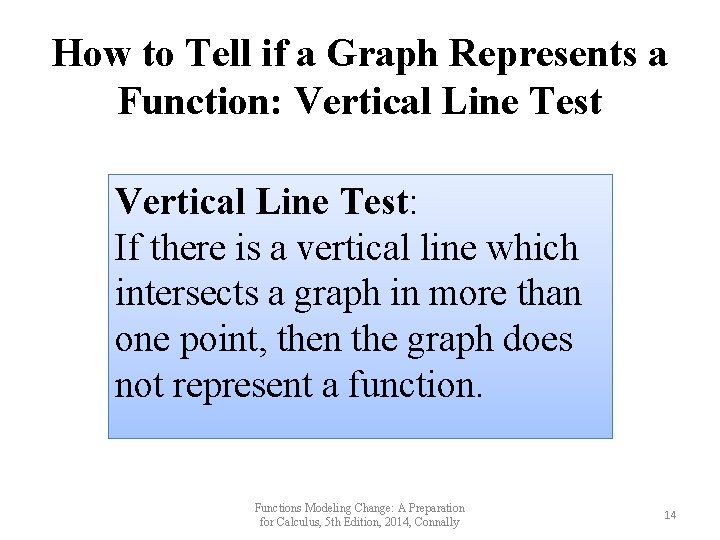
How to Tell if a Graph Represents a Function: Vertical Line Test: If there is a vertical line which intersects a graph in more than one point, then the graph does not represent a function. Functions Modeling Change: A Preparation for Calculus, 5 th Edition, 2014, Connally 14
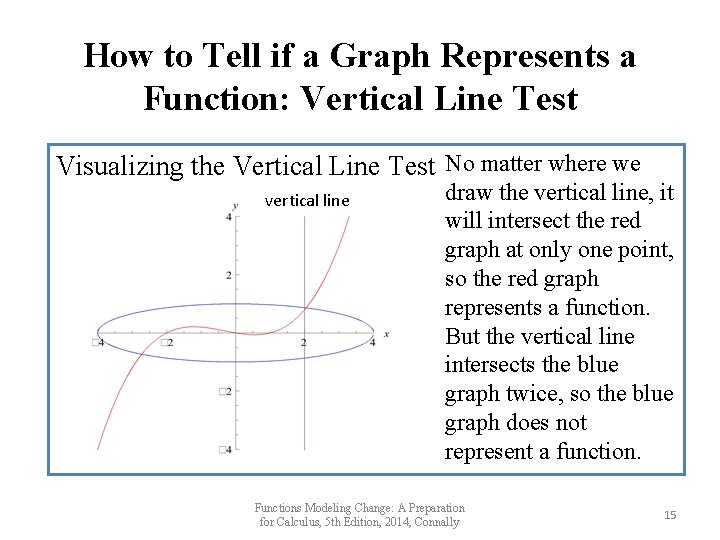
How to Tell if a Graph Represents a Function: Vertical Line Test Visualizing the Vertical Line Test No matter where we vertical line draw the vertical line, it will intersect the red graph at only one point, so the red graph represents a function. But the vertical line intersects the blue graph twice, so the blue graph does not represent a function. Functions Modeling Change: A Preparation for Calculus, 5 th Edition, 2014, Connally 15
1. 2 RATE OF CHANGE Functions Modeling Change: A Preparation for Calculus, 5 th Edition, 2014, Connally 16
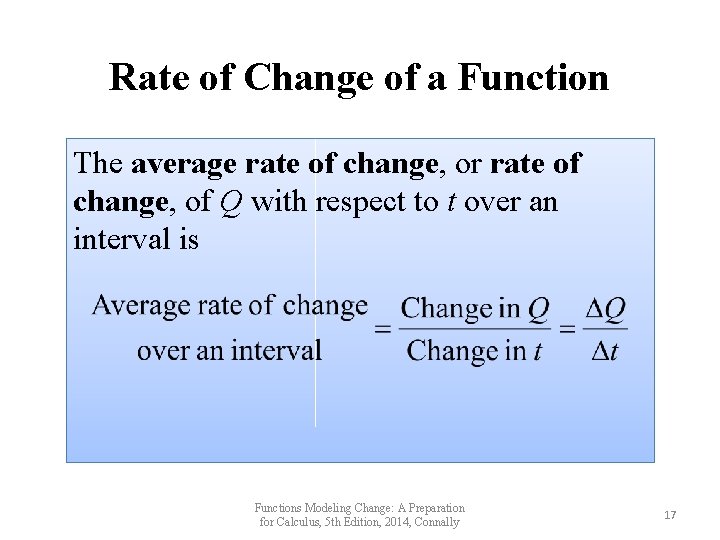
Rate of Change of a Function The average rate of change, or rate of change, of Q with respect to t over an interval is Functions Modeling Change: A Preparation for Calculus, 5 th Edition, 2014, Connally 17
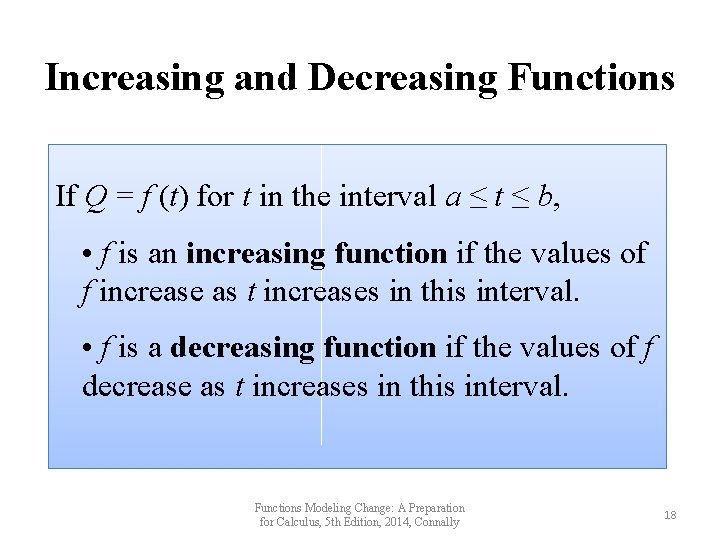
Increasing and Decreasing Functions If Q = f (t) for t in the interval a ≤ t ≤ b, • f is an increasing function if the values of f increase as t increases in this interval. • f is a decreasing function if the values of f decrease as t increases in this interval. Functions Modeling Change: A Preparation for Calculus, 5 th Edition, 2014, Connally 18
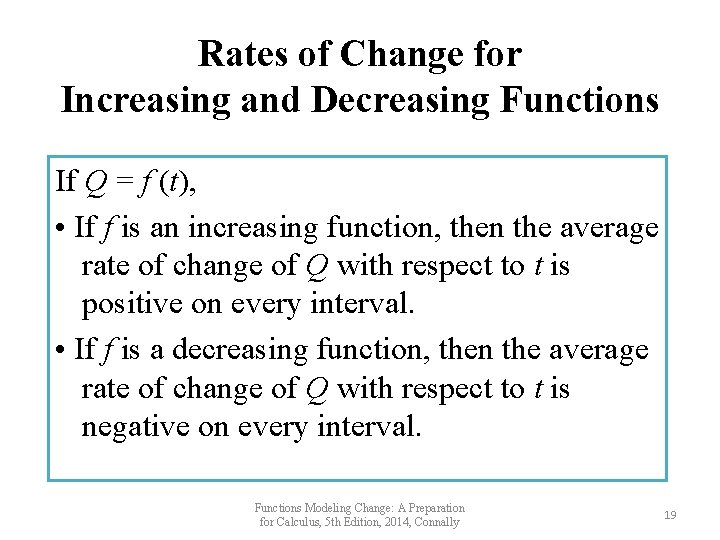
Rates of Change for Increasing and Decreasing Functions If Q = f (t), • If f is an increasing function, then the average rate of change of Q with respect to t is positive on every interval. • If f is a decreasing function, then the average rate of change of Q with respect to t is negative on every interval. Functions Modeling Change: A Preparation for Calculus, 5 th Edition, 2014, Connally 19
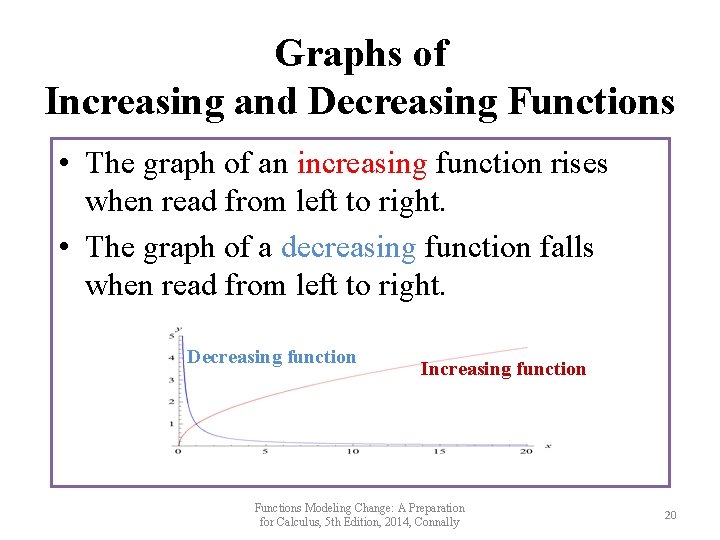
Graphs of Increasing and Decreasing Functions • The graph of an increasing function rises when read from left to right. • The graph of a decreasing function falls when read from left to right. Decreasing function Increasing function Functions Modeling Change: A Preparation for Calculus, 5 th Edition, 2014, Connally 20
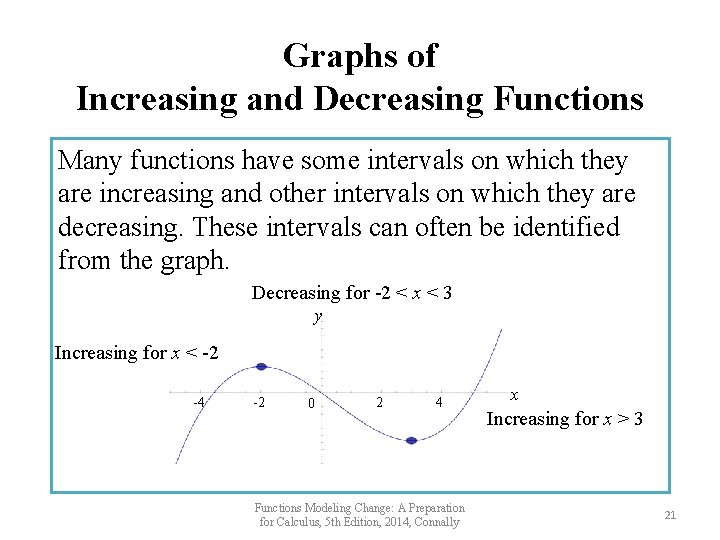
Graphs of Increasing and Decreasing Functions Many functions have some intervals on which they are increasing and other intervals on which they are decreasing. These intervals can often be identified from the graph. Decreasing for -2 < x < 3 y Increasing for x < -2 -4 -2 0 2 4 Functions Modeling Change: A Preparation for Calculus, 5 th Edition, 2014, Connally x Increasing for x > 3 21
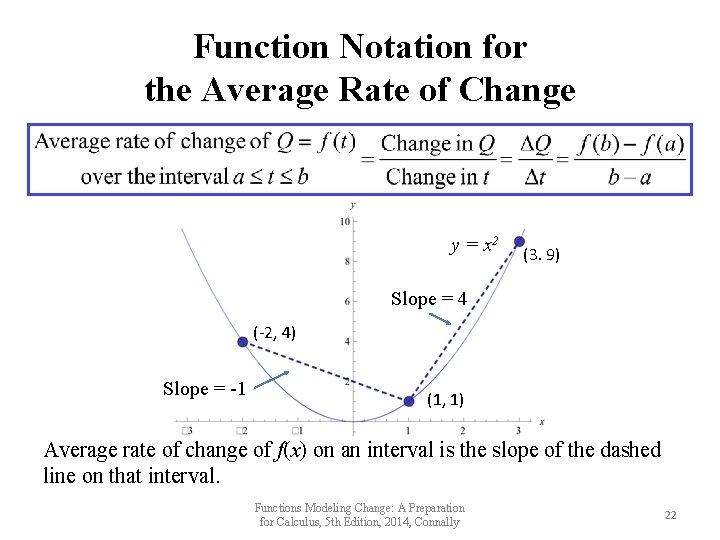
Function Notation for the Average Rate of Change y = x 2 (3. 9) Slope = 4 (-2, 4) Slope = -1 (1, 1) Average rate of change of f(x) on an interval is the slope of the dashed line on that interval. Functions Modeling Change: A Preparation for Calculus, 5 th Edition, 2014, Connally 22
1. 3 LINEAR FUNCTIONS Functions Modeling Change: A Preparation for Calculus, 5 th Edition, 2014, Connally 23
Constant Rate of Change • A linear function has a constant rate of change. • The graph of any linear function is a straight line. • Population Growth Mathematical models of population growth are used by city planners to project the growth of towns and states. Biologists model the growth of animal populations and physicians model the spread of an infection in the bloodstream. One possible model, a linear model, assumes that the population changes at the same average rate on every time interval. • Financial Models Economists and accountants use linear functions for straight-line depreciation. For tax purposes, the value of certain equipment is considered to decrease, or depreciate, over time. For example, computer equipment may be state-of-theart today, but after several years it is outdated. Straight-line depreciation assumes that the rate of change of value with respect to time is constant. Functions Modeling Change: A Preparation for Calculus, 5 th Edition, 2014, Connally 24
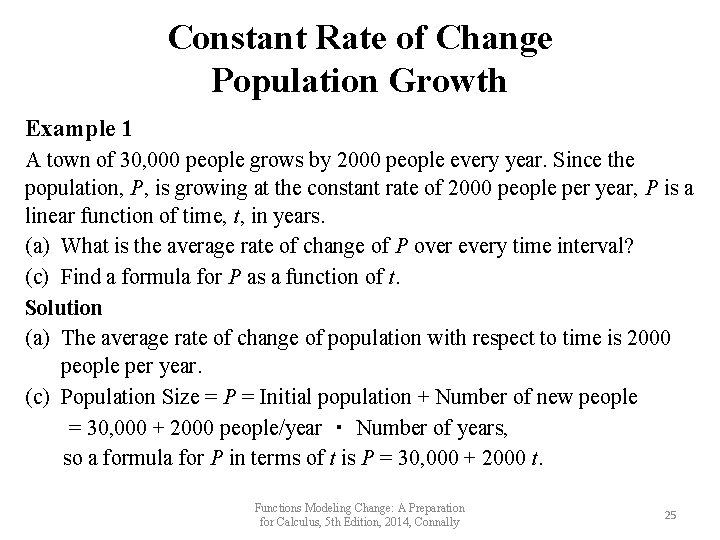
Constant Rate of Change Population Growth Example 1 A town of 30, 000 people grows by 2000 people every year. Since the population, P, is growing at the constant rate of 2000 people per year, P is a linear function of time, t, in years. (a) What is the average rate of change of P over every time interval? (c) Find a formula for P as a function of t. Solution (a) The average rate of change of population with respect to time is 2000 people per year. (c) Population Size = P = Initial population + Number of new people = 30, 000 + 2000 people/year ・ Number of years, so a formula for P in terms of t is P = 30, 000 + 2000 t. Functions Modeling Change: A Preparation for Calculus, 5 th Edition, 2014, Connally 25
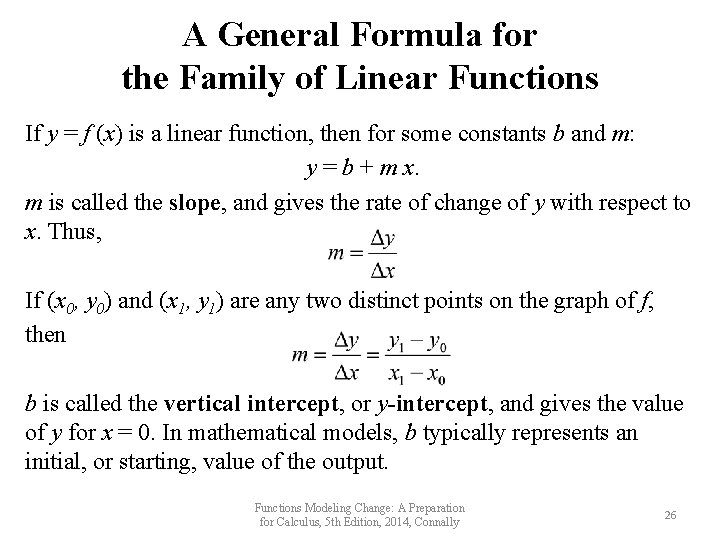
A General Formula for the Family of Linear Functions If y = f (x) is a linear function, then for some constants b and m: y = b + m x. m is called the slope, and gives the rate of change of y with respect to x. Thus, If (x 0, y 0) and (x 1, y 1) are any two distinct points on the graph of f, then b is called the vertical intercept, or y-intercept, and gives the value of y for x = 0. In mathematical models, b typically represents an initial, or starting, value of the output. Functions Modeling Change: A Preparation for Calculus, 5 th Edition, 2014, Connally 26
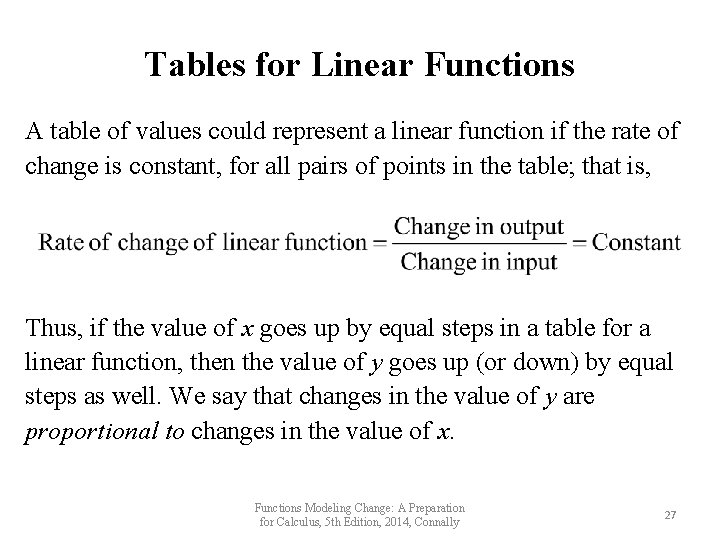
Tables for Linear Functions A table of values could represent a linear function if the rate of change is constant, for all pairs of points in the table; that is, Thus, if the value of x goes up by equal steps in a table for a linear function, then the value of y goes up (or down) by equal steps as well. We say that changes in the value of y are proportional to changes in the value of x. Functions Modeling Change: A Preparation for Calculus, 5 th Edition, 2014, Connally 27
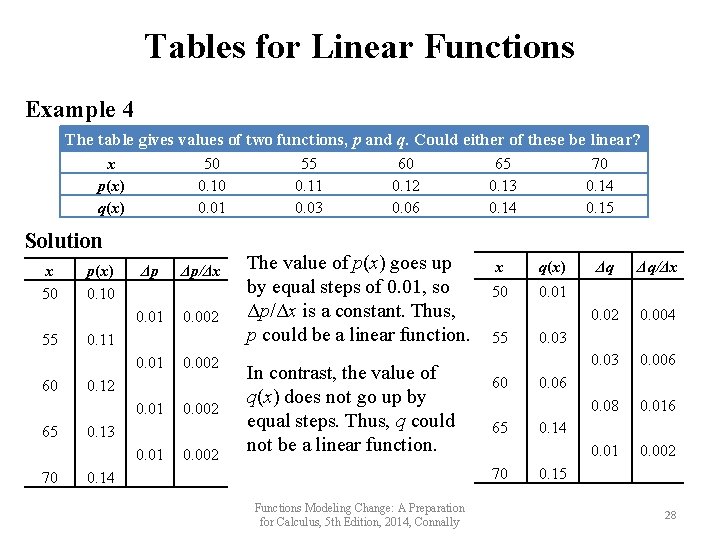
Tables for Linear Functions Example 4 The table gives values of two functions, p and q. Could either of these be linear? x p(x) q(x) 50 0. 10 0. 01 Solution x 50 p(x) 0. 10 Δp 0. 01 55 0. 002 0. 13 0. 01 70 0. 002 0. 12 0. 01 65 0. 002 0. 11 0. 01 60 Δp/Δx 0. 002 55 0. 11 0. 03 60 0. 12 0. 06 The value of p(x) goes up by equal steps of 0. 01, so Δp/Δx is a constant. Thus, p could be a linear function. In contrast, the value of q(x) does not go up by equal steps. Thus, q could not be a linear function. 65 0. 13 0. 14 x q(x) 50 0. 01 55 60 65 70 0. 14 Functions Modeling Change: A Preparation for Calculus, 5 th Edition, 2014, Connally 70 0. 14 0. 15 Δq Δq/Δx 0. 02 0. 004 0. 03 0. 006 0. 08 0. 016 0. 01 0. 002 0. 03 0. 06 0. 14 0. 15 28
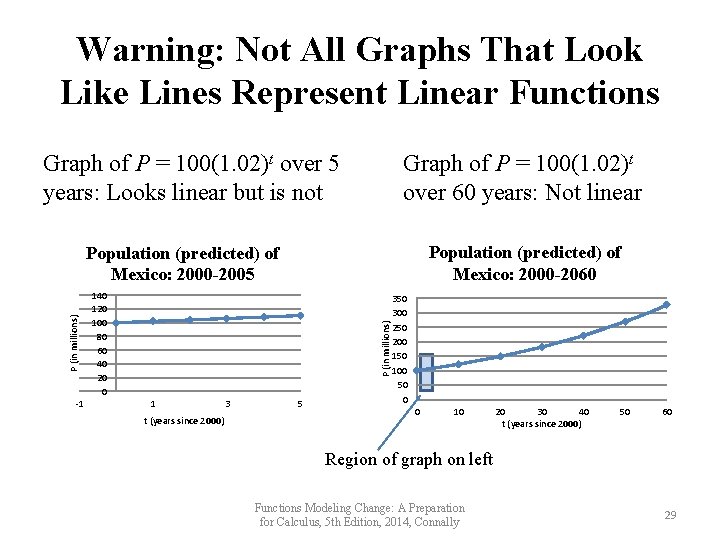
Warning: Not All Graphs That Look Like Lines Represent Linear Functions Graph of P = 100(1. 02)t over 5 years: Looks linear but is not Graph of P = 100(1. 02)t over 60 years: Not linear Population (predicted) of Mexico: 2000 -2060 -1 140 120 100 80 60 40 20 0 P (in millions) Population (predicted) of Mexico: 2000 -2005 1 t (years since 2000) 3 5 350 300 250 200 150 100 50 0 0 10 20 30 40 t (years since 2000) 50 60 Region of graph on left Functions Modeling Change: A Preparation for Calculus, 5 th Edition, 2014, Connally 29
1. 4 FORMULAS FOR LINEAR FUNCTIONS Functions Modeling Change: A Preparation for Calculus, 5 th Edition, 2014, Connally 30
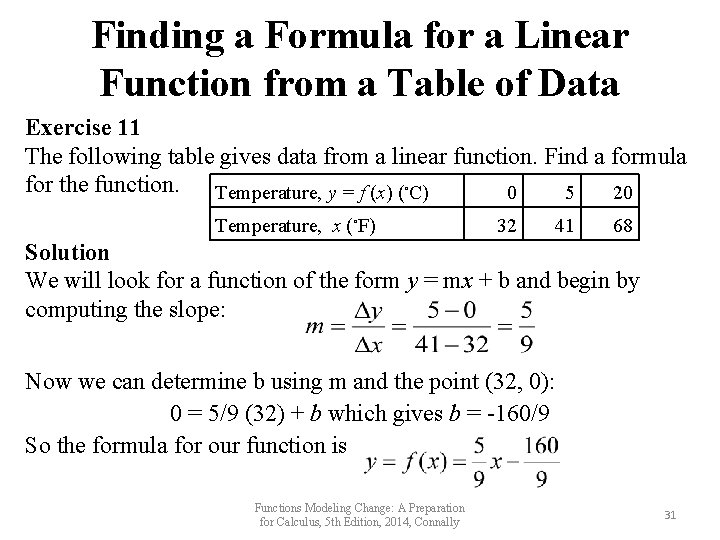
Finding a Formula for a Linear Function from a Table of Data Exercise 11 The following table gives data from a linear function. Find a formula for the function. Temperature, y = f (x) (◦C) 0 5 20 Temperature, x (◦F) 32 41 68 Solution We will look for a function of the form y = mx + b and begin by computing the slope: Now we can determine b using m and the point (32, 0): 0 = 5/9 (32) + b which gives b = -160/9 So the formula for our function is Functions Modeling Change: A Preparation for Calculus, 5 th Edition, 2014, Connally 31
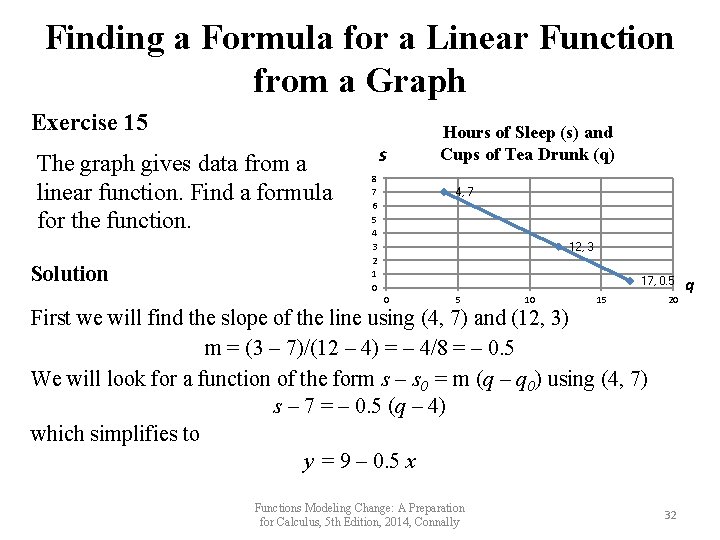
Finding a Formula for a Linear Function from a Graph Exercise 15 The graph gives data from a linear function. Find a formula for the function. Solution s 8 7 6 5 4 3 2 1 0 Hours of Sleep (s) and Cups of Tea Drunk (q) 4, 7 12, 3 17, 0. 5 0 5 10 15 First we will find the slope of the line using (4, 7) and (12, 3) m = (3 – 7)/(12 – 4) = – 4/8 = – 0. 5 We will look for a function of the form s – s 0 = m (q – q 0) using (4, 7) s – 7 = – 0. 5 (q – 4) which simplifies to y = 9 – 0. 5 x Functions Modeling Change: A Preparation for Calculus, 5 th Edition, 2014, Connally 20 32 q
Finding a Formula for a Linear Function from a Verbal Description Example 3 We have $48 to spend on soda and chips for a party. A six-pack of soda costs $6 and a bag of chips costs $4. The number of six-packs we can afford, y, is a function of the number of bags of chips we decide to buy, x. (a) Find an equation relating x and y. Solution (a) • The amount of money ($) spent on soda will be 6 y. • The amount of money ($) spent on chips will be 4 x. • Assuming we spend all $24, the equation becomes: 4 x + 6 y = 48 or y = 8 – 2/3 x Functions Modeling Change: A Preparation for Calculus, 5 th Edition, 2014, Connally 33
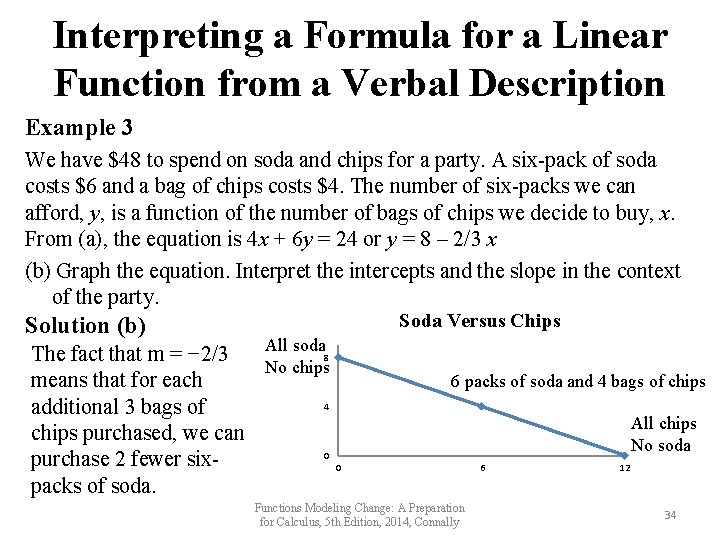
Interpreting a Formula for a Linear Function from a Verbal Description Example 3 We have $48 to spend on soda and chips for a party. A six-pack of soda costs $6 and a bag of chips costs $4. The number of six-packs we can afford, y, is a function of the number of bags of chips we decide to buy, x. From (a), the equation is 4 x + 6 y = 24 or y = 8 – 2/3 x (b) Graph the equation. Interpret the intercepts and the slope in the context of the party. Soda Versus Chips Solution (b) All soda 8 The fact that m = − 2/3 No chips means that for each 4 additional 3 bags of chips purchased, we can 0 purchase 2 fewer sixpacks of soda. 6 packs of soda and 4 bags of chips All chips No soda 0 Functions Modeling Change: A Preparation for Calculus, 5 th Edition, 2014, Connally 6 12 34
Alternative Forms for the Equation of a Line • The slope-intercept form is y=b+mx where m is the slope and b is the y-intercept. • The point-slope form is y − y 0 = m(x − x 0) where m is the slope and (x 0, y 0) is a point on the line. • The standard form is Ax + By + C = 0 where A, B, and C are constants. Functions Modeling Change: A Preparation for Calculus, 5 th Edition, 2014, Connally 35
Equations of Horizontal and Vertical Lines For any constant k: • The graph of the equation y = k is a horizontal line and its slope is zero. • The graph of the equation x = k is a vertical line and its slope is undefined. Functions Modeling Change: A Preparation for Calculus, 5 th Edition, 2014, Connally 36
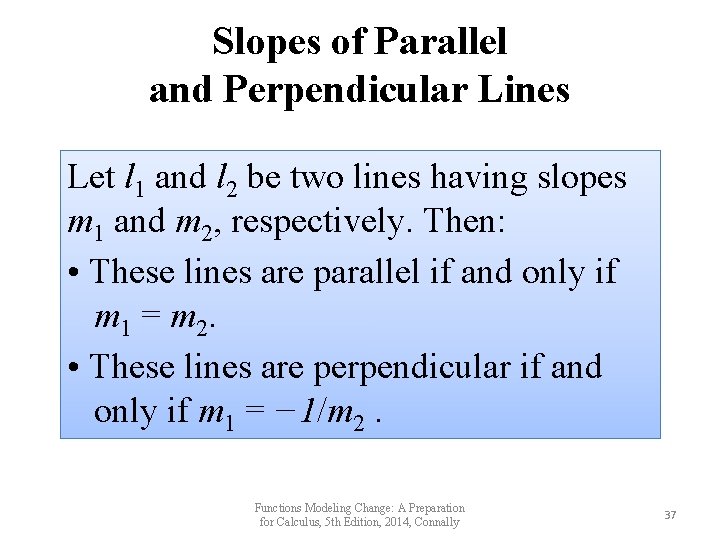
Slopes of Parallel and Perpendicular Lines Let l 1 and l 2 be two lines having slopes m 1 and m 2, respectively. Then: • These lines are parallel if and only if m 1 = m 2. • These lines are perpendicular if and only if m 1 = − 1/m 2. Functions Modeling Change: A Preparation for Calculus, 5 th Edition, 2014, Connally 37
1. 5 MODELING WITH LINEAR FUNCTIONS Functions Modeling Change: A Preparation for Calculus, 5 th Edition, 2014, Connally 38
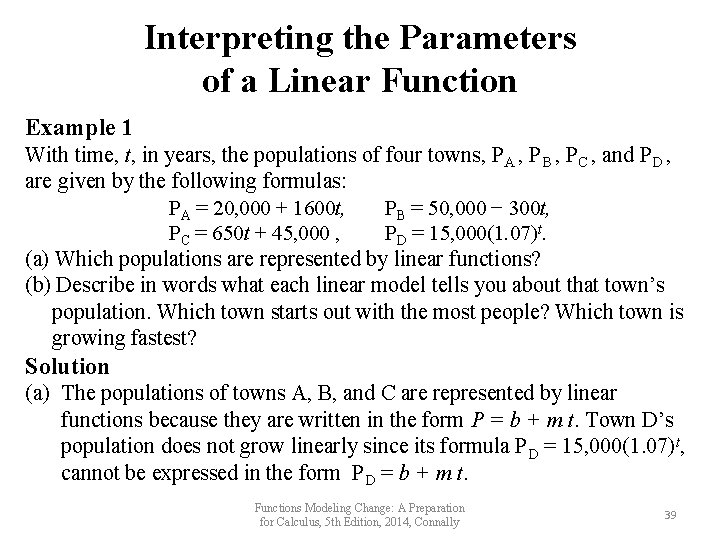
Interpreting the Parameters of a Linear Function Example 1 With time, t, in years, the populations of four towns, PA , PB , PC , and PD , are given by the following formulas: PA = 20, 000 + 1600 t, PB = 50, 000 − 300 t, PC = 650 t + 45, 000 , PD = 15, 000(1. 07)t. (a) Which populations are represented by linear functions? (b) Describe in words what each linear model tells you about that town’s population. Which town starts out with the most people? Which town is growing fastest? Solution (a) The populations of towns A, B, and C are represented by linear functions because they are written in the form P = b + m t. Town D’s population does not grow linearly since its formula PD = 15, 000(1. 07)t, cannot be expressed in the form PD = b + m t. Functions Modeling Change: A Preparation for Calculus, 5 th Edition, 2014, Connally 39
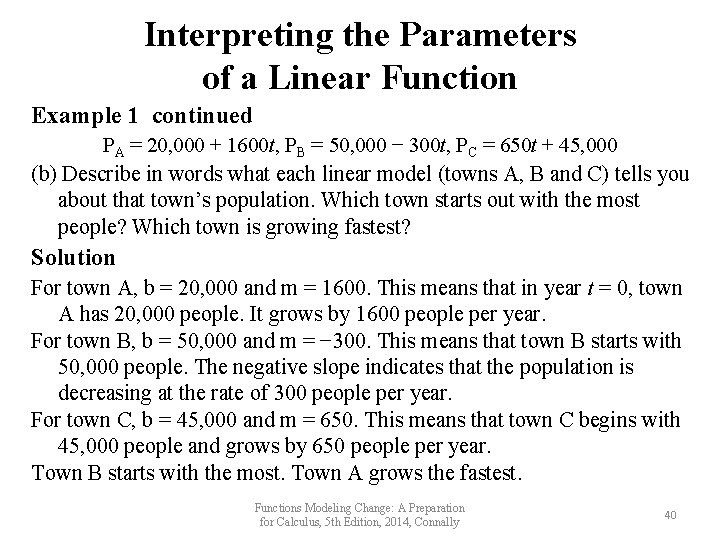
Interpreting the Parameters of a Linear Function Example 1 continued PA = 20, 000 + 1600 t, PB = 50, 000 − 300 t, PC = 650 t + 45, 000 (b) Describe in words what each linear model (towns A, B and C) tells you about that town’s population. Which town starts out with the most people? Which town is growing fastest? Solution For town A, b = 20, 000 and m = 1600. This means that in year t = 0, town A has 20, 000 people. It grows by 1600 people per year. For town B, b = 50, 000 and m = − 300. This means that town B starts with 50, 000 people. The negative slope indicates that the population is decreasing at the rate of 300 people per year. For town C, b = 45, 000 and m = 650. This means that town C begins with 45, 000 people and grows by 650 people per year. Town B starts with the most. Town A grows the fastest. Functions Modeling Change: A Preparation for Calculus, 5 th Edition, 2014, Connally 40
The Effect of the Parameters on the Graph of a Linear Function Let y = b + m x. Then the graph of y against x is a line. • The y-intercept, b, tells us where the line crosses the y-axis. • If the slope, m, is positive, the line climbs from left to right. If the slope, m, is negative, the line falls from left to right. • The slope, m, tells us how fast the line is climbing or falling. • The larger the magnitude of m (either positive or negative), the steeper the graph of f. Functions Modeling Change: A Preparation for Calculus, 5 th Edition, 2014, Connally 41
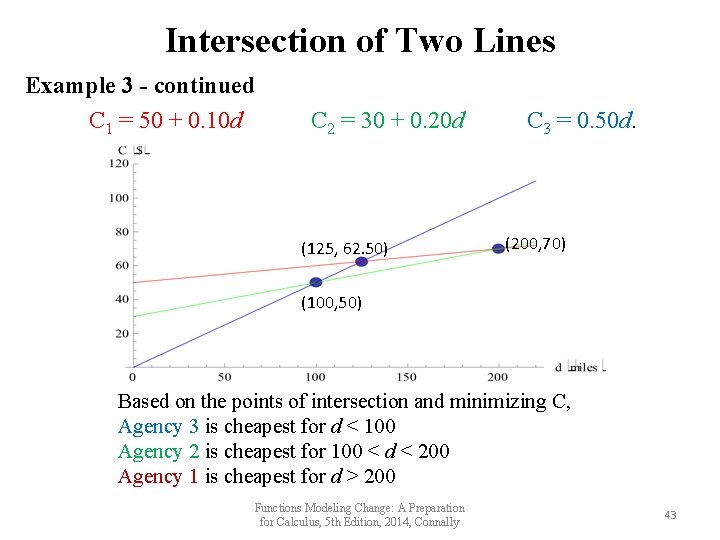
Intersection of Two Lines Example 3 The cost in dollars of renting a car for a day from three differental agencies and driving it d miles is given by the following functions: C 1 = 50 + 0. 10 d C 2 = 30 + 0. 20 d C 3 = 0. 50 d. (a) Describe in words the daily rental arrangements made by each of these three agencies. (b) Which agency is cheapest? Solution (a) Agency 1 charges $50 plus $0. 10 per mile driven. Agency 2 charges $30 plus $0. 20 per mile. Agency 3 charges $0. 50 per mile driven. (b) To determine which agency is cheapest, we will graph all three. Functions Modeling Change: A Preparation for Calculus, 5 th Edition, 2014, Connally 42
Intersection of Two Lines Example 3 - continued C 1 = 50 + 0. 10 d C 2 = 30 + 0. 20 d (125, 62. 50) C 3 = 0. 50 d. (200, 70) (100, 50) Based on the points of intersection and minimizing C, Agency 3 is cheapest for d < 100 Agency 2 is cheapest for 100 < d < 200 Agency 1 is cheapest for d > 200 Functions Modeling Change: A Preparation for Calculus, 5 th Edition, 2014, Connally 43
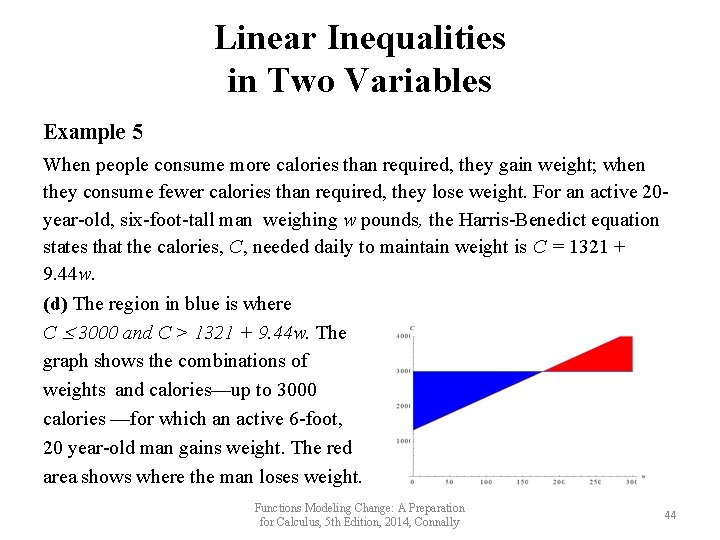
Linear Inequalities in Two Variables Example 5 When people consume more calories than required, they gain weight; when they consume fewer calories than required, they lose weight. For an active 20 year-old, six-foot-tall man weighing w pounds, the Harris-Benedict equation states that the calories, C, needed daily to maintain weight is C = 1321 + 9. 44 w. (d) The region in blue is where C 3000 and C > 1321 + 9. 44 w. The graph shows the combinations of weights and calories—up to 3000 calories —for which an active 6 -foot, 20 year-old man gains weight. The red area shows where the man loses weight. Functions Modeling Change: A Preparation for Calculus, 5 th Edition, 2014, Connally 44
1. 6 FITTING LINEAR FUNCTIONS TO DATA Functions Modeling Change: A Preparation for Calculus, 5 th Edition, 2014, Connally 45
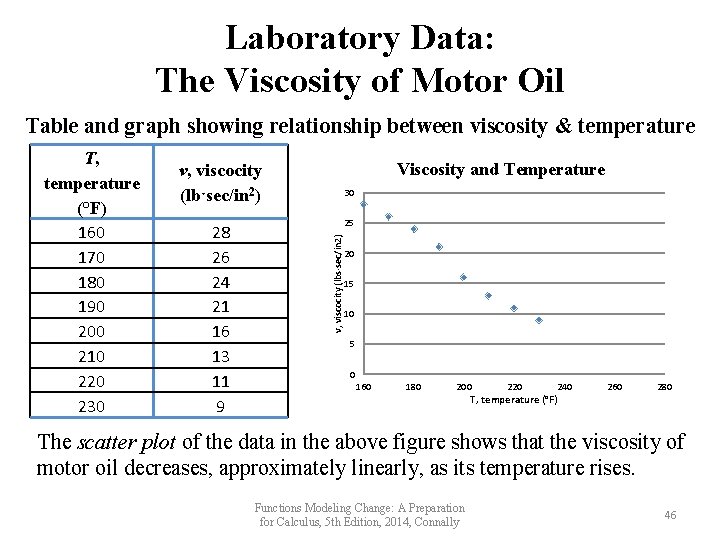
Laboratory Data: The Viscosity of Motor Oil Table and graph showing relationship between viscosity & temperature Viscosity and Temperature v, viscocity (lbˑsec/in 2) 28 26 24 21 16 13 11 9 30 25 v, viscocity (lbsˑsec/in 2) T, temperature (°F) 160 170 180 190 200 210 220 230 20 15 10 5 0 160 180 200 220 240 T, temperature (°F) 260 280 The scatter plot of the data in the above figure shows that the viscosity of motor oil decreases, approximately linearly, as its temperature rises. Functions Modeling Change: A Preparation for Calculus, 5 th Edition, 2014, Connally 46
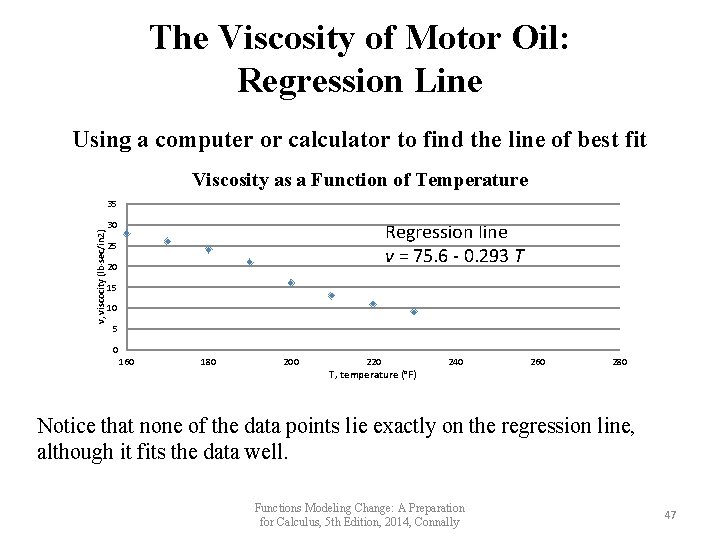
The Viscosity of Motor Oil: Regression Line Using a computer or calculator to find the line of best fit Viscosity as a Function of Temperature v, viscocity (lbˑsec/in 2) 35 30 Regression line v = 75. 6 - 0. 293 T 25 20 15 10 5 0 160 180 200 220 T, temperature (°F) 240 260 280 Notice that none of the data points lie exactly on the regression line, although it fits the data well. Functions Modeling Change: A Preparation for Calculus, 5 th Edition, 2014, Connally 47
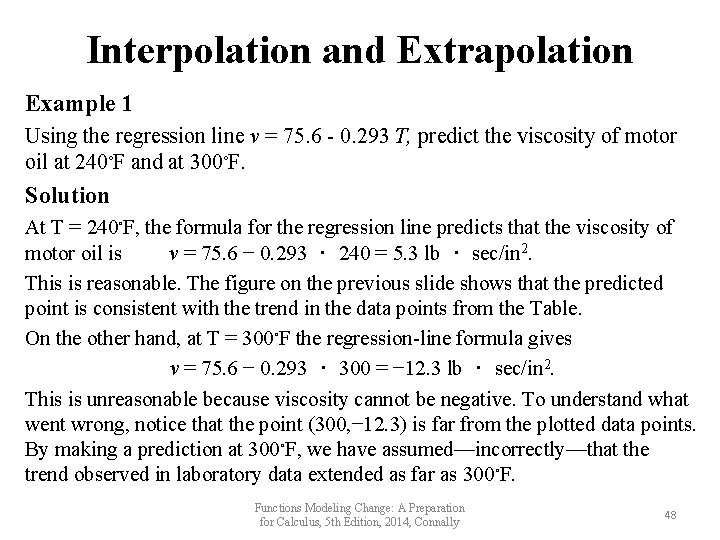
Interpolation and Extrapolation Example 1 Using the regression line v = 75. 6 - 0. 293 T, predict the viscosity of motor oil at 240◦F and at 300◦F. Solution At T = 240◦F, the formula for the regression line predicts that the viscosity of motor oil is v = 75. 6 − 0. 293 ・ 240 = 5. 3 lb ・ sec/in 2. This is reasonable. The figure on the previous slide shows that the predicted point is consistent with the trend in the data points from the Table. On the other hand, at T = 300◦F the regression-line formula gives v = 75. 6 − 0. 293 ・ 300 = − 12. 3 lb ・ sec/in 2. This is unreasonable because viscosity cannot be negative. To understand what went wrong, notice that the point (300, − 12. 3) is far from the plotted data points. By making a prediction at 300◦F, we have assumed—incorrectly—that the trend observed in laboratory data extended as far as 300◦F. Functions Modeling Change: A Preparation for Calculus, 5 th Edition, 2014, Connally 48
Correlation • When a computer or calculates a regression line, it also gives a correlation coefficient, r. • This number lies between − 1 and +1 and measures how well a particular regression line fits the data. • If r = 1, the data lie exactly on a line of positive slope. • If r = − 1, the data lie exactly on a line of negative slope. • If r is close to 0, the data may be completely scattered, or there may be a non-linear relationship between the variables. See Figure 1. 61 in your text. • For Example 1, r ≈ - 0. 99. It is negative because the slope of the line is negative. The fact that r is close to -1 indicates that the regression line is a good fit. Functions Modeling Change: A Preparation for Calculus, 5 th Edition, 2014, Connally 49
The Difference between Relation, Correlation, and Causation • It is important to understand that a high correlation (either positive or negative) between two quantities does not imply causation. For example, there is a high correlation between children’s reading level and shoe size. However, large feet do not cause a child to read better (or vice versa). Larger feet and improved reading ability are both a consequence of growing older. • A correlation of r = 0 usually implies there is no linear relationship between x and y, but this does not mean there is no relationship at all. Functions Modeling Change: A Preparation for Calculus, 5 th Edition, 2014, Connally 50