
Chapter 1 Lesson 1 Scientific Problem Solving What
Chapter 1 Lesson 1 Scientific Problem Solving
What is Science? -Science is the investigation and exploration of natural events (through observation and experimentation) -Split into Social Sciences and Natural Sciences -Natural Science tries to understand how “nature, ” or the “whole universe” behaves/works -Made up of 3 branches/parts of science: -Physical, Earth, and Biological(Life) sciences
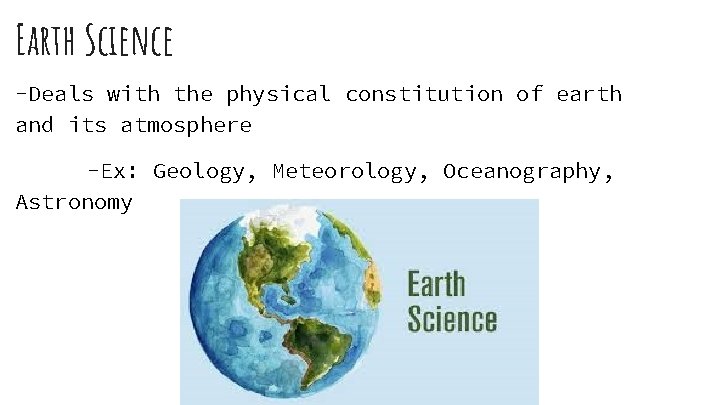
Earth Science -Deals with the physical constitution of earth and its atmosphere -Ex: Geology, Meteorology, Oceanography, Astronomy
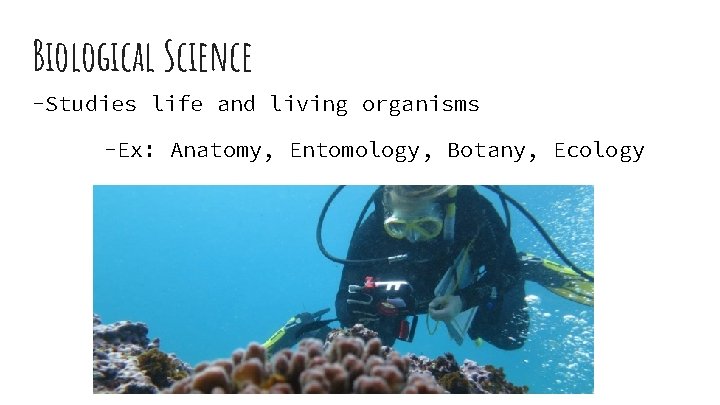
Biological Science -Studies life and living organisms -Ex: Anatomy, Entomology, Botany, Ecology
Physical Science -Studies non-living systems -Composed of two main branches -Chemistry -science of matter and its changes -Physics -science of forces and
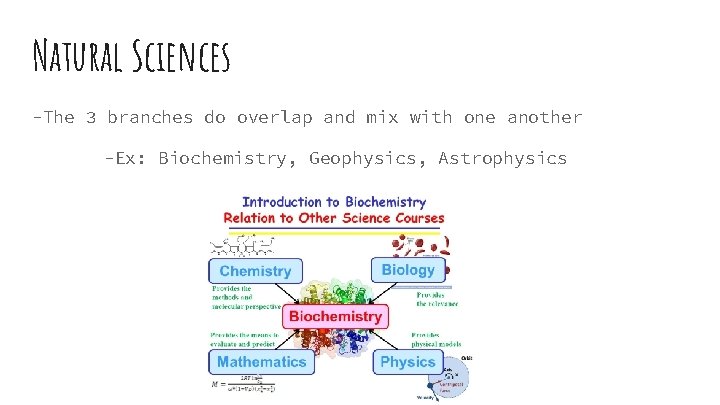
Natural Sciences -The 3 branches do overlap and mix with one another -Ex: Biochemistry, Geophysics, Astrophysics
Scientific Inquiry -A process for experimentation that is used to explore observations and answer questions -Also referred to as the scientific method
Scientific Inquiry (continued) -Observations -The results of using one or more of your senses to gather information and taking note of what occurs -How does it sound, look like, smell like, taste, etc. -Inference -A logical explanation of an observation that is drawn from prior knowledge or experience
Scientific Inquiry (continued) -Hypothesis -A possible explanation for an observation that can be tested by scientific investigations (an educated guess) -Has a reason/because! (making it educated) -Prediction -A statement of what will happen next in a sequence of events (just a guess)
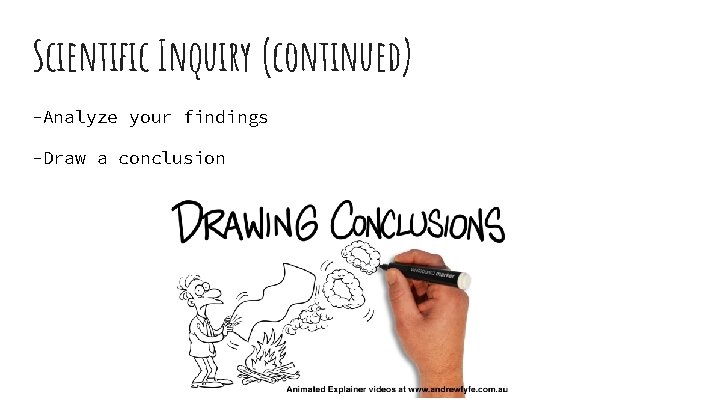
Scientific Inquiry (continued) -Analyze your findings -Draw a conclusion
Scientific Laws and Theories -Individually read pages 9 & 10 in Physical Science Textbook
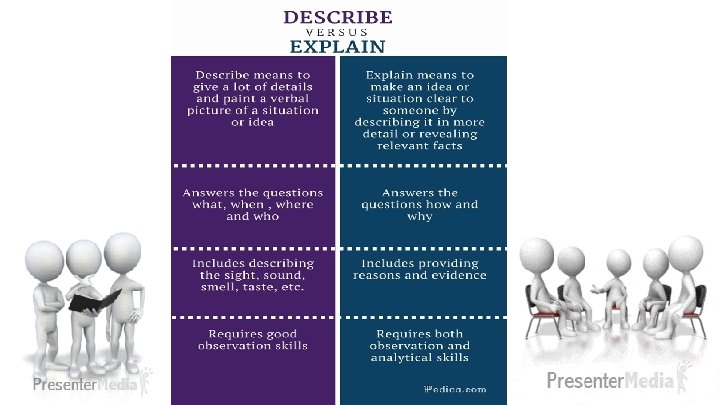
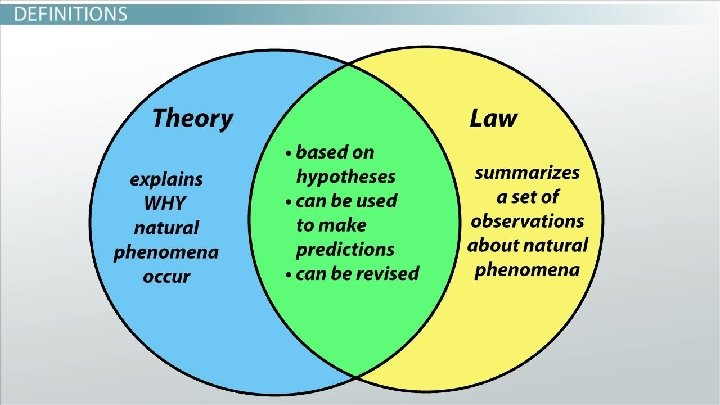
Scientific Laws and Theories -Scientific Law: -Descriptions (often a mathematical description) of natural phenomenon -Scientific Theory: -A system of ideas that explains many related observations and is supported by a large body of evidence acquired through scientific investigation
Scientific Laws and Theories (continued) -Theories explain WHY something happens -Laws describe What is happening
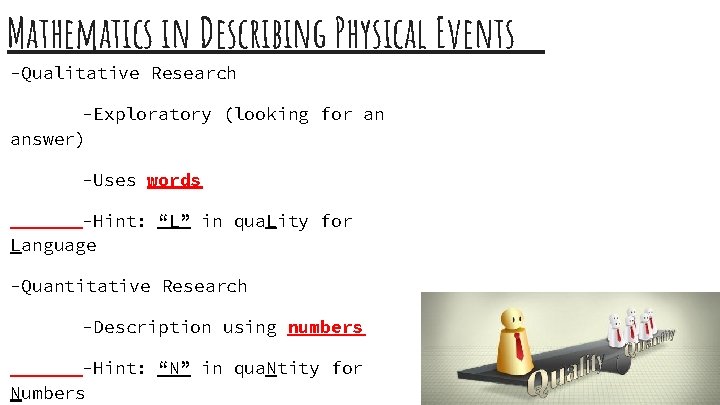
Mathematics in Describing Physical Events -Qualitative Research -Exploratory (looking for an answer) -Uses words -Hint: “L” in qua. Lity for Language -Quantitative Research -Description using numbers -Hint: “N” in qua. Ntity for Numbers
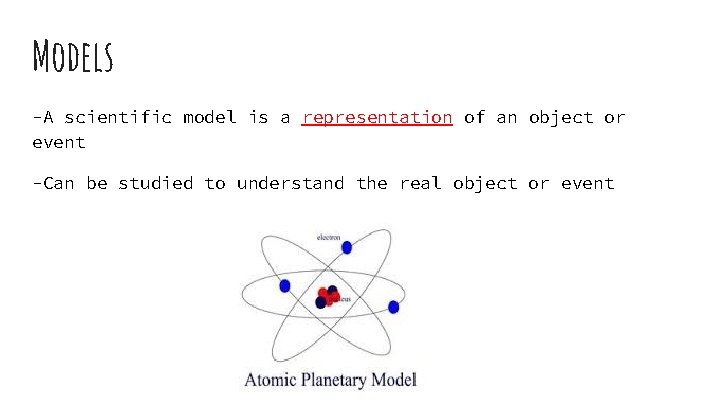
Models -A scientific model is a representation of an object or event -Can be studied to understand the real object or event
Section 1 Review -Answer questions 1 -6 on page 12 of your textbook -Answer in COMPLETE sentences
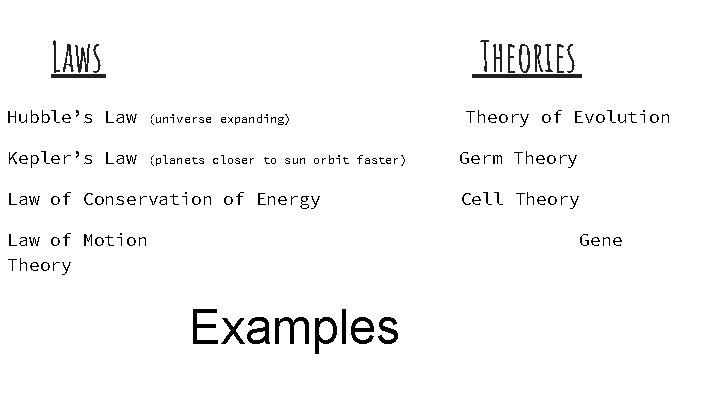
Laws Theories Hubble’s Law (universe expanding) Kepler’s Law (planets closer to sun orbit faster) Law of Conservation of Energy Law of Motion Theory of Evolution Germ Theory Cell Theory Gene Examples
- Slides: 20