
Chapter 1 lesson 1 How scientists work Do


- Slides: 10
Chapter 1, lesson 1 -How scientists work Do now: Answer the following question in your notebook �What are the six skills scientists use? � Observing � Classifying � Making models � Inferring � Predicting � Analyzing In your class notes, title the page, BASKET ACTIVITY
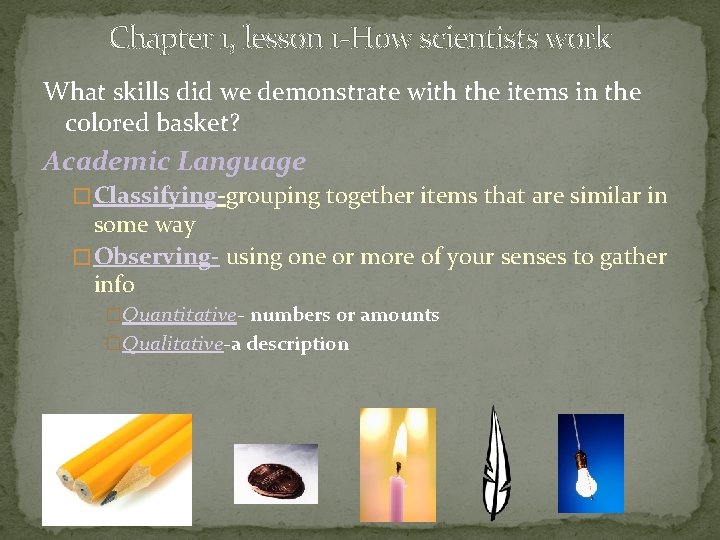
Chapter 1, lesson 1 -How scientists work What skills did we demonstrate with the items in the colored basket? Academic Language � Classifying-grouping together items that are similar in some way � Observing- using one or more of your senses to gather info �Quantitative- numbers or amounts �Qualitative-a description
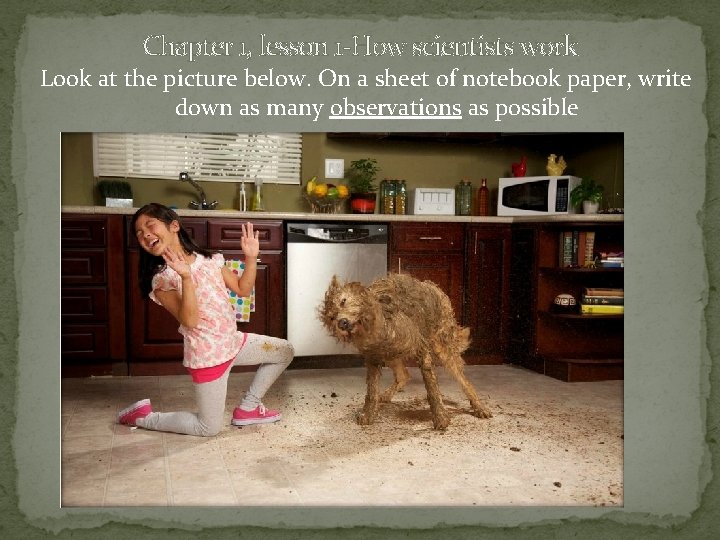
Chapter 1, lesson 1 -How scientists work Look at the picture below. On a sheet of notebook paper, write down as many observations as possible
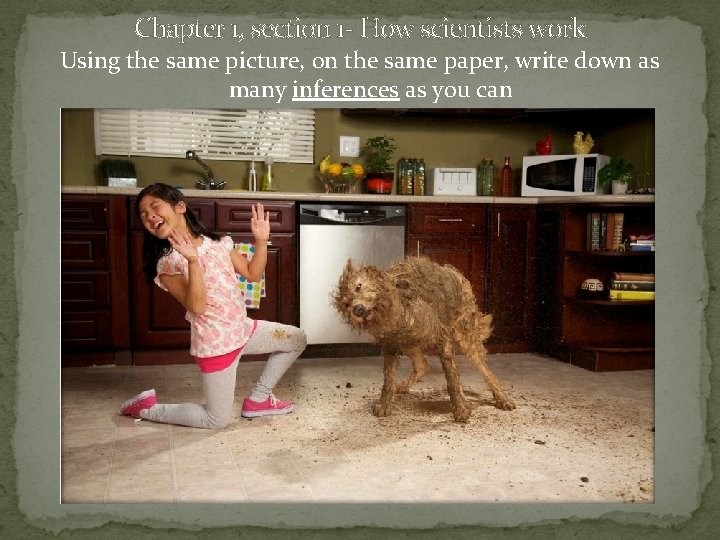
Chapter 1, section 1 - How scientists work Using the same picture, on the same paper, write down as many inferences as you can
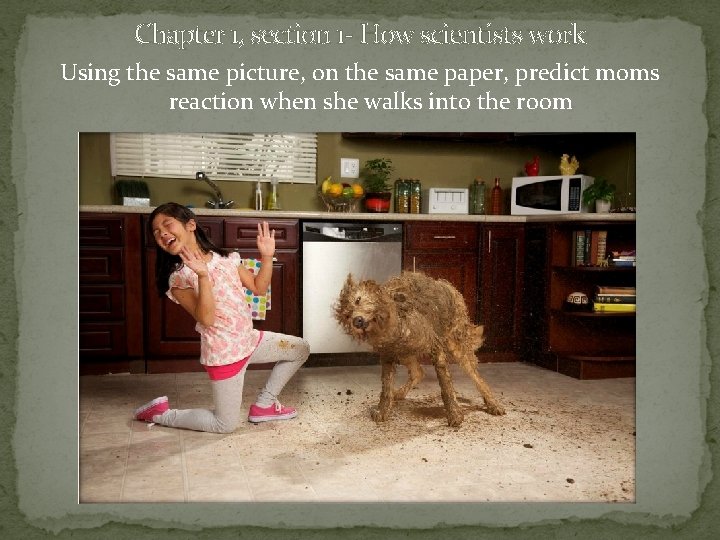
Chapter 1, section 1 - How scientists work Using the same picture, on the same paper, predict moms reaction when she walks into the room
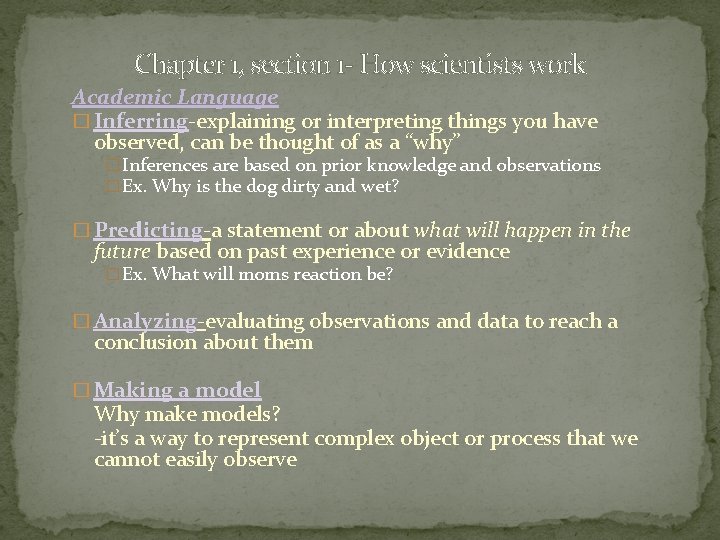
Chapter 1, section 1 - How scientists work Academic Language � Inferring-explaining or interpreting things you have observed, can be thought of as a “why” � Inferences are based on prior knowledge and observations � Ex. Why is the dog dirty and wet? � Predicting-a statement or about what will happen in the future based on past experience or evidence � Ex. What will moms reaction be? � Analyzing-evaluating observations and data to reach a conclusion about them � Making a model Why make models? -it’s a way to represent complex object or process that we cannot easily observe
Chapter 1, section 1 - How scientists work Based on the skills we have learned that scientists use…how can we define the word science? Academic Language Science� a way of learning about the natural world � includes the knowledge we gain through exploration
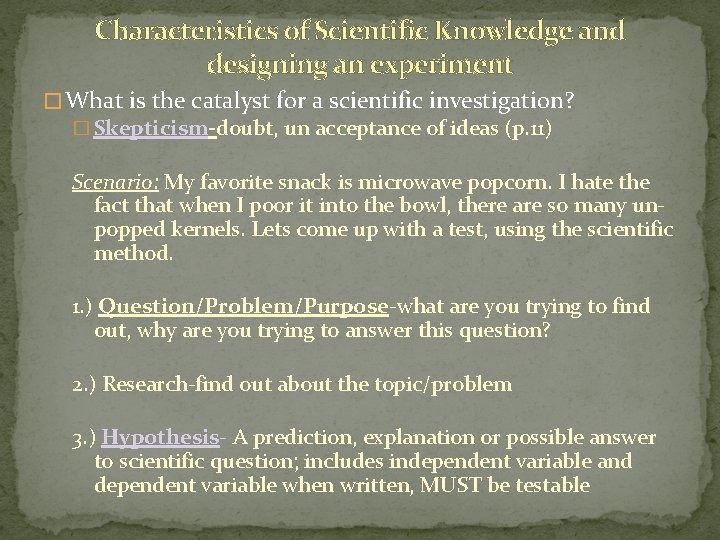
Characteristics of Scientific Knowledge and designing an experiment � What is the catalyst for a scientific investigation? � Skepticism-doubt, un acceptance of ideas (p. 11) Scenario: My favorite snack is microwave popcorn. I hate the fact that when I poor it into the bowl, there are so many unpopped kernels. Lets come up with a test, using the scientific method. 1. ) Question/Problem/Purpose-what are you trying to find out, why are you trying to answer this question? 2. ) Research-find out about the topic/problem 3. ) Hypothesis- A prediction, explanation or possible answer to scientific question; includes independent variable and dependent variable when written, MUST be testable
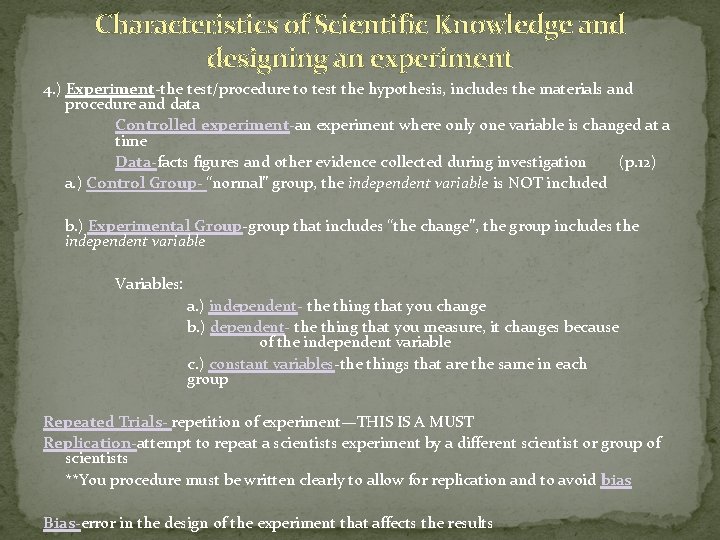
Characteristics of Scientific Knowledge and designing an experiment 4. ) Experiment-the test/procedure to test the hypothesis, includes the materials and procedure and data Controlled experiment-an experiment where only one variable is changed at a time Data-facts figures and other evidence collected during investigation (p. 12) a. ) Control Group- “normal” group, the independent variable is NOT included b. ) Experimental Group-group that includes “the change”, the group includes the independent variable Variables: a. ) independent- the thing that you change b. ) dependent- the thing that you measure, it changes because of the independent variable c. ) constant variables-the things that are the same in each group Repeated Trials- repetition of experiment—THIS IS A MUST Replication-attempt to repeat a scientists experiment by a different scientist or group of scientists **You procedure must be written clearly to allow for replication and to avoid bias Bias-error in the design of the experiment that affects the results
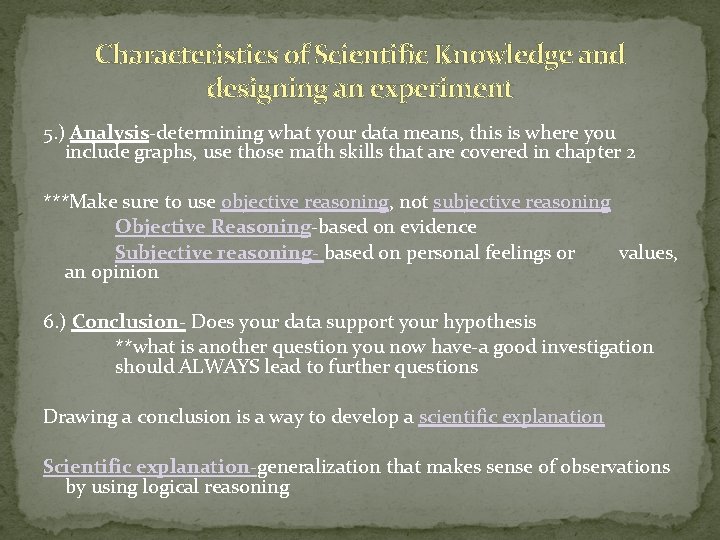
Characteristics of Scientific Knowledge and designing an experiment 5. ) Analysis-determining what your data means, this is where you include graphs, use those math skills that are covered in chapter 2 ***Make sure to use objective reasoning, not subjective reasoning Objective Reasoning-based on evidence Subjective reasoning- based on personal feelings or values, an opinion 6. ) Conclusion- Does your data support your hypothesis **what is another question you now have-a good investigation should ALWAYS lead to further questions Drawing a conclusion is a way to develop a scientific explanation Scientific explanation-generalization that makes sense of observations by using logical reasoning