
Chapter 1 Legal Heritage and the Information Age
- Slides: 23
Chapter 1 Legal Heritage and the Information Age Copyright © 2010 Pearson Education, Inc. Publishing as Prentice Hall. 1 -
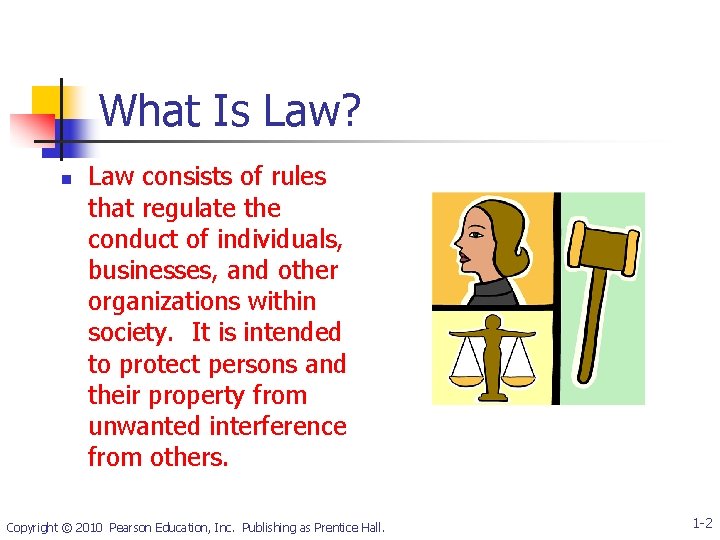
What Is Law? n Law consists of rules that regulate the conduct of individuals, businesses, and other organizations within society. It is intended to protect persons and their property from unwanted interference from others. Copyright © 2010 Pearson Education, Inc. Publishing as Prentice Hall. 1 -2
Functions of Law Keeping the peace n Shaping moral standards n Promoting social justice n Maintaining the status quo n Copyright © 2010 Pearson Education, Inc. Publishing as Prentice Hall. 1 -3
Functions of Law Facilitating orderly change n Facilitating planning n Providing a basis for compromise n Maximizing individual freedom n Copyright © 2010 Pearson Education, Inc. Publishing as Prentice Hall. 1 -4
Qualities of the Law n Fairness n The U. S. legal system is one of the most comprehensive, fair, and democratic systems of law ever developed and enforced. Copyright © 2010 Pearson Education, Inc. Publishing as Prentice Hall. 1 -5
Qualities of the Law n Flexibility n U. S. law evolves and changes along with the norms of society, technology, and the growth and expansion of commerce in the U. S. and the rest of the world. Copyright © 2010 Pearson Education, Inc. Publishing as Prentice Hall. 1 -6
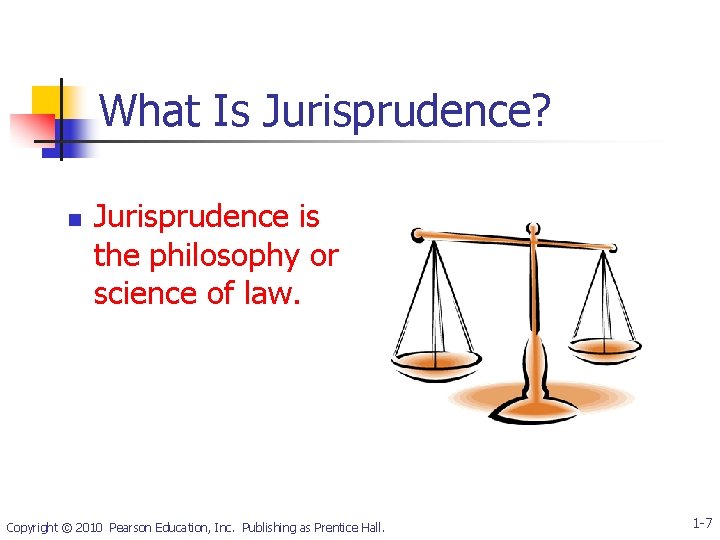
What Is Jurisprudence? n Jurisprudence is the philosophy or science of law. Copyright © 2010 Pearson Education, Inc. Publishing as Prentice Hall. 1 -7
Schools of Jurisprudential Thought n n n Natural school—Believes law is based on what is “correct” Historical school—Believes law is an aggregate of social traditions and customs Analytical school—Believes law is shaped by logic Copyright © 2010 Pearson Education, Inc. Publishing as Prentice Hall. 1 -8
Schools of Jurisprudential Thought n n Sociological school—Believes law is a means of achieving and advancing certain sociological goals Command school—Believes law is a set of rules developed, communicated and enforced by the ruling party Copyright © 2010 Pearson Education, Inc. Publishing as Prentice Hall. 1 -9
Schools of Jurisprudential Thought n n Critical legal studies school—Believes legal rules are unnecessary and that legal disputes should be solved using rules of fairness Law and economics school—Believes promoting market efficiency should be the central concern of legal decision making Copyright © 2010 Pearson Education, Inc. Publishing as Prentice Hall. 1 -10
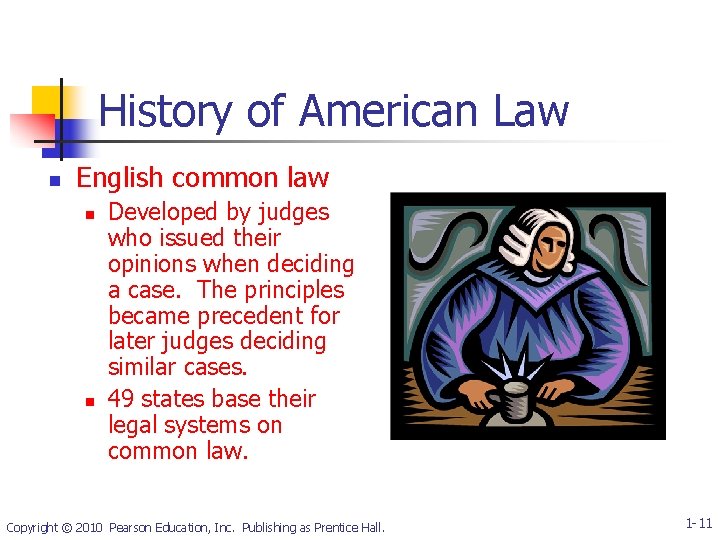
History of American Law n English common law n n Developed by judges who issued their opinions when deciding a case. The principles became precedent for later judges deciding similar cases. 49 states base their legal systems on common law. Copyright © 2010 Pearson Education, Inc. Publishing as Prentice Hall. 1 -11
History of American Law court n n Court of Chancery (Equity Court) n n n A court that developed and administered a uniform set of laws decreed by the kings and queens after William the Conqueror. Legal procedure was emphasized over merits. Court that granted relief based on fairness Equitable remedies were shaped to fit individual situations. Merchant court n Courts that were established to administer the “law of merchants” Copyright © 2010 Pearson Education, Inc. Publishing as Prentice Hall. 1 -12
Sources of U. S. Law Constitutions n Treaties n Codified law n Executive orders n Regulations and administrative orders n Judicial decisions n Copyright © 2010 Pearson Education, Inc. Publishing as Prentice Hall. 1 -13
Constitutions n The U. S. Constitution established the structure of the federal government. n n Legislative branch Executive branch Judicial branch The U. S. Constitution and treaties take precedence over all other conflicting laws. Copyright © 2010 Pearson Education, Inc. Publishing as Prentice Hall. 1 -14
Treaties n A treaty is a compact made between two or more nations. Copyright © 2010 Pearson Education, Inc. Publishing as Prentice Hall. 1 -15
Codified Law n Statutes n n Written law enacted by the legislative branches of federal and state governments Ordinances n Laws enacted by local government bodies such as cities and municipalities, counties, school districts, and water districts Copyright © 2010 Pearson Education, Inc. Publishing as Prentice Hall. 1 -16
Executive Orders n An executive order is an order issued by a member of the executive branch of government. Copyright © 2010 Pearson Education, Inc. Publishing as Prentice Hall. 1 -17
Administrative Agency Rules and Regulations n n The legislative and executive branches of federal and state governments establish administrative agencies to enforce and interpret statutes enacted by Congress and state legislatures. Many agencies regulate business. Copyright © 2010 Pearson Education, Inc. Publishing as Prentice Hall. 1 -18
Judicial Decisions n A judicial decision is a decision about an individual case issued by a federal or state court. Copyright © 2010 Pearson Education, Inc. Publishing as Prentice Hall. 1 -19
Doctrine of Stare Decisis n n n Based on the common law tradition, past court decisions become precedent for deciding future cases. Precedent is a rule of law established in a court decision. Lower courts must follow the precedent established by higher courts. Stare decisis—Latin for “to stand by the decision”—means adherence to precedent. Copyright © 2010 Pearson Education, Inc. Publishing as Prentice Hall. 1 -20
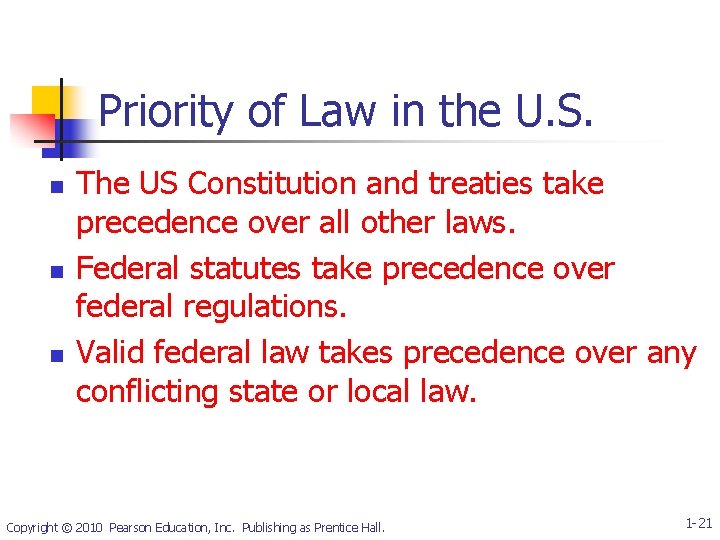
Priority of Law in the U. S. n n n The US Constitution and treaties take precedence over all other laws. Federal statutes take precedence over federal regulations. Valid federal law takes precedence over any conflicting state or local law. Copyright © 2010 Pearson Education, Inc. Publishing as Prentice Hall. 1 -21
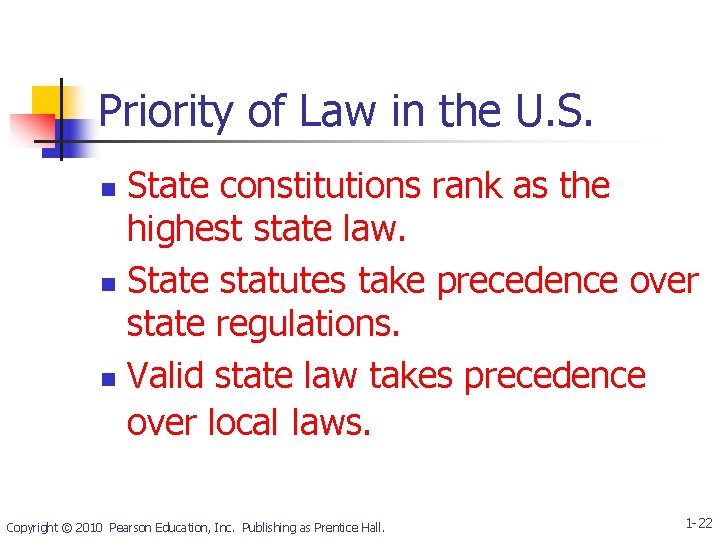
Priority of Law in the U. S. State constitutions rank as the highest state law. n State statutes take precedence over state regulations. n Valid state law takes precedence over local laws. n Copyright © 2010 Pearson Education, Inc. Publishing as Prentice Hall. 1 -22
Copyright © 2010 Pearson Education, Inc. Publishing as Prentice Hall. 1 -23