
Chapter 1 Lecture Outline See Power Point Image

- Slides: 32
Chapter 1 Lecture Outline See Power. Point Image Slides for all figures and tables pre-inserted into Power. Point without notes. 1
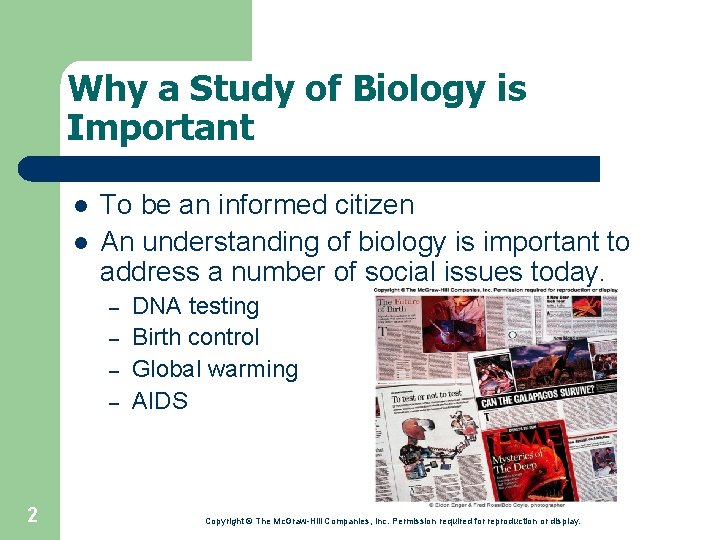
Why a Study of Biology is Important l l To be an informed citizen An understanding of biology is important to address a number of social issues today. – – 2 DNA testing Birth control Global warming AIDS Copyright © The Mc. Graw-Hill Companies, Inc. Permission required for reproduction or display.
So then, what is biology? l l Biology is the science that deals with life. What is science? – – 3 A process used to solve problems and understand natural events Involves the scientific method Copyright © The Mc. Graw-Hill Companies, Inc. Permission required for reproduction or display.
Basic Assumptions in Science l Scientists approach their work with some basic assumptions: – – – l 4 Natural events have specific causes. The causes for events in nature can be identified. Natural events follow general rules and patterns. A recurrent natural event has a common cause. Different people can observe the same natural events. Natural laws hold true regardless of time and place. Example: Lightning Copyright © The Mc. Graw-Hill Companies, Inc. Permission required for reproduction or display.
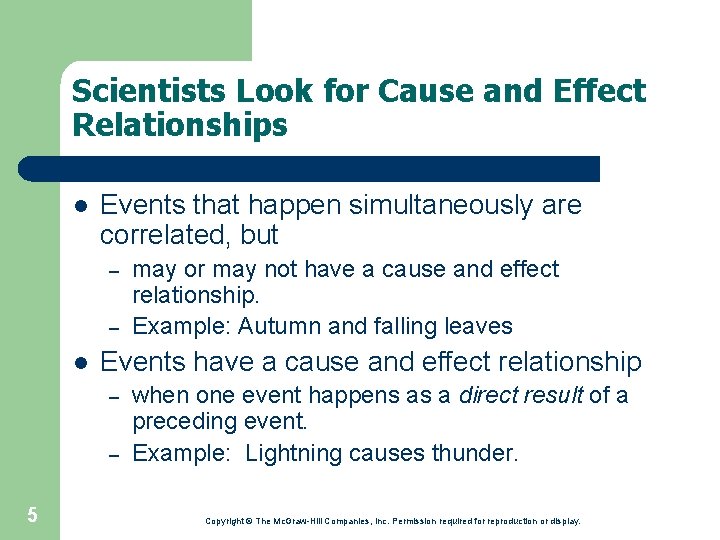
Scientists Look for Cause and Effect Relationships l Events that happen simultaneously are correlated, but – – l Events have a cause and effect relationship – – 5 may or may not have a cause and effect relationship. Example: Autumn and falling leaves when one event happens as a direct result of a preceding event. Example: Lightning causes thunder. Copyright © The Mc. Graw-Hill Companies, Inc. Permission required for reproduction or display.
The Scientific Method l A way of gaining information about the world that involves – – 6 forming possible solutions to questions. rigorous testing to determine if the solutions are supported. continual checking and rechecking to make sure that previous conclusions are still supported. modification of unsupported conclusions. Copyright © The Mc. Graw-Hill Companies, Inc. Permission required for reproduction or display.
Components of the Scientific Method l l l 7 Observation Questioning and exploration Forming and testing hypotheses Evaluation of new information Review by peers Copyright © The Mc. Graw-Hill Companies, Inc. Permission required for reproduction or display.
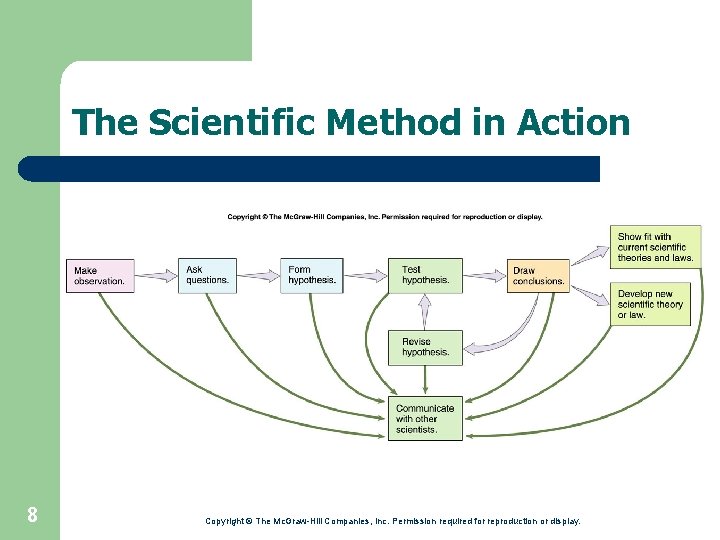
The Scientific Method in Action 8 Copyright © The Mc. Graw-Hill Companies, Inc. Permission required for reproduction or display.
Observation, Questioning and Exploration l l An observation is a thoughtful and careful recognition of an event or a fact. The careful observation of a phenomenon leads to a question. – – l l 9 How does this happen? What causes it to occur? The question must be testable. Scientists then explore scientific publications to find any information that has been gathered about the question. Copyright © The Mc. Graw-Hill Companies, Inc. Permission required for reproduction or display.
Constructing Hypotheses l l l Once the question is asked, scientists propose answers. These answers are hypotheses. Hypotheses must: – – 10 be logical account for all current information be testable make the least possible assumptions Copyright © The Mc. Graw-Hill Companies, Inc. Permission required for reproduction or display.
Testing Hypotheses l Hypotheses need to be tested to see if they are supported or disproved. – – l There are several ways to test a hypothesis: – – – 11 Disproved hypotheses are rejected. Hypotheses can be supported but not proven. Gathering relevant historical information Make additional observations from the natural world. Experimentation Copyright © The Mc. Graw-Hill Companies, Inc. Permission required for reproduction or display.
Experimentation l An experiment is a re-creation of an occurrence. – l It tests whether or not the hypothesis can be supported or rejected. Experiments must be controlled. – – This means that all aspects except for one variable must be kept constant. They usually include any two groups. l l 12 Experimental group: variable is altered Control group: variable is not altered Copyright © The Mc. Graw-Hill Companies, Inc. Permission required for reproduction or display.
Experimental Design l The variable that is altered is called the independent variable. – l The variables that change in response to the independent variable are called dependent variables. – l 13 Experiments should have only one independent variable. Changes in the dependent variables are documented as data. Data from the experiment is analyzed and hypotheses are rejected and revised or supported. Copyright © The Mc. Graw-Hill Companies, Inc. Permission required for reproduction or display.
A Sample Experiment l l l l 14 Hypothesis: Male sex hormones produced by the testes stimulate male birds to sing. Experimental group: Male birds with testes removed at birth. Control group: Male birds subjected to a similar surgery that were allowed to develop normally with testes. Independent variable: presence or absence of testes. Dependent variable: presence of singing behavior. Data: Male songbirds without testes do not exhibit singing behavior. Conclusion: Hypothesis is supported. Copyright © The Mc. Graw-Hill Companies, Inc. Permission required for reproduction or display.
Experimental Data l Experiments must: – – l The validity of experimental results must: – – l 15 use large numbers of subjects or must be repeated several times (replication). be independently reproducible. be tested statistically. be scrutinized by other scientists. If the hypothesis is supported by ample experimental data, it leads to a theory. Copyright © The Mc. Graw-Hill Companies, Inc. Permission required for reproduction or display.
Theory l A theory may be defined as a widely accepted, plausible general statement about a fundamental concept in science. – The germ theory states that infectious diseases are caused by microorganisms. l – Theories continue to be tested. l l 16 Many diseases are not caused by microorganisms, so we must be careful not to generalize theories too broadly. Exceptions identified Modifications made Copyright © The Mc. Graw-Hill Companies, Inc. Permission required for reproduction or display.
A Scientific Law l A scientific law is a uniform and constant fact of nature that describes what happens in nature. – l Scientific laws promote the process of generalization. – – l Inductive reasoning Since every bird that has been studied lays eggs, we can generalize that all birds lay eggs. Once a theory becomes established, it can be used to predict specific facts. – – 17 An example: All living things come from pre-existing living things. Deductive reasoning We can predict that a newly discovered bird species will lay eggs. Copyright © The Mc. Graw-Hill Companies, Inc. Permission required for reproduction or display.
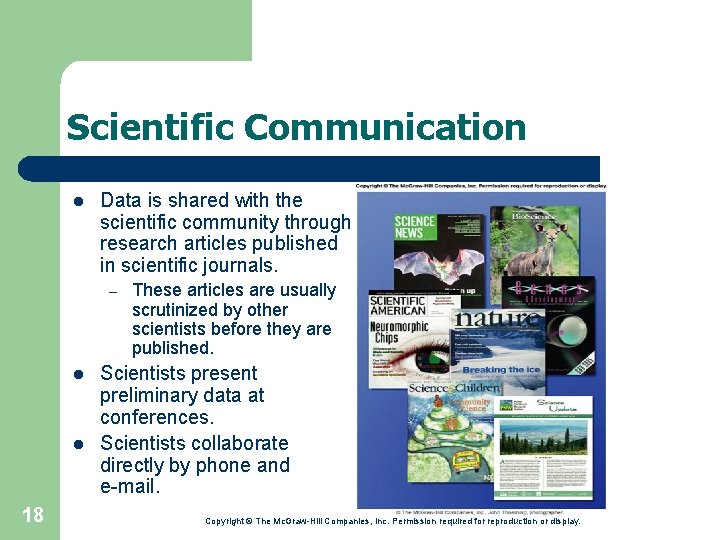
Scientific Communication l Data is shared with the scientific community through research articles published in scientific journals. – l l 18 These articles are usually scrutinized by other scientists before they are published. Scientists present preliminary data at conferences. Scientists collaborate directly by phone and e-mail. Copyright © The Mc. Graw-Hill Companies, Inc. Permission required for reproduction or display.
Fundamental Attitudes in Science l Scientists must distinguish between opinions and scientific facts. – l A good scientist must – – – l 19 Scientists’ opinions may become facts if supported by data. be skeptical. not be biased. be honest in analyzing and reporting data. The critical difference between science and nonscience is that in science, one can test the principle. In non-science, one may not be able to. Copyright © The Mc. Graw-Hill Companies, Inc. Permission required for reproduction or display.
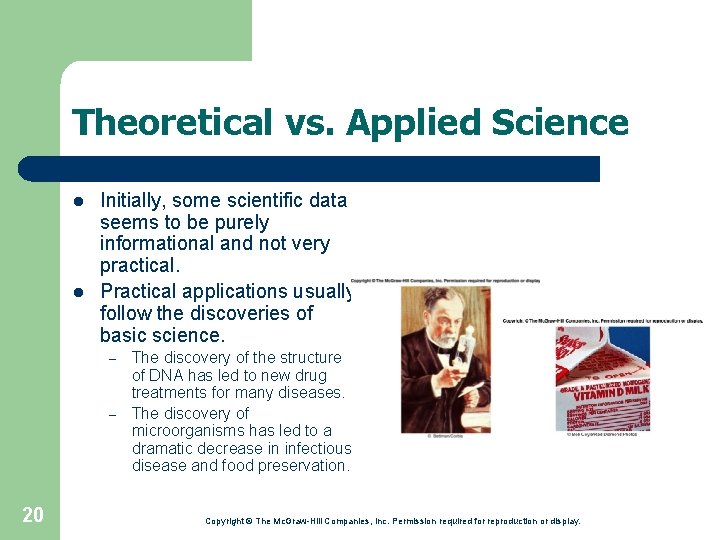
Theoretical vs. Applied Science l l Initially, some scientific data seems to be purely informational and not very practical. Practical applications usually follow the discoveries of basic science. – – 20 The discovery of the structure of DNA has led to new drug treatments for many diseases. The discovery of microorganisms has led to a dramatic decrease in infectious disease and food preservation. Copyright © The Mc. Graw-Hill Companies, Inc. Permission required for reproduction or display.
Science vs. Nonscience l Scientists continually challenge and test principles to determine cause-and-effect relationships. – l Nonscientists cannot test their hypotheses directly and often cannot establish cause-and -effect relationships. – 21 Biology, Physics, Chemistry, Astronomy History, Literature, Philosophy, Art, Sociology, etc. Copyright © The Mc. Graw-Hill Companies, Inc. Permission required for reproduction or display.
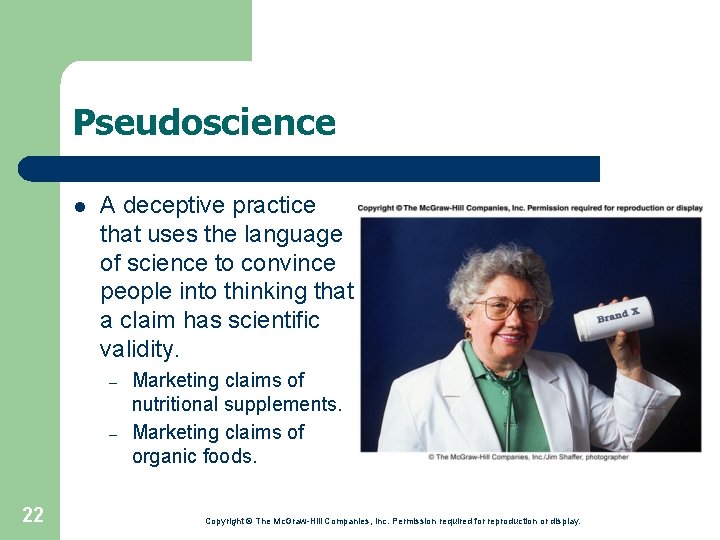
Pseudoscience l A deceptive practice that uses the language of science to convince people into thinking that a claim has scientific validity. – – 22 Marketing claims of nutritional supplements. Marketing claims of organic foods. Copyright © The Mc. Graw-Hill Companies, Inc. Permission required for reproduction or display.
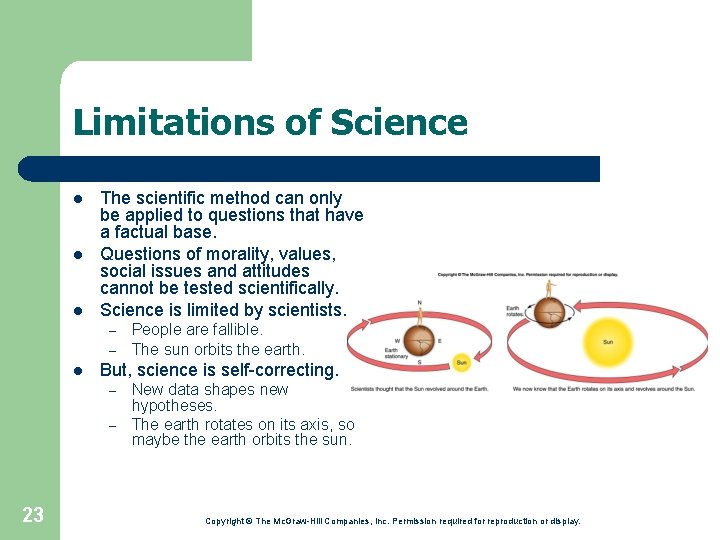
Limitations of Science l l l The scientific method can only be applied to questions that have a factual base. Questions of morality, values, social issues and attitudes cannot be tested scientifically. Science is limited by scientists. – – l But, science is self-correcting. – – 23 People are fallible. The sun orbits the earth. New data shapes new hypotheses. The earth rotates on its axis, so maybe the earth orbits the sun. Copyright © The Mc. Graw-Hill Companies, Inc. Permission required for reproduction or display.
The Science of Biology l l Biology is the study of living things. Theoretical biology – l Applied biology – 24 Evolutionary biology, animal behavior, biochemistry Medicine, crop science, plant breeding, wildlife management Copyright © The Mc. Graw-Hill Companies, Inc. Permission required for reproduction or display.
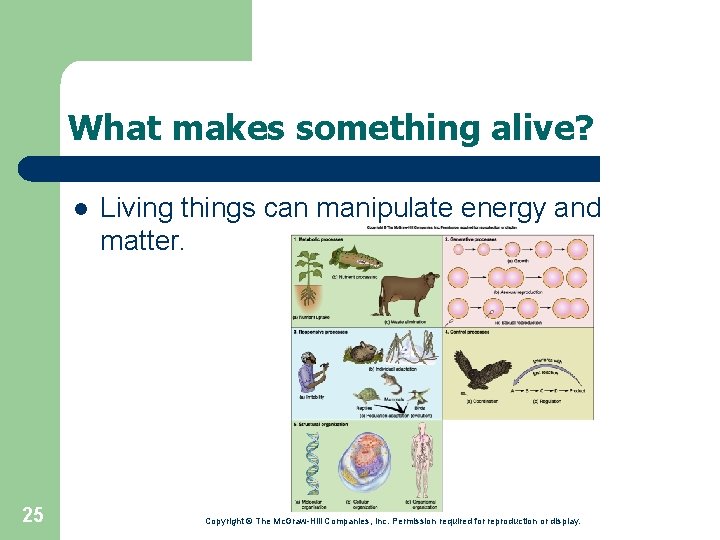
What makes something alive? l 25 Living things can manipulate energy and matter. Copyright © The Mc. Graw-Hill Companies, Inc. Permission required for reproduction or display.
Characteristics of Living Things l Metabolic processes – l Generative processes – – 26 Organisms gain and store energy in the chemical bonds in the nutrients they take in. Organisms grow by increasing the number of cells. Organisms reproduce either sexually or asexually. Copyright © The Mc. Graw-Hill Companies, Inc. Permission required for reproduction or display.
Characteristics of Living Things l Responsive processes – Organisms react to changes in their environment. l Irritability: the ability to recognize that something in its surroundings has changed (a stimulus) and respond to it quickly. l Individual adaptation: a longer term response to an environmental change. l Evolution: changes in a population over time. 27 Copyright © The Mc. Graw-Hill Companies, Inc. Permission required for reproduction or display.
Characteristics of Living Things l Control processes – Enable organisms to carry out metabolic processes in the right order. l Coordination: Enzymes coordinate metabolic reactions. l Regulation: Enzymes are regulated in order to maintain homeostasis. l Unique structural organization – 28 Organisms are made of cells. Copyright © The Mc. Graw-Hill Companies, Inc. Permission required for reproduction or display.
Levels of Biological Organization l l l 29 Biosphere—the worldwide ecosystem. Ecosystem—communities that interact with one another in a particular place. Communities—populations of different organisms interacting with each other in a particular place. Population—a group of individual organisms in a particular place. Organism—an independent living unit. Copyright © The Mc. Graw-Hill Companies, Inc. Permission required for reproduction or display.
Levels of Biological Organization l l l 30 Organ system—many organs that perform a particular function. Organ—many tissues that perform a particular function. Tissue—many cells that perform a particular function. Cell—simplest unit that shows characteristics of life. Molecules—specific arrangements of atoms. Atoms—the fundamental units of matter. Copyright © The Mc. Graw-Hill Companies, Inc. Permission required for reproduction or display.
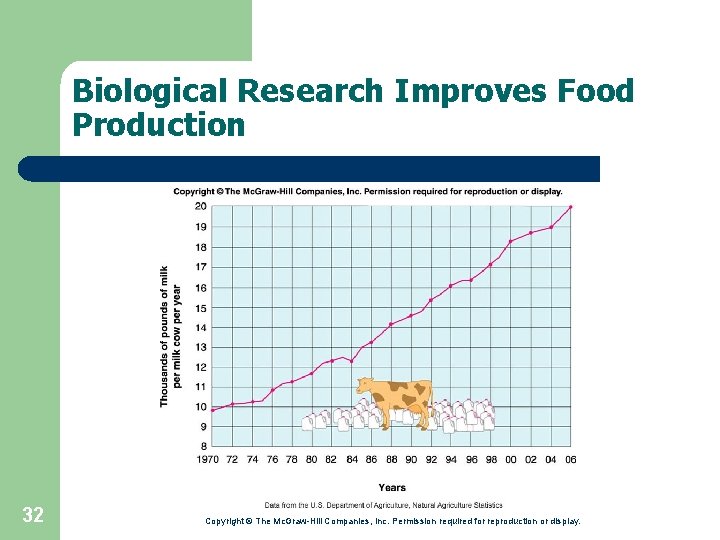
The Significance of Biology in our Lives l l Biology has significantly contributed to our high standard of living. For example: – – – 31 Advanced food production Significant progress in health Advances in disease control Advances in plant and animal breeding Advances in biotechnology Progress in genome studies Copyright © The Mc. Graw-Hill Companies, Inc. Permission required for reproduction or display.
Biological Research Improves Food Production 32 Copyright © The Mc. Graw-Hill Companies, Inc. Permission required for reproduction or display.