
Chapter 1 LEARNING ABOUT WORK 1 1 Why
Chapter 1 LEARNING ABOUT WORK 1. 1 Why People Work 1. 2 Work Experience Education © Thomson/South-Western CHAPTER 1 Slide 1
Lesson 1. 1 WHY PEOPLE WORK Objectives n Discuss reasons why people work n Define the terms work, occupation, and job © Thomson/South-Western CHAPTER 1 Slide 2
Lesson 1. 1 REASONS TO WORK n n n n Earn money Social satisfaction Positive feelings Prestige Personal development Contributions to health Self-expression © Thomson/South-Western CHAPTER 1 Slide 3
Lesson 1. 1 WORK, OCCUPATION, AND JOB n Work can be defined as activity directed toward a purpose or goal that produces something of value to oneself and/or to society. n An occupation is the name given to a group of similar tasks that a person performs for pay. n A job is a paid position at a specific place or setting. © Thomson/South-Western CHAPTER 1 Slide 4
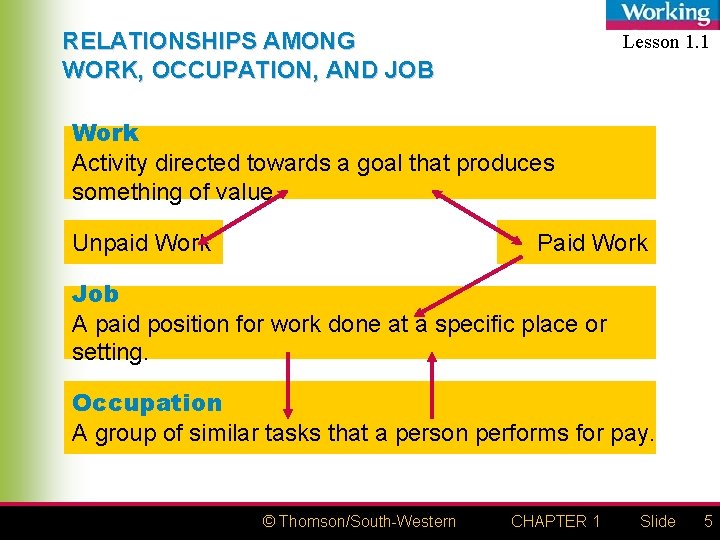
RELATIONSHIPS AMONG WORK, OCCUPATION, AND JOB Lesson 1. 1 Work Activity directed towards a goal that produces something of value. Unpaid Work Paid Work Job A paid position for work done at a specific place or setting. Occupation A group of similar tasks that a person performs for pay. © Thomson/South-Western CHAPTER 1 Slide 5
Lesson 1. 2 WORK EXPERIENCE EDUCATION Objectives n Name three types of work experience education n Identify the benefits of work experience education © Thomson/South-Western CHAPTER 1 Slide 6
Lesson 1. 2 WORK EXPERIENCE PROGRAMS n Work experience programs are education programs to help young people learn about and prepare for work. n Examples of work experience programs n Cooperative (co-op) career and technical education n Work-study n Exploratory work experience education © Thomson/South-Western CHAPTER 1 Slide 7
COOPERATIVE CAREER AND TECHNICAL EDUCATION Lesson 1. 2 n Occupational skills are skills needed to perform tasks or duties of a specific occupation. n The coordinator also approves each student’s place of employment, called the training station. n Early on, all three parties sign a training agreement outlining the relationships and responsibilities of the parties. n A training plan describes the knowledge, attitudes, and skills to be developed by the student. © Thomson/South-Western CHAPTER 1 Slide 8

Lesson 1. 2 Sample Training Agreement © Thomson/South-Western CHAPTER 1 Slide 9
Lesson 1. 2 WORK-STUDY n Not a program of on-the-job training for a specific occupation n Focuses on the development of employability skills, the general work habits and attitudes required in all jobs. © Thomson/South-Western CHAPTER 1 Slide 10
EXPLORATORY WORK EXPERIENCE EDUCATION Lesson 1. 2 n Provides students with opportunities to observe work and to try out various work tasks n Concerned with career guidance rather than development of occupational or employability skills n Career guidance is assisting students in career planning and decision making. © Thomson/South-Western CHAPTER 1 Slide 11
Lesson 1. 2 BENEFITS OF WORK EXPERIENCE n n n You can learn occupational skills. You can develop employability skills. You can establish a work record. You can earn while you learn. You can discover career interests and goals. You can recognize the relationship between education and work. n You can remain employed after graduation. © Thomson/South-Western CHAPTER 1 Slide 12
- Slides: 12