
Chapter 1 Invitation to Biology Scientific study of
Chapter 1 - Invitation to Biology Scientific study of life • Lays the foundation for asking basic questions about life and the natural world • Why Study Biology? To learn how organisms are constructed, how they function, where they live, and what they do • To help develop, modify, and refine ideas about life •
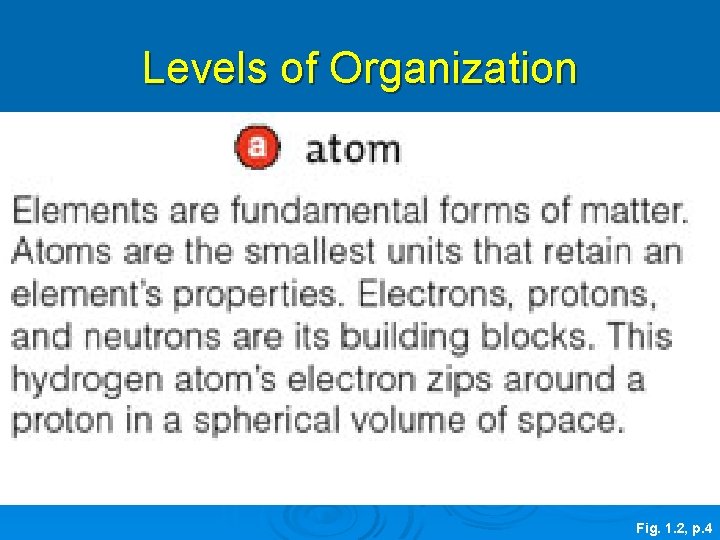
Levels of Organization Fig. 1. 2, p. 4
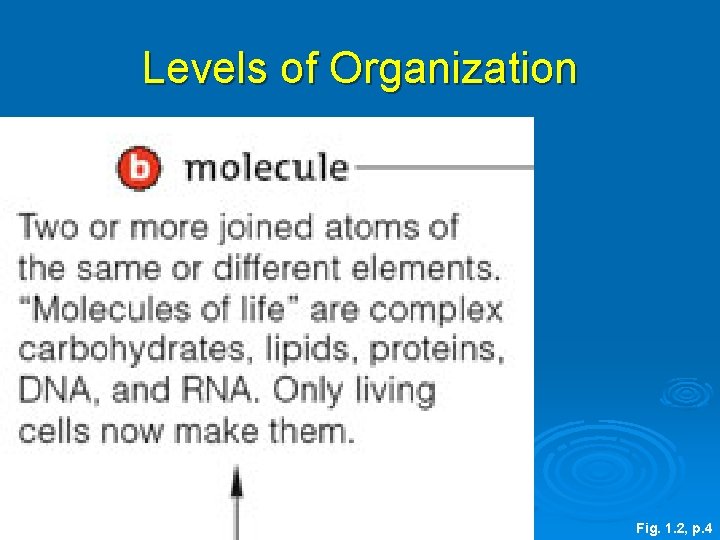
Levels of Organization Fig. 1. 2, p. 4
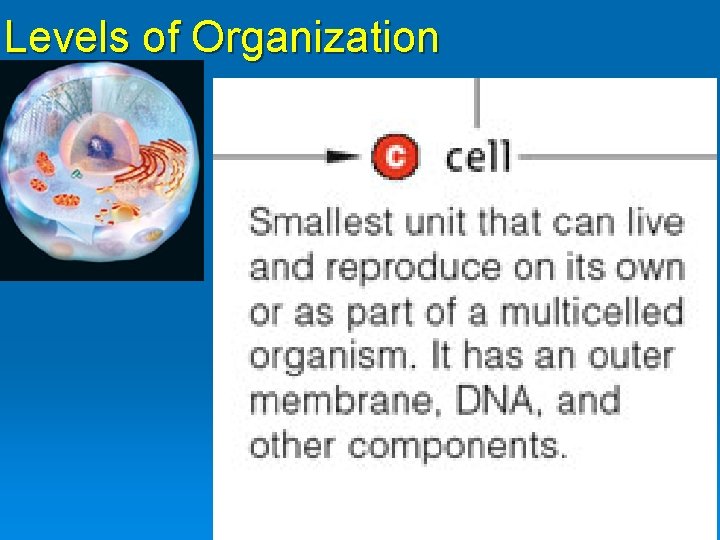
Levels of Organization Fig. 1. 2, p. 4
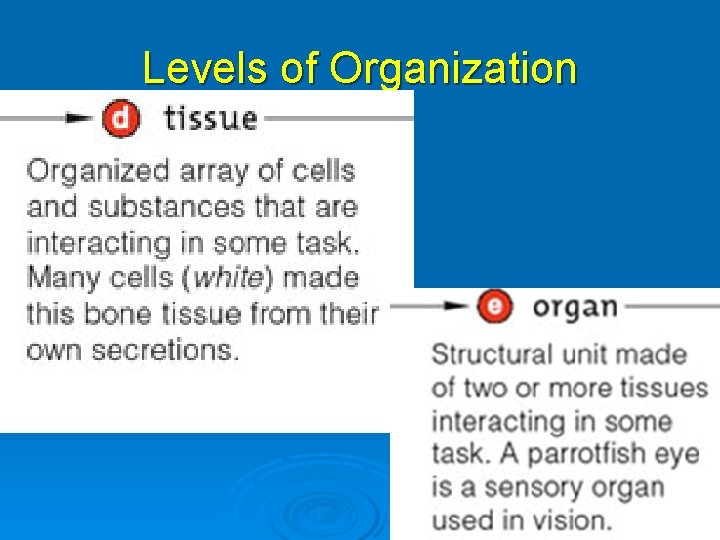
Levels of Organization Fig. 1. 2, p. 4
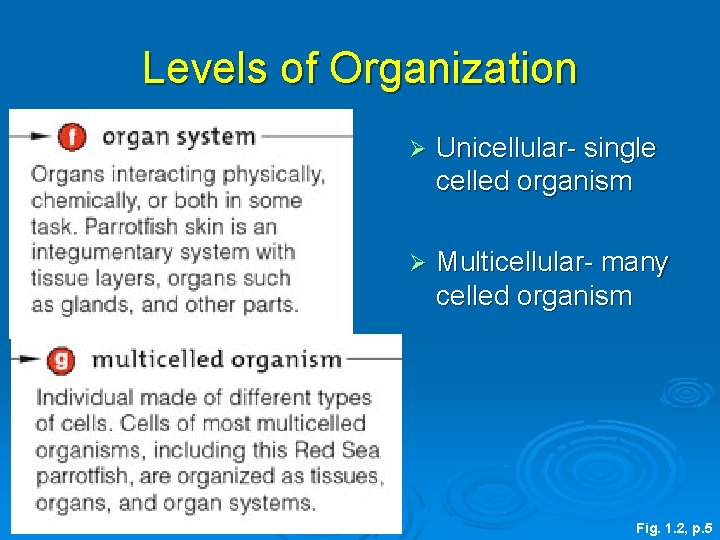
Levels of Organization Ø Unicellular- single celled organism Ø Multicellular- many celled organism Fig. 1. 2, p. 5
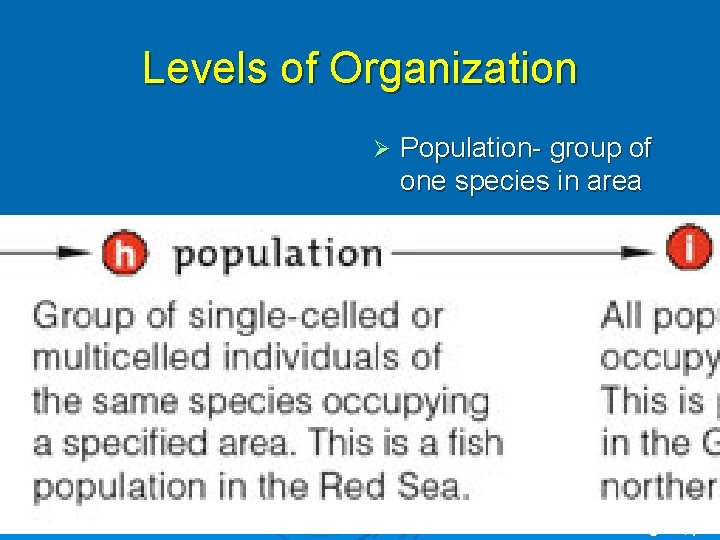
Levels of Organization Ø Population- group of one species in area Fig. 1. 2, p. 5
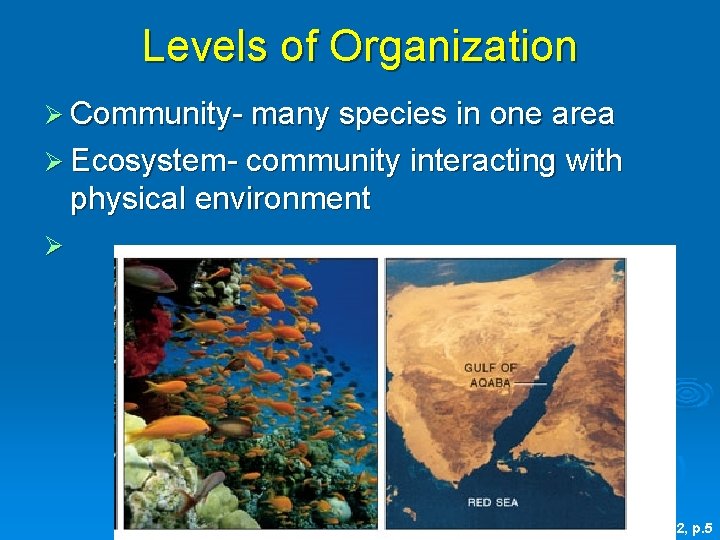
Levels of Organization Ø Community- many species in one area Ø Ecosystem- community interacting with physical environment Ø Fig. 1. 2, p. 5
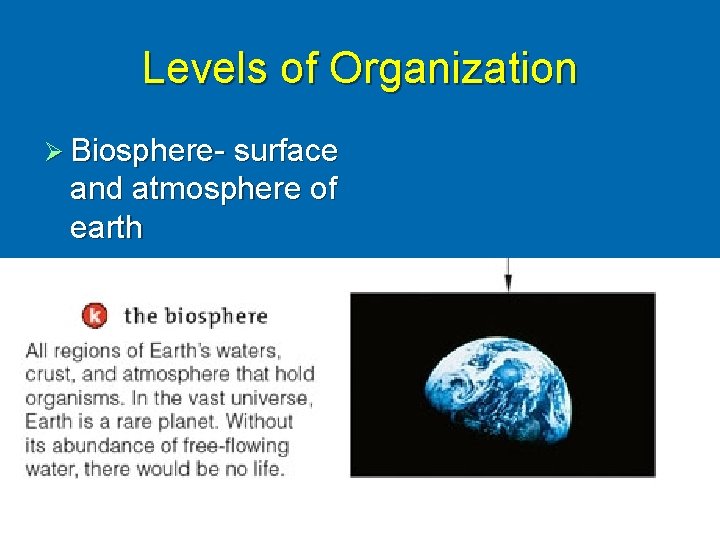
Levels of Organization Ø Biosphere- surface and atmosphere of earth Fig. 1. 2, p. 5
ALL LIVING THINGS… Require Energy Ø Energy = Capacity to do work Ø Metabolism = Reactions by which cells acquire and use energy to grow, survive, and reproduce ALL LIVING THINGS… Are Made of Cells Ø Are composed of the same substances from atoms to molecules to cells etc.
ALL LIVING THINGS… Sense and Respond Ø Organisms sense changes in their environment and make responses to them Ø Receptors detect specific forms of energy (stimuli) Ø Allows maintenance of homeostasis
ALL LIVING THINGS… Grow and Develop Ø Cell division increases the size of an organism. Ø The instructions from DNA allow cells to differentiate as the organism develops from egg to adulthood.
ALL LIVING THINGS… Reproduce Ø Have the capacity to reproduce based on instructions in DNA. This ability is not required for the survival of the individual, but must occur to continue the species. Ø Two types Ø Asexual Reproduction- offspring produced without use of sex cells Ø Sexual Reproduction- offspring produced by joining sex cells
ALL LIVING THINGS… Adapt/Evolve Ø Adaptations are traits that give an advantage in a certain environment. Ø Variation of individuals comes from mutations and sexual reproduction. Ø Evolution is when these changes areas passed down from generation to generation.
CLASSIFICATION & Binomial Nomenclature Ø Devised by Carolus Linnaeus Ø First name is genus (plural, genera) which helps to characterize the organism. l Homo sapiens - genus is Homo Ø Second name is species within genus. Species characteristics are unique to that species. l Homo sapiens – species is sapiens
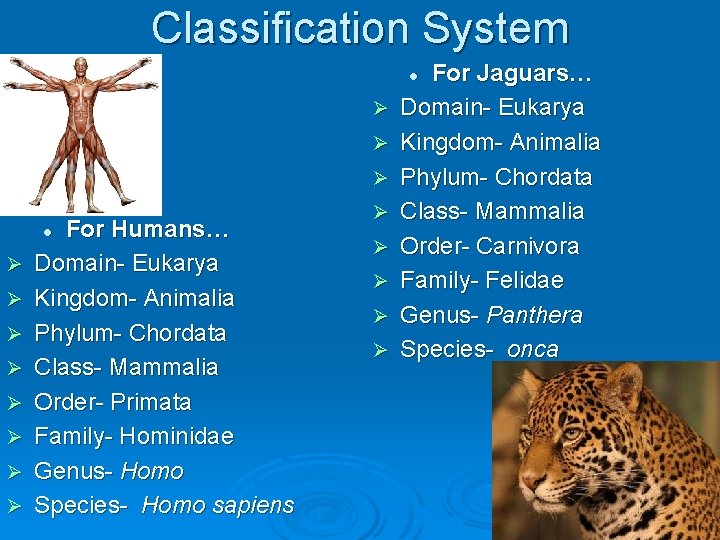
Classification System For Jaguars… Domain- Eukarya Kingdom- Animalia Phylum- Chordata Class- Mammalia Order- Carnivora Family- Felidae Genus- Panthera Species- onca l Ø Ø Ø For Humans… Domain- Eukarya Kingdom- Animalia Phylum- Chordata Class- Mammalia Order- Primata Family- Hominidae Genus- Homo Species- Homo sapiens l Ø Ø Ø Ø
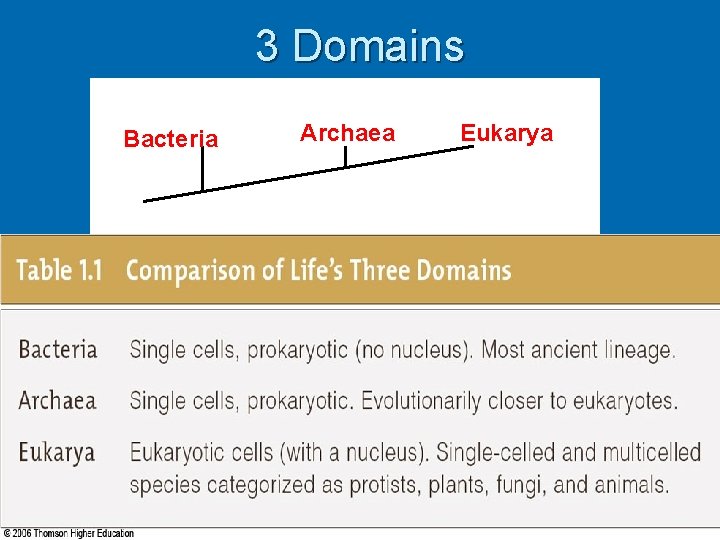
3 Domains Bacteria Archaea Eukarya Fig. 1 -7, p. 8
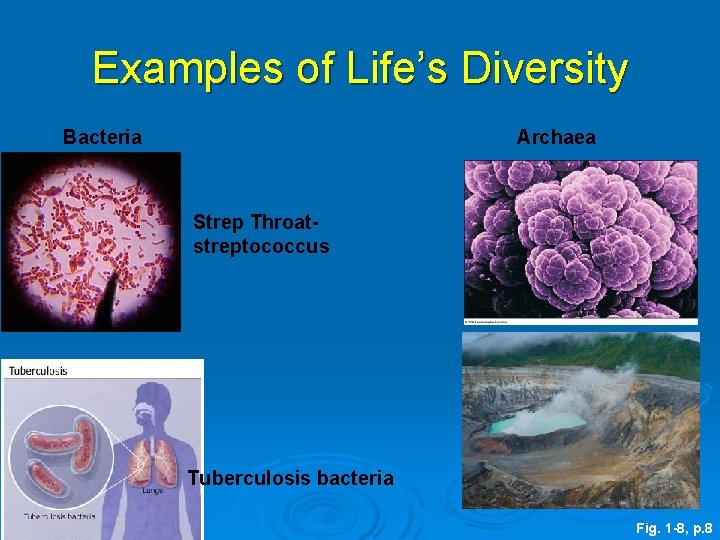
Examples of Life’s Diversity Bacteria Archaea Strep Throatstreptococcus Tuberculosis bacteria Fig. 1 -8, p. 8
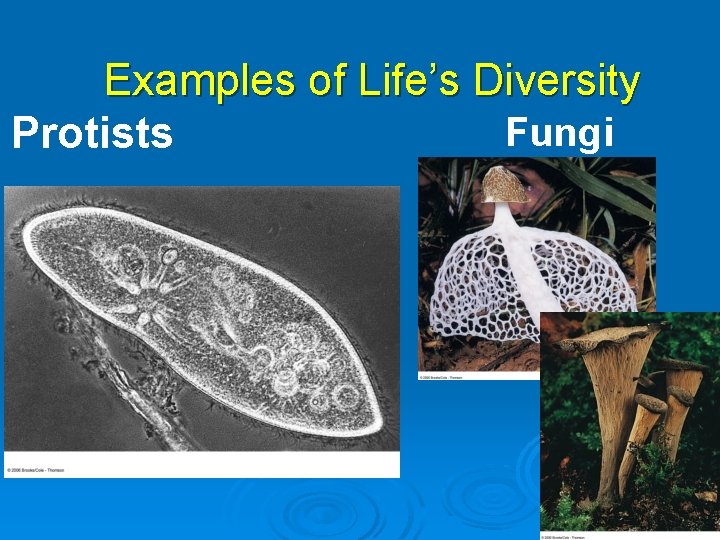
Examples of Life’s Diversity Fungi Protists Fig. 1 -8 c(2), p. 9
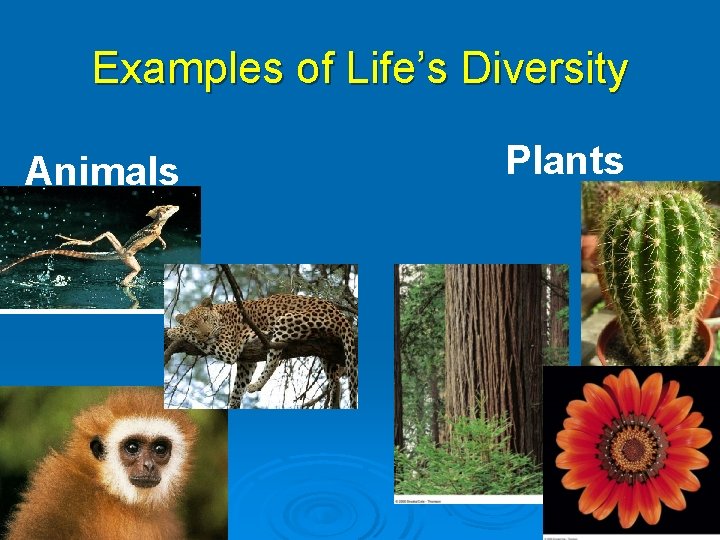
Examples of Life’s Diversity Animals Plants Fig. 1 -8 c(10), p. 9
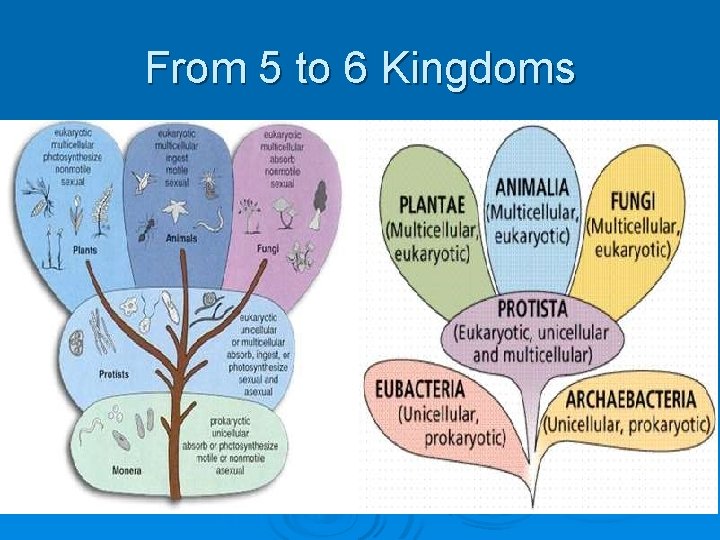
From 5 to 6 Kingdoms
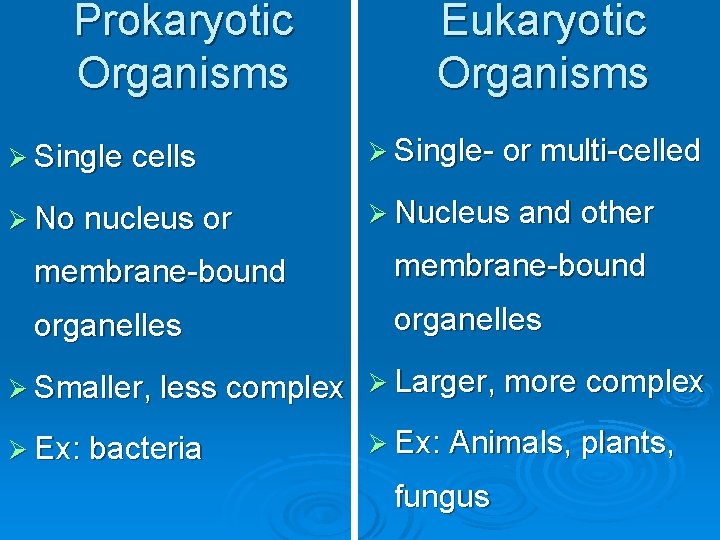
Prokaryotic Organisms Eukaryotic Organisms Ø Single cells Ø Single- or multi-celled Ø No nucleus or Ø Nucleus and other membrane-bound organelles Ø Smaller, less complex Ø Larger, more complex Ø Ex: bacteria Ø Ex: Animals, plants, fungus
Mutation: Source of Variation Ø Mutation = change in structure of DNA Ø Basis for the variation in heritable traits Ø Most are harmful Adaptive Trait / Adaptation Ø A trait that gives the individual an advantage in survival or reproduction, under a given set of circumstances
Evolution Ø Genetically based change in a line of descent over time Ø Population changes, not individuals
Natural Selection Ø Individuals vary in some heritable traits Ø Some forms of heritable traits are more adaptive Ø Natural selection is differences in survival and reproduction among individuals that vary in their traits Ø Adaptive forms of traits become more common than other forms
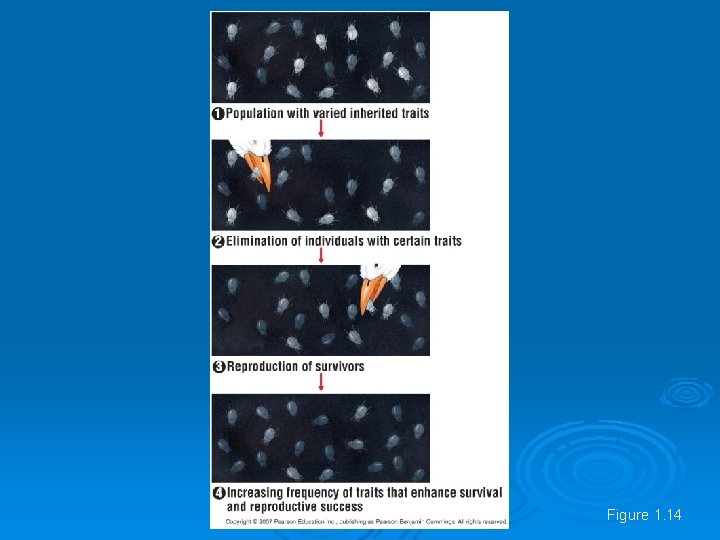
Figure 1. 14
Scientific Method Ø Observe phenomenon Ø Develop hypotheses Ø Make predictions Ø Devise test of predictions Ø Carry out test and analyze results
Inductive Logic Ø Using observations and facts to arrive at generalizations or hypotheses Ø Observation: Eagles, swallows, and robins have feathers Ø Hypothesis: All birds have feathers
Deductive Logic Ø Drawing a specific conclusion based on a generalization l Generalization - Birds have feathers l Example - Eagles are birds l Conclusion - Eagles have feathers
Role of Experiments Ø Used to study a phenomenon under known conditions Ø Allows you to predict what will happen if a hypothesis is not wrong Ø Can never prove a hypothesis 100% correct
Scientific Theory Ø A hypothesis that has been tested for its predictive power many times and has not yet been found incorrect; based on Evidencefacts or information holding an idea to be valid Ø Valid-quality of being logically or factually sound Ø Has wide-ranging explanatory power l Darwin’s theory of evolution by natural selection Ø Does not contain bias- favor of or against one thing
Law Notes only that something happens, happens consistently and across the universe; usually simply stated; frequently can be stated mathematically. Ø Example: nd Law: F = ma l Newtons 2 • A body of mass (m) subject to a force (F) undergoes an acceleration (a) that has the same direction as the force and a magnitude that is directly proportional to the force and inversely proportional to the mass. Ø
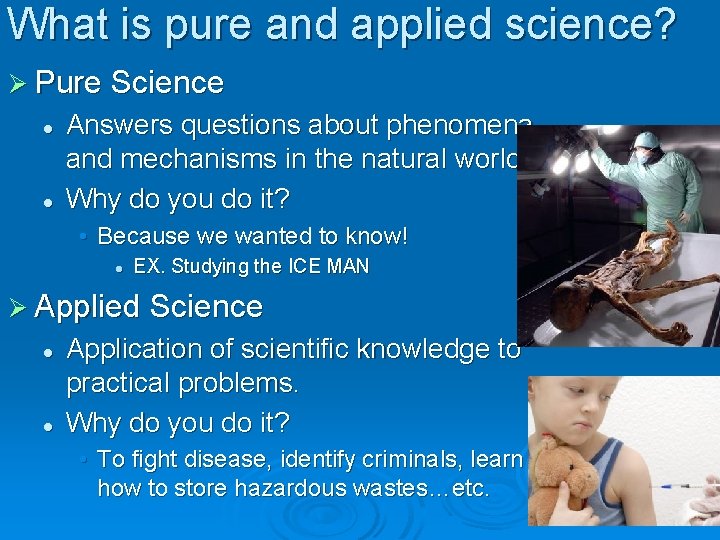
What is pure and applied science? Ø Pure Science l l Answers questions about phenomena and mechanisms in the natural world. Why do you do it? • Because we wanted to know! l EX. Studying the ICE MAN Ø Applied Science l l Application of scientific knowledge to practical problems. Why do you do it? • To fight disease, identify criminals, learn how to store hazardous wastes…etc.
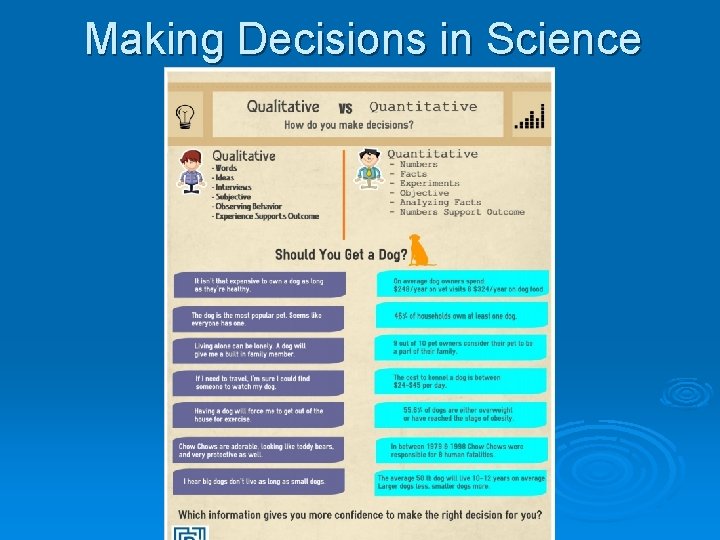
Making Decisions in Science
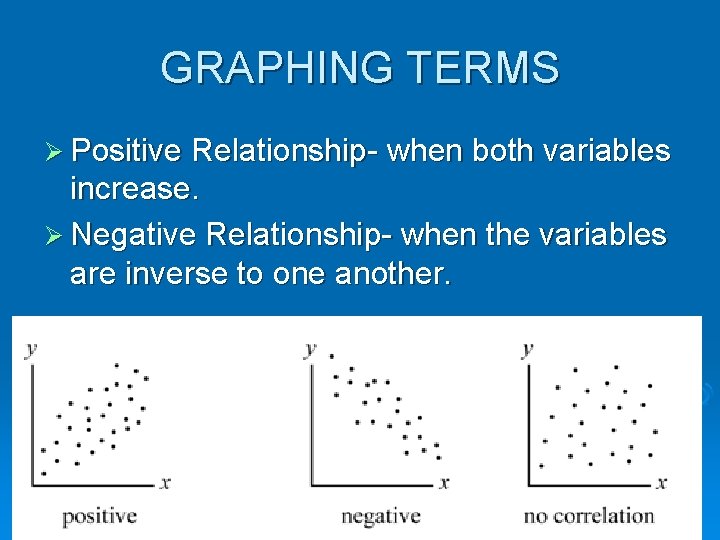
GRAPHING TERMS Ø Positive Relationship- when both variables increase. Ø Negative Relationship- when the variables are inverse to one another.
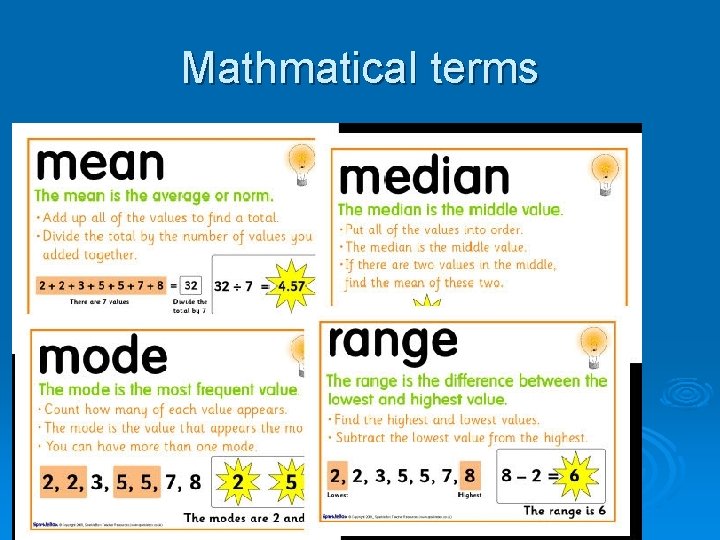
Mathmatical terms
- Slides: 36