
Chapter 1 Introduction to Welding 2012 Delmar Cengage

- Slides: 28
Chapter 1 Introduction to Welding © 2012 Delmar, Cengage Learning
Objectives • Explain how each one of the major welding processes works • List the factors that must be considered before a welding process is selected • Discuss the history of welding • Describe briefly the responsibilities and duties of the welder in various welding positions • Define the terms weld, forge welding, resistance welding, fusion welding, coalescence, and certification © 2012 Delmar, Cengage Learning
Introduction • Civilization developed – Materials, tools, and machinery improved • Egyptians fastened stones with gypsum mortar • Ancient times: adhesives joined wood and stone • Bronze and Iron Ages: forming, casting, and alloying metals • Early metal-joining methods: sand molds for casting and pouring molten metal between two pieces of metal © 2012 Delmar, Cengage Learning
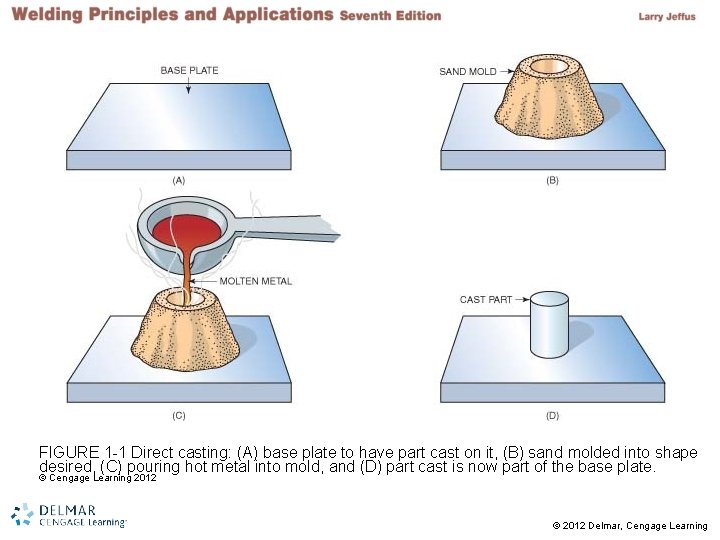
FIGURE 1 -1 Direct casting: (A) base plate to have part cast on it, (B) sand molded into shape desired, (C) pouring hot metal into mold, and (D) part cast is now part of the base plate. © Cengage Learning 2012 © 2012 Delmar, Cengage Learning
Introduction (cont'd. ) • Industrial Revolution (1750 -1850): forge welding – Also known as hammer welding – Forge was used to heat metal – Ends of the iron were hammered together • Elihu Thomson (1886): resistance welding – Faster and more reliable • Riveting was replaced by fusion welding – Welding considered vital to military security • Welding repairs to ships damaged during WWI were done in secrecy © 2012 Delmar, Cengage Learning
Welding Defined • Weld: localized coalescence of metals or nonmetals produced by heating materials – Coalescence: fusion of grain structure of materials being welded – Done with or without pressure • Can be created by applying pressure alone – Filler material can be added as needed • Can be made from plastic, glass, and ceramics © 2012 Delmar, Cengage Learning
Uses of Welding • Several uses – Ships, bridges, and recreational rides – Machines to manufacture new products – Commercial and military aircraft – Space program • Modern techniques enabled space exploration • Space shuttle's construction required the improvement of welding processes – Several other uses © 2012 Delmar, Cengage Learning
Welding and Cutting Processes • Welding processes has grown recently – Differ in the manner in which heat, pressure, or both are applied and equipment used • Popular welding processes – Oxyacetylene welding (OAW) – Shielded metal arc welding (SMAW) – Gas tungsten arc welding (GTAW) – Gas metal arc welding (GMAW) – Flux cored arc welding (FCAW) – Torch or oxyfuel brazing (TB) © 2012 Delmar, Cengage Learning
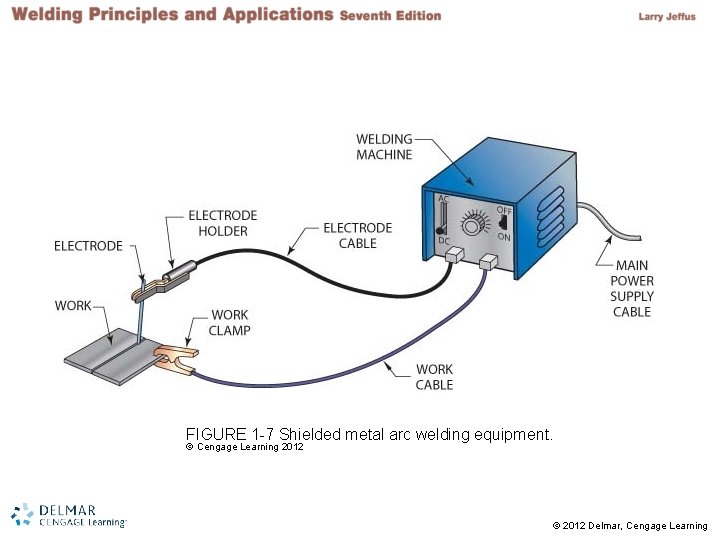
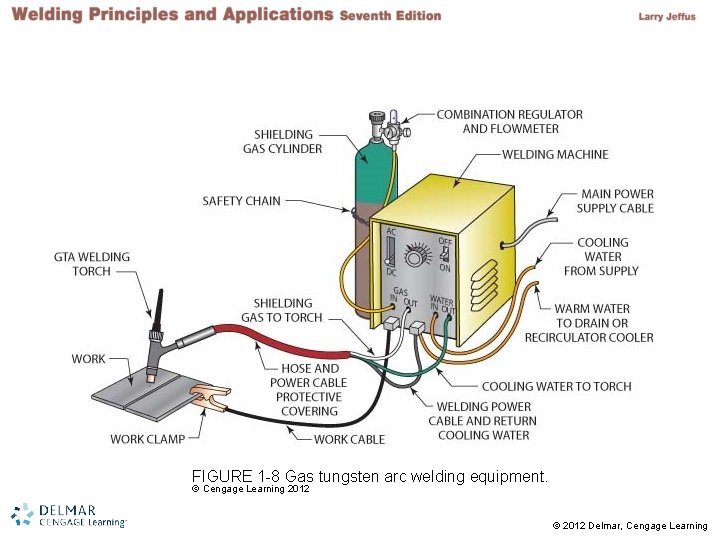
Welding and Cutting Processes (cont'd. ) • Shielded metal arc welding (SMAW) – Equipment can be very basic – Wide selection of filler metal – Wide variety of metal types and metal thicknesses can be joined with one machine • Gas tungsten arc welding (GTAW) – Cleanest of all manual welding processes – Slower and requires a higher skill level – Used to make extremely high-quality welds © 2012 Delmar, Cengage Learning
FIGURE 1 -7 Shielded metal arc welding equipment. © Cengage Learning 2012 © 2012 Delmar, Cengage Learning
FIGURE 1 -8 Gas tungsten arc welding equipment. © Cengage Learning 2012 © 2012 Delmar, Cengage Learning
Welding and Cutting Processes (cont'd. ) • Gas metal arc welding (GMAW) – Extremely fast and economical – Can produce long welds rapidly – Easily used for thin-gauge sheet metal and heavy plate • Flux cored arc welding (FCAW) – Requires some slag clean-up – Advantages: high quality, versatility, and speed © 2012 Delmar, Cengage Learning
Welding and Cutting Processes (cont'd. ) • GMA and FCA welding – Very different welding processes – Use very similar welding equipment – Classified as semiautomatic processes – First choice for many welding fabricators • Effective • Produce high-quality welds • Flexible and versatile © 2012 Delmar, Cengage Learning
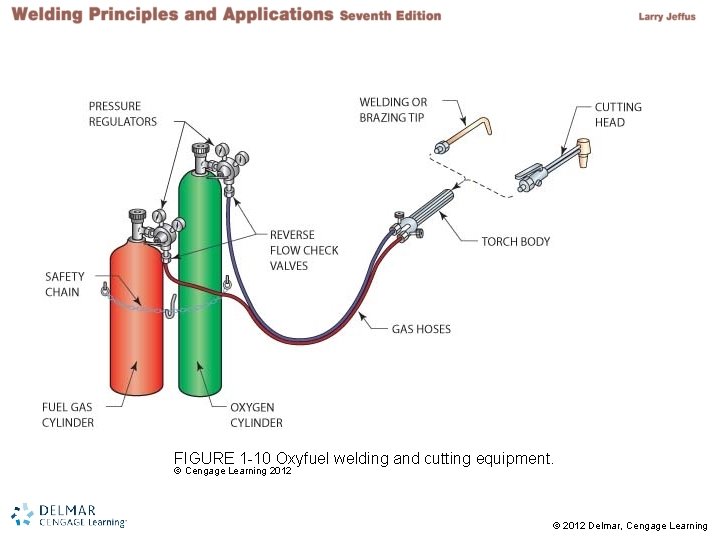
Oxyacetylene Welding, Brazing, and Cutting • Oxyacetylene welding (OAW) and torch brazing (TB) – Can be done with the same equipment • Oxyfuel gas cutting (OFC) uses very similar equipment © 2012 Delmar, Cengage Learning
FIGURE 1 -10 Oxyfuel welding and cutting equipment. © Cengage Learning 2012 © 2012 Delmar, Cengage Learning
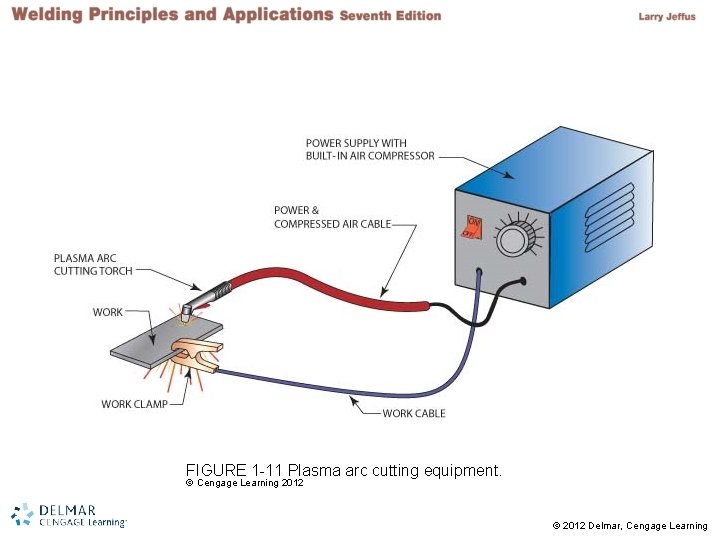
Thermal Cutting Processes • Several processes – Oxyfuel cutting (OFC) • Uses high-temperature flame to heat the surface – Plasma arc cutting (PAC) • Uses a stiff, highly ionized, hot column of gas to almost instantly vaporize metal being cut – Air carbon arc cutting (AAC) • Frequently used – Laser beam cutting (LBC) • Used in larger fabrication shops © 2012 Delmar, Cengage Learning
FIGURE 1 -11 Plasma arc cutting equipment. © Cengage Learning 2012 © 2012 Delmar, Cengage Learning
Selection of the Joining Process • Selection depends upon many factors – Availability of equipment – Repetitiveness of the operation – Quality requirements – Location of work – Materials to be joined – Appearance of the finished product © 2012 Delmar, Cengage Learning
Selection of the Joining Process (cont’d. ) – Size of the parts to be joined – Time available for work – Skill or experience of workers – Cost of materials – Code or specification requirements © 2012 Delmar, Cengage Learning
Selection of the Joining Process (cont’d. ) • Welder must also select application method – Manual: welder manipulates the process – Semiautomatic: filler metal is added automatically – Machine: done mechanically under observation – Automatic: no interaction with the operator – Automated performed repeatedly by a robot programmed for a variety of tasks © 2012 Delmar, Cengage Learning
Occupational Opportunities in Welding • Classifications – Welders: perform actual welding – Tack welders make small welds to hold parts in place – Welding operators: operate automatic equipment – Welders' helpers: clean slag and position weldments – Welder assemblers: position the parts – Welding inspectors: hold a special certification © 2012 Delmar, Cengage Learning
Occupational Opportunities in Welding (cont'd. ) – Shop supervisors: have good management skills – Salespersons: have understanding of welding and marketing skills – Shop owners: often skilled welders with knowledge of small-business management – Welding engineers: design, specify, and oversee construction of complex weldments – Highest-paid welders: have education and skills to read blueprints and do required work to produce a weldment to strict specifications © 2012 Delmar, Cengage Learning
Training for Welding Occupations • Skilled welder – School and work experience are required • Entry-level welder – Must have workplace skills – Some jobs require theoretical knowledge – Robotics and computer-aided manufacturing (CAM) require computer literacy – Employers prefer high school or vocational training in welding processes – A formal apprenticeship is usually not required © 2012 Delmar, Cengage Learning
Training for Welding Occupations (cont'd. ) • The American Welding Society (AWS) – Three levels of certification for welders – Entry Level Welder: beginner welders – Level II and Level III: more skilled welders • Skills. USA – Sponsors welding skill competitions for students – Emphasizes community service and citizenship © 2012 Delmar, Cengage Learning
Experiments and Practices • Chapters contain both experiments and practices – Intended to develop welding knowledge and skills – Work in small groups as you try experiments – Practices are designed to build welding skills – Welding is developed in stages from basic to complex – Each practice gives evaluation or acceptable limits © 2012 Delmar, Cengage Learning
Welding Video Series • Each of the sets covers specific equipment setup and operation – Welding – Cutting – Soldering – Brazing • Read the material, watch the video, and practice to develop your welding skills © 2012 Delmar, Cengage Learning
Metric Units • Both standard and metric (SI) units are given – SI units are in brackets () following the unit • SI units are rounded to the nearest whole number • Rounded to agree with the standard value – Whole numbers are easier to work with – Rounding metric units makes the system easier – Sometimes conversions must be exact • Many calculators have standard-metric conversions © 2012 Delmar, Cengage Learning
Summary • Welding is diverse – Used in almost every manufacturing process • Welded products range – Small objects to buildings and space shuttles • Art and science of joining metals – Around for centuries • With changes and improvements, it will be around through the remainder of the twenty-first century © 2012 Delmar, Cengage Learning