
Chapter 1 Introduction to Victimology Chapter 1 What
- Slides: 13
Chapter 1: Introduction to Victimology � Chapter 1
What is Victimology? �Benjamin Mendelsohn coined the term in 1947 �Definition: “Scientific study of crime victims” �Considered a subfield of Criminology Daigle, Victimology © 2015 SAGE Publications
History of Victimology �Before Victims’ Rights Movement ◦ Prior to and during Middle Ages �Victims are the focus of the justice system ◦ Code of Hammurabi �Focus on restoration of equity between victim and offender ◦ Industrial Revolution �State is the focus of the justice system ◦ 1940 s �Attention returned to victim �Didn’t include making them a part of the justice system �Research focused on victim contribution to the criminal incident Daigle, Victimology © 2015 SAGE Publications
Role of the Victim in Crime � Victim blaming main focus of victimological research � Victim precipitation – continuum of responsibility for victims � Victim facilitation – unconscious or irresponsible action that led to victimization � Victim provocation – incited someone to commit a criminal offense against him or her Daigle, Victimology © 2015 SAGE Publications
Early Victimology Theorists �Hans von Hentig ◦ Looked at characteristics of victims that put them at risk ◦ Criminal-victim dyad ◦ 13 categories of risk �Benjamin Mendelsohn ◦ “Father of victimology” ◦ Explored victim-offender relationships ◦ Classification system based on victim culpability Daigle, Victimology © 2015 SAGE Publications
Early Victimology Theorists � Stephen Schafer ◦ Victim typology based on culpability – included social characteristics and behaviors � Marvin Wolfgang ◦ Empirically investigated victim precipitation for the first time in 1957 ◦ Discovered that 26% of homicides were precipitated ◦ Found common characteristics in precipitated homicides ◦ Subintentional homicide � Menachem Amir ◦ Victim precipitation in rape cases ◦ Concluded that 20% of cases were precipitated ◦ Controversial study Daigle, Victimology © 2015 SAGE Publications
Victims’ Rights Movement � 1960 s – focus on how criminal justice system dealt with victims � 1966 – President’s Commission on Law Enforcement and the Administration of Justice ◦ 1 st government sponsored victimization survey ◦ National Crime Survey – became National Crime Victimization Survey ◦ Shed light on how much crime went unreported (Dark Figure of Crime) ◦ Identified why people were reluctant to report to law enforcement Daigle, Victimology © 2015 SAGE Publications
Victims’ Rights Movement �Other social movements contributed to creation of Victims’ Rights Movement ◦ Women’s Movement �Brought attention to violence against women �Also brought attention to effects of victimization on children �Revictimization by CJ system highlighted ◦ Civil Rights Movement �Brought attention to mistreatment of minorities by CJ system as both offenders and victims Daigle, Victimology © 2015 SAGE Publications
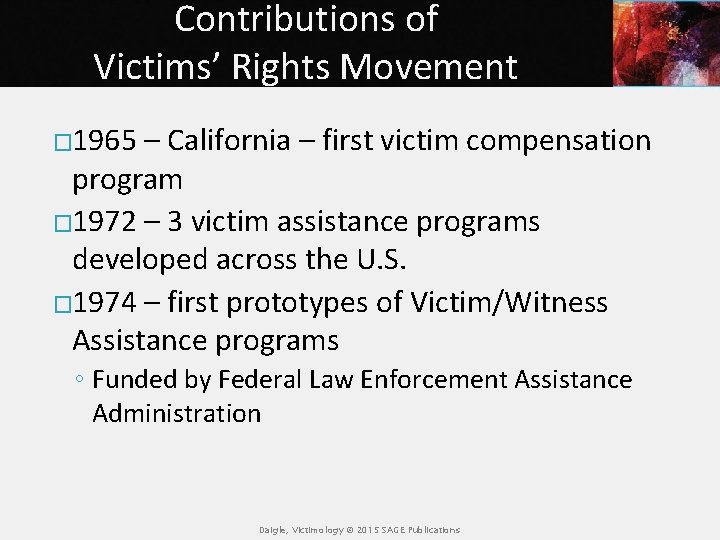
Contributions of Victims’ Rights Movement � 1965 – California – first victim compensation program � 1972 – 3 victim assistance programs developed across the U. S. � 1974 – first prototypes of Victim/Witness Assistance programs ◦ Funded by Federal Law Enforcement Assistance Administration Daigle, Victimology © 2015 SAGE Publications
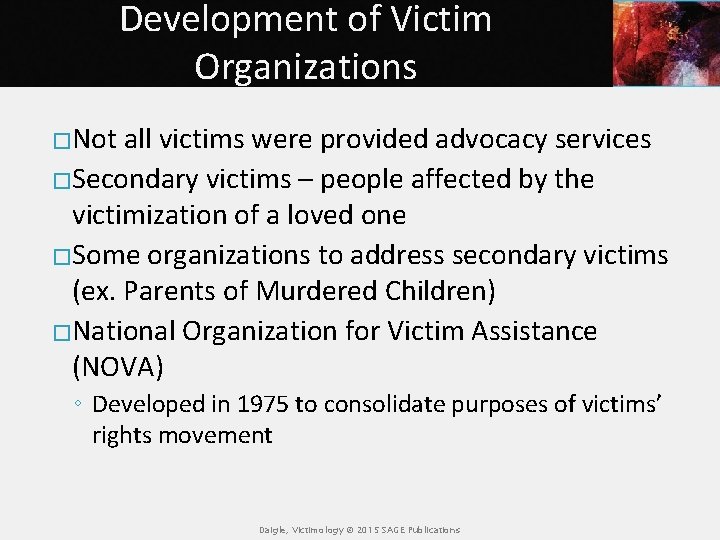
Development of Victim Organizations �Not all victims were provided advocacy services �Secondary victims – people affected by the victimization of a loved one �Some organizations to address secondary victims (ex. Parents of Murdered Children) �National Organization for Victim Assistance (NOVA) ◦ Developed in 1975 to consolidate purposes of victims’ rights movement Daigle, Victimology © 2015 SAGE Publications
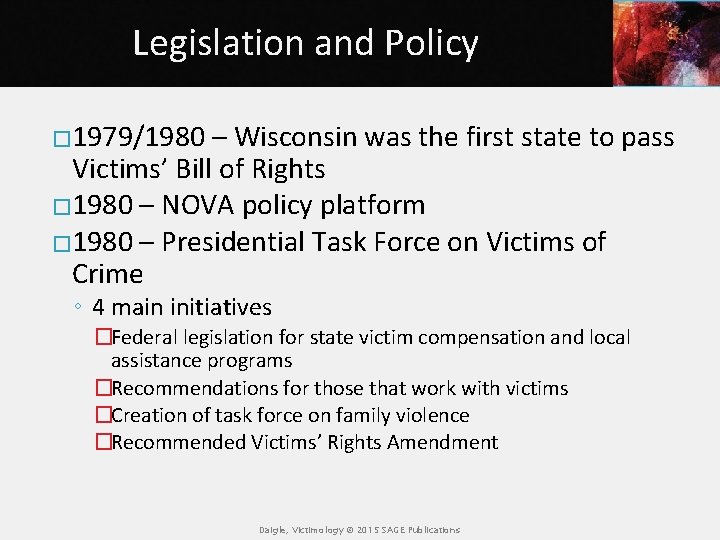
Legislation and Policy � 1979/1980 – Wisconsin was the first state to pass Victims’ Bill of Rights � 1980 – NOVA policy platform � 1980 – Presidential Task Force on Victims of Crime ◦ 4 main initiatives �Federal legislation for state victim compensation and local assistance programs �Recommendations for those that work with victims �Creation of task force on family violence �Recommended Victims’ Rights Amendment Daigle, Victimology © 2015 SAGE Publications
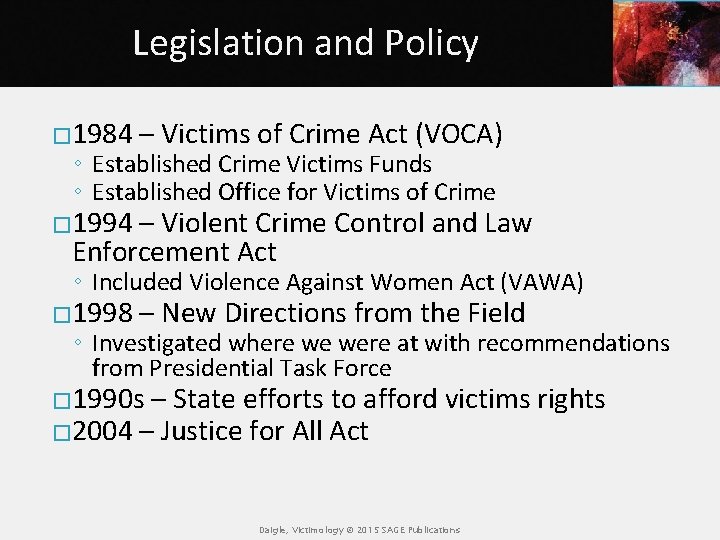
Legislation and Policy � 1984 – Victims of Crime Act (VOCA) ◦ Established Crime Victims Funds ◦ Established Office for Victims of Crime � 1994 – Violent Crime Control and Law Enforcement Act ◦ Included Violence Against Women Act (VAWA) � 1998 – New Directions from the Field ◦ Investigated where we were at with recommendations from Presidential Task Force � 1990 s – State efforts to afford victims rights � 2004 – Justice for All Act Daigle, Victimology © 2015 SAGE Publications
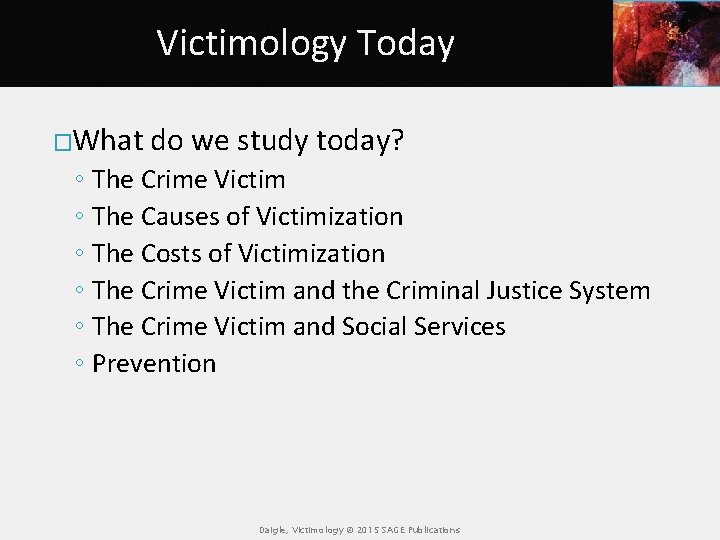
Victimology Today �What do we study today? ◦ The Crime Victim ◦ The Causes of Victimization ◦ The Costs of Victimization ◦ The Crime Victim and the Criminal Justice System ◦ The Crime Victim and Social Services ◦ Prevention Daigle, Victimology © 2015 SAGE Publications