
Chapter 1 Introduction to Tourism Its Tourism Concepts
- Slides: 36
Chapter 1 Introduction to Tourism It’s Tourism: Concepts and Practices John Walker Copyright © 2011 by Pearson Education, Inc. publishing as Pearson [imprint]
Objectives • After reading and studying this chapter, you should be able to: – Describe the evolution of tourism – Define the scope and importance of tourism, both for the U. S. economy and internationally – Explain why tourism is described by Gunn and Leiper as a system It’s Tourism: Concepts and Practices John Walker Copyright © 2011 by Pearson Education, Inc. publishing as Pearson [imprint]
Objectives (cont’d. ) – Suggest why so many governments promote tourism and why tourist revenue is so highly valued – Describe the types and characteristics of tourism It’s Tourism: Concepts and Practices John Walker Copyright © 2011 by Pearson Education, Inc. publishing as Pearson [imprint]
Introduction • We can approach tourism from multiple viewpoints – Areas are interrelated – Industry experts recommend a systems approach • If something happens in one area, it will likely cause an effect in another It’s Tourism: Concepts and Practices John Walker Copyright © 2011 by Pearson Education, Inc. publishing as Pearson [imprint]
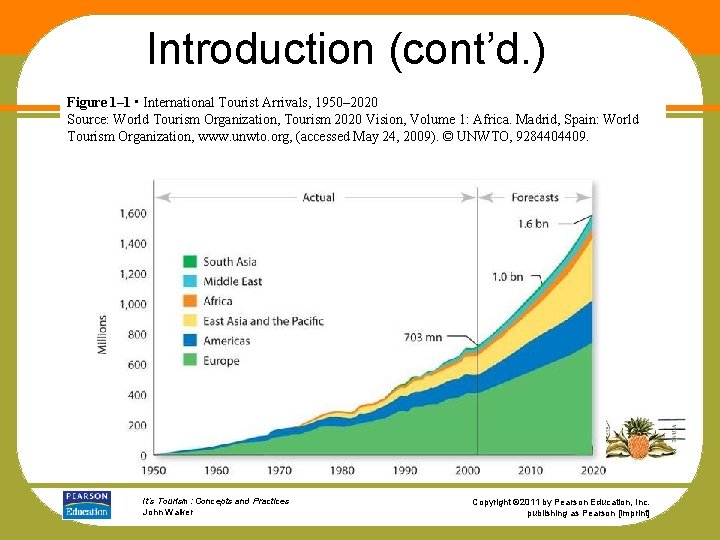
Introduction (cont’d. ) Figure 1– 1 • International Tourist Arrivals, 1950– 2020 Source: World Tourism Organization, Tourism 2020 Vision, Volume 1: Africa. Madrid, Spain: World Tourism Organization, www. unwto. org, (accessed May 24, 2009). © UNWTO, 9284404409. It’s Tourism: Concepts and Practices John Walker Copyright © 2011 by Pearson Education, Inc. publishing as Pearson [imprint]
Definition of Tourism • United Nations World Tourism Organization (UNWTO) definition: – Activities of persons traveling to, and staying in places outside their usual environment • Not more than one consecutive year for leisure, business, and other purposes It’s Tourism: Concepts and Practices John Walker Copyright © 2011 by Pearson Education, Inc. publishing as Pearson [imprint]
Definition of Tourism (cont’d. ) • Important terms: – Demand side • Tourists’ motivations – Supply side • Sectors that satisfy tourist needs – Infrastructure • Components that an area’s residents rely on – Superstructure • Facilities built to accommodate tourist needs It’s Tourism: Concepts and Practices John Walker Copyright © 2011 by Pearson Education, Inc. publishing as Pearson [imprint]
A Systems Approach • Ludwig von Bertalanffy: – General systems theory • Defined a system as “a set of elements standing in interrelation among themselves and with the environments” 4 • Clare Gunn: – Functioning tourism system • Consists of supply side of attractions, services, promotion, information, and transportation It’s Tourism: Concepts and Practices John Walker Copyright © 2011 by Pearson Education, Inc. publishing as Pearson [imprint]
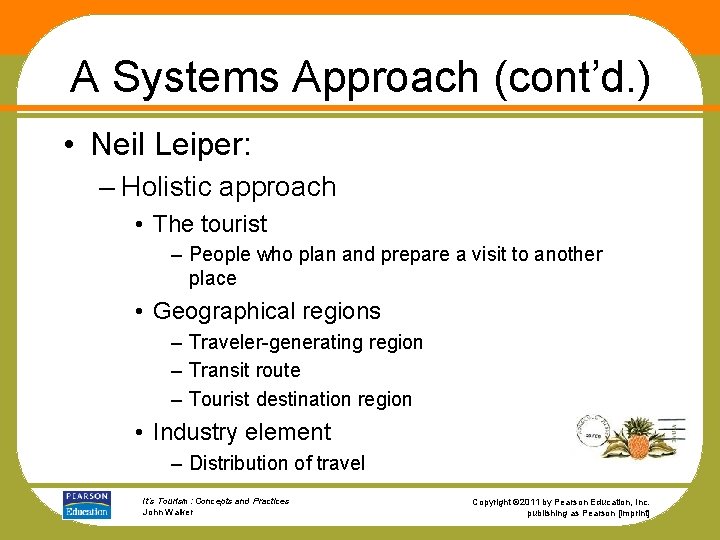
A Systems Approach (cont’d. ) • Neil Leiper: – Holistic approach • The tourist – People who plan and prepare a visit to another place • Geographical regions – Traveler-generating region – Transit route – Tourist destination region • Industry element – Distribution of travel It’s Tourism: Concepts and Practices John Walker Copyright © 2011 by Pearson Education, Inc. publishing as Pearson [imprint]
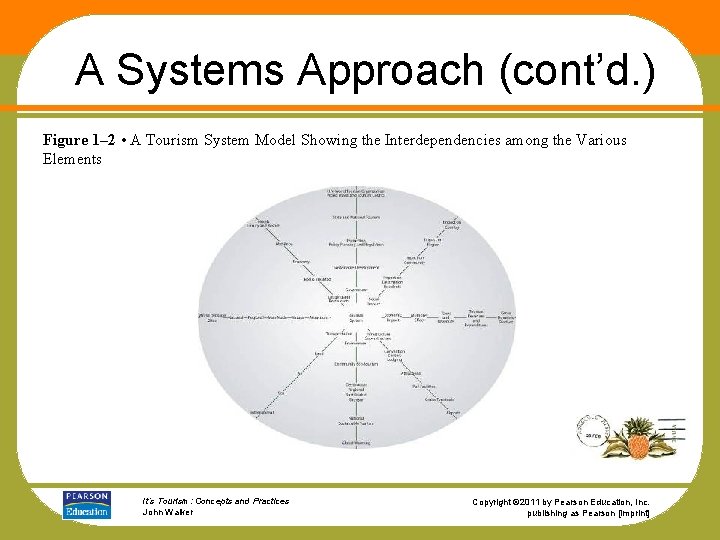
A Systems Approach (cont’d. ) Figure 1– 2 • A Tourism System Model Showing the Interdependencies among the Various Elements It’s Tourism: Concepts and Practices John Walker Copyright © 2011 by Pearson Education, Inc. publishing as Pearson [imprint]
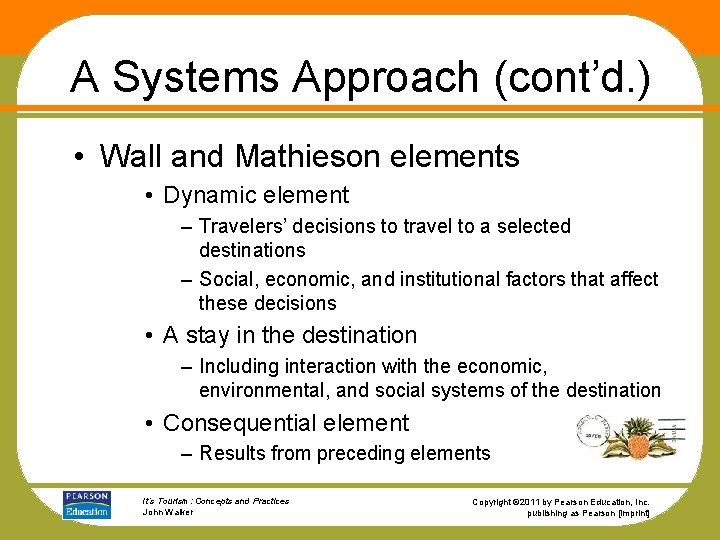
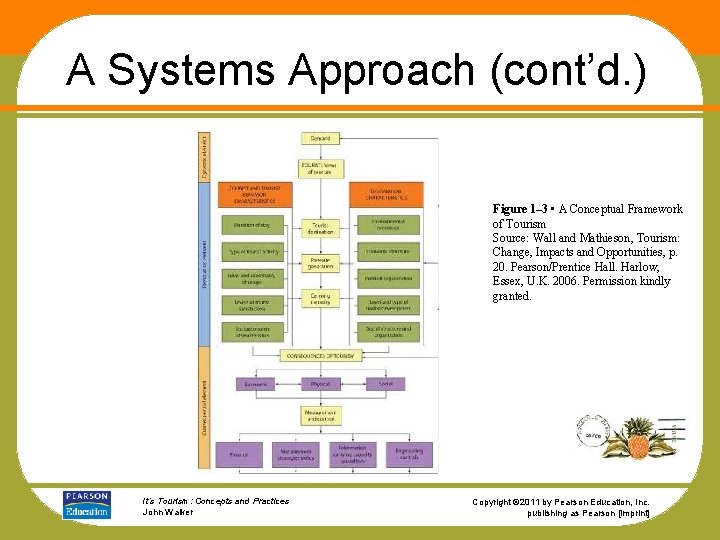
A Systems Approach (cont’d. ) • Wall and Mathieson elements • Dynamic element – Travelers’ decisions to travel to a selected destinations – Social, economic, and institutional factors that affect these decisions • A stay in the destination – Including interaction with the economic, environmental, and social systems of the destination • Consequential element – Results from preceding elements It’s Tourism: Concepts and Practices John Walker Copyright © 2011 by Pearson Education, Inc. publishing as Pearson [imprint]
A Systems Approach (cont’d. ) Figure 1– 3 • A Conceptual Framework of Tourism Source: Wall and Mathieson, Tourism: Change, Impacts and Opportunities, p. 20. Pearson/Prentice Hall. Harlow, Essex, U. K. 2006. Permission kindly granted. It’s Tourism: Concepts and Practices John Walker Copyright © 2011 by Pearson Education, Inc. publishing as Pearson [imprint]
Perspectives of Tourism • We can study tourism from several perspectives – Holistic interdisciplinary approach • Includes all elements of Figure 1– 2 – Also includes several other elements (e. g. , geography, motivation, marketing, economics, policy, agriculture, etc. ) It’s Tourism: Concepts and Practices John Walker Copyright © 2011 by Pearson Education, Inc. publishing as Pearson [imprint]
The Tourism Product • Narrow sense – Consists of what the tourist buys • Wider sense – Combination of what the tourist does at the destination and services used It’s Tourism: Concepts and Practices John Walker Copyright © 2011 by Pearson Education, Inc. publishing as Pearson [imprint]
The Tourism Product (cont’d. ) • Characteristics of a tourism product: – Service, which is intangible (e. g. , cannot be inspected physically) – Psychological in attraction – Varies in quality and standards – Supply side is fixed (e. g. , more hotel rooms cannot be instantly created to meet demand) It’s Tourism: Concepts and Practices John Walker Copyright © 2011 by Pearson Education, Inc. publishing as Pearson [imprint]
Characteristics of Tourism • Major types: – Internal tourism • Residents of a country visiting other parts of their own country – Domestic tourism • Inbound tourism plus internal tourism It’s Tourism: Concepts and Practices John Walker Copyright © 2011 by Pearson Education, Inc. publishing as Pearson [imprint]
Characteristics (cont’d. ) – International tourism • Inbound tourism, which are visits to a country or region by nonresident – Outbound tourism • Visits by residents of a country or region to another country or region It’s Tourism: Concepts and Practices John Walker Copyright © 2011 by Pearson Education, Inc. publishing as Pearson [imprint]
Characteristics (cont’d. ) • Characteristics: – Combination of phenomena and relationships – Dynamic elements (the journey) and static elements (the stay) – Movement to destinations is temporary – Not connected with paid work – Tourist goes to the product It’s Tourism: Concepts and Practices John Walker Copyright © 2011 by Pearson Education, Inc. publishing as Pearson [imprint]
Characteristics (cont’d. ) – Tourism products are not used up – Labor-intensive – People-oriented – Multidimensional – Seasonal – Dynamic It’s Tourism: Concepts and Practices John Walker Copyright © 2011 by Pearson Education, Inc. publishing as Pearson [imprint]
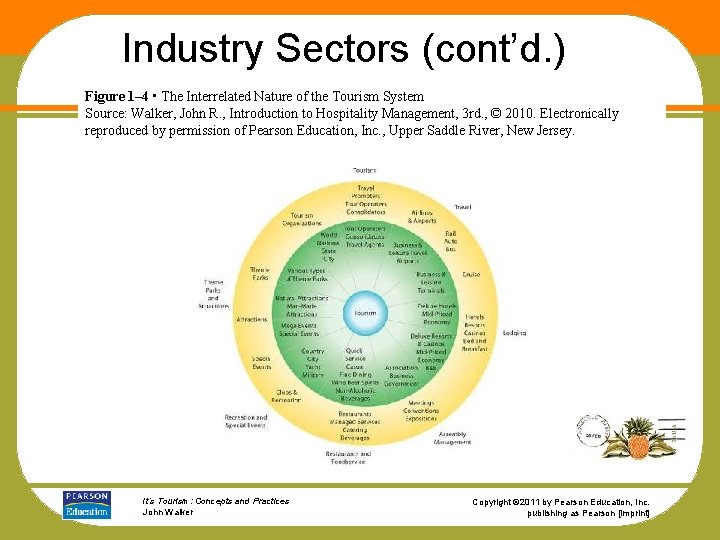
Tourism Industry Sectors • Several interacting industries make up the tourism system, including: – Transportation – Lodging – Attractions – Foodservice It’s Tourism: Concepts and Practices John Walker Copyright © 2011 by Pearson Education, Inc. publishing as Pearson [imprint]
Industry Sectors (cont’d. ) Figure 1– 4 • The Interrelated Nature of the Tourism System Source: Walker, John R. , Introduction to Hospitality Management, 3 rd. , © 2010. Electronically reproduced by permission of Pearson Education, Inc. , Upper Saddle River, New Jersey. It’s Tourism: Concepts and Practices John Walker Copyright © 2011 by Pearson Education, Inc. publishing as Pearson [imprint]
Tourism Past • Preindustrial age – Cruises on the Nile – Wealthy Egyptians, Greeks, and Romans – Olympics – The wheel and roads – Trade – The Grand Tour It’s Tourism: Concepts and Practices John Walker Copyright © 2011 by Pearson Education, Inc. publishing as Pearson [imprint]
Tourism Past (cont’d. ) • Trains – Steam power gave birth to rail travel • Causes of increased growth: – Need to move goods – Politics, immigrants, and labor – Travel and tourism • Causes of decline: – New modes of transportation (e. g. , bus, car, and airplanes) – Great Depression It’s Tourism: Concepts and Practices John Walker Copyright © 2011 by Pearson Education, Inc. publishing as Pearson [imprint]
Tourism Past (cont’d. ) • Cruising – Until 1830, travel by ship was primitive • Mostly used for discovery, trading, or migration – The Peninsula and Orient (P&O) company • First to offer cruises between Britain, Spain, and Portugal It’s Tourism: Concepts and Practices John Walker Copyright © 2011 by Pearson Education, Inc. publishing as Pearson [imprint]
Tourism Past (cont’d. ) • Automobile travel – Internal combustion engine automobile • Emerged from steam engines – Henry Ford • Automobile assembly line – Model-T Ford – Increased leisure travel It’s Tourism: Concepts and Practices John Walker Copyright © 2011 by Pearson Education, Inc. publishing as Pearson [imprint]
Tourism Past (cont’d. ) • Air travel – Wright brothers – 1935 commercial flights became feasible – World War II • Pressed planes into military service – 1950 commercial jet airplanes • Boeing 700 series It’s Tourism: Concepts and Practices John Walker Copyright © 2011 by Pearson Education, Inc. publishing as Pearson [imprint]
Tourism Present • Main elements: – Vital force for peace – Social importance – Economic importance – Cultural enrichment – Employment opportunities – Educational significance It’s Tourism: Concepts and Practices John Walker Copyright © 2011 by Pearson Education, Inc. publishing as Pearson [imprint]
Tourism Present (cont’d. ) • Jafari’s platforms: – Advocacy platform • Many were advocating for tourism development – Cautionary platform • Studies that argued tourism is not all benefits – Adaptancy platform • Favoring one alternative over another – Knowledge based platform • Combined the platforms It’s Tourism: Concepts and Practices John Walker Copyright © 2011 by Pearson Education, Inc. publishing as Pearson [imprint]
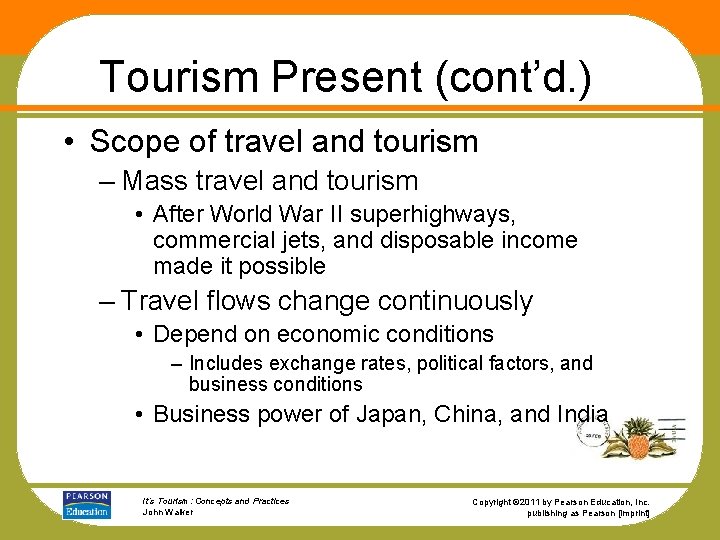
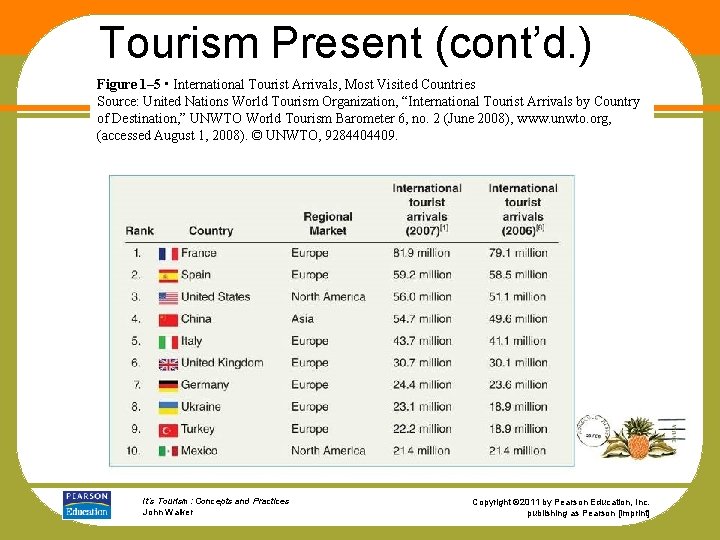
Tourism Present (cont’d. ) • Scope of travel and tourism – Mass travel and tourism • After World War II superhighways, commercial jets, and disposable income made it possible – Travel flows change continuously • Depend on economic conditions – Includes exchange rates, political factors, and business conditions • Business power of Japan, China, and India It’s Tourism: Concepts and Practices John Walker Copyright © 2011 by Pearson Education, Inc. publishing as Pearson [imprint]
Tourism Present (cont’d. ) Figure 1– 5 • International Tourist Arrivals, Most Visited Countries Source: United Nations World Tourism Organization, “International Tourist Arrivals by Country of Destination, ” UNWTO World Tourism Barometer 6, no. 2 (June 2008), www. unwto. org, (accessed August 1, 2008). © UNWTO, 9284404409. It’s Tourism: Concepts and Practices John Walker Copyright © 2011 by Pearson Education, Inc. publishing as Pearson [imprint]
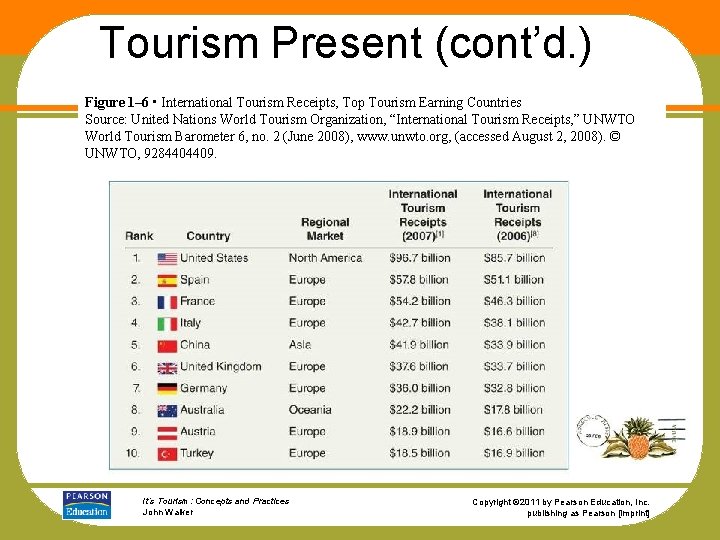
Tourism Present (cont’d. ) Figure 1– 6 • International Tourism Receipts, Top Tourism Earning Countries Source: United Nations World Tourism Organization, “International Tourism Receipts, ” UNWTO World Tourism Barometer 6, no. 2 (June 2008), www. unwto. org, (accessed August 2, 2008). © UNWTO, 9284404409. It’s Tourism: Concepts and Practices John Walker Copyright © 2011 by Pearson Education, Inc. publishing as Pearson [imprint]
Tourism Present (cont’d. ) • Business travel – Meetings, conferences, seminars, workshops, and training sessions – Incentive travel – Normal business travel • May be a combination of first two – Research and teaching travel It’s Tourism: Concepts and Practices John Walker Copyright © 2011 by Pearson Education, Inc. publishing as Pearson [imprint]
Domestic Travel and Tourism • Domestic leisure travel – Large and growing sector • Includes travel for recreation, visiting friends and relatives, history and culture, attractions, entertainment, cruising, and sightseeing • Domestic business travel – Includes all forms that are work related • MICE (meetings, incentives, conferences, exhibitions) It’s Tourism: Concepts and Practices John Walker Copyright © 2011 by Pearson Education, Inc. publishing as Pearson [imprint]
Interrelated Business • Travel and tourism industry involves a complex set of interrelated businesses – Hospitality, travel, and tourism businesses • • Retailers Transportation sector Recreation or gaming facilities Hotels and restaurants It’s Tourism: Concepts and Practices John Walker Copyright © 2011 by Pearson Education, Inc. publishing as Pearson [imprint]
Where Do Americans Travel? • Many possible destinations – Some are more popular than others • Most Americans tend to think of vacation spots as beaches, mountains, and forests • Many vacations take place in major cities • Main purpose of a vacation is sightseeing, recreation, and visiting friends and relatives – Followed by trips for business or conventions It’s Tourism: Concepts and Practices John Walker Copyright © 2011 by Pearson Education, Inc. publishing as Pearson [imprint]
Tourism and You • World Travel and Tourism Council – Tourism industry is expected to grow 50 percent faster than other sectors • Excellent career option • Already the largest of all sectors of world employment It’s Tourism: Concepts and Practices John Walker Copyright © 2011 by Pearson Education, Inc. publishing as Pearson [imprint]