
Chapter 1 INTRODUCTION TO THEORY OF COMPUTATION Learning
- Slides: 15
Chapter 1 INTRODUCTION TO THEORY OF COMPUTATION
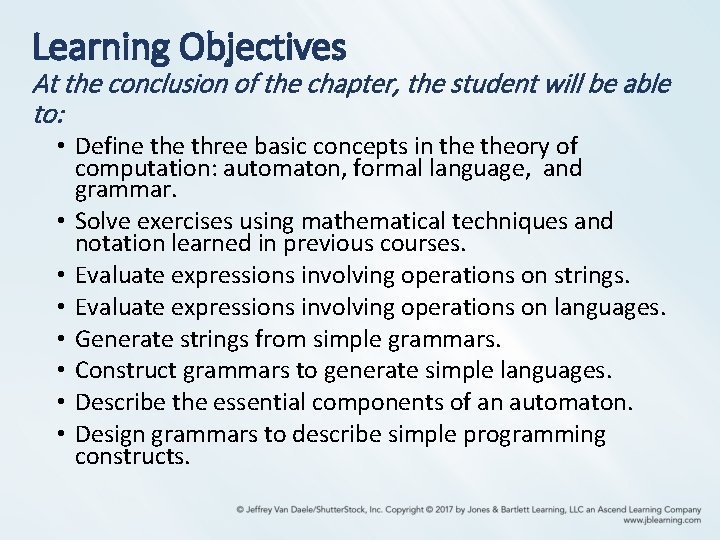
Learning Objectives At the conclusion of the chapter, the student will be able to: • Define three basic concepts in theory of computation: automaton, formal language, and grammar. • Solve exercises using mathematical techniques and notation learned in previous courses. • Evaluate expressions involving operations on strings. • Evaluate expressions involving operations on languages. • Generate strings from simple grammars. • Construct grammars to generate simple languages. • Describe the essential components of an automaton. • Design grammars to describe simple programming constructs.
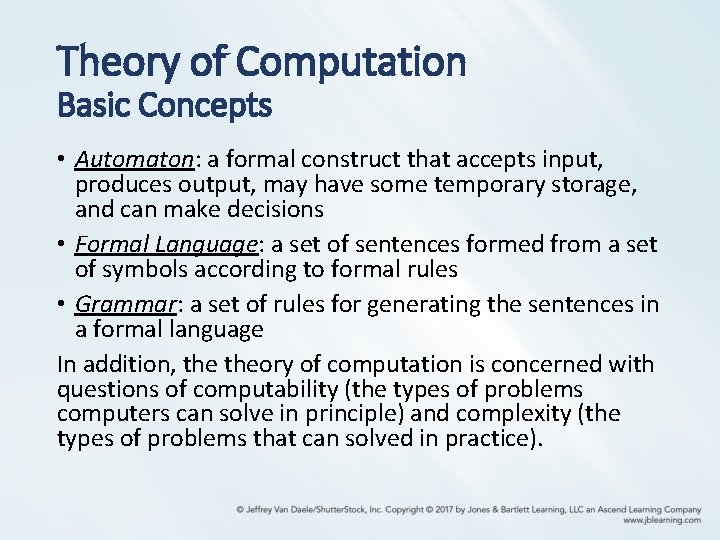
Theory of Computation Basic Concepts • Automaton: a formal construct that accepts input, produces output, may have some temporary storage, and can make decisions • Formal Language: a set of sentences formed from a set of symbols according to formal rules • Grammar: a set of rules for generating the sentences in a formal language In addition, theory of computation is concerned with questions of computability (the types of problems computers can solve in principle) and complexity (the types of problems that can solved in practice).
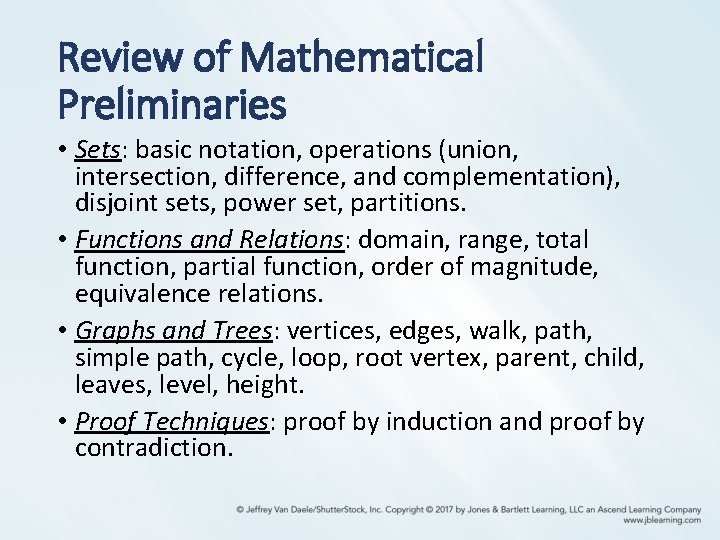
Review of Mathematical Preliminaries • Sets: basic notation, operations (union, intersection, difference, and complementation), disjoint sets, power set, partitions. • Functions and Relations: domain, range, total function, partial function, order of magnitude, equivalence relations. • Graphs and Trees: vertices, edges, walk, path, simple path, cycle, loop, root vertex, parent, child, leaves, level, height. • Proof Techniques: proof by induction and proof by contradiction.
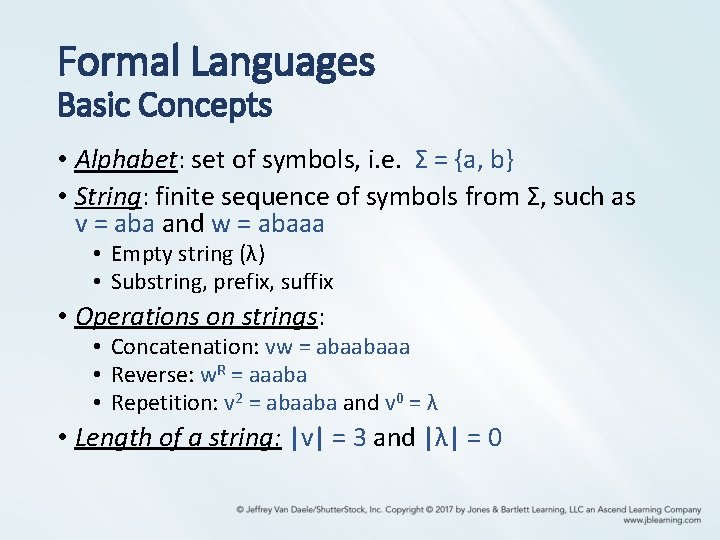
Formal Languages Basic Concepts • Alphabet: set of symbols, i. e. Σ = {a, b} • String: finite sequence of symbols from Σ, such as v = aba and w = abaaa • Empty string (λ) • Substring, prefix, suffix • Operations on strings: • Concatenation: vw = abaabaaa • Reverse: w. R = aaaba • Repetition: v 2 = abaaba and v 0 = λ • Length of a string: |v| = 3 and |λ| = 0
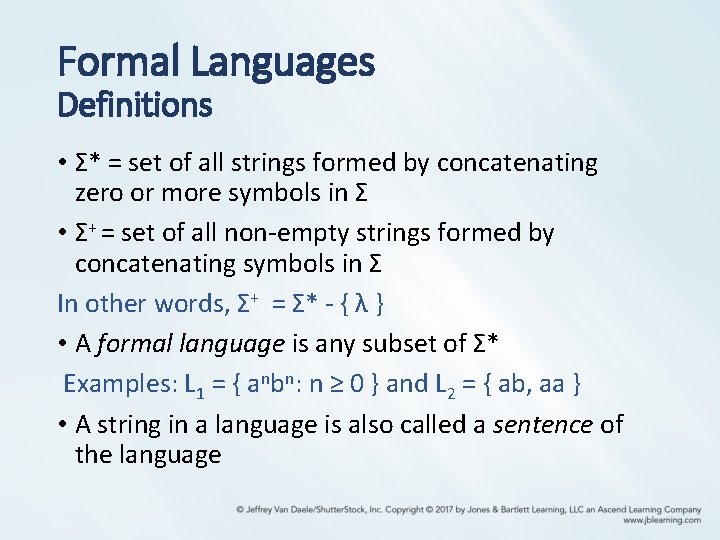
Formal Languages Definitions • Σ* = set of all strings formed by concatenating zero or more symbols in Σ • Σ+ = set of all non-empty strings formed by concatenating symbols in Σ In other words, Σ+ = Σ* - { λ } • A formal language is any subset of Σ* Examples: L 1 = { anbn: n ≥ 0 } and L 2 = { ab, aa } • A string in a language is also called a sentence of the language
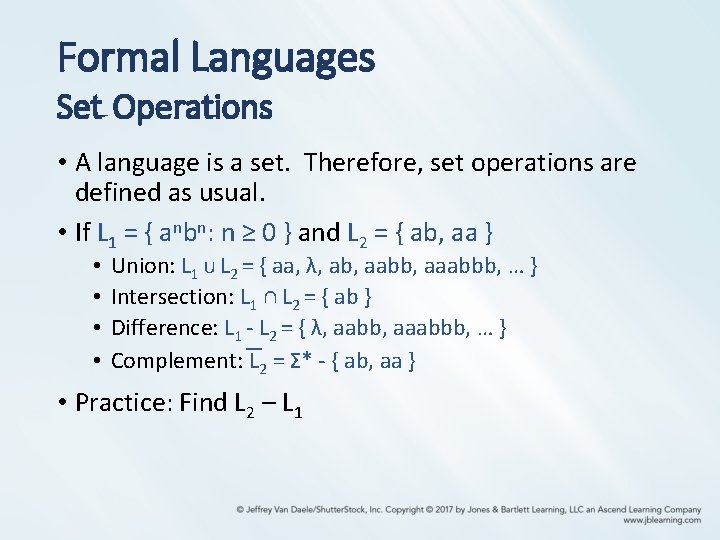
Formal Languages Set Operations • A language is a set. Therefore, set operations are defined as usual. • If L 1 = { anbn: n ≥ 0 } and L 2 = { ab, aa } • • Union: L 1 ᴜ L 2 = { aa, λ, ab, aabb, aaabbb, … } Intersection: L 1 ∩ L 2 = { ab } Difference: L 1 - L 2 = { λ, aabb, aaabbb, … } Complement: L 2 = Σ* - { ab, aa } • Practice: Find L 2 – L 1
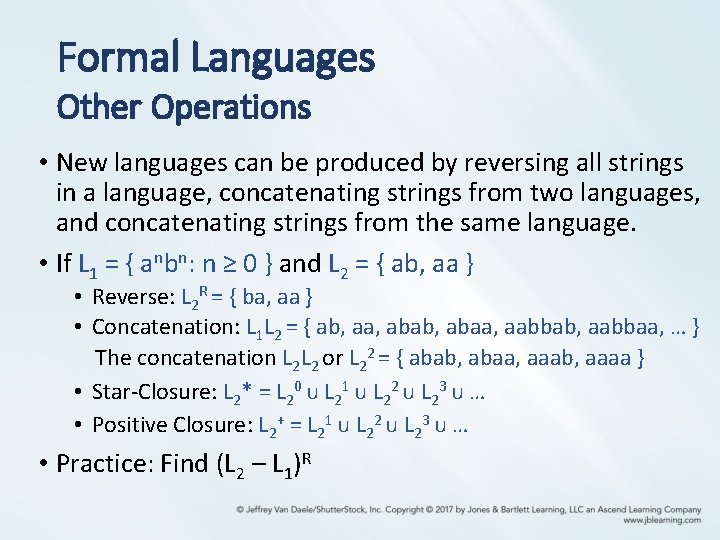
Formal Languages Other Operations • New languages can be produced by reversing all strings in a language, concatenating strings from two languages, and concatenating strings from the same language. • If L 1 = { anbn: n ≥ 0 } and L 2 = { ab, aa } • Reverse: L 2 R = { ba, aa } • Concatenation: L 1 L 2 = { ab, aa, abab, abaa, aabbab, aabbaa, … } The concatenation L 2 L 2 or L 22 = { abab, abaa, aaab, aaaa } • Star-Closure: L 2* = L 20 ᴜ L 21 ᴜ L 22 ᴜ L 23 ᴜ … • Positive Closure: L 2+ = L 21 ᴜ L 22 ᴜ L 23 ᴜ … • Practice: Find (L 2 – L 1)R
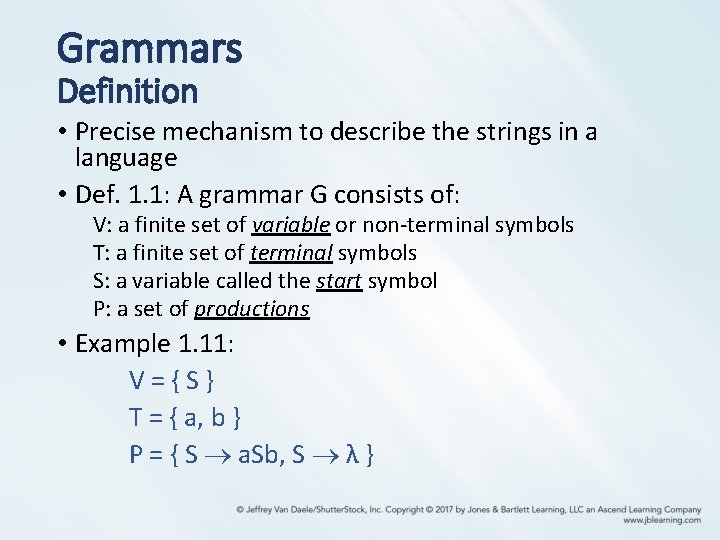
Grammars Definition • Precise mechanism to describe the strings in a language • Def. 1. 1: A grammar G consists of: V: a finite set of variable or non-terminal symbols T: a finite set of terminal symbols S: a variable called the start symbol P: a set of productions • Example 1. 11: V={S} T = { a, b } P = { S a. Sb, S λ }
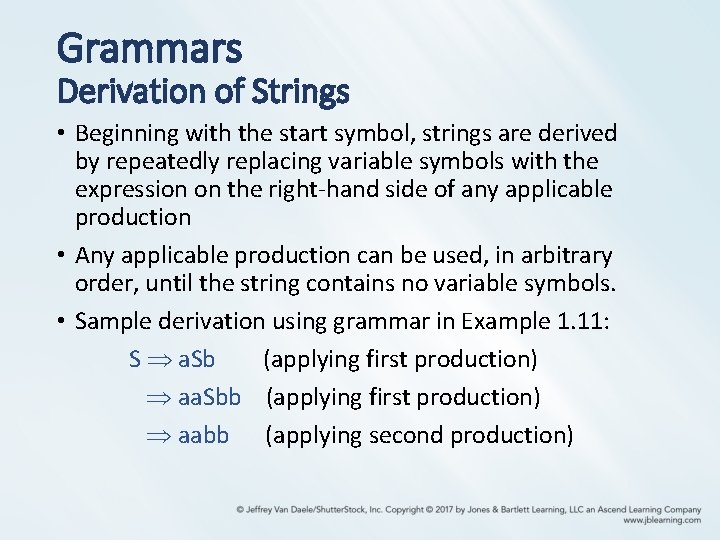
Grammars Derivation of Strings • Beginning with the start symbol, strings are derived by repeatedly replacing variable symbols with the expression on the right-hand side of any applicable production • Any applicable production can be used, in arbitrary order, until the string contains no variable symbols. • Sample derivation using grammar in Example 1. 11: S a. Sb (applying first production) aa. Sbb (applying first production) aabb (applying second production)
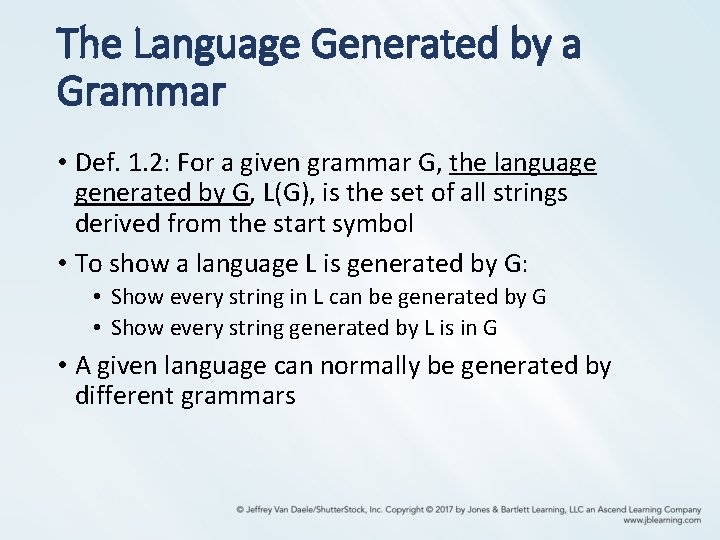
The Language Generated by a Grammar • Def. 1. 2: For a given grammar G, the language generated by G, L(G), is the set of all strings derived from the start symbol • To show a language L is generated by G: • Show every string in L can be generated by G • Show every string generated by L is in G • A given language can normally be generated by different grammars
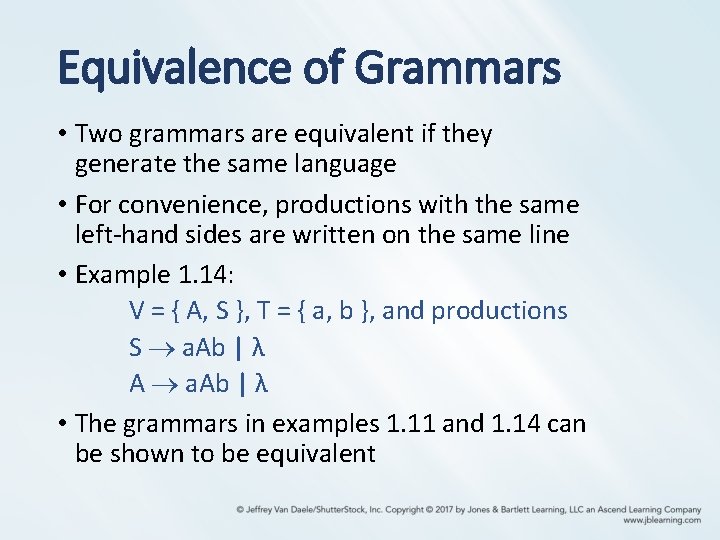
Equivalence of Grammars • Two grammars are equivalent if they generate the same language • For convenience, productions with the same left-hand sides are written on the same line • Example 1. 14: V = { A, S }, T = { a, b }, and productions S a. Ab | λ A a. Ab | λ • The grammars in examples 1. 11 and 1. 14 can be shown to be equivalent
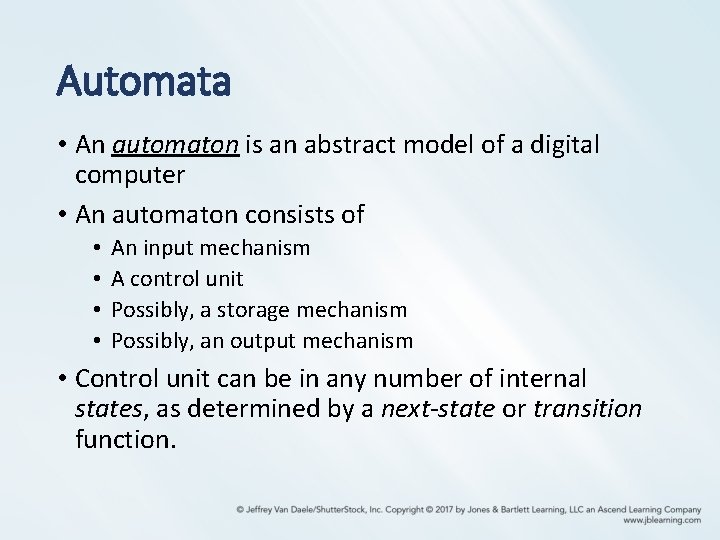
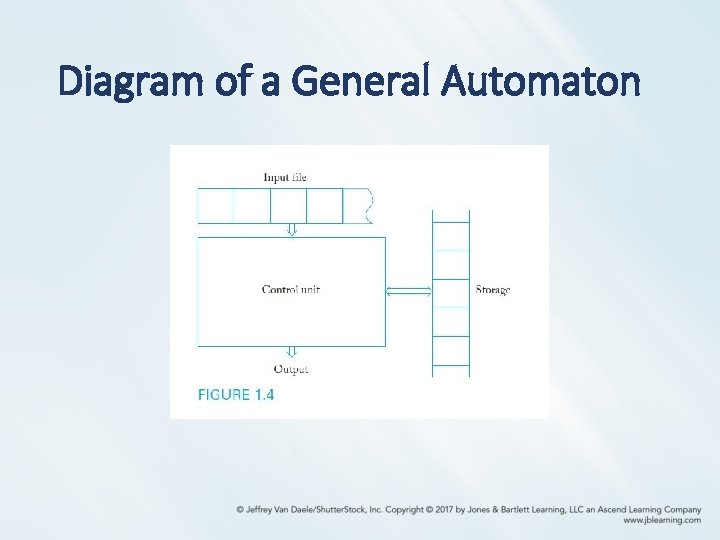
Automata • An automaton is an abstract model of a digital computer • An automaton consists of • • An input mechanism A control unit Possibly, a storage mechanism Possibly, an output mechanism • Control unit can be in any number of internal states, as determined by a next-state or transition function.
Diagram of a General Automaton
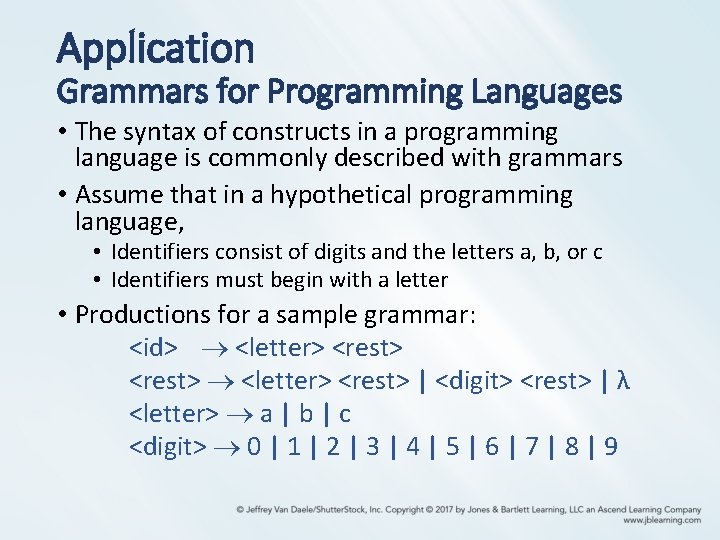
Application Grammars for Programming Languages • The syntax of constructs in a programming language is commonly described with grammars • Assume that in a hypothetical programming language, • Identifiers consist of digits and the letters a, b, or c • Identifiers must begin with a letter • Productions for a sample grammar: <id> <letter> <rest> | <digit> <rest> | λ <letter> a | b | c <digit> 0 | 1 | 2 | 3 | 4 | 5 | 6 | 7 | 8 | 9