
Chapter 1 Introduction to the Microprocessor and Computer
- Slides: 89
Chapter 1: Introduction to the Microprocessor and Computer
Introduction • • Overview of Intel microprocessors. Discussion of history of computers. Function of the microprocessor. Terms and jargon (computerese). The Intel Microprocessors: 8086/8088, 80186/80188, 80286, 80386, 80486 Pentium, Pentium Processor, Pentium II, Pentium, 4, and Core 2 with 64 -bit Extensions Architecture, Programming, and Interfacing, Eighth Edition Barry B. Brey Copyright © 2009 by Pearson Education, Inc. Upper Saddle River, New Jersey 07458 • All rights reserved.
Chapter Objectives Upon completion of this chapter, you will have an idea about: • Computer terminology such as – bit, byte, data, real memory system, protected mode memory system, Windows, DOS, I/O. • History of the computers. • An overview of the various 80 X 86 and Pentium family members. The Intel Microprocessors: 8086/8088, 80186/80188, 80286, 80386, 80486 Pentium, Pentium Processor, Pentium II, Pentium, 4, and Core 2 with 64 -bit Extensions Architecture, Programming, and Interfacing, Eighth Edition Barry B. Brey Copyright © 2009 by Pearson Education, Inc. Upper Saddle River, New Jersey 07458 • All rights reserved.
Chapter Objectives (cont. ) • Draw the block diagram of a computer system and explain the purpose of each block. • Describe the function of the microprocessor and detail its basic operation. • Define the contents of the memory system in the personal computer. The Intel Microprocessors: 8086/8088, 80186/80188, 80286, 80386, 80486 Pentium, Pentium Processor, Pentium II, Pentium, 4, and Core 2 with 64 -bit Extensions Architecture, Programming, and Interfacing, Eighth Edition Barry B. Brey Copyright © 2009 by Pearson Education, Inc. Upper Saddle River, New Jersey 07458 • All rights reserved.
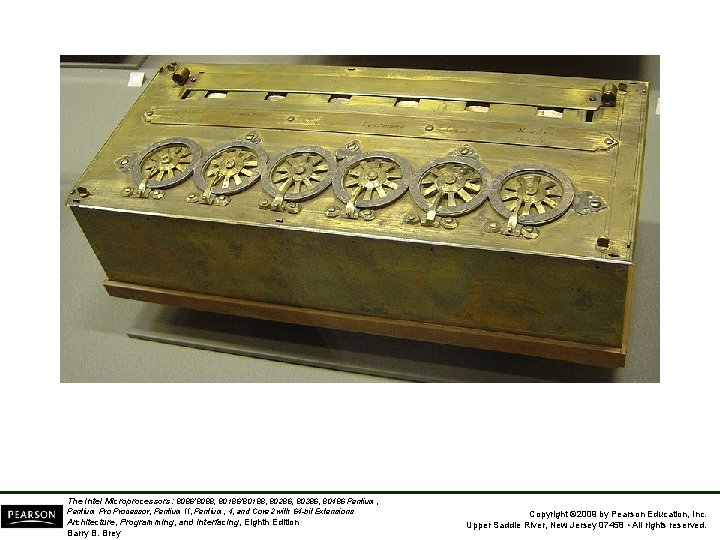
History • Blaise Pascal (1642) invented a calculator constructed of gears and wheels. – each gear contained 10 teeth • When moved one complete revolution, a second gear advances one place. – same principle used in automobile odometer • Basis of all mechanical calculators. • PASCAL programming language is named in honor of Blaise Pascal. The Intel Microprocessors: 8086/8088, 80186/80188, 80286, 80386, 80486 Pentium, Pentium Processor, Pentium II, Pentium, 4, and Core 2 with 64 -bit Extensions Architecture, Programming, and Interfacing, Eighth Edition Barry B. Brey Copyright © 2009 by Pearson Education, Inc. Upper Saddle River, New Jersey 07458 • All rights reserved.
The Intel Microprocessors: 8086/8088, 80186/80188, 80286, 80386, 80486 Pentium, Pentium Processor, Pentium II, Pentium, 4, and Core 2 with 64 -bit Extensions Architecture, Programming, and Interfacing, Eighth Edition Barry B. Brey Copyright © 2009 by Pearson Education, Inc. Upper Saddle River, New Jersey 07458 • All rights reserved.
• First practical geared mechanical machines to compute information date to early 1800 s. – humans dreamed of mechanical machines that could compute with a program • One early pioneer of mechanical computing machinery was Charles Babbage. – aided by Ada Byron, Countess of Lovelace • Commissioned in 1823 by Royal Astronomical Society to build programmable calculating machine. – to generate Royal Navy navigational tables The Intel Microprocessors: 8086/8088, 80186/80188, 80286, 80386, 80486 Pentium, Pentium Processor, Pentium II, Pentium, 4, and Core 2 with 64 -bit Extensions Architecture, Programming, and Interfacing, Eighth Edition Barry B. Brey Copyright © 2009 by Pearson Education, Inc. Upper Saddle River, New Jersey 07458 • All rights reserved.
• Babbage’s Analytical Engine. • Steam-powered mechanical computer. – stored a thousand 20 -digit decimal numbers – input through punched cards, much as computers in the 1950 s and 1960 s used punched cards • It is assumed idea of punched cards is from Joseph Jacquard, a Frenchman. – used punched cards as input to a weaving machine he invented in 1801 The Intel Microprocessors: 8086/8088, 80186/80188, 80286, 80386, 80486 Pentium, Pentium Processor, Pentium II, Pentium, 4, and Core 2 with 64 -bit Extensions Architecture, Programming, and Interfacing, Eighth Edition Barry B. Brey Copyright © 2009 by Pearson Education, Inc. Upper Saddle River, New Jersey 07458 • All rights reserved.
The Electrical Age • 1800 s saw advent of the electric motor. – conceived by Michael Faraday • Also a multitude of electrically motor-driven adding machines based on the Pascal mechanical calculator. – common office equipment until 1970 s • Introduced by Bomar Corporation the Bomar Brain, was a handheld electronic calculator. – first appeared in early 1970 s The Intel Microprocessors: 8086/8088, 80186/80188, 80286, 80386, 80486 Pentium, Pentium Processor, Pentium II, Pentium, 4, and Core 2 with 64 -bit Extensions Architecture, Programming, and Interfacing, Eighth Edition Barry B. Brey Copyright © 2009 by Pearson Education, Inc. Upper Saddle River, New Jersey 07458 • All rights reserved.
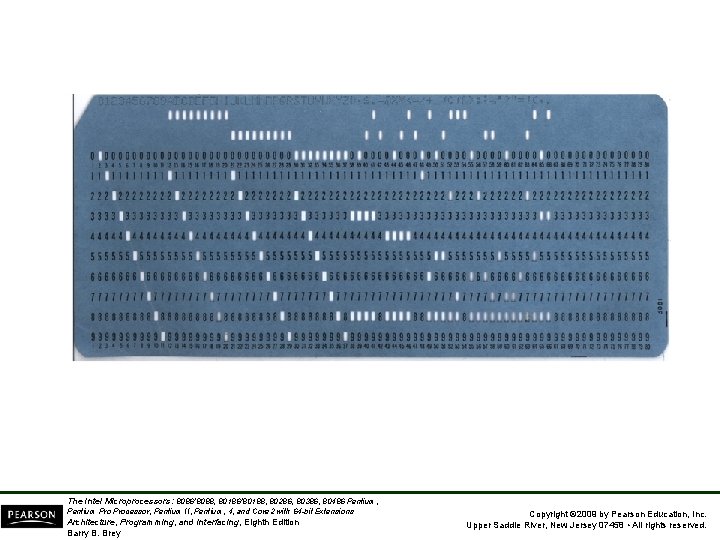
• In 1889, Herman Hollerith developed the punched card for storing data. – apparently also borrowed Jacquard ideas • Also developed mechanical machine that counted, sorted, and collated information stored on punched cards. – driven by one of the new electric motors The Intel Microprocessors: 8086/8088, 80186/80188, 80286, 80386, 80486 Pentium, Pentium Processor, Pentium II, Pentium, 4, and Core 2 with 64 -bit Extensions Architecture, Programming, and Interfacing, Eighth Edition Barry B. Brey Copyright © 2009 by Pearson Education, Inc. Upper Saddle River, New Jersey 07458 • All rights reserved.
• Punched cards used in early computer systems often called Hollerith cards. – in honor of Herman Hollerith • 12 -bit code used on a punched card is called the Hollerith code. The Intel Microprocessors: 8086/8088, 80186/80188, 80286, 80386, 80486 Pentium, Pentium Processor, Pentium II, Pentium, 4, and Core 2 with 64 -bit Extensions Architecture, Programming, and Interfacing, Eighth Edition Barry B. Brey Copyright © 2009 by Pearson Education, Inc. Upper Saddle River, New Jersey 07458 • All rights reserved.
The Intel Microprocessors: 8086/8088, 80186/80188, 80286, 80386, 80486 Pentium, Pentium Processor, Pentium II, Pentium, 4, and Core 2 with 64 -bit Extensions Architecture, Programming, and Interfacing, Eighth Edition Barry B. Brey Copyright © 2009 by Pearson Education, Inc. Upper Saddle River, New Jersey 07458 • All rights reserved.
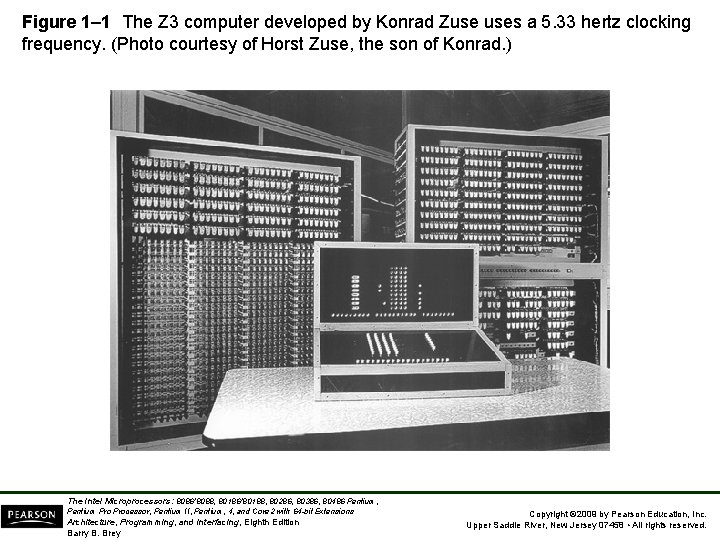
• Mechanical-electric machines dominated information processing world until 1941. – construction of first electronic calculating machine • German inventor Konrad Zuse, invented the first modern electromechanical computer. • His Z 3 calculating computer probably invented for aircraft and missile design. – during World War II for the German war effort • Z 3 a relay logic machine clocked at 5. 33 Hz. – far slower than latest multiple GHz microprocessors The Intel Microprocessors: 8086/8088, 80186/80188, 80286, 80386, 80486 Pentium, Pentium Processor, Pentium II, Pentium, 4, and Core 2 with 64 -bit Extensions Architecture, Programming, and Interfacing, Eighth Edition Barry B. Brey Copyright © 2009 by Pearson Education, Inc. Upper Saddle River, New Jersey 07458 • All rights reserved.
Figure 1– 1 The Z 3 computer developed by Konrad Zuse uses a 5. 33 hertz clocking frequency. (Photo courtesy of Horst Zuse, the son of Konrad. ) The Intel Microprocessors: 8086/8088, 80186/80188, 80286, 80386, 80486 Pentium, Pentium Processor, Pentium II, Pentium, 4, and Core 2 with 64 -bit Extensions Architecture, Programming, and Interfacing, Eighth Edition Barry B. Brey Copyright © 2009 by Pearson Education, Inc. Upper Saddle River, New Jersey 07458 • All rights reserved.
• System invented by Alan Turing. – used vacuum tubes, • Turing called his machine Colossus. – probably because of its size • First electronic computer placed in operation to break secret German military codes. The Intel Microprocessors: 8086/8088, 80186/80188, 80286, 80386, 80486 Pentium, Pentium Processor, Pentium II, Pentium, 4, and Core 2 with 64 -bit Extensions Architecture, Programming, and Interfacing, Eighth Edition Barry B. Brey Copyright © 2009 by Pearson Education, Inc. Upper Saddle River, New Jersey 07458 • All rights reserved.
• Although design allowed it to break secret German military codes generated by the mechanical Enigma machine, it could not solve other problems. • Colossus not programmable • A fixed-program computer system – today often called a special-purpose computer The Intel Microprocessors: 8086/8088, 80186/80188, 80286, 80386, 80486 Pentium, Pentium Processor, Pentium II, Pentium, 4, and Core 2 with 64 -bit Extensions Architecture, Programming, and Interfacing, Eighth Edition Barry B. Brey Copyright © 2009 by Pearson Education, Inc. Upper Saddle River, New Jersey 07458 • All rights reserved.
• Electronic Numerical Integrator and Calculator (ENIAC) • First general-purpose, programmable electronic computer system developed 1946. – at University of Pennsylvania • a huge machine. – over 17, 000 vacuum tubes; 500 miles of wires – weighed over 30 tons – about 100, 000 operations per second The Intel Microprocessors: 8086/8088, 80186/80188, 80286, 80386, 80486 Pentium, Pentium Processor, Pentium II, Pentium, 4, and Core 2 with 64 -bit Extensions Architecture, Programming, and Interfacing, Eighth Edition Barry B. Brey Copyright © 2009 by Pearson Education, Inc. Upper Saddle River, New Jersey 07458 • All rights reserved.
• Electronic Numerical Integrator and Calculator (ENIAC) • Programmed by rewiring its circuits. – process took many workers several days – workers changed electrical connections on plugboards like early telephone switchboards • Required frequent maintenance. – vacuum tube service life a problem The Intel Microprocessors: 8086/8088, 80186/80188, 80286, 80386, 80486 Pentium, Pentium Processor, Pentium II, Pentium, 4, and Core 2 with 64 -bit Extensions Architecture, Programming, and Interfacing, Eighth Edition Barry B. Brey Copyright © 2009 by Pearson Education, Inc. Upper Saddle River, New Jersey 07458 • All rights reserved.
• December 23, 1947, John Bardeen, William Shockley, and Walter Brattain develop the transistor at Bell Labs. • Followed by 1958 invention of the integrated circuit (IC) by Jack Kilby of Texas Instruments. • IC led to development of digital integrated circuits in the 1960 s. – RTL, or resistor-to-transistor logic The Intel Microprocessors: 8086/8088, 80186/80188, 80286, 80386, 80486 Pentium, Pentium Processor, Pentium II, Pentium, 4, and Core 2 with 64 -bit Extensions Architecture, Programming, and Interfacing, Eighth Edition Barry B. Brey Copyright © 2009 by Pearson Education, Inc. Upper Saddle River, New Jersey 07458 • All rights reserved.
• First microprocessor developed at Intel Corporation in 1971. • Intel engineers Federico Faggin, Ted Hoff, and Stan Mazor developed the 4004 microprocessor. • U. S. Patent 3, 821, 715. • Device started the microprocessor revolution continued today at an ever-accelerating pace. The Intel Microprocessors: 8086/8088, 80186/80188, 80286, 80386, 80486 Pentium, Pentium Processor, Pentium II, Pentium, 4, and Core 2 with 64 -bit Extensions Architecture, Programming, and Interfacing, Eighth Edition Barry B. Brey Copyright © 2009 by Pearson Education, Inc. Upper Saddle River, New Jersey 07458 • All rights reserved.
Programming Advancements • Once programmable machines developed, programs and programming languages began to appear. • The first, machine language, was constructed of ones and zeros using binary codes. – stored in the computer memory system as groups of instructions called a program The Intel Microprocessors: 8086/8088, 80186/80188, 80286, 80386, 80486 Pentium, Pentium Processor, Pentium II, Pentium, 4, and Core 2 with 64 -bit Extensions Architecture, Programming, and Interfacing, Eighth Edition Barry B. Brey Copyright © 2009 by Pearson Education, Inc. Upper Saddle River, New Jersey 07458 • All rights reserved.
• More efficient than rewiring a machine to program it. – still time-consuming to develop a program due to sheer number of program codes required • Mathematician John von Neumann first modern person to develop a system to accept instructions and store them in memory. • Computers are often called von Neumann machines in his honor. The Intel Microprocessors: 8086/8088, 80186/80188, 80286, 80386, 80486 Pentium, Pentium Processor, Pentium II, Pentium, 4, and Core 2 with 64 -bit Extensions Architecture, Programming, and Interfacing, Eighth Edition Barry B. Brey Copyright © 2009 by Pearson Education, Inc. Upper Saddle River, New Jersey 07458 • All rights reserved.
• Once systems such as UNIVAC became available in early 1950 s, assembly language was used to simplify entering binary code. • Assembler allows programmer to use mnemonic codes… – such as ADD for addition • In place of a binary number. – such as 0100 0111 • Assembly language an aid to programming. The Intel Microprocessors: 8086/8088, 80186/80188, 80286, 80386, 80486 Pentium, Pentium Processor, Pentium II, Pentium, 4, and Core 2 with 64 -bit Extensions Architecture, Programming, and Interfacing, Eighth Edition Barry B. Brey Copyright © 2009 by Pearson Education, Inc. Upper Saddle River, New Jersey 07458 • All rights reserved.
• 1957 Grace Hopper developed first high-level programming language called FLOWMATIC. – computers became easier to program • In same year, IBM developed FORTRAN FORmula TRANslator) for its systems. – Allowed programmers to develop programs that used formulas to solve mathematical problems. • FORTRAN is still used by some scientists for computer programming. – Similar language, ALGOL (ALGOrithmic Language) introduced about a year later The Intel Microprocessors: 8086/8088, 80186/80188, 80286, 80386, 80486 Pentium, Pentium Processor, Pentium II, Pentium, 4, and Core 2 with 64 -bit Extensions Architecture, Programming, and Interfacing, Eighth Edition Barry B. Brey Copyright © 2009 by Pearson Education, Inc. Upper Saddle River, New Jersey 07458 • All rights reserved.
• First successful, widespread programming language for business applications was COBOL (COmputer Business Oriented Language). • COBOL usage diminished in recent years. – still a player in some large business and government systems • Another once-popular business language is RPG (Report Program Generator). – allows programming by specifying form of the input, output, and calculations The Intel Microprocessors: 8086/8088, 80186/80188, 80286, 80386, 80486 Pentium, Pentium Processor, Pentium II, Pentium, 4, and Core 2 with 64 -bit Extensions Architecture, Programming, and Interfacing, Eighth Edition Barry B. Brey Copyright © 2009 by Pearson Education, Inc. Upper Saddle River, New Jersey 07458 • All rights reserved.
• Since early days of programming, additional languages have appeared. • Some common modern programming languages are BASIC, C#, C/C++, Java, PASCAL, and ADA. – BASIC and PASCAL languages both designed as teaching languages, but escaped the classroom. • BASIC used in many computer systems. – among most common languages today – probably easiest of all to learn The Intel Microprocessors: 8086/8088, 80186/80188, 80286, 80386, 80486 Pentium, Pentium Processor, Pentium II, Pentium, 4, and Core 2 with 64 -bit Extensions Architecture, Programming, and Interfacing, Eighth Edition Barry B. Brey Copyright © 2009 by Pearson Education, Inc. Upper Saddle River, New Jersey 07458 • All rights reserved.
The Microprocessor Age • World’s first microprocessor the Intel 4004. • A 4 -bit microprocessor-programmable controller on a chip. • Addressed 4096, 4 -bit-wide memory locations. – a bit is a binary digit with a value of one or zero – 4 -bit-wide memory location often called a nibble • The 4004 instruction set contained 45 instructions. The Intel Microprocessors: 8086/8088, 80186/80188, 80286, 80386, 80486 Pentium, Pentium Processor, Pentium II, Pentium, 4, and Core 2 with 64 -bit Extensions Architecture, Programming, and Interfacing, Eighth Edition Barry B. Brey Copyright © 2009 by Pearson Education, Inc. Upper Saddle River, New Jersey 07458 • All rights reserved.
• Main problems with early microprocessor were speed, word width, and memory size. • Evolution of 4 -bit microprocessor ended when Intel released the 4040, an updated 4004. – operated at a higher speed; lacked improvements in word width and memory size • Texas Instruments and others also produced 4 -bit microprocessors. – still survives in low-end applications such as microwave ovens and small control systems – Calculators still based on 4 -bit BCD (binarycoded decimal) codes The Intel Microprocessors: 8086/8088, 80186/80188, 80286, 80386, 80486 Pentium, Pentium Processor, Pentium II, Pentium, 4, and Core 2 with 64 -bit Extensions Architecture, Programming, and Interfacing, Eighth Edition Barry B. Brey Copyright © 2009 by Pearson Education, Inc. Upper Saddle River, New Jersey 07458 • All rights reserved.
• Intel released 8008 in 1971. – extended 8 -bit version of 4004 microprocessor • Addressed expanded memory of 16 K bytes. – A byte is generally an 8 -bit-wide binary number and a K is 1024. – memory size often specified in K bytes • Contained additional instructions, 48 total. • Provided opportunity for application in more advanced systems. – engineers developed demanding uses for 8008 The Intel Microprocessors: 8086/8088, 80186/80188, 80286, 80386, 80486 Pentium, Pentium Processor, Pentium II, Pentium, 4, and Core 2 with 64 -bit Extensions Architecture, Programming, and Interfacing, Eighth Edition Barry B. Brey Copyright © 2009 by Pearson Education, Inc. Upper Saddle River, New Jersey 07458 • All rights reserved.
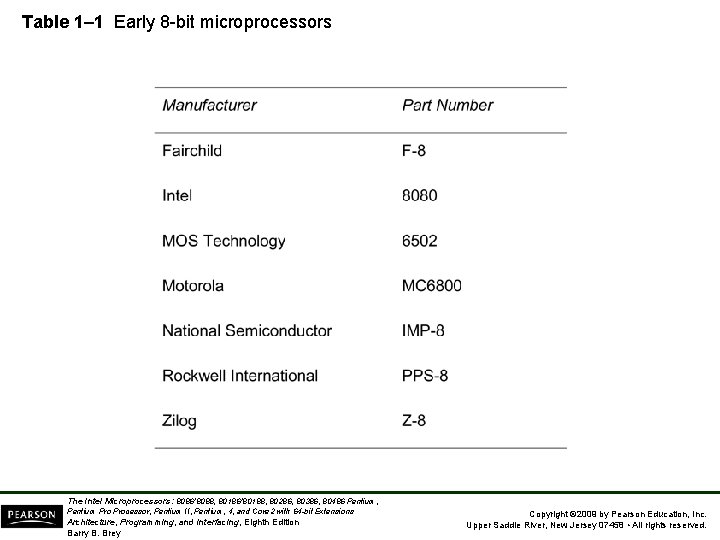
• Intel introduced 8080 microprocessor in 1973. – first of the modem 8 -bit microprocessors • Motorola Corporation introduced MC 6800 microprocessor about six months later. • 8080—and, to a lesser degree, the MC 6800— ushered in the age of the microprocessor. – other companies soon introduced their own versions of the 8 -bit microprocessor The Intel Microprocessors: 8086/8088, 80186/80188, 80286, 80386, 80486 Pentium, Pentium Processor, Pentium II, Pentium, 4, and Core 2 with 64 -bit Extensions Architecture, Programming, and Interfacing, Eighth Edition Barry B. Brey Copyright © 2009 by Pearson Education, Inc. Upper Saddle River, New Jersey 07458 • All rights reserved.
Table 1– 1 Early 8 -bit microprocessors The Intel Microprocessors: 8086/8088, 80186/80188, 80286, 80386, 80486 Pentium, Pentium Processor, Pentium II, Pentium, 4, and Core 2 with 64 -bit Extensions Architecture, Programming, and Interfacing, Eighth Edition Barry B. Brey Copyright © 2009 by Pearson Education, Inc. Upper Saddle River, New Jersey 07458 • All rights reserved.
• Only Intel and Motorola continue to create new, improved microprocessors. – IBM also produces Motorola-style microprocessors • Motorola sold its microprocessor division. – now called Freescale Semiconductors, Inc. • Zilog still manufactures microprocessors. – microcontrollers and embedded controllers instead of general-purpose microprocessors The Intel Microprocessors: 8086/8088, 80186/80188, 80286, 80386, 80486 Pentium, Pentium Processor, Pentium II, Pentium, 4, and Core 2 with 64 -bit Extensions Architecture, Programming, and Interfacing, Eighth Edition Barry B. Brey Copyright © 2009 by Pearson Education, Inc. Upper Saddle River, New Jersey 07458 • All rights reserved.
What Was Special about the 8080? • 8080 addressed four times more memory. – 64 K bytes vs l 6 K bytes for 8008 • Executed additional instructions; 10 x faster. – addition taking 20 µs on an 8008 -based system required only 2. 0 µs on an 8080 -based system • TTL (transistor-transistor logic) compatible. – the 8008 was not directly compatible • Interfacing made easier and less expensive. The Intel Microprocessors: 8086/8088, 80186/80188, 80286, 80386, 80486 Pentium, Pentium Processor, Pentium II, Pentium, 4, and Core 2 with 64 -bit Extensions Architecture, Programming, and Interfacing, Eighth Edition Barry B. Brey Copyright © 2009 by Pearson Education, Inc. Upper Saddle River, New Jersey 07458 • All rights reserved.
• The MITS (Micro Instrumentation and Telemetry Systems) Altair 8800, was released in 1974. – number 8800 probably chosen to avoid copyright violations with Intel • BASIC language interpreter for the Altair 8800 computer developed in 1975. – Bill Gates and Paul Allen, founders of Microsoft Corporation The Intel Microprocessors: 8086/8088, 80186/80188, 80286, 80386, 80486 Pentium, Pentium Processor, Pentium II, Pentium, 4, and Core 2 with 64 -bit Extensions Architecture, Programming, and Interfacing, Eighth Edition Barry B. Brey Copyright © 2009 by Pearson Education, Inc. Upper Saddle River, New Jersey 07458 • All rights reserved.
The 8085 Microprocessor • In 1977 Intel Corporation introduced an updated version of the 8080—the 8085. • Last 8 -bit, general-purpose microprocessor developed by Intel. • Slightly more advanced than 8080; executed software at an even higher speed. – 769, 230 instructions per second vs 500, 000 per second on the 8080). The Intel Microprocessors: 8086/8088, 80186/80188, 80286, 80386, 80486 Pentium, Pentium Processor, Pentium II, Pentium, 4, and Core 2 with 64 -bit Extensions Architecture, Programming, and Interfacing, Eighth Edition Barry B. Brey Copyright © 2009 by Pearson Education, Inc. Upper Saddle River, New Jersey 07458 • All rights reserved.
The Modern Microprocessor • In 1978 Intel released the 8086; a year or so later, it released the 8088. • Both devices are 16 -bit microprocessors. – executed instructions in as little as 400 ns (2. 5 millions of instructions per second) – major improvement over execution speed of 8085 • 8086 & 8088 addressed 1 M byte of memory. – 16 times more memory than the 8085 – 1 M-byte memory contains 1024 K byte-sized memory locations or 1, 048, 576 bytes The Intel Microprocessors: 8086/8088, 80186/80188, 80286, 80386, 80486 Pentium, Pentium Processor, Pentium II, Pentium, 4, and Core 2 with 64 -bit Extensions Architecture, Programming, and Interfacing, Eighth Edition Barry B. Brey Copyright © 2009 by Pearson Education, Inc. Upper Saddle River, New Jersey 07458 • All rights reserved.
• Increased memory size and additional instructions in 8086/8088 led to many sophisticated applications. • Improvements to the instruction set included multiply and divide instructions. – missing on earlier microprocessors • Number of instructions increased. – from 45 on the 4004, to 246 on the 8085 – over 20, 000 variations on the 8086 & 8088 The Intel Microprocessors: 8086/8088, 80186/80188, 80286, 80386, 80486 Pentium, Pentium Processor, Pentium II, Pentium, 4, and Core 2 with 64 -bit Extensions Architecture, Programming, and Interfacing, Eighth Edition Barry B. Brey Copyright © 2009 by Pearson Education, Inc. Upper Saddle River, New Jersey 07458 • All rights reserved.
• These microprocessors are called CISC (complex instruction set computers). – additional instructions eased task of developing efficient and sophisticated applications • 16 -bit microprocessor also provided more internal register storage space. • Popularity of Intel ensured in 1981 when IBM chose the 8088 in its personal computer. The Intel Microprocessors: 8086/8088, 80186/80188, 80286, 80386, 80486 Pentium, Pentium Processor, Pentium II, Pentium, 4, and Core 2 with 64 -bit Extensions Architecture, Programming, and Interfacing, Eighth Edition Barry B. Brey Copyright © 2009 by Pearson Education, Inc. Upper Saddle River, New Jersey 07458 • All rights reserved.
The 80286 Microprocessor • Even the 1 M-byte memory system proved limiting for databases and other applications. – Intel introduced the 80286 in 1983 – an updated 8086 • Almost identical to the 8086/8088. – addressed 16 M-byte memory system instead of a 1 M-byte system • Instruction set almost identical except for a few additional instructions. – managed the extra 15 M bytes of memory The Intel Microprocessors: 8086/8088, 80186/80188, 80286, 80386, 80486 Pentium, Pentium Processor, Pentium II, Pentium, 4, and Core 2 with 64 -bit Extensions Architecture, Programming, and Interfacing, Eighth Edition Barry B. Brey Copyright © 2009 by Pearson Education, Inc. Upper Saddle River, New Jersey 07458 • All rights reserved.
• 80286 clock speed increased in 8. 0 Mhz version. – executed some instructions in as little as 250 ns (4. 0 MIPs) • Some changes to internal execution of instructions led to eightfold increase in speed for many instructions. The Intel Microprocessors: 8086/8088, 80186/80188, 80286, 80386, 80486 Pentium, Pentium Processor, Pentium II, Pentium, 4, and Core 2 with 64 -bit Extensions Architecture, Programming, and Interfacing, Eighth Edition Barry B. Brey Copyright © 2009 by Pearson Education, Inc. Upper Saddle River, New Jersey 07458 • All rights reserved.
The 32 -Bit Microprocessor • Applications demanded faster microprocessor speeds, more memory, and wider data paths. • Led to the 80386 in 1986 by Intel. • Intel’s first practical microprocessor to contain a 32 -bit data bus and 32 -bit memory address. • Through 32 -bit buses, 80386 addressed up to 4 G bytes of memory. – 1 G memory = 1024 M, or 1, 073, 741, 824 locations The Intel Microprocessors: 8086/8088, 80186/80188, 80286, 80386, 80486 Pentium, Pentium Processor, Pentium II, Pentium, 4, and Core 2 with 64 -bit Extensions Architecture, Programming, and Interfacing, Eighth Edition Barry B. Brey Copyright © 2009 by Pearson Education, Inc. Upper Saddle River, New Jersey 07458 • All rights reserved.
• Intel released 80386 EX in 1995. • Called an embedded PC. – contains all components of the AT class computer on a single integrated circuit • • 24 lines for input/output data. 26 -bit address bus; 16 -bit data bus. DRAM refresh controller. Programmable chip selection logic The Intel Microprocessors: 8086/8088, 80186/80188, 80286, 80386, 80486 Pentium, Pentium Processor, Pentium II, Pentium, 4, and Core 2 with 64 -bit Extensions Architecture, Programming, and Interfacing, Eighth Edition Barry B. Brey Copyright © 2009 by Pearson Education, Inc. Upper Saddle River, New Jersey 07458 • All rights reserved.
The 80486 Microprocessor • • • In 1989 Intel released the 8048. Highly integrated package. 80386 -like microprocessor. 80387 -like numeric coprocessor. 8 K-byte cache memory system. The Intel Microprocessors: 8086/8088, 80186/80188, 80286, 80386, 80486 Pentium, Pentium Processor, Pentium II, Pentium, 4, and Core 2 with 64 -bit Extensions Architecture, Programming, and Interfacing, Eighth Edition Barry B. Brey Copyright © 2009 by Pearson Education, Inc. Upper Saddle River, New Jersey 07458 • All rights reserved.
• Internal structure of 80486 modified so about half of its instructions executed in one clock instead of two clocks. • Double-clocked 80486 DX 2 executed instructions at 66 MHz, with memory transfers at 33 MHz. – called a double-clocked microprocessor The Intel Microprocessors: 8086/8088, 80186/80188, 80286, 80386, 80486 Pentium, Pentium Processor, Pentium II, Pentium, 4, and Core 2 with 64 -bit Extensions Architecture, Programming, and Interfacing, Eighth Edition Barry B. Brey Copyright © 2009 by Pearson Education, Inc. Upper Saddle River, New Jersey 07458 • All rights reserved.
The Pentium Microprocessor • Introduced 1993, Pentium was similar to 80386 and 80486 microprocessors. • Originally labeled the P 5 or 80586. – Intel decided not to use a number because it appeared to be impossible to copyright a number • Introductory versions operated with a clocking frequency of 60 MHz & 66 MHz, and a speed of 110 MIPs. The Intel Microprocessors: 8086/8088, 80186/80188, 80286, 80386, 80486 Pentium, Pentium Processor, Pentium II, Pentium, 4, and Core 2 with 64 -bit Extensions Architecture, Programming, and Interfacing, Eighth Edition Barry B. Brey Copyright © 2009 by Pearson Education, Inc. Upper Saddle River, New Jersey 07458 • All rights reserved.
• Intel may allow Pentium to replace some RISC (reduced instruction set computer) machines. • Some newer RISC processors execute more than one instruction per clock. – through superscaler technology • Motorola, Apple, and IBM produce Power. PC, a RISC with two integer units and a floating-point unit. The Intel Microprocessors: 8086/8088, 80186/80188, 80286, 80386, 80486 Pentium, Pentium Processor, Pentium II, Pentium, 4, and Core 2 with 64 -bit Extensions Architecture, Programming, and Interfacing, Eighth Edition Barry B. Brey Copyright © 2009 by Pearson Education, Inc. Upper Saddle River, New Jersey 07458 • All rights reserved.
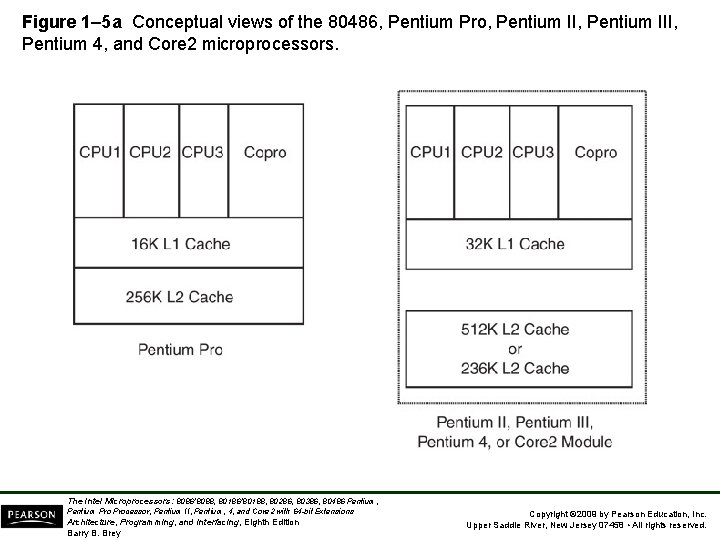
Pentium Processor • A recent entry, formerly named the P 6. • 21 million transistors, integer units, floatingpoint unit, clock frequency 150 and 166 MHz • Internal 16 K level-one (L 1) cache. – 8 K data, 8 K for instructions – Pentium Pro contains 256 K level-two (L 2) cache • Pentium Pro uses three execution engines, to execute up to three instructions at a time. – can conflict and still execute in parallel The Intel Microprocessors: 8086/8088, 80186/80188, 80286, 80386, 80486 Pentium, Pentium Processor, Pentium II, Pentium, 4, and Core 2 with 64 -bit Extensions Architecture, Programming, and Interfacing, Eighth Edition Barry B. Brey Copyright © 2009 by Pearson Education, Inc. Upper Saddle River, New Jersey 07458 • All rights reserved.
• Pentium Pro optimized to efficiently execute 32 -bit code. – often bundled with Windows NT rather than normal versions of Windows 95 – Intel launched Pentium Pro for server market • Pentium Pro can address 4 G-byte or a 64 Gbyte memory system. – 36 -bit address bus if configured for a 64 G memory system The Intel Microprocessors: 8086/8088, 80186/80188, 80286, 80386, 80486 Pentium, Pentium Processor, Pentium II, Pentium, 4, and Core 2 with 64 -bit Extensions Architecture, Programming, and Interfacing, Eighth Edition Barry B. Brey Copyright © 2009 by Pearson Education, Inc. Upper Saddle River, New Jersey 07458 • All rights reserved.
Pentium II and Pentium Xeon Microprocessors • Pentium II, released 1997, represents new direction for Intel. • Intel has placed Pentium II on a small circuit board, instead of being an integrated circuit. • In 1998 Intel changed Pentium II bus speed. – newer Pentium II uses a 100 MHz bus speed The Intel Microprocessors: 8086/8088, 80186/80188, 80286, 80386, 80486 Pentium, Pentium Processor, Pentium II, Pentium, 4, and Core 2 with 64 -bit Extensions Architecture, Programming, and Interfacing, Eighth Edition Barry B. Brey Copyright © 2009 by Pearson Education, Inc. Upper Saddle River, New Jersey 07458 • All rights reserved.
• Intel announced Xeon in mid-1998. – specifically designed for high-end workstation and server applications • Xeon available with 32 K L 1 cache and L 2 cache size of 512 K, 1 M, or 2 M bytes. • Newer product represents strategy change. – Intel produces a professional and home/business version of the Pentium II – Pentium III available with clock frequencies up to 1 GHz. The Intel Microprocessors: 8086/8088, 80186/80188, 80286, 80386, 80486 Pentium, Pentium Processor, Pentium II, Pentium, 4, and Core 2 with 64 -bit Extensions Architecture, Programming, and Interfacing, Eighth Edition Barry B. Brey Copyright © 2009 by Pearson Education, Inc. Upper Saddle River, New Jersey 07458 • All rights reserved.
Pentium 4 and Core 2 Microprocessors • Pentium 4 first made available in late 2000. – most recent version of Pentium called Core 2 – uses Intel P 6 architecture • Pentium 4 available to 3. 2 GHz and faster. – supporting chip sets use RAMBUS or DDR memory in place of SDRAM technology • Core 2 is available at speeds of up to 3 GHz. – improvement in internal integration, at present the 0. 045 micron or 45 nm technology The Intel Microprocessors: 8086/8088, 80186/80188, 80286, 80386, 80486 Pentium, Pentium Processor, Pentium II, Pentium, 4, and Core 2 with 64 -bit Extensions Architecture, Programming, and Interfacing, Eighth Edition Barry B. Brey Copyright © 2009 by Pearson Education, Inc. Upper Saddle River, New Jersey 07458 • All rights reserved.
Pentium 4 and Core 2, 64 -bit and Multiple Core Microprocessors • Recent modifications to Pentium 4 and Core 2 include a 64 -bit core and multiple cores. • 64 -bit modification allows address of over 4 G bytes of memory through a 64 -bit address. – 40 address pins in these newer versions allow up to 1 T (terabytes) of memory to be accessed • Also allows 64 -bit integer arithmetic. – less important than ability to address more memory The Intel Microprocessors: 8086/8088, 80186/80188, 80286, 80386, 80486 Pentium, Pentium Processor, Pentium II, Pentium, 4, and Core 2 with 64 -bit Extensions Architecture, Programming, and Interfacing, Eighth Edition Barry B. Brey Copyright © 2009 by Pearson Education, Inc. Upper Saddle River, New Jersey 07458 • All rights reserved.
The Future of Microprocessors • No one can make accurate predictions. • Success of Intel should continue. • Change to RISC technology may occur; more likely improvements to new hyper-threading technology. – joint effort by Intel and Hewlett-Packard • New technology embodies CISC instruction set of 80 X 86 family. – software for the system will survive The Intel Microprocessors: 8086/8088, 80186/80188, 80286, 80386, 80486 Pentium, Pentium Processor, Pentium II, Pentium, 4, and Core 2 with 64 -bit Extensions Architecture, Programming, and Interfacing, Eighth Edition Barry B. Brey Copyright © 2009 by Pearson Education, Inc. Upper Saddle River, New Jersey 07458 • All rights reserved.
• Basic premise is many microprocessors communicate directly with each other. – allows parallel processing without any change to the instruction set or program • Current superscaler technology uses many microprocessors; all share same register set. – new technology contains many microprocessors – each contains its own register set linked with the other microprocessors’ registers • Offers true parallel processing without writing any special program. The Intel Microprocessors: 8086/8088, 80186/80188, 80286, 80386, 80486 Pentium, Pentium Processor, Pentium II, Pentium, 4, and Core 2 with 64 -bit Extensions Architecture, Programming, and Interfacing, Eighth Edition Barry B. Brey Copyright © 2009 by Pearson Education, Inc. Upper Saddle River, New Jersey 07458 • All rights reserved.
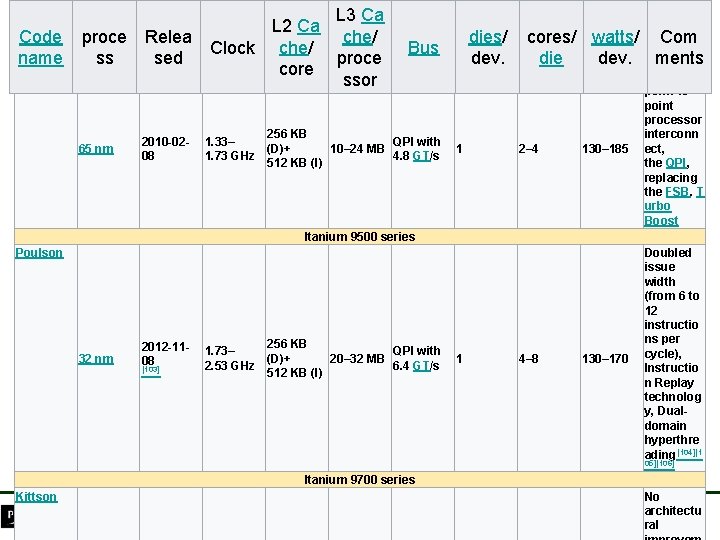
• In 2002, Intel released a new architecture 64 bits in width with a 128 -bit data bus. • Named Itanium; joint venture called EPIC (Explicitly Parallel Instruction Computing) of Intel and Hewlett-Packard. • The Itanium architecture allows greater parallelism than traditional architectures. • 128 general-purpose integer and 128 floatingpoint registers; 64 predicate registers. • Many execution units to ensure enough hardware resources for software. The Intel Microprocessors: 8086/8088, 80186/80188, 80286, 80386, 80486 Pentium, Pentium Processor, Pentium II, Pentium, 4, and Core 2 with 64 -bit Extensions Architecture, Programming, and Interfacing, Eighth Edition Barry B. Brey Copyright © 2009 by Pearson Education, Inc. Upper Saddle River, New Jersey 07458 • All rights reserved.
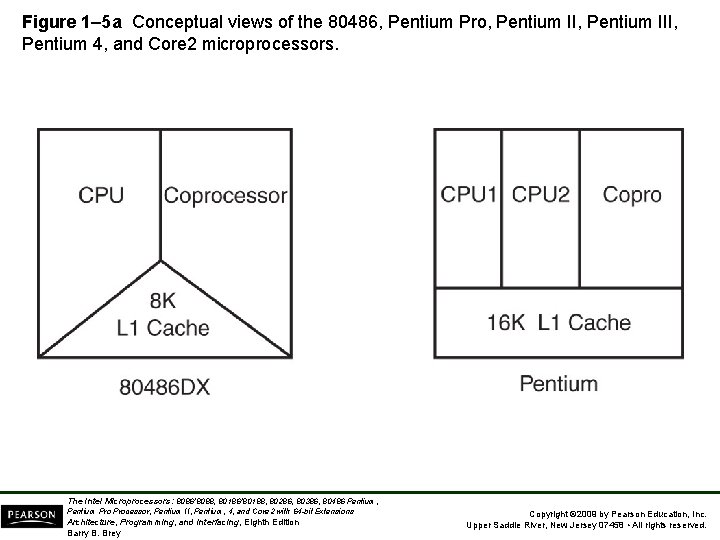
Figure 1– 5 a Conceptual views of the 80486, Pentium Pro, Pentium III, Pentium 4, and Core 2 microprocessors. The Intel Microprocessors: 8086/8088, 80186/80188, 80286, 80386, 80486 Pentium, Pentium Processor, Pentium II, Pentium, 4, and Core 2 with 64 -bit Extensions Architecture, Programming, and Interfacing, Eighth Edition Barry B. Brey Copyright © 2009 by Pearson Education, Inc. Upper Saddle River, New Jersey 07458 • All rights reserved.
Figure 1– 5 a Conceptual views of the 80486, Pentium Pro, Pentium III, Pentium 4, and Core 2 microprocessors. The Intel Microprocessors: 8086/8088, 80186/80188, 80286, 80386, 80486 Pentium, Pentium Processor, Pentium II, Pentium, 4, and Core 2 with 64 -bit Extensions Architecture, Programming, and Interfacing, Eighth Edition Barry B. Brey Copyright © 2009 by Pearson Education, Inc. Upper Saddle River, New Jersey 07458 • All rights reserved.
Code name Tukwila L 3 Ca L 2 Ca che/ proce Relea Clock che/ Bus proce ss sed Itanium 9300 series core ssor 65 nm 2010 -0208 1. 33– 1. 73 GHz 256 KB QPI with (D)+ 10– 24 MB 4. 8 GT/s 512 KB (I) dies/ dev. 1 cores/ watts/ Com die dev. ments 2– 4 130– 185 A new point-topoint processor interconn ect, the QPI, replacing the FSB. T urbo Boost 130– 170 Doubled issue width (from 6 to 12 instructio ns per cycle), Instructio n Replay technolog y, Dualdomain hyperthre ading[104][1 Itanium 9500 series Poulson 32 nm 2012 -1108 [103] 1. 73– 2. 53 GHz 256 KB QPI with (D)+ 20– 32 MB 6. 4 GT/s 512 KB (I) 1 4– 8 05][106] Itanium 9700 series Kittson The Intel Microprocessors: 8086/8088, 80186/80188, 80286, 80386, 80486 Pentium, Pentium Processor, Pentium II, Pentium, 4, and Core 2 with 64 -bit Extensions Architecture, Programming, and Interfacing, Eighth Edition Barry B. Brey No Copyright © 2009 by Pearsonarchitectu Education, Inc. Upper Saddle River, New Jersey 07458 • All ral rights reserved.
1– 2 THE MICROPROCESSORBASED PERSONAL COMPUTER SYSTEM • Computers have undergone many changes recently. • Machines that once filled large areas reduced to small desktop computer systems because of the microprocessor. – although compact, they possess computing power only dreamed of a few years ago The Intel Microprocessors: 8086/8088, 80186/80188, 80286, 80386, 80486 Pentium, Pentium Processor, Pentium II, Pentium, 4, and Core 2 with 64 -bit Extensions Architecture, Programming, and Interfacing, Eighth Edition Barry B. Brey Copyright © 2009 by Pearson Education, Inc. Upper Saddle River, New Jersey 07458 • All rights reserved.
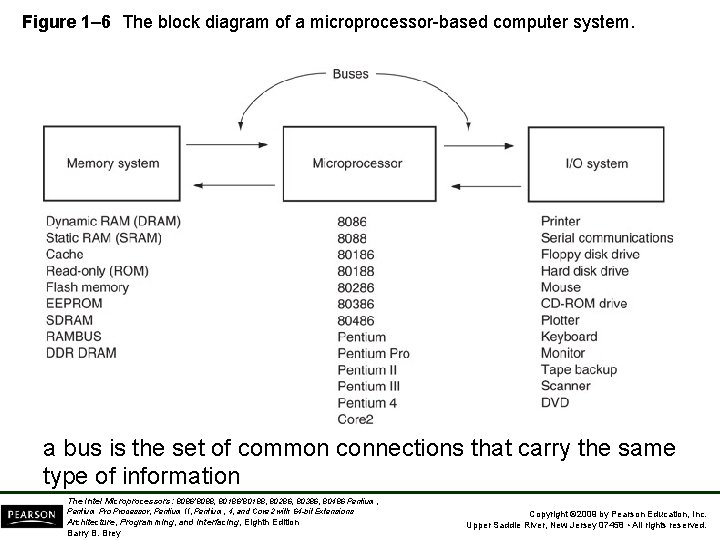
Figure 1– 6 The block diagram of a microprocessor-based computer system. a bus is the set of common connections that carry the same type of information The Intel Microprocessors: 8086/8088, 80186/80188, 80286, 80386, 80486 Pentium, Pentium Processor, Pentium II, Pentium, 4, and Core 2 with 64 -bit Extensions Architecture, Programming, and Interfacing, Eighth Edition Barry B. Brey Copyright © 2009 by Pearson Education, Inc. Upper Saddle River, New Jersey 07458 • All rights reserved.
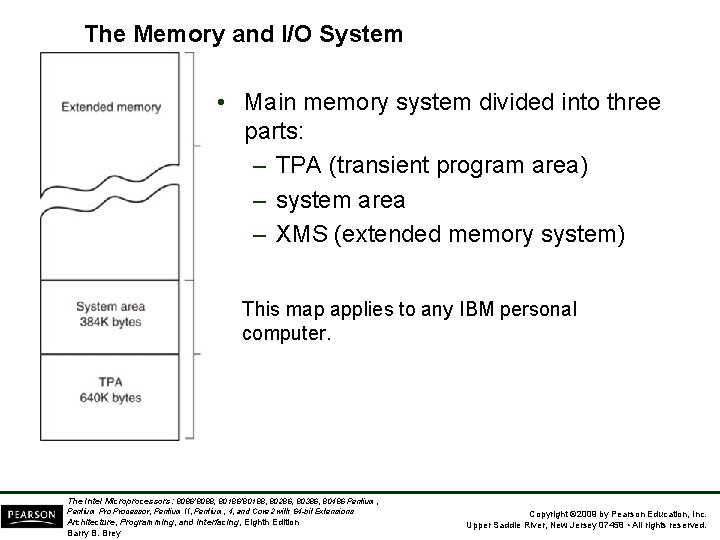
The Memory and I/O System • Main memory system divided into three parts: – TPA (transient program area) – system area – XMS (extended memory system) This map applies to any IBM personal computer. The Intel Microprocessors: 8086/8088, 80186/80188, 80286, 80386, 80486 Pentium, Pentium Processor, Pentium II, Pentium, 4, and Core 2 with 64 -bit Extensions Architecture, Programming, and Interfacing, Eighth Edition Barry B. Brey Copyright © 2009 by Pearson Education, Inc. Upper Saddle River, New Jersey 07458 • All rights reserved.
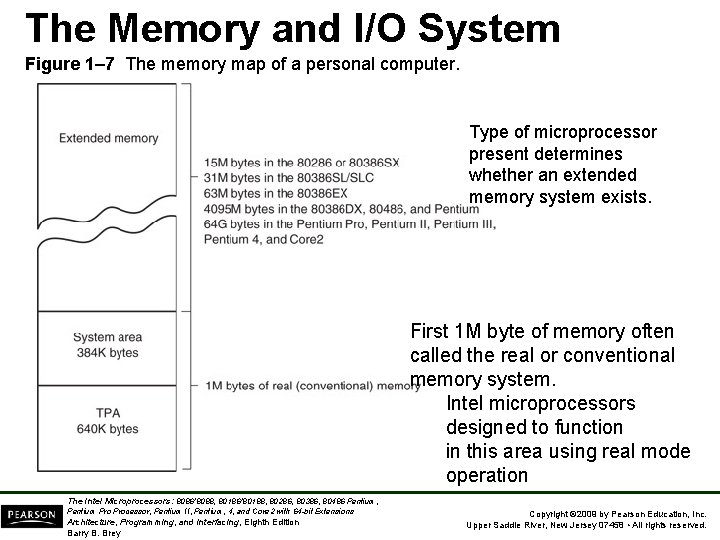
The Memory and I/O System Figure 1– 7 The memory map of a personal computer. Type of microprocessor present determines whether an extended memory system exists. First 1 M byte of memory often called the real or conventional memory system. Intel microprocessors designed to function in this area using real mode operation The Intel Microprocessors: 8086/8088, 80186/80188, 80286, 80386, 80486 Pentium, Pentium Processor, Pentium II, Pentium, 4, and Core 2 with 64 -bit Extensions Architecture, Programming, and Interfacing, Eighth Edition Barry B. Brey Copyright © 2009 by Pearson Education, Inc. Upper Saddle River, New Jersey 07458 • All rights reserved.
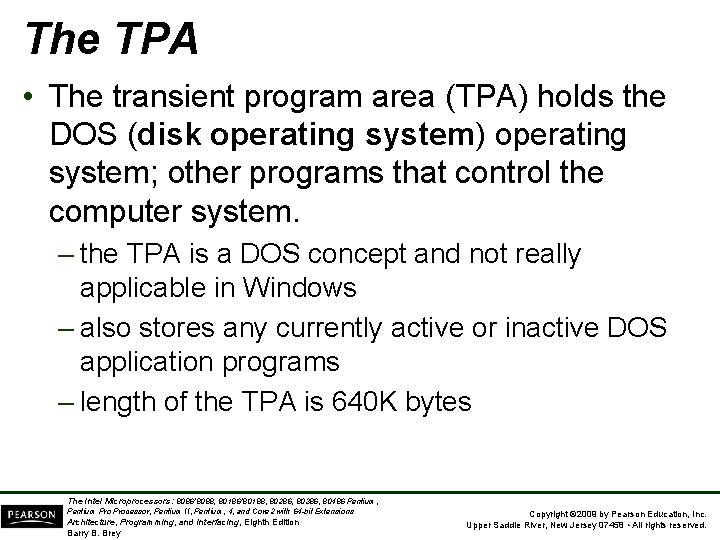
The TPA • The transient program area (TPA) holds the DOS (disk operating system) operating system; other programs that control the computer system. – the TPA is a DOS concept and not really applicable in Windows – also stores any currently active or inactive DOS application programs – length of the TPA is 640 K bytes The Intel Microprocessors: 8086/8088, 80186/80188, 80286, 80386, 80486 Pentium, Pentium Processor, Pentium II, Pentium, 4, and Core 2 with 64 -bit Extensions Architecture, Programming, and Interfacing, Eighth Edition Barry B. Brey Copyright © 2009 by Pearson Education, Inc. Upper Saddle River, New Jersey 07458 • All rights reserved.
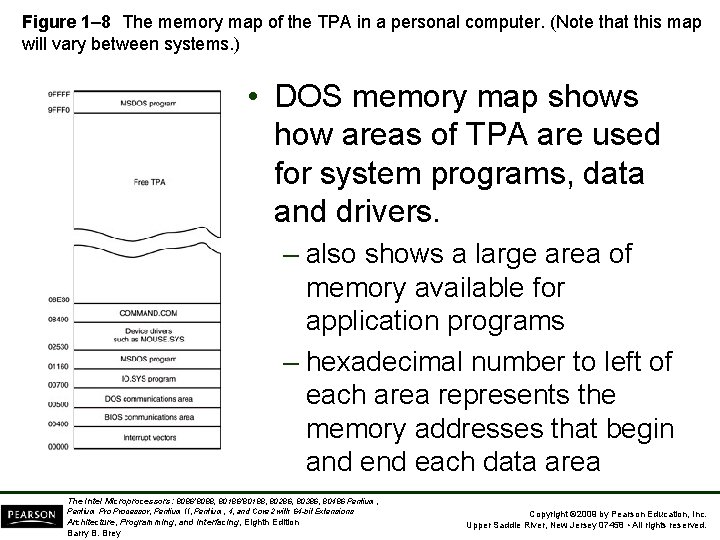
Figure 1– 8 The memory map of the TPA in a personal computer. (Note that this map will vary between systems. ) • DOS memory map shows how areas of TPA are used for system programs, data and drivers. – also shows a large area of memory available for application programs – hexadecimal number to left of each area represents the memory addresses that begin and each data area The Intel Microprocessors: 8086/8088, 80186/80188, 80286, 80386, 80486 Pentium, Pentium Processor, Pentium II, Pentium, 4, and Core 2 with 64 -bit Extensions Architecture, Programming, and Interfacing, Eighth Edition Barry B. Brey Copyright © 2009 by Pearson Education, Inc. Upper Saddle River, New Jersey 07458 • All rights reserved.
• The IO. SYS loads into the TPA from the disk whenever an MSDOS system is started. • IO. SYS contains programs that allow DOS to use keyboard, video display, printer, and other I/O devices often found in computers. • The IO. SYS program links DOS to the programs stored on the system BIOS ROM. The Intel Microprocessors: 8086/8088, 80186/80188, 80286, 80386, 80486 Pentium, Pentium Processor, Pentium II, Pentium, 4, and Core 2 with 64 -bit Extensions Architecture, Programming, and Interfacing, Eighth Edition Barry B. Brey Copyright © 2009 by Pearson Education, Inc. Upper Saddle River, New Jersey 07458 • All rights reserved.
• Drivers are programs that control installable I/O devices. – mouse, disk cache, hand scanner, CD-ROM memory (Compact Disk Read-Only Memory), DVD (Digital Versatile Disk), or installable devices, as well as programs • Installable drivers control or drive devices or programs added to the computer system. • DOS drivers normally have an extension of. SYS; MOUSE. SYS. • DOS version 3. 2 and later files have an extension of. EXE; EMM 386. EXE. The Intel Microprocessors: 8086/8088, 80186/80188, 80286, 80386, 80486 Pentium, Pentium Processor, Pentium II, Pentium, 4, and Core 2 with 64 -bit Extensions Architecture, Programming, and Interfacing, Eighth Edition Barry B. Brey Copyright © 2009 by Pearson Education, Inc. Upper Saddle River, New Jersey 07458 • All rights reserved.
• Windows uses a file called SYSTEM. INI to load drivers used by Windows. • Newer versions of Windows have a registry added to contain information about the system and the drivers used. • You can view the registry with the REGEDIT program. The Intel Microprocessors: 8086/8088, 80186/80188, 80286, 80386, 80486 Pentium, Pentium Processor, Pentium II, Pentium, 4, and Core 2 with 64 -bit Extensions Architecture, Programming, and Interfacing, Eighth Edition Barry B. Brey Copyright © 2009 by Pearson Education, Inc. Upper Saddle River, New Jersey 07458 • All rights reserved.
• COMMAND. COM (command processor) controls operation of the computer from the keyboard when operated in the DOS mode. • COMMAND. COM processes DOS commands as they are typed from the keyboard. • If COMMAND. COM is erased, the computer cannot be used from the keyboard in DOS mode. – never erase COMMAND. COM, IO. SYS, or MSDOS. SYS to make room for other software – your computer will not function The Intel Microprocessors: 8086/8088, 80186/80188, 80286, 80386, 80486 Pentium, Pentium Processor, Pentium II, Pentium, 4, and Core 2 with 64 -bit Extensions Architecture, Programming, and Interfacing, Eighth Edition Barry B. Brey Copyright © 2009 by Pearson Education, Inc. Upper Saddle River, New Jersey 07458 • All rights reserved.
The System Area • Smaller than the TPA; just as important. • The system area contains programs on readonly (ROM) or flash memory, and areas of read/write (RAM) memory for data storage. The Intel Microprocessors: 8086/8088, 80186/80188, 80286, 80386, 80486 Pentium, Pentium Processor, Pentium II, Pentium, 4, and Core 2 with 64 -bit Extensions Architecture, Programming, and Interfacing, Eighth Edition Barry B. Brey Copyright © 2009 by Pearson Education, Inc. Upper Saddle River, New Jersey 07458 • All rights reserved.
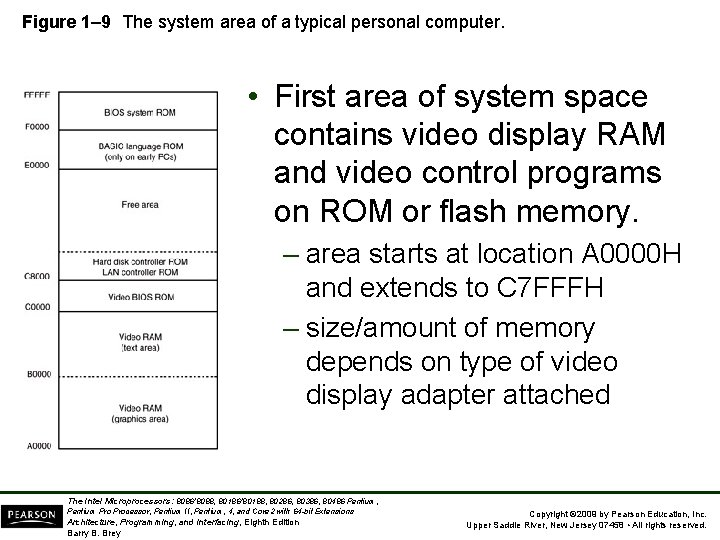
Figure 1– 9 The system area of a typical personal computer. • First area of system space contains video display RAM and video control programs on ROM or flash memory. – area starts at location A 0000 H and extends to C 7 FFFH – size/amount of memory depends on type of video display adapter attached The Intel Microprocessors: 8086/8088, 80186/80188, 80286, 80386, 80486 Pentium, Pentium Processor, Pentium II, Pentium, 4, and Core 2 with 64 -bit Extensions Architecture, Programming, and Interfacing, Eighth Edition Barry B. Brey Copyright © 2009 by Pearson Education, Inc. Upper Saddle River, New Jersey 07458 • All rights reserved.
• Display adapters generally have video RAM at A 0000 H–AFFFFH. – stores graphical or bit-mapped data • Memory at B 0000 H–BFFFFH stores text data. • The video BIOS on a ROM or flash memory, is at locations C 0000 H–C 7 FFFH. – contains programs to control DOS video display • C 8000 H–DFFFFH is often open or free. – used for expanded memory system (EMS) in PC or XT system; upper memory system in an AT The Intel Microprocessors: 8086/8088, 80186/80188, 80286, 80386, 80486 Pentium, Pentium Processor, Pentium II, Pentium, 4, and Core 2 with 64 -bit Extensions Architecture, Programming, and Interfacing, Eighth Edition Barry B. Brey Copyright © 2009 by Pearson Education, Inc. Upper Saddle River, New Jersey 07458 • All rights reserved.
• Expanded memory system allows a 64 K-byte page frame of memory for use by applications. – page frame (D 0000 H - DFFFFH) used to expand memory system by switching in pages of memory from EMS into this range of memory addresses • Locations E 0000 H–EFFFFH contain cassette BASIC on ROM found in early IBM systems. – often open or free in newer computer systems • Video system has its own BIOS ROM at location C 0000 H. The Intel Microprocessors: 8086/8088, 80186/80188, 80286, 80386, 80486 Pentium, Pentium Processor, Pentium II, Pentium, 4, and Core 2 with 64 -bit Extensions Architecture, Programming, and Interfacing, Eighth Edition Barry B. Brey Copyright © 2009 by Pearson Education, Inc. Upper Saddle River, New Jersey 07458 • All rights reserved.
• System BIOS ROM is located in the top 64 K bytes of the system area (F 0000 H–FFFFFH). – controls operation of basic I/O devices connected to the computer system – does not control operation of video • The first part of the system BIOS (F 0000 H– F 7 FFFH) often contains programs that set up the computer. • Second part contains procedures that control the basic I/O system. The Intel Microprocessors: 8086/8088, 80186/80188, 80286, 80386, 80486 Pentium, Pentium Processor, Pentium II, Pentium, 4, and Core 2 with 64 -bit Extensions Architecture, Programming, and Interfacing, Eighth Edition Barry B. Brey Copyright © 2009 by Pearson Education, Inc. Upper Saddle River, New Jersey 07458 • All rights reserved.
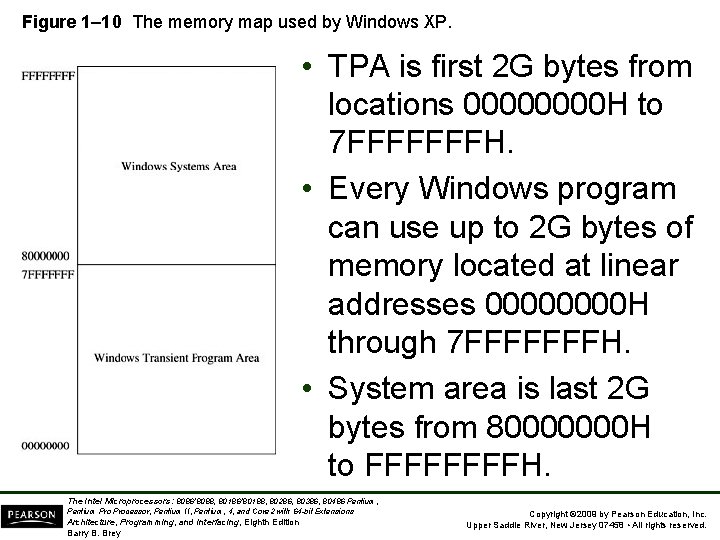
Windows Systems • Modern computers use a different memory map with Windows than DOS memory maps. • The Windows memory map in Figure 1– 10 has two main areas; a TPA and system area. • The difference between it and the DOS memory map are sizes and locations of these areas. The Intel Microprocessors: 8086/8088, 80186/80188, 80286, 80386, 80486 Pentium, Pentium Processor, Pentium II, Pentium, 4, and Core 2 with 64 -bit Extensions Architecture, Programming, and Interfacing, Eighth Edition Barry B. Brey Copyright © 2009 by Pearson Education, Inc. Upper Saddle River, New Jersey 07458 • All rights reserved.
Figure 1– 10 The memory map used by Windows XP. • TPA is first 2 G bytes from locations 0000 H to 7 FFFFFFFH. • Every Windows program can use up to 2 G bytes of memory located at linear addresses 0000 H through 7 FFFFFFFH. • System area is last 2 G bytes from 80000000 H to FFFFH. The Intel Microprocessors: 8086/8088, 80186/80188, 80286, 80386, 80486 Pentium, Pentium Processor, Pentium II, Pentium, 4, and Core 2 with 64 -bit Extensions Architecture, Programming, and Interfacing, Eighth Edition Barry B. Brey Copyright © 2009 by Pearson Education, Inc. Upper Saddle River, New Jersey 07458 • All rights reserved.
• Memory system physical map is much different. • Every process in a Windows Vista, XP, or 2000 system has its own set of page tables. • The process can be located anywhere in the memory, even in noncontiguous pages. • The operating system assigns physical memory to application. – if not enough exists, it uses the hard disk for any that is not available The Intel Microprocessors: 8086/8088, 80186/80188, 80286, 80386, 80486 Pentium, Pentium Processor, Pentium II, Pentium, 4, and Core 2 with 64 -bit Extensions Architecture, Programming, and Interfacing, Eighth Edition Barry B. Brey Copyright © 2009 by Pearson Education, Inc. Upper Saddle River, New Jersey 07458 • All rights reserved.
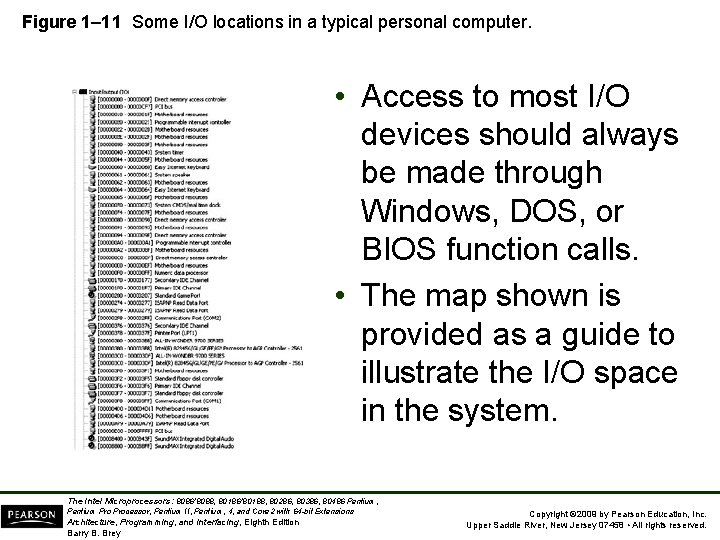
I/O Space • I/O devices allow the microprocessor to communicate with the outside world. • I/O (input/output) space in a computer system extends from I/O port 0000 H to port FFFFH. – I/O port address is similar to a memory address – instead of memory, it addresses an I/O device • Figure 1– 11 shows the I/O map found in many personal computer systems. The Intel Microprocessors: 8086/8088, 80186/80188, 80286, 80386, 80486 Pentium, Pentium Processor, Pentium II, Pentium, 4, and Core 2 with 64 -bit Extensions Architecture, Programming, and Interfacing, Eighth Edition Barry B. Brey Copyright © 2009 by Pearson Education, Inc. Upper Saddle River, New Jersey 07458 • All rights reserved.
Figure 1– 11 Some I/O locations in a typical personal computer. • Access to most I/O devices should always be made through Windows, DOS, or BIOS function calls. • The map shown is provided as a guide to illustrate the I/O space in the system. The Intel Microprocessors: 8086/8088, 80186/80188, 80286, 80386, 80486 Pentium, Pentium Processor, Pentium II, Pentium, 4, and Core 2 with 64 -bit Extensions Architecture, Programming, and Interfacing, Eighth Edition Barry B. Brey Copyright © 2009 by Pearson Education, Inc. Upper Saddle River, New Jersey 07458 • All rights reserved.
• The area below I/O location 0400 H is considered reserved for system devices • Area available for expansion extends from I/O port 0400 H through FFFFH. • Generally, 0000 H - 00 FFH addresses main board components; 0100 H - 03 FFH handles devices located on plug-in cards or also on the main board. • The limitation of I/O addresses between 0000 and 03 FFH comes from original standards specified by IBM for the PC standard. The Intel Microprocessors: 8086/8088, 80186/80188, 80286, 80386, 80486 Pentium, Pentium Processor, Pentium II, Pentium, 4, and Core 2 with 64 -bit Extensions Architecture, Programming, and Interfacing, Eighth Edition Barry B. Brey Copyright © 2009 by Pearson Education, Inc. Upper Saddle River, New Jersey 07458 • All rights reserved.
The Microprocessor • Called the CPU (central processing unit). • The controlling element in a computer system. • Controls memory and I/O through connections called buses. – buses select an I/O or memory device, transfer data between I/O devices or memory and the microprocessor, control I/O and memory systems • Memory and I/O controlled via instructions stored in memory, executed by the microprocessor. The Intel Microprocessors: 8086/8088, 80186/80188, 80286, 80386, 80486 Pentium, Pentium Processor, Pentium II, Pentium, 4, and Core 2 with 64 -bit Extensions Architecture, Programming, and Interfacing, Eighth Edition Barry B. Brey Copyright © 2009 by Pearson Education, Inc. Upper Saddle River, New Jersey 07458 • All rights reserved.
• Microprocessor performs three main tasks: – data transfer between itself and the memory or I/O systems – simple arithmetic and logic operations – program flow via simple decisions • Power of the microprocessor is capability to execute billions of millions of instructions per second from a program or software (group of instructions) stored in the memory system. – stored programs make the microprocessor and computer system very powerful devices The Intel Microprocessors: 8086/8088, 80186/80188, 80286, 80386, 80486 Pentium, Pentium Processor, Pentium II, Pentium, 4, and Core 2 with 64 -bit Extensions Architecture, Programming, and Interfacing, Eighth Edition Barry B. Brey Copyright © 2009 by Pearson Education, Inc. Upper Saddle River, New Jersey 07458 • All rights reserved.
• Another powerful feature is the ability to make simple decisions based upon numerical facts. – a microprocessor can decide if a number is zero, positive, and so forth • These decisions allow the microprocessor to modify the program flow, so programs appear to think through these simple decisions. The Intel Microprocessors: 8086/8088, 80186/80188, 80286, 80386, 80486 Pentium, Pentium Processor, Pentium II, Pentium, 4, and Core 2 with 64 -bit Extensions Architecture, Programming, and Interfacing, Eighth Edition Barry B. Brey Copyright © 2009 by Pearson Education, Inc. Upper Saddle River, New Jersey 07458 • All rights reserved.
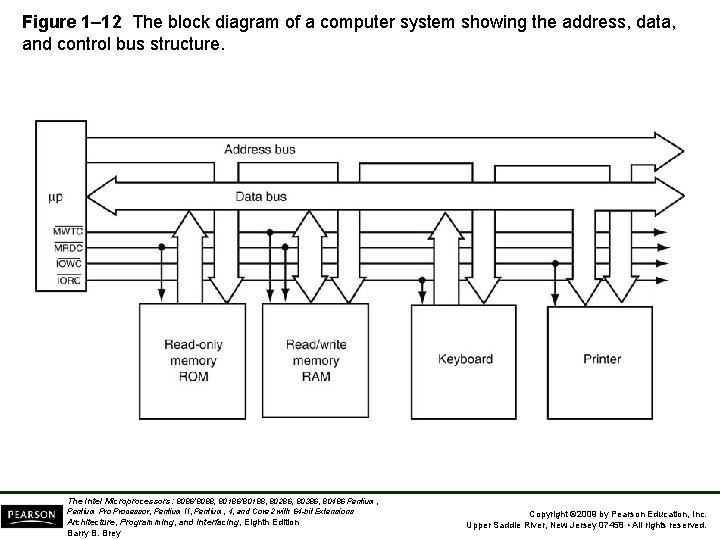
Buses • A common group of wires that interconnect components in a computer system. • Transfer address, data, & control information between microprocessor, memory and I/O. • Three buses exist for this transfer of information: address, data, and control. • Figure 1– 12 shows how these buses interconnect various system components. The Intel Microprocessors: 8086/8088, 80186/80188, 80286, 80386, 80486 Pentium, Pentium Processor, Pentium II, Pentium, 4, and Core 2 with 64 -bit Extensions Architecture, Programming, and Interfacing, Eighth Edition Barry B. Brey Copyright © 2009 by Pearson Education, Inc. Upper Saddle River, New Jersey 07458 • All rights reserved.
Figure 1– 12 The block diagram of a computer system showing the address, data, and control bus structure. The Intel Microprocessors: 8086/8088, 80186/80188, 80286, 80386, 80486 Pentium, Pentium Processor, Pentium II, Pentium, 4, and Core 2 with 64 -bit Extensions Architecture, Programming, and Interfacing, Eighth Edition Barry B. Brey Copyright © 2009 by Pearson Education, Inc. Upper Saddle River, New Jersey 07458 • All rights reserved.
• The address bus requests a memory location from the memory or an I/O location from the I/O devices. – if I/O is addressed, the address bus contains a 16 bit I/O address from 0000 H through FFFFH. – if memory is addressed, the bus contains a memory address, varying in width by type of microprocessor. • 64 -bit extensions to Pentium provide 40 address pins, allowing up to 1 T byte of memory to be accessed. The Intel Microprocessors: 8086/8088, 80186/80188, 80286, 80386, 80486 Pentium, Pentium Processor, Pentium II, Pentium, 4, and Core 2 with 64 -bit Extensions Architecture, Programming, and Interfacing, Eighth Edition Barry B. Brey Copyright © 2009 by Pearson Education, Inc. Upper Saddle River, New Jersey 07458 • All rights reserved.
• The data bus transfers information between the microprocessor and its memory and I/O address space. • Data transfers vary in size, from 8 bits wide to 64 bits wide in various Intel microprocessors. – 8088 has an 8 -bit data bus that transfers 8 bits of data at a time – 8086, 80286, 80386 SL, 80386 SX, and 80386 EX transfer 16 bits of data – 80386 DX, 80486 SX, and 80486 DX, 32 bits – Pentium through Core 2 microprocessors transfer 64 bits of data The Intel Microprocessors: 8086/8088, 80186/80188, 80286, 80386, 80486 Pentium, Pentium Processor, Pentium II, Pentium, 4, and Core 2 with 64 -bit Extensions Architecture, Programming, and Interfacing, Eighth Edition Barry B. Brey Copyright © 2009 by Pearson Education, Inc. Upper Saddle River, New Jersey 07458 • All rights reserved.
• Control bus lines select and cause memory or I/O to perform a read or write operation. • In most computer systems, there are four control bus connections: • MRDC (memory read control) • MWTC (memory write control) • IORC (I/O read control) • IOWC (I/O write control). • overbar indicates the control signal is activelow; (active when logic zero appears on control line) The Intel Microprocessors: 8086/8088, 80186/80188, 80286, 80386, 80486 Pentium, Pentium Processor, Pentium II, Pentium, 4, and Core 2 with 64 -bit Extensions Architecture, Programming, and Interfacing, Eighth Edition Barry B. Brey Copyright © 2009 by Pearson Education, Inc. Upper Saddle River, New Jersey 07458 • All rights reserved.
• The microprocessor reads a memory location by sending the memory address through the address bus. • Next, it sends a memory read control signal to cause the memory to read data. • Data read from memory are passed to the microprocessor through the data bus. • Whenever a memory write, I/O write, or I/O read occurs, the same sequence ensues. The Intel Microprocessors: 8086/8088, 80186/80188, 80286, 80386, 80486 Pentium, Pentium Processor, Pentium II, Pentium, 4, and Core 2 with 64 -bit Extensions Architecture, Programming, and Interfacing, Eighth Edition Barry B. Brey Copyright © 2009 by Pearson Education, Inc. Upper Saddle River, New Jersey 07458 • All rights reserved.
1– 3 NUMBER SYSTEMS • Use of a microprocessor requires working knowledge of numbering systems. – binary, decimal, and hexadecimal • This section provides a background for these numbering systems. • Conversions are described. – decimal and binary – decimal and hexadecimal – binary and hexadecimal The Intel Microprocessors: 8086/8088, 80186/80188, 80286, 80386, 80486 Pentium, Pentium Processor, Pentium II, Pentium, 4, and Core 2 with 64 -bit Extensions Architecture, Programming, and Interfacing, Eighth Edition Barry B. Brey Copyright © 2009 by Pearson Education, Inc. Upper Saddle River, New Jersey 07458 • All rights reserved.