
CHAPTER 1 INTRODUCTION TO THE AUSTRALIAN LEGAL SYSTEM
- Slides: 16
CHAPTER 1 INTRODUCTION TO THE AUSTRALIAN LEGAL SYSTEM 2011 Thomson Legal & Regulatory Ltd. All Rights Reserved. Power. Point slides to accompany A Guide to Business Law, 19 th Edition
IMPORTANT DATES IN OUR LEGAL HISTORY There have been many important dates/events. Some of the more significant ones include: • 1788: Doctrines of Reception • 1855: The New South Wales Government Act (UK) • 1900: The Commonwealth of Australia Constitution Act (UK) • 1986: The Australia Acts (UK and Cth) • 1992: Mabo v Queensland [No 2] case • 1993: Native Title Act (Cth) 2011 Thomson Legal & Regulatory Ltd. All Rights Reserved. Power. Point slides to accompany A Guide to Business Law, 19 th Edition
1788: THE DOCTRINE OF RECEPTION • On settlement , NSW was regarded as “terra nullius” (uninhabited or uncultivated land, land belonging to noone) • As a result, the colony was treated as being “settled” and the applicable laws of England were immediately introduced and applied • In effect the laws of England were “received” on settlement Thoson Legal & Regulatory Ltd. All Rights Reserved. 2011 Thomson Legal 2008 & Regulatory Ltd. All Rights Reserved. th Edition Power. Point slides to accompany A Guide. A to Business Law, 19 th 18 Edition Power. Point slides to accompany Guide to Business
1823: THE ACT OF 1823 (IMP) • Supreme Court established based on English models • Trial by jury was also allowed in certain cases • A Legislative Council was established, comprising between 5 and 7 people appointed by the Crown to assist the Governor in making and applying laws 2011 Thomson Legal & Regulatory Ltd. All Rights Reserved. Power. Point slides to accompany A Guide to Business Law, 19 th Edition
1855: THE NEW SOUTH WALES GOVERNMENT ACT (UK) • British Parliament established a Constitution for NSW • The NSW Parliament to consist of a Legislative Assembly (Lower House), a Legislative Council (Upper House), and the Governor as the Queen’s representative • Constitution authorised the NSW Parliament to make laws for “the peace, order and good government of New South Wales” 2011 Thomson Legal & Regulatory Ltd. All Rights Reserved. Power. Point slides to accompany A Guide to Business Law, 19 th Edition
1865: THE COLONIAL LAWS VALIDITY ACT (UK) • Gave the colonial Parliaments power to make laws that could override or amend English statutes and English common laws (except for statute laws that applied to the colonies by PARAMOUNT FORCE ) • Statutes with paramount force were laws that expressly applied to the colonies and had to be followed by colonial governments to protect the interests of the British Empire 2011 Thomson Legal & Regulatory Ltd. All Rights Reserved. Power. Point slides to accompany A Guide to Business Law, 19 th Edition
1900: THE COMMONWEALTH OF AUSTRALIA CONSTITUTION ACT (UK) • Commenced on 1 st January 1901 • Created the Commonwealth of Australia by establishing a Commonwealth Constitution and Commonwealth Parliament • Converted the separate colonies into “States” of the Commonwealth • The Constitution gave various law-making powers to the Commonwealth Parliament and the States retained some lawmaking powers • The law-making powers were either: – Exclusive: only the Commonwealth can make laws in specific areas – Concurrent: Commonwealth and States can both make laws in the same areas (s 51); if there is a conflict, Commonwealth prevails (s 109) – Residual: only the States can make laws in specific areas 2011 Thomson Legal & Regulatory Ltd. All Rights Reserved. Power. Point slides to accompany A Guide to Business Law, 19 th Edition
1986: THE AUSTRALIA ACTS (UK & CTH) • Section 1 stated that no Act of the UK Parliament after 3 March 1986 applied to either the Commonwealth or any States • Colonial Laws Validity Act 1865 was abolished in relation to State laws • Responsibility of UK government in relation to State matters was terminated • State Parliaments granted the power to pass extraterritorial laws • Appeals to the English Privy Council from State Supreme Courts was abolished (making the High Court of Australia the final court of appeal) 2011 Thomson Legal & Regulatory Ltd. All Rights Reserved. Power. Point slides to accompany A Guide to Business Law, 19 th Edition
MABO’S CASE AND TERRA NULLIUS • On settlement, no recognition was given to Aboriginal customary law and the Aboriginal people lost whatever land rights they held and received no compensation • In Mabo v Queensland [No 2] (1992) the High Court rejected the concept of terra nullius, at least in a limited way, and gave partial recognition to Aboriginal land rights called “native title”. • Native title could exist on vacant Crown land other places where Aboriginal people had maintained a strong connection with the land or waters based on traditions, laws and customs 2011 Thomson Legal & Regulatory Ltd. All Rights Reserved. Power. Point slides to accompany A Guide to Business Law, 19 th Edition
THE MAIN SOURCES OF LAW • Common law (made by the courts) • Equity (made by the courts) • Statute law (made by the Parliaments) • Delegated legislation (made by authorised bodies) • International law 2011 Thomson Legal & Regulatory Ltd. All Rights Reserved. Power. Point slides to accompany A Guide to Business Law, 19 th Edition
THE COMPOSITION OF PARLIAMENTS • Federal Parliament has a lower house (House of Representatives), and an upper house (the Senate) • The Queen’s representative in the federal parliamentary system is the Governor-General who gives Royal Assent to the laws made by Federal Parliament • In all States except QLD there is a “lower” house (the Legislative Assembly) and an “upper” house (the Legislative Council) • The Queen’s representative in the State parliamentary system is the Governor who gives Royal Assent to the laws made by State Parliaments 2011 Thomson Legal & Regulatory Ltd. All Rights Reserved. Power. Point slides to accompany A Guide to Business Law, 19 th Edition
HOW STATUTE LAW IS MADE • Introduction of a Bill into Parliament - First Reading (lower house) • Second Reading (lower house) • Third Reading (lower house) • The process is then repeated in the upper house • Upon approval of both houses, Bill goes to the Governor General (or Governor) for signature • When Bill is signed it becomes an Act of Parliament or a Statute 2011 Thomson Legal & Regulatory Ltd. All Rights Reserved. Power. Point slides to accompany A Guide to Business Law, 19 th Edition
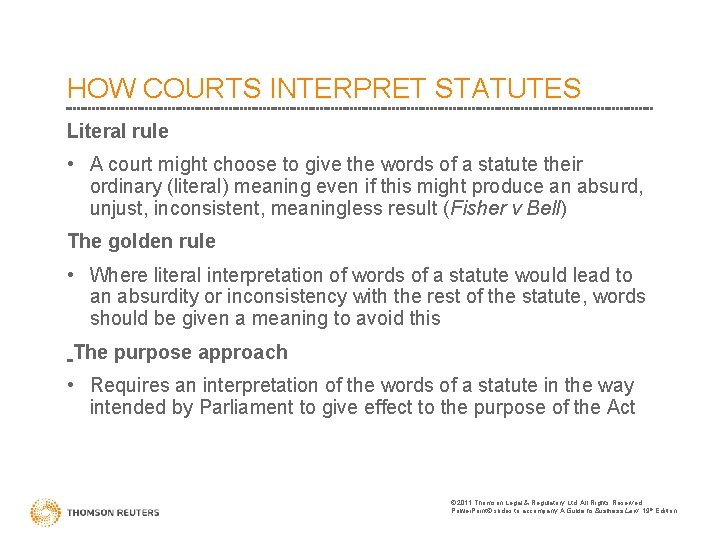
HOW COURTS INTERPRET STATUTES Literal rule • A court might choose to give the words of a statute their ordinary (literal) meaning even if this might produce an absurd, unjust, inconsistent, meaningless result (Fisher v Bell) The golden rule • Where literal interpretation of words of a statute would lead to an absurdity or inconsistency with the rest of the statute, words should be given a meaning to avoid this The purpose approach • Requires an interpretation of the words of a statute in the way intended by Parliament to give effect to the purpose of the Act 2011 Thomson Legal & Regulatory Ltd. All Rights Reserved. Power. Point slides to accompany A Guide to Business Law, 19 th Edition
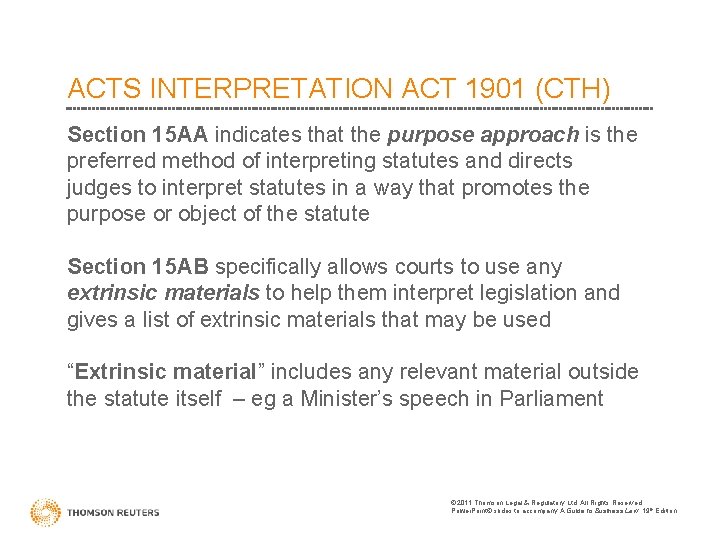
ACTS INTERPRETATION ACT 1901 (CTH) Section 15 AA indicates that the purpose approach is the preferred method of interpreting statutes and directs judges to interpret statutes in a way that promotes the purpose or object of the statute Section 15 AB specifically allows courts to use any extrinsic materials to help them interpret legislation and gives a list of extrinsic materials that may be used “Extrinsic material” includes any relevant material outside the statute itself – eg a Minister’s speech in Parliament 2011 Thomson Legal & Regulatory Ltd. All Rights Reserved. Power. Point slides to accompany A Guide to Business Law, 19 th Edition
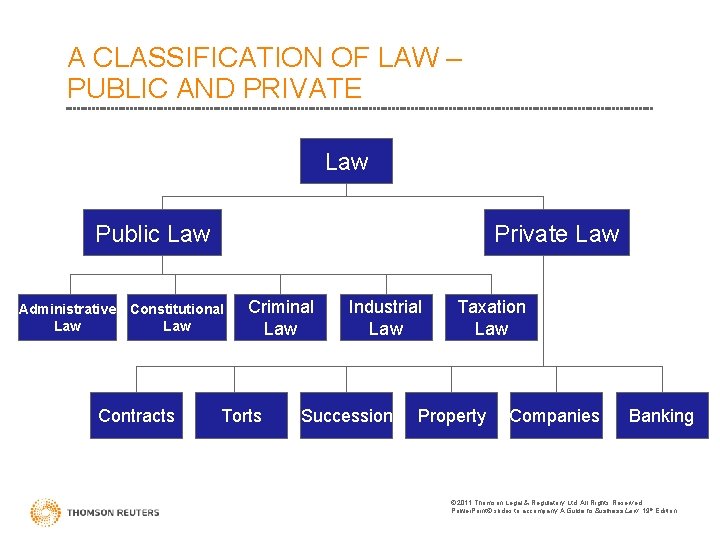
A CLASSIFICATION OF LAW – PUBLIC AND PRIVATE Law Public Law Private Law Administrative Constitutional Law Contracts Criminal Law Torts Industrial Law Succession Taxation Law Property Companies Banking 2011 Thomson Legal & Regulatory Ltd. All Rights Reserved. Power. Point slides to accompany A Guide to Business Law, 19 th Edition
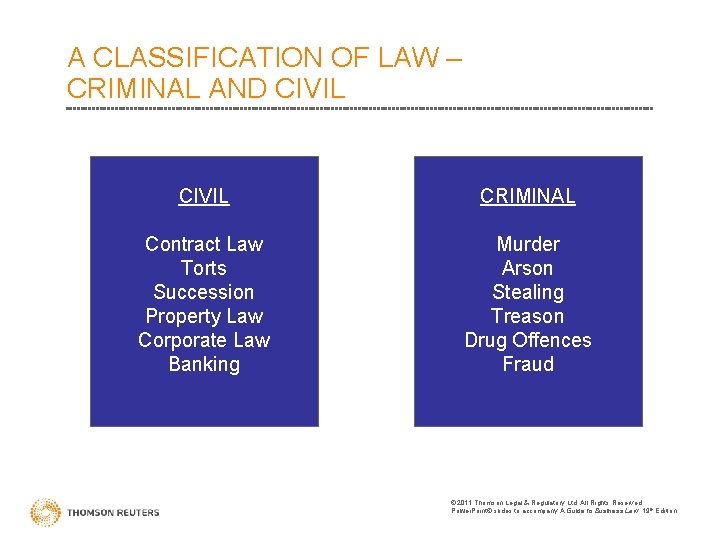
A CLASSIFICATION OF LAW – CRIMINAL AND CIVIL CRIMINAL Contract Law Torts Succession Property Law Corporate Law Banking Murder Arson Stealing Treason Drug Offences Fraud 2011 Thomson Legal & Regulatory Ltd. All Rights Reserved. Power. Point slides to accompany A Guide to Business Law, 19 th Edition