
CHAPTER 1 INTRODUCTION TO SYSTEM ANALYSIS AND DESIGN
- Slides: 63
CHAPTER 1 INTRODUCTION TO SYSTEM ANALYSIS AND DESIGN
Chapter Objectives 2 Discuss the impact of information technology on business strategy and success Define an information system and describe its components Explain how profiles and models can represent business functions and operations Explain how the Internet has affected business strategies and relationships
Chapter Objectives 3 Identify various types of information systems and explain who uses them Distinguish between structured analysis, object -oriented analysis, and agile methods Compare the traditional waterfall model with agile methods and models Discuss the role of the information technology department and the systems analysts who work there
Introduction 4 Companies use information: to sustain and survive in a business environment as a weapon in the battle to increase productivity, deliver quality products and services, maintain customer loyalty, and make sound decisions. IT can mean the difference between success and failure Figure 1 -1
5 The Impact of Information Technology (IT) Combination of hardware and software products and services that companies use to manage, access, communicate, and share information A vital asset that must be used effectively, updated constantly, and safeguarded carefully
6 The Impact of Information Technology The Future of IT Will see robust growth for at least a decade The greatest need will be for systems analysts, network administrators, data communications analysts, and software engineers
7 The Impact of Information Technology The Role of Systems Analysis and Design Step-by-step process for developing high-quality information systems Systems Plan, Analyst develop, and maintain information systems
8 The Impact of Information Technology Who develops Information Systems? In-house applications Software packages Internet-based application services Outsourcing Custom solutions Enterprise-wide software strategies How versus What
9 Information System Components A system is a set of related components that produces specific results A Mission-critical system is one that is vital to a company’s operations Data consists of basic facts that are the system’s raw material
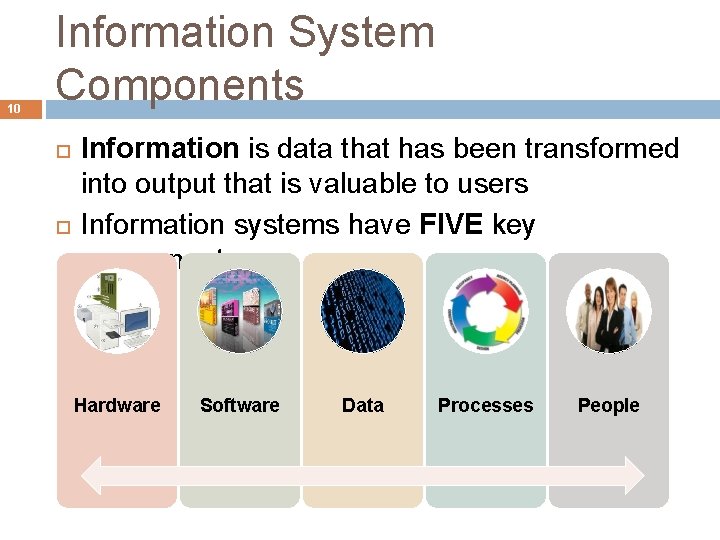
10 Information System Components Information is data that has been transformed into output that is valuable to users Information systems have FIVE key components: Hardware Software Data Processes People
11 Information System Components Hardware Is the physical layer of the information system Moore’s Law Figure 1 -9
12 Information System Components Software System software Application software Enterprise applications Horizontal system Vertical system Legacy systems
13 Information System Components Data Is the raw material that an information system transforms into useful information Tables store data By linking the tables, the system can extract specific information
14 Information System Components Processes Describe the tasks and business functions that users, managers, and IT staff members perform to achieve specific results People Stakeholders Users, or end users
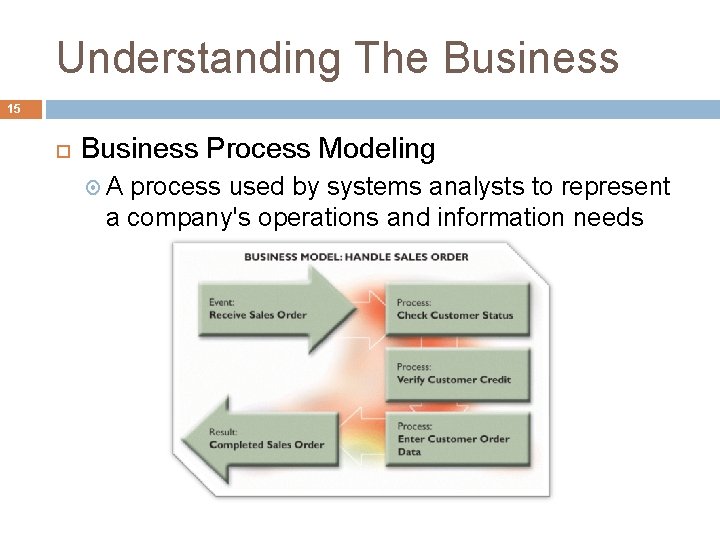
Understanding The Business 15 Business Process Modeling A process used by systems analysts to represent a company's operations and information needs
Understanding The Business 16 Business Profile defines a company's overall functions, processes, organization, products, services, customers, suppliers, competitors, constraints, and future direction
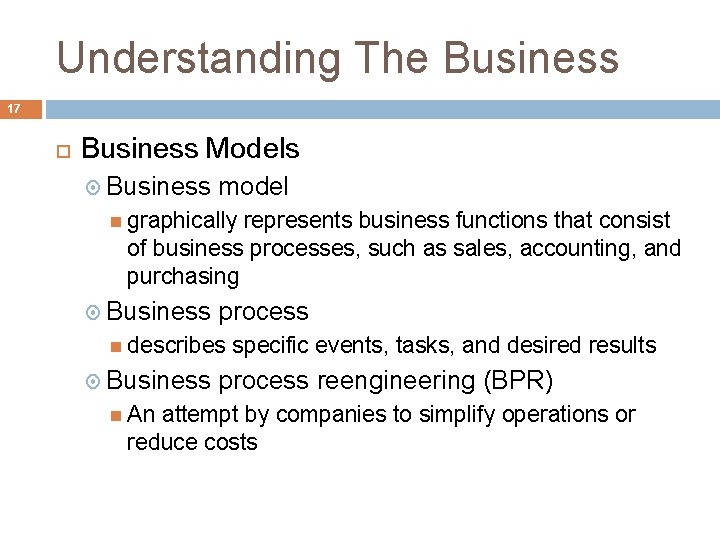
Understanding The Business 17 Business Models Business model graphically represents business functions that consist of business processes, such as sales, accounting, and purchasing Business process describes Business An specific events, tasks, and desired results process reengineering (BPR) attempt by companies to simplify operations or reduce costs
Understanding The Business 18 New Kinds of Companies Production-oriented Service-oriented Internet-dependent Dot-com (. com) Brick-and-mortar
Impact of the Internet 19 E-Commerce or I-Commerce B 2 C (Business-to-Consumer) B 2 B (Business-to-Business) EDI Extensible markup language (XML) Supplier relationship management (SRM)
Impact of the Internet 20 Web-Based System Development Web. Sphere: IBM . NET: Microsoft PHP Zend Framework: Zend Web services Internet-based systems involve various hardware and software designs Career opportunities will expand
21 How Business Uses Information Systems In past, IT managers divided systems into categories based on the user group the system served Office systems Operational systems Decision support systems Executive information systems
22 How Business Uses Information Systems Today, it makes more sense to identify a system by its functions and features, rather than by its users Enterprise computing systems Transaction processing systems Business support systems Knowledge management systems User productivity systems
23 How Business Uses Information Systems Enterprise computing systems Support company-wide operations and data management requirements Enterprise resource planning (ERP) Many hardware and software vendors target the enterprise computing market
24 How Business Uses Information Systems Transaction processing systems Involve large amounts of data and are missioncritical systems Efficient because they process a set of transaction-related commands as a group rather than individually
25 How Business Uses Information Systems Business support systems Provide job-related information to users at all levels of a company Management information systems (MIS) Radio frequency identification (RFID) What-if
26 How Business Uses Information Systems Knowledge management systems Called expert systems Simulate human reasoning by combining a knowledge base and inference rules Many knowledge management systems use technique called fuzzy logic
27 How Business Uses Information Systems User productivity systems Technology that improves productivity Groupware Information systems integration Most large companies require systems that combine transaction processing, business support, knowledge management, and user productivity features
28 Information System Users and Their Needs A systems analyst must understand the company’s organizational model to recognize who is responsible for specific processes and decisions and to be aware of what information is required by whom
29 Information System Users and Their Needs Top managers Strategic plans Middle Managers and Knowledge Workers Supervisors and Team Leaders Operational Employees Empowerment
Systems Development Tools 30 Systems analysts must know how to use a variety of techniques such as modeling, prototyping, and computer-aided systems engineering tools to plan, design, and implement information systems. Systems analysts work with these tools in a team environment
Systems Development Tools 31 Modeling Business model Requirements model Data model Object model Network model Process model
Systems Development Tools 32 Prototyping Prototype Speeds up the development process significantly Important decisions might be made too early, before business or IT issues are thoroughly understood Can be an extremely valuable tool
Systems Development Tools 33 Computer-Aided Systems Engineering (CASE) Tools Also called computer-aided software engineering CASE tools Can generate program code, which speeds the implementation process
34 Overview of Systems Development Methods The most popular alternatives are structured analysis, which is a traditional method that still is widely used, and object-oriented analysis (O -O), which is a newer approach that many analysts prefer, and agile methods, also called adaptive methods Understand the various methods and the strengths and weaknesses of each approach
35 Overview of Systems Development Methods It is not unusual for system developers to mix and match methods People, tasks, timetables, and costs must be managed efficiently Project management
36 Overview of Systems Development Methods Structured Analysis Systems development life cycle (SDLC) Predictive approach Uses a set of process models to describe a system graphically Process-centered technique Waterfall model
37 Overview of Systems Development Methods Structured Analysis Deliverable or end product Disadvantage in the built-in structure of the SDLC, because the waterfall model does not emphasize interactivity among the phases This criticism can be valid if the SDLC phases are followed too rigidly Adjacent phases usually interact
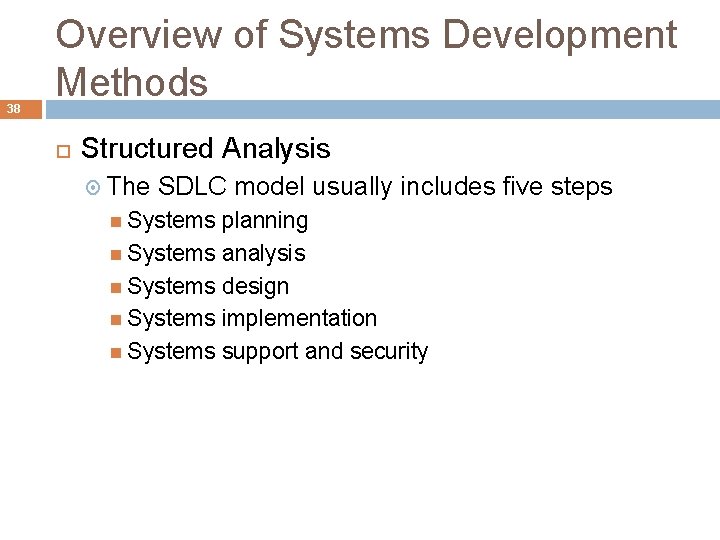
38 Overview of Systems Development Methods Structured Analysis The SDLC model usually includes five steps Systems planning Systems analysis Systems design Systems implementation Systems support and security
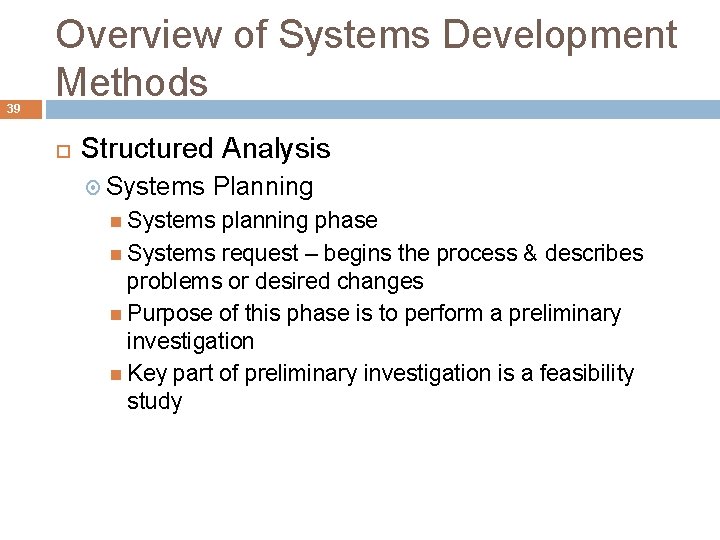
39 Overview of Systems Development Methods Structured Analysis Systems Planning Systems planning phase Systems request – begins the process & describes problems or desired changes Purpose of this phase is to perform a preliminary investigation Key part of preliminary investigation is a feasibility study
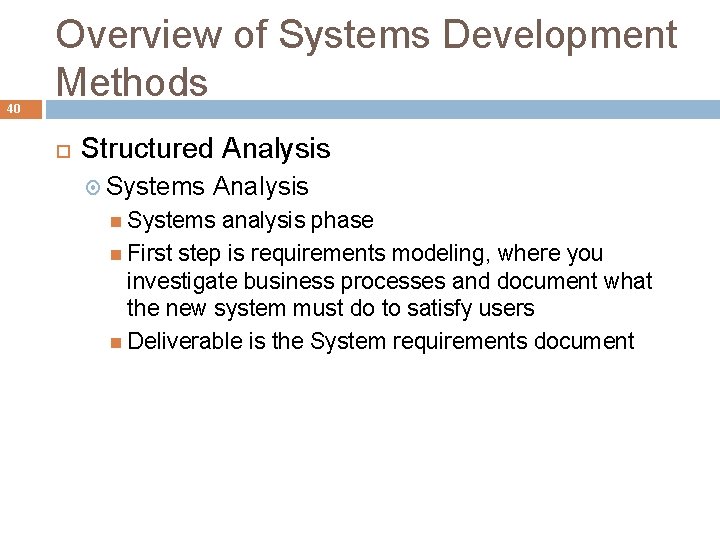
40 Overview of Systems Development Methods Structured Analysis Systems analysis phase First step is requirements modeling, where you investigate business processes and document what the new system must do to satisfy users Deliverable is the System requirements document
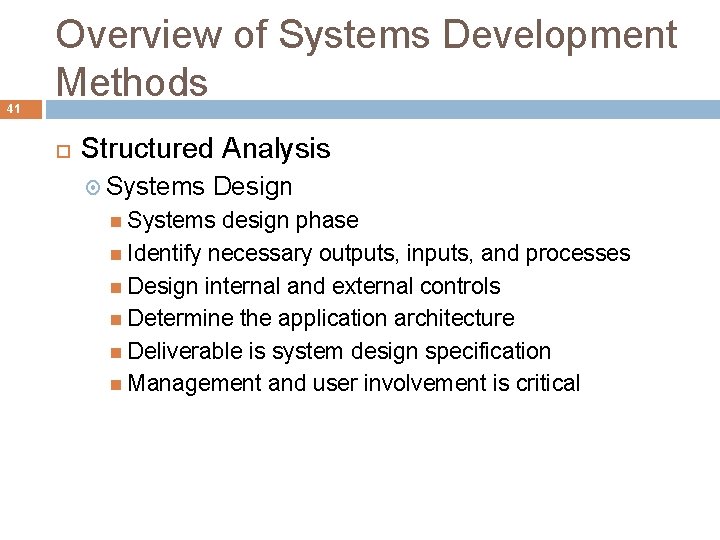
41 Overview of Systems Development Methods Structured Analysis Systems Design Systems design phase Identify necessary outputs, inputs, and processes Design internal and external controls Determine the application architecture Deliverable is system design specification Management and user involvement is critical
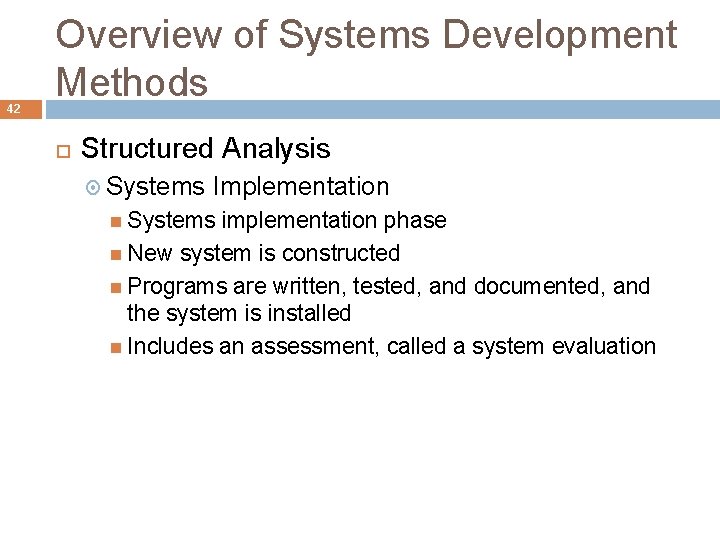
42 Overview of Systems Development Methods Structured Analysis Systems Implementation Systems implementation phase New system is constructed Programs are written, tested, and documented, and the system is installed Includes an assessment, called a system evaluation
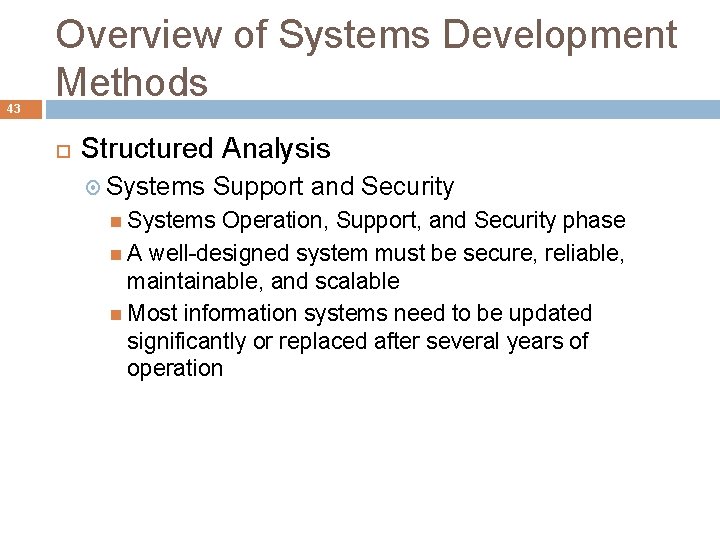
43 Overview of Systems Development Methods Structured Analysis Systems Support and Security Systems Operation, Support, and Security phase A well-designed system must be secure, reliable, maintainable, and scalable Most information systems need to be updated significantly or replaced after several years of operation
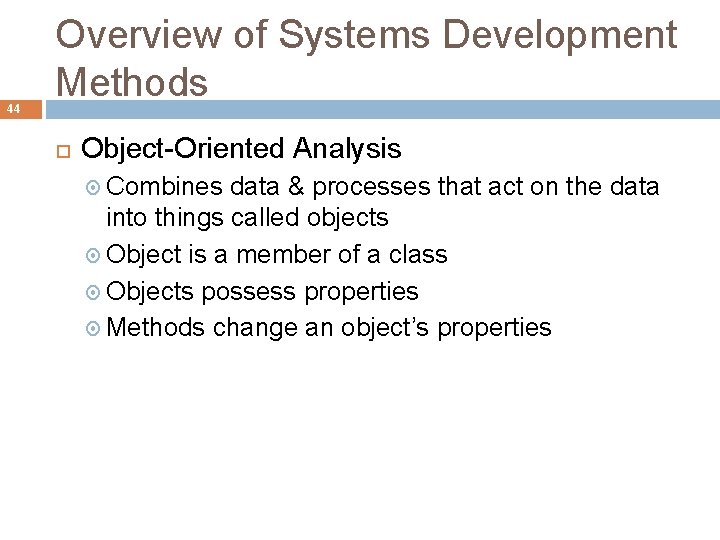
44 Overview of Systems Development Methods Object-Oriented Analysis Combines data & processes that act on the data into things called objects Object is a member of a class Objects possess properties Methods change an object’s properties
45 Overview of Systems Development Methods Object-Oriented Analysis A message requests specific behavior or information from another object Usually follow a series of analysis and design phases that are similar to the SDLC Interactive model
46 Overview of Systems Development Methods Agile Methods Are the newest development Emphasizes continuous feedback Iterative development Agile community has published the Agile Manifesto Spiral model
47 Overview of Systems Development Methods Agile process determines the end result Other adaptive variations and related methods exist Two examples are Scrum and Extreme Programming (XP) Analysts should understand the pros and cons of any approach before selecting a development method
48 Overview of Systems Development Methods Other Development Methods IT departments have long sought to avoid systems that were developed without sufficient input from users Joint application development (JAD) Rapid application development (RAD)
49 Overview of Systems Development Methods Other Development Methods Might encounter other systems development techniques Rational Unified Process (RUP®) Microsoft Solutions Framework (MSF)
50 Systems Development Guidelines Develop a project plan Involve users and listen carefully to them Use project management tools to identify tasks and milestones Develop accurate cost and benefit information Remain flexible
51 Information Technology Department The information technology (IT) department develops and maintains a company’s information systems. The IT group provides technical support These functions overlap considerably and often have different names in different companies
52 Information Technology Department Application Development Teams consisting of users, managers and IT Staff members Systems Support and Security Deployment team User Support Help desk or information center (IC)
53 Information Technology Department Database Administration Database design, management, security, backup, and user access Network Administration Includes hardware and software maintenance, support, and security Web Support Webmasters
54 Information Technology Department Quality Assurance (QA) Reviews and tests all applications and systems changes to verify specifications and software quality standards Is a separate unit that reports directly to IT management
The Systems Analyst Position 55 A systems analyst investigates, analyzes, designs, develops, installs, evaluates, and maintains a company’s information systems On large projects, the analyst works as a member of an IT department team Smaller companies often use consultants to perform systems analysis work on an asneeded basis
The Systems Analyst Position 56 Responsibilities Translate business requirements into IT projects Required Skills and Background Solid technical knowledge, strong oral and written communication skills and analytic ability, and an understanding of business operations and processes.
The Systems Analyst Position 57 Certification Important credential Career Opportunities Job titles Company organization Company size Corporate culture Salary, location, and future growth
Chapter Summary 58 IT refers to the combination of hardware and software resources that companies use to manage, access, communicate, and share information The essential components of an information system are hardware, software, data, processes, and people Most companies offer a mix of products, technical and financial services, consulting, and customer support
Chapter Summary 59 Information systems are identified as enterprise computing systems, transactional processing or operational systems, business support systems, knowledge management systems, or user productivity systems Organization structure includes top managers, middle managers and knowledge workers, supervisors and team leaders
Chapter Summary 60 Systems analysts use modeling, prototyping, and computer aided systems engineering (CASE) tools Three popular system development approaches are structured analysis, objectoriented analysis (O-O), and agile methods, also called adaptive methods
Chapter Summary 61 Regardless of the development strategy, people, tasks, timetables, and cost must be managed effectively using project management tools The IT department develops, maintains and operates a company’s information systems
Chapter Summary 62 Systems analysts need a combination of technical and business knowledge, analytical ability, and communication skills Systems analysts need to consider salary, location, and future growth potential when making a career decision
End of Chapter 1 Continue Next Chapter 2