
Chapter 1 Introduction to Statistics Slide 1 1
- Slides: 7
Chapter 1 Introduction to Statistics Slide 1 -1
Classification of Data using levels of measurement 1. 2. 3. 4. Nominal level of measurement Ordinal level of measurement Interval level of measurement Ratio level of measurement Slide 1 -2
Nominal Level v Nominal level of measurement is characterized by data that consist of names, labels, or categories only, and the data cannot be arranged in an ordering scheme (such as low to high) Examples: ü Survey responses yes, no, undecided ü Political Party: The political party affiliation of survey respondents (Democrat, Republican, Independent, other) Slide 1 -3
Ordinal Level v. Ordinal level of measurement involves data that can be arranged in some order, but differences (obtained by subtraction) between data values either cannot be determined or are meaningless Example: ü Course grades A, B, C, D, or F ü Universities rank in USA (like 1 st, 2 nd, 3 rd, 4 th, …) Slide 1 -4
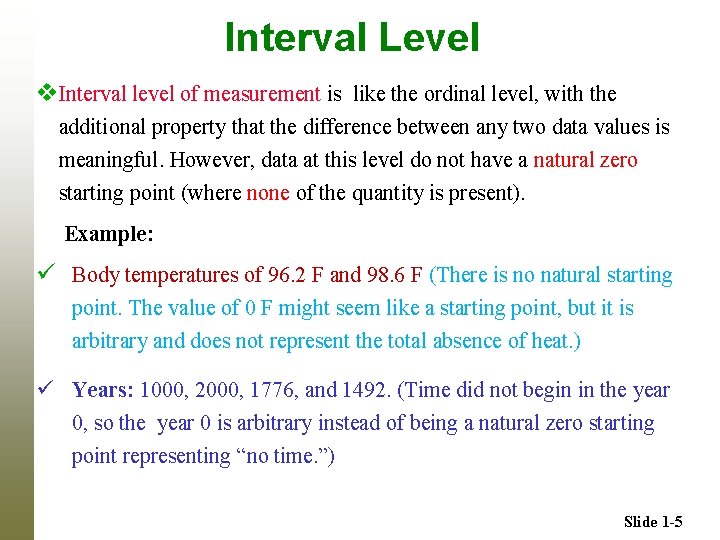
Interval Level v. Interval level of measurement is like the ordinal level, with the additional property that the difference between any two data values is meaningful. However, data at this level do not have a natural zero starting point (where none of the quantity is present). Example: ü Body temperatures of 96. 2 F and 98. 6 F (There is no natural starting point. The value of 0 F might seem like a starting point, but it is arbitrary and does not represent the total absence of heat. ) ü Years: 1000, 2000, 1776, and 1492. (Time did not begin in the year 0, so the year 0 is arbitrary instead of being a natural zero starting point representing “no time. ”) Slide 1 -5
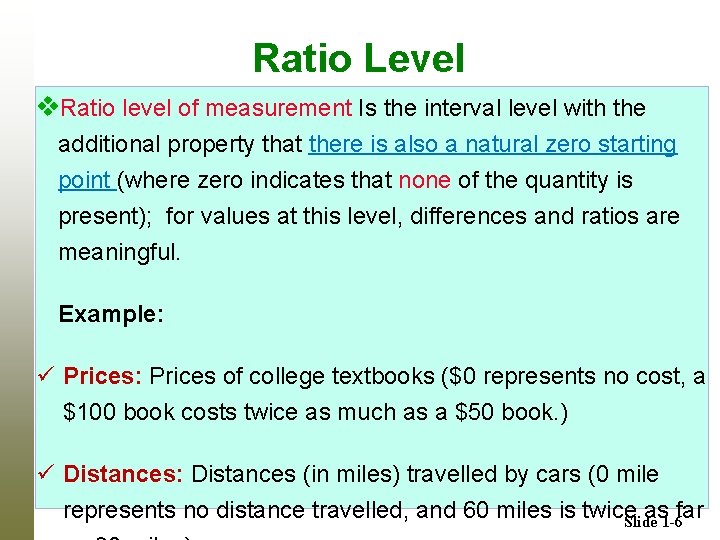
Ratio Level v. Ratio level of measurement Is the interval level with the additional property that there is also a natural zero starting point (where zero indicates that none of the quantity is present); for values at this level, differences and ratios are meaningful. Example: ü Prices: Prices of college textbooks ($0 represents no cost, a $100 book costs twice as much as a $50 book. ) ü Distances: Distances (in miles) travelled by cars (0 mile represents no distance travelled, and 60 miles is twice as far Slide 1 -6
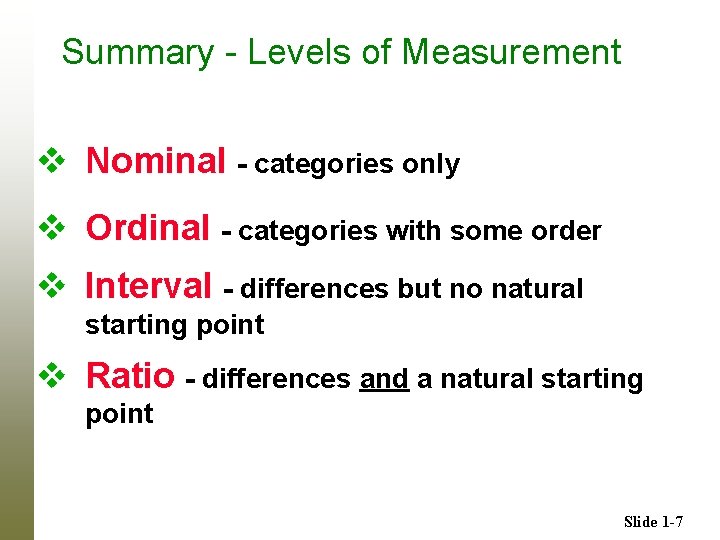
Summary - Levels of Measurement v Nominal - categories only v Ordinal - categories with some order v Interval - differences but no natural starting point v Ratio - differences and a natural starting point Slide 1 -7