
Chapter 1 Introduction to Statistics 1 1 Overview
- Slides: 47
Chapter 1 Introduction to Statistics 1 -1 Overview 1 -2 Types of Data 1 -3 Critical Thinking 1 -4 Design of Experiments Slide 1
Overview Slide 2 A common goal of surveys and other data collecting tools is to collect data from a smaller part of a larger group so we can learn something about the larger group. In this section we will look at some of ways to describe data. Copyright © 2004 Pearson Education, Inc.
Definitions Slide 3 v Data observations (such as measurements, genders, survey responses) that have been collected. Copyright © 2004 Pearson Education, Inc.
Definitions Slide 4 v Statistics a collection of methods for planning experiments, obtaining data, and then organizing, summarizing, presenting, analyzing, interpreting, and drawing conclusions based on the data. Copyright © 2004 Pearson Education, Inc.
Definitions Slide 5 v. Population the complete collection of all elements (scores, people, measurements, and so on) to be studied. The collection is complete in the sense that it includes all subjects to be studied. Copyright © 2004 Pearson Education, Inc.
Definitions v. Census the collection of data from every member of the population. v. Sample a sub-collection of elements drawn from a population. Copyright © 2004 Pearson Education, Inc. Slide 6
Key Concepts Slide 7 v Sample data must be collected in an appropriate way, such as through a process of random selection. v If sample data are not collected in an appropriate way, the data may be so completely useless that no amount of statistical torturing can salvage them. Copyright © 2004 Pearson Education, Inc.
Slide 8 Section 1 -2 Types of Data Created by Tom Wegleitner, Centreville, Virginia Copyright © 2004 Pearson Education, Inc.
Definitions Slide 9 v Parameter a numerical measurement describing some characteristic of a population Copyright © 2004 Pearson Education, Inc.
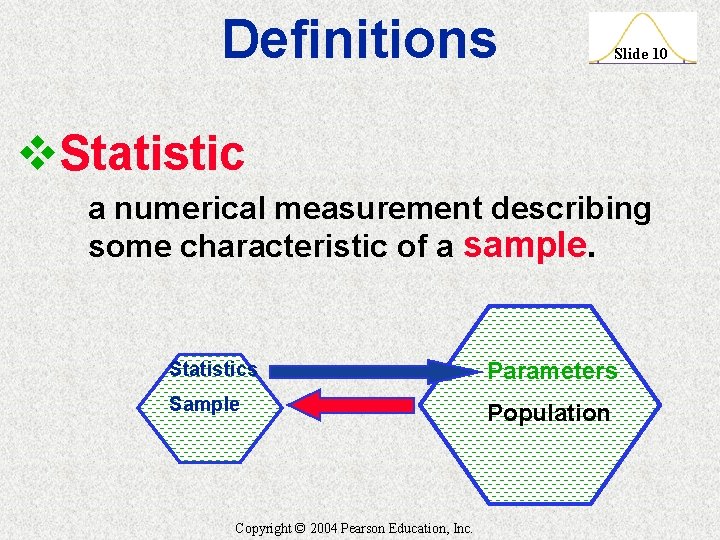
Definitions Slide 10 v. Statistic a numerical measurement describing some characteristic of a sample. Statistics Parameters Sample Population Copyright © 2004 Pearson Education, Inc.
Definitions v. Quantitative data numbers representing counts or measurements. Example: weights of supermodels. Copyright © 2004 Pearson Education, Inc. Slide 11
Definitions Slide 12 v. Qualitative (or categorical or attribute) data can be separated into different categories that are distinguished by some nonnumeric characteristics. Example: genders (male/female) of professional athletes. Copyright © 2004 Pearson Education, Inc.
Working with Quantitative Data Slide 13 Quantitative data can further be distinguished between discrete and continuous types. Copyright © 2004 Pearson Education, Inc.
Definitions Slide 14 v. Discrete data result when the number of possible values is either a finite number or a ‘countable’ number of possible values. 0, 1, 2, 3, . . . Example: The number of eggs that hens lay. Copyright © 2004 Pearson Education, Inc.
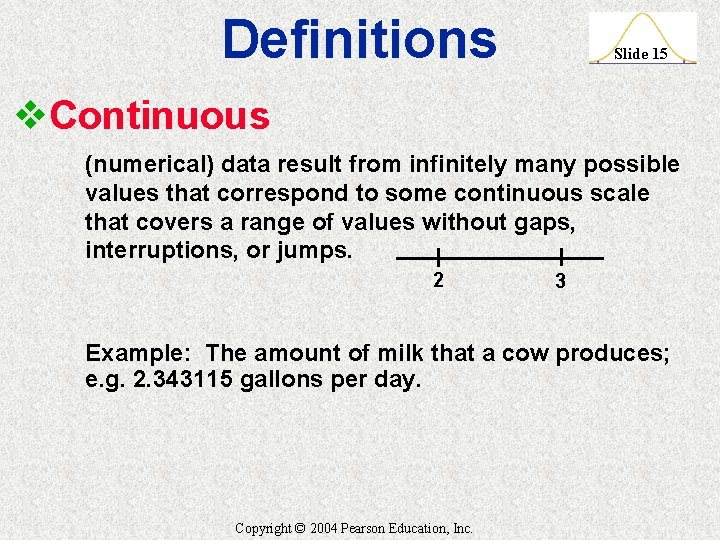
Definitions Slide 15 v. Continuous (numerical) data result from infinitely many possible values that correspond to some continuous scale that covers a range of values without gaps, interruptions, or jumps. 2 3 Example: The amount of milk that a cow produces; e. g. 2. 343115 gallons per day. Copyright © 2004 Pearson Education, Inc.
Levels of Measurement Slide 16 Another way to classify data is to use levels of measurement. Four of these levels are discussed in the following slides. Copyright © 2004 Pearson Education, Inc.
Definitions Slide 17 v nominal level of measurement characterized by data that consist of names, labels, or categories only. The data cannot be arranged in a meaningful ordering scheme (such as low to high) Example: survey responses yes, no, undecided Copyright © 2004 Pearson Education, Inc.
Definitions Slide 18 v ordinal level of measurement involves data that may be arranged in some order, but differences between data values either cannot be determined or are meaningless Example: Course grades A, A-, B+, B, B-, etc. Copyright © 2004 Pearson Education, Inc.
Definitions Slide 19 v interval level of measurement like the ordinal level, with the additional property that the difference between any two data values is meaningful. However, there is no natural zero starting point (where none of the quantity is present) Example: Years 1000, 2000, 1776, and 1492 Copyright © 2004 Pearson Education, Inc.
Definitions Slide 20 v ratio level of measurement the interval level modified to include the natural zero starting point (where zero indicates that none of the quantity is present). For values at this level, differences and ratios are meaningful. Example: Prices of college textbooks ($0 represents no cost) Copyright © 2004 Pearson Education, Inc.
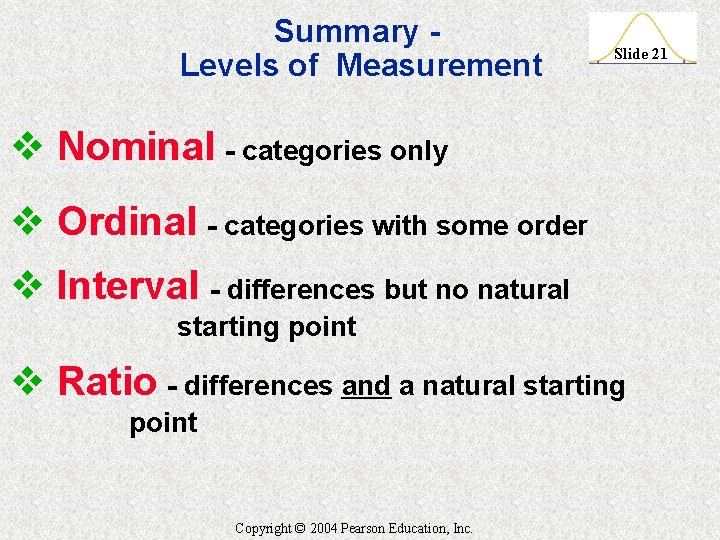
Summary Levels of Measurement Slide 21 v Nominal - categories only v Ordinal - categories with some order v Interval - differences but no natural starting point v Ratio - differences and a natural starting point Copyright © 2004 Pearson Education, Inc.
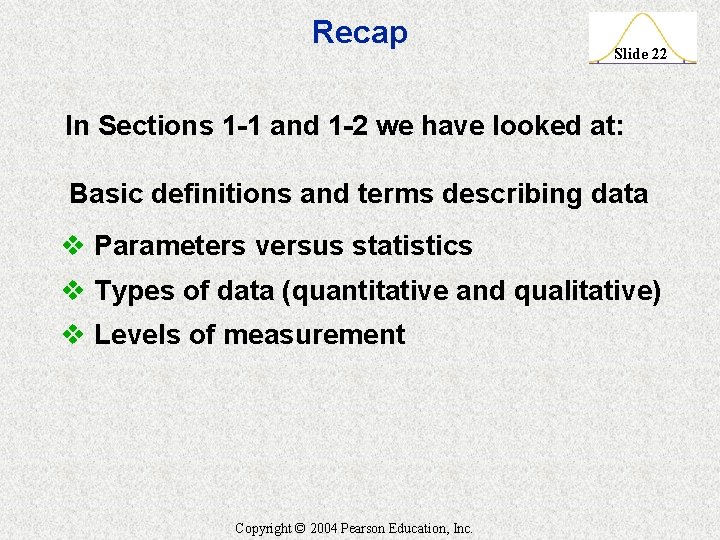
Recap Slide 22 In Sections 1 -1 and 1 -2 we have looked at: Basic definitions and terms describing data v Parameters versus statistics v Types of data (quantitative and qualitative) v Levels of measurement Copyright © 2004 Pearson Education, Inc.
Slide 23 Section 1 -3 Critical Thinking Created by Tom Wegleitner, Centreville, Virginia Copyright © 2004 Pearson Education, Inc.
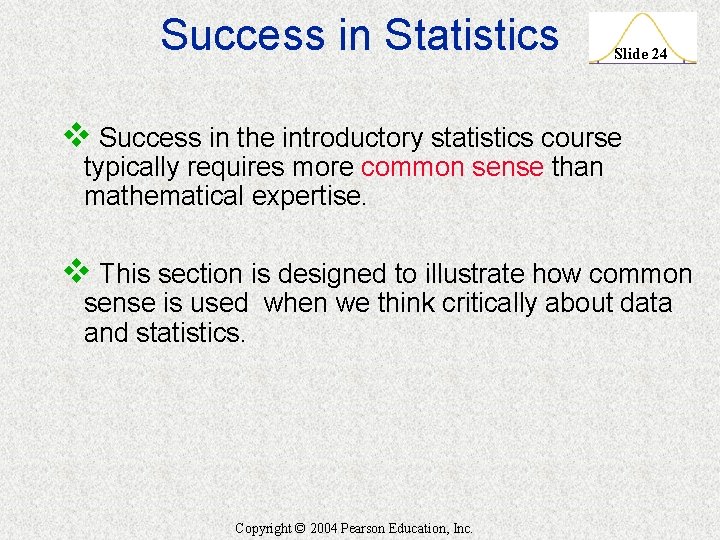
Success in Statistics Slide 24 v Success in the introductory statistics course typically requires more common sense than mathematical expertise. v This section is designed to illustrate how common sense is used when we think critically about data and statistics. Copyright © 2004 Pearson Education, Inc.
Misuses of Statistics v Bad Samples Copyright © 2004 Pearson Education, Inc. Slide 25
Definitions Slide 26 v. Voluntary response sample (or self-selected survey) one in which the respondents themselves decide whether to be included. In this case, valid conclusions can be made only about the specific group of people who agree to participate. Copyright © 2004 Pearson Education, Inc.
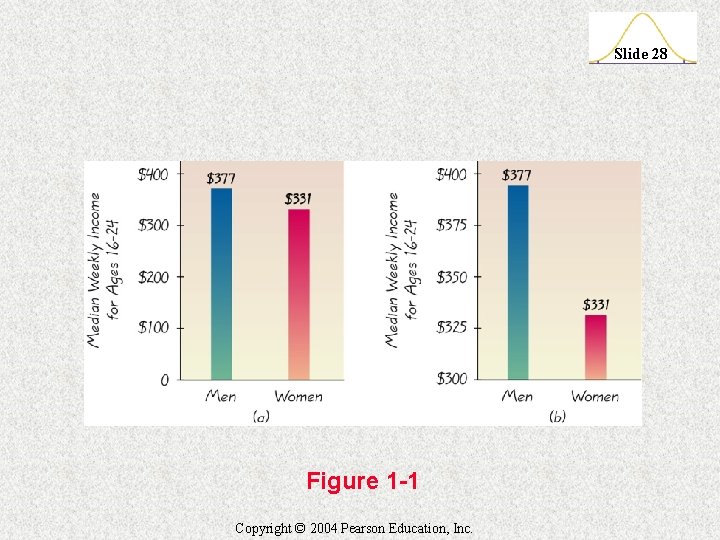
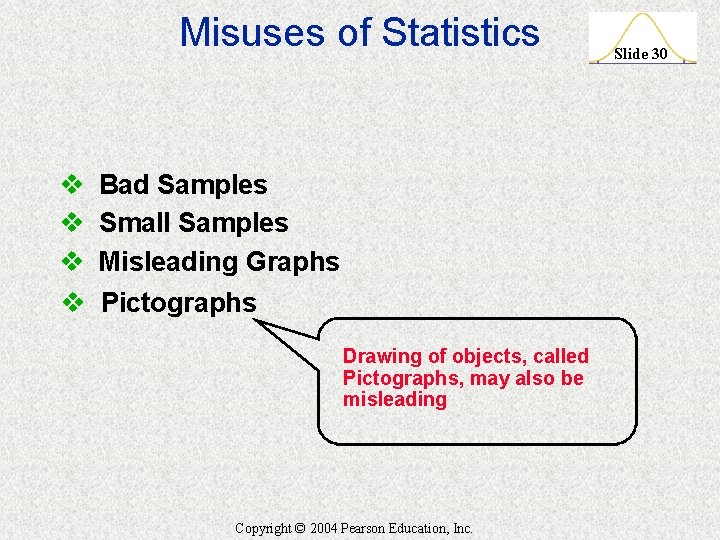
Misuses of Statistics Slide 27 Conclusions should not be based on samples which are far too small v Bad Samples v Small Samples v Misleading Graphs Bar graphs and pie charts can be used to exaggerate or understate the true nature of data Copyright © 2004 Pearson Education, Inc.
Slide 28 Figure 1 -1 Copyright © 2004 Pearson Education, Inc.
Slide 29 To correctly interpret a graph, we should analyze the numerical information given in the graph instead of being mislead by its general shape. Copyright © 2004 Pearson Education, Inc.
Misuses of Statistics v v Bad Samples Small Samples Misleading Graphs Pictographs Drawing of objects, called Pictographs, may also be misleading Copyright © 2004 Pearson Education, Inc. Slide 30
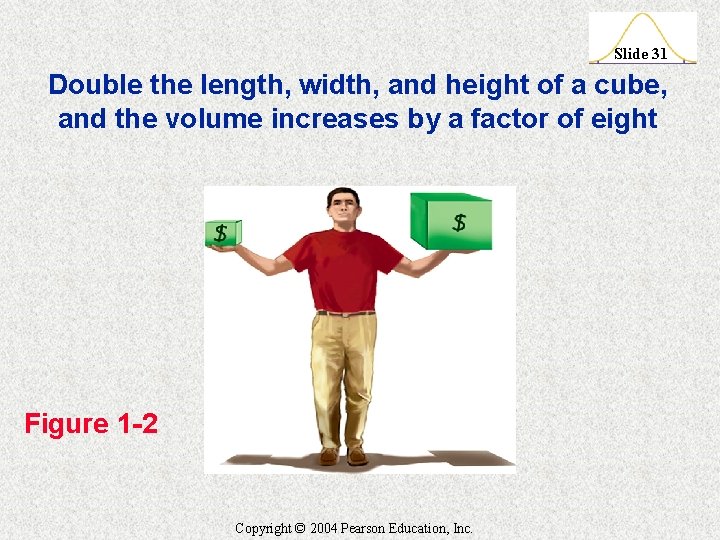
Slide 31 Double the length, width, and height of a cube, and the volume increases by a factor of eight Figure 1 -2 Copyright © 2004 Pearson Education, Inc.
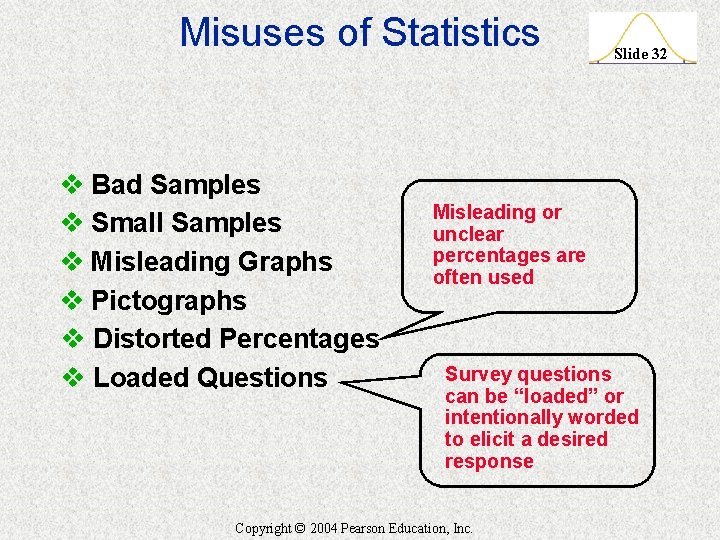
Misuses of Statistics v Bad Samples v Small Samples v Misleading Graphs v Pictographs v Distorted Percentages v Loaded Questions Slide 32 Misleading or unclear percentages are often used Survey questions can be “loaded” or intentionally worded to elicit a desired response Copyright © 2004 Pearson Education, Inc.
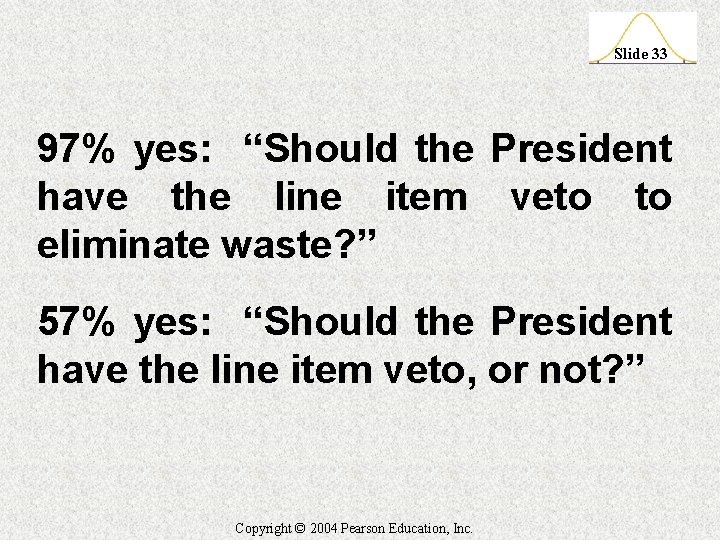
Slide 33 97% yes: “Should the President have the line item veto to eliminate waste? ” 57% yes: “Should the President have the line item veto, or not? ” Copyright © 2004 Pearson Education, Inc.
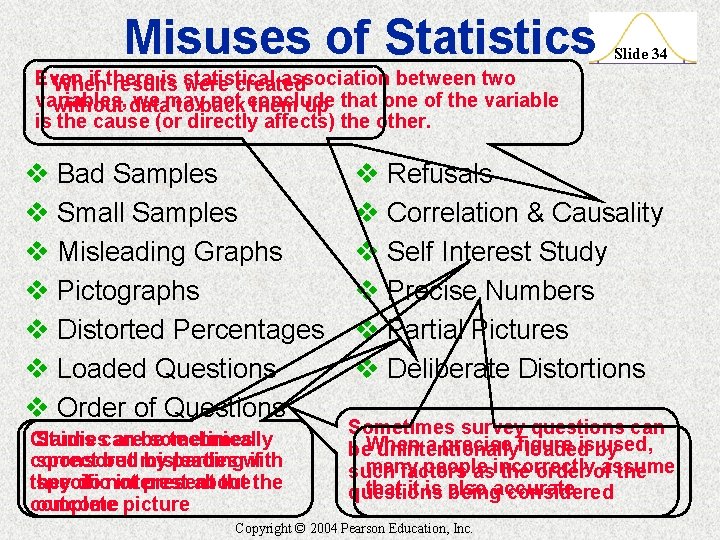
Misuses of Statistics Slide 34 Even if there is statistical association between two When results were created variables, we may not conclude without data to back them up that one of the variable is the cause (or directly affects) the other. v Bad Samples v Small Samples v Misleading Graphs v Pictographs v Distorted Percentages v Loaded Questions v Order of Questions Claims Studiescan arebe sometimes technically correct sponsored but misleading by parties with if they specific do not interest present about the complete outcome picture v Refusals v Correlation & Causality v Self Interest Study v Precise Numbers v Partial Pictures v Deliberate Distortions Sometimes survey questions can a precise figure isby used, be. When unintentionally loaded many people assume such factors asincorrectly the order of the that it is also questions beingaccurate considered Copyright © 2004 Pearson Education, Inc.
Recap Slide 35 In this section we have: v Reviewed 13 misuses of statistics. v Illustrated how common sense can play a big role in interpreting data and statistics Copyright © 2004 Pearson Education, Inc.
Slide 36 Section 1 -4 Design of Experiments Created by Tom Wegleitner, Centreville, Virginia Copyright © 2004 Pearson Education, Inc.
Slide 37 Broadly, there could be two kinds of study in Statistics v Observational Study observing and measuring specific characteristics without attempting to modify the subjects being studied Copyright © 2004 Pearson Education, Inc.
Definitions Slide 38 v Experiment apply some treatment and then observe its effects on the subjects Copyright © 2004 Pearson Education, Inc.
Slide 39 Different types of Observational Studies v Cross Sectional Study Data are observed, measured, and collected at one point in time. v Retrospective (or Case Control) Study Data are collected from the past by going back in time. v Prospective (or Longitudinal or Cohort) Study Data are collected in the future from groups (called cohorts) sharing common factors. Copyright © 2004 Pearson Education, Inc.
Definitions Slide 40 v Random Sample members of the population are selected in such a way that each individual member has an equal chance of being selected v. Simple Random Sample (of size n) subjects selected in such a way that every possible sample of the same size n has the same chance of being chosen Copyright © 2004 Pearson Education, Inc.
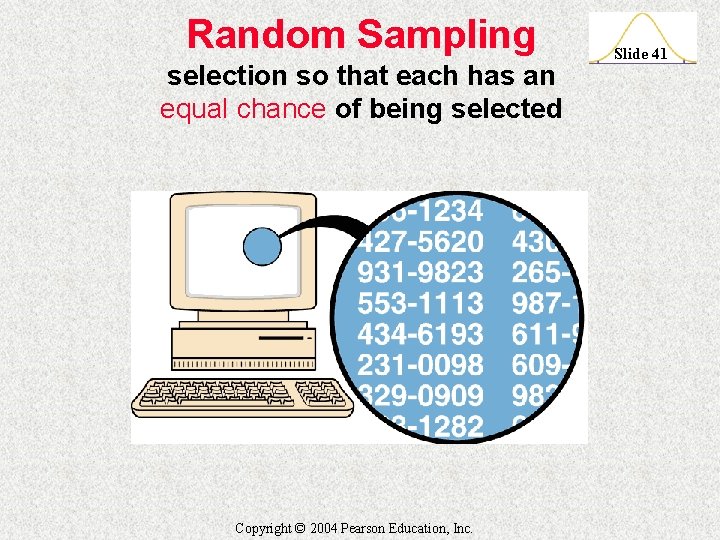
Random Sampling selection so that each has an equal chance of being selected Copyright © 2004 Pearson Education, Inc. Slide 41
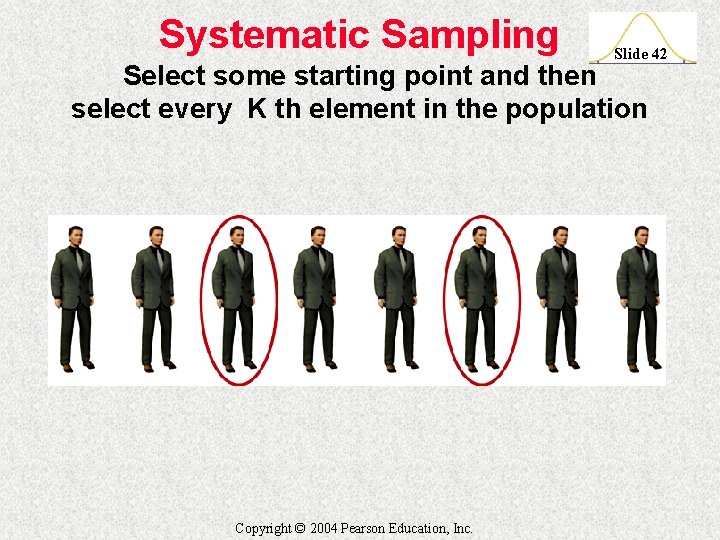
Systematic Sampling Slide 42 Select some starting point and then select every K th element in the population Copyright © 2004 Pearson Education, Inc.
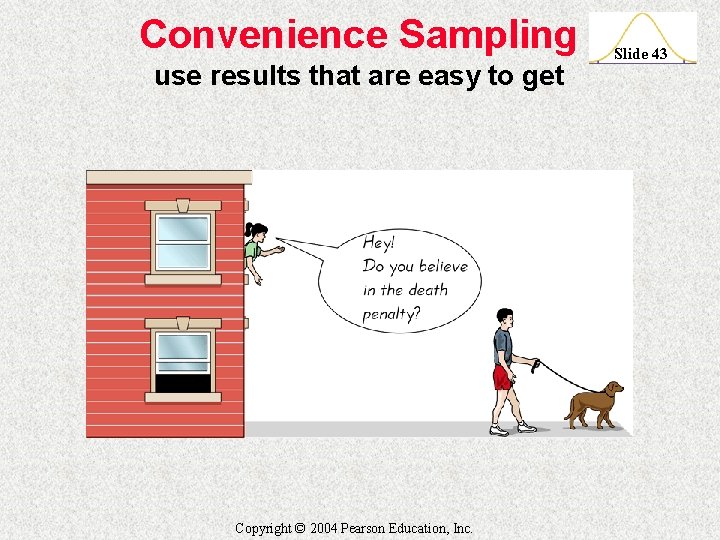
Convenience Sampling use results that are easy to get Copyright © 2004 Pearson Education, Inc. Slide 43
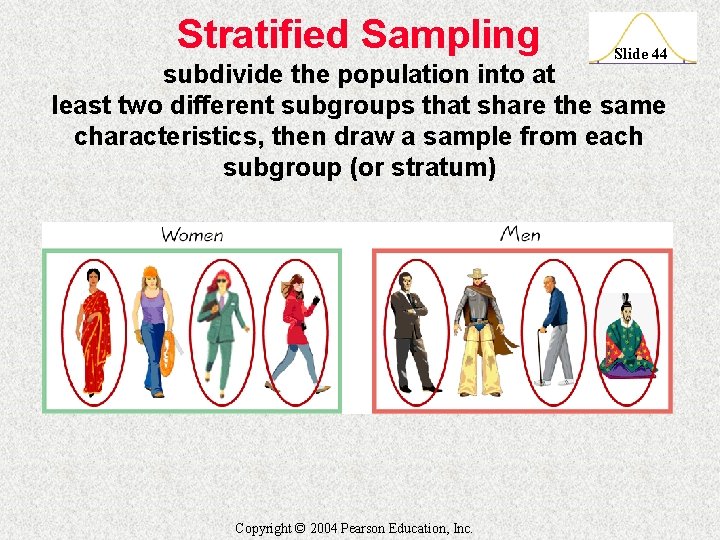
Stratified Sampling Slide 44 subdivide the population into at least two different subgroups that share the same characteristics, then draw a sample from each subgroup (or stratum) Copyright © 2004 Pearson Education, Inc.
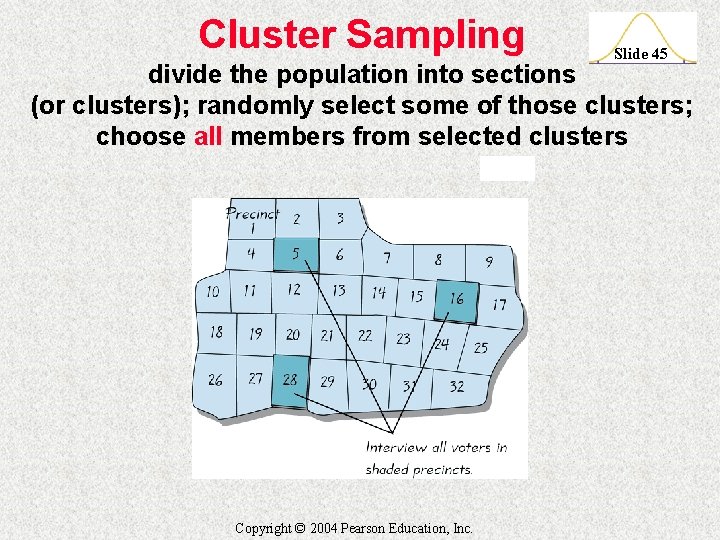
Cluster Sampling Slide 45 divide the population into sections (or clusters); randomly select some of those clusters; choose all members from selected clusters Copyright © 2004 Pearson Education, Inc.
Methods of Sampling v Random v Systematic v Convenience v Stratified v Cluster Copyright © 2004 Pearson Education, Inc. Slide 46
Definitions v Slide 47 Sampling Error the difference between a sample result and the true population result; such an error results from chance sample fluctuations v Nonsampling Error sample data that are incorrectly collected, recorded, or analyzed (such as by selecting a biased sample, using a defective instrument, or copying the data incorrectly) Copyright © 2004 Pearson Education, Inc.