
CHAPTER 1 Introduction to Services Marketing Slide by
CHAPTER 1 Introduction to Services Marketing Slide © by Lovelock, Wirtz and Chew 2009 Essentials of Services Marketing Chapter 1 - Page 1
Overview of Chapter 1 § Why study services? § Powerful forces that are transforming service Markets § What are services? § Four broad categories of services § Challenges posed by services § Expanded marketing mix for services § Framework for effective services marketing strategies Slide © by Lovelock, Wirtz and Chew 2009 Essentials of Services Marketing Chapter 1 - Page 2
Why Study Services? Slide © by Lovelock, Wirtz and Chew 2009 Essentials of Services Marketing Chapter 1 - Page 3
Why Study Services? § Services Dominate Economy in Most Nations § Most New Jobs are Generated by Services Ø Fastest Growth Expected in Knowledge-Based Industries Ø Many New Jobs are Well-Paid Positions Requiring Good Educational Qualifications Slide © by Lovelock, Wirtz and Chew 2009 Essentials of Services Marketing Chapter 1 - Page 4
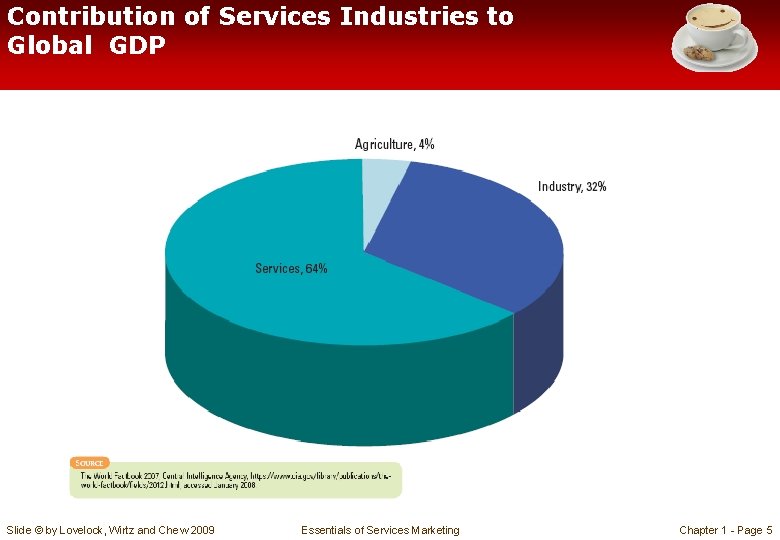
Contribution of Services Industries to Global GDP Slide © by Lovelock, Wirtz and Chew 2009 Essentials of Services Marketing Chapter 1 - Page 5
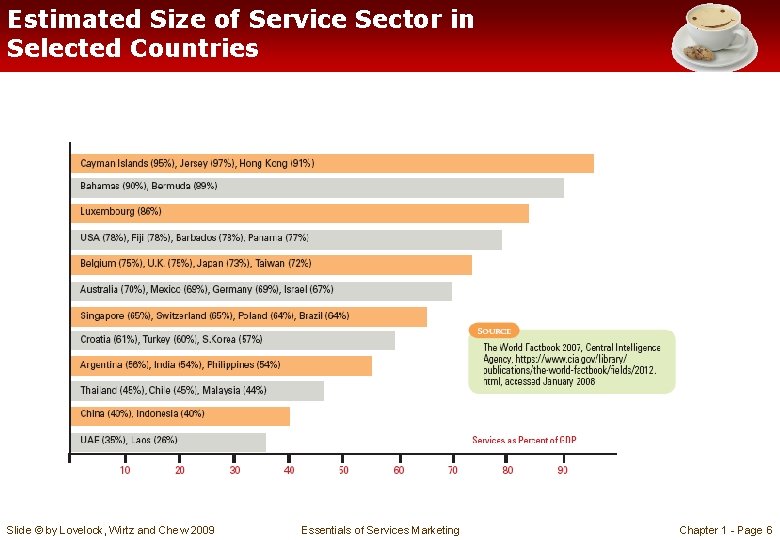
Estimated Size of Service Sector in Selected Countries Slide © by Lovelock, Wirtz and Chew 2009 Essentials of Services Marketing Chapter 1 - Page 6
Powerful Forces Are Transforming Service Markets Slide © by Lovelock, Wirtz and Chew 2009 Essentials of Services Marketing Chapter 1 - Page 7
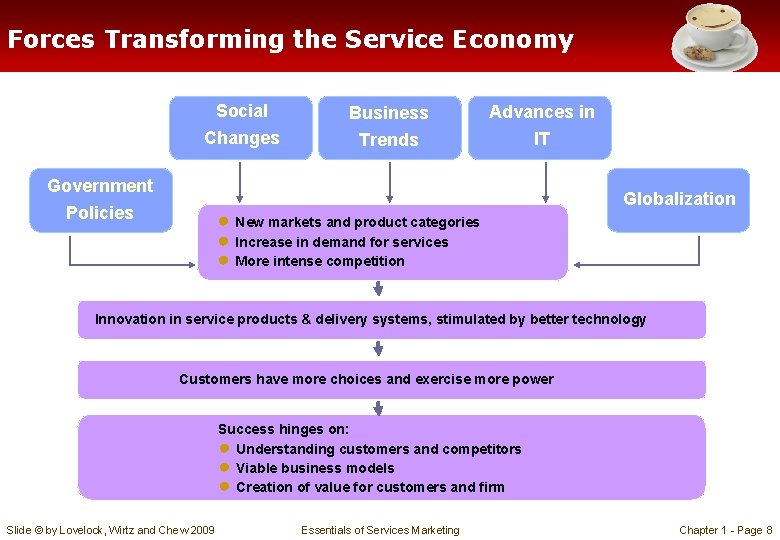
Forces Transforming the Service Economy Social Changes Government Policies Business Trends Advances in IT ● New markets and product categories ● Increase in demand for services ● More intense competition Globalization Innovation in service products & delivery systems, stimulated by better technology Customers have more choices and exercise more power Success hinges on: ● Understanding customers and competitors ● Viable business models ● Creation of value for customers and firm Slide © by Lovelock, Wirtz and Chew 2009 Essentials of Services Marketing Chapter 1 - Page 8
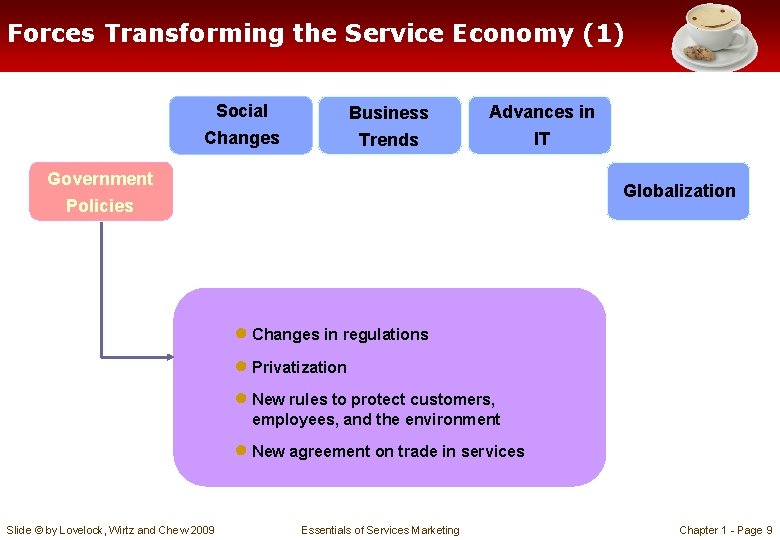
Forces Transforming the Service Economy (1) Social Changes Business Trends Advances in IT Government Policies Globalization ● Changes in regulations ● Privatization ● New rules to protect customers, employees, and the environment ● New agreement on trade in services Slide © by Lovelock, Wirtz and Chew 2009 Essentials of Services Marketing Chapter 1 - Page 9
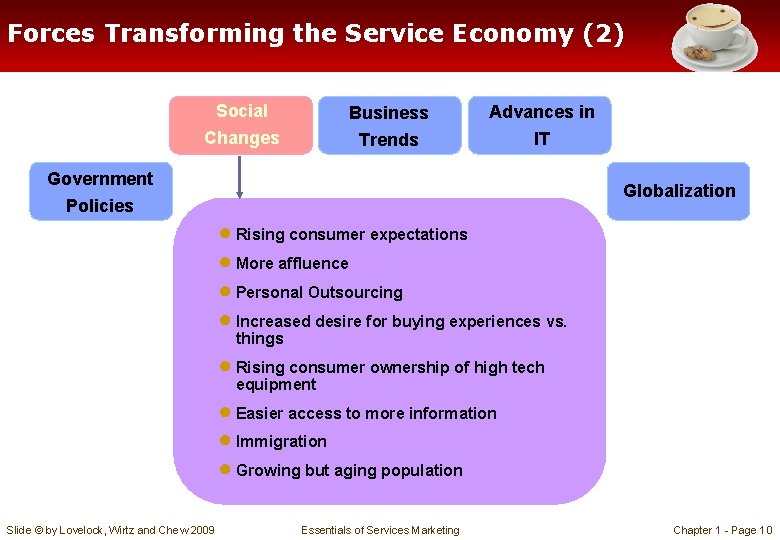
Forces Transforming the Service Economy (2) Social Changes Business Trends Advances in IT Government Policies Globalization ● Rising consumer expectations ● More affluence ● Personal Outsourcing ● Increased desire for buying experiences vs. things ● Rising consumer ownership of high tech equipment ● Easier access to more information ● Immigration ● Growing but aging population Slide © by Lovelock, Wirtz and Chew 2009 Essentials of Services Marketing Chapter 1 - Page 10
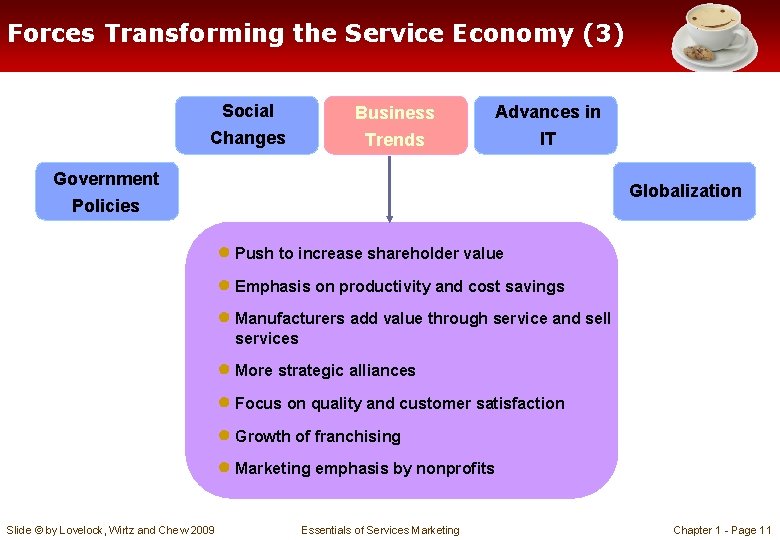
Forces Transforming the Service Economy (3) Social Changes Business Trends Advances in IT Government Policies Globalization ● Push to increase shareholder value ● Emphasis on productivity and cost savings ● Manufacturers add value through service and sell services ● More strategic alliances ● Focus on quality and customer satisfaction ● Growth of franchising ● Marketing emphasis by nonprofits Slide © by Lovelock, Wirtz and Chew 2009 Essentials of Services Marketing Chapter 1 - Page 11
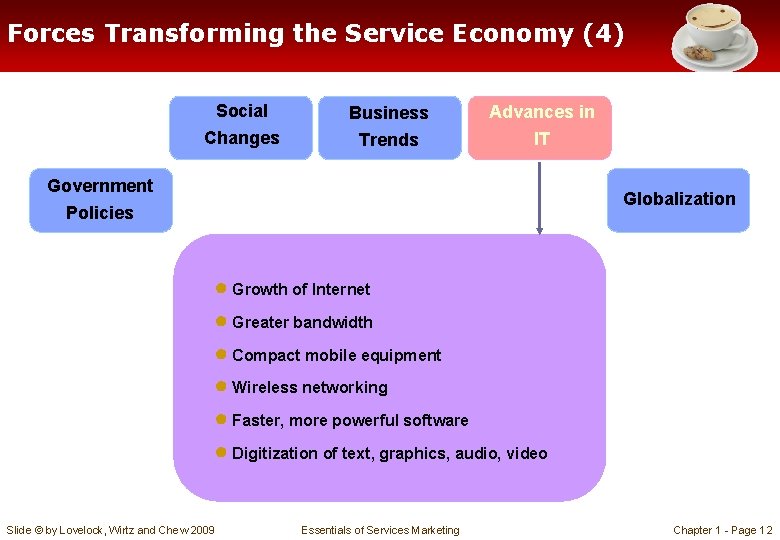
Forces Transforming the Service Economy (4) Social Changes Business Trends Advances in IT Government Policies Globalization ● Growth of Internet ● Greater bandwidth ● Compact mobile equipment ● Wireless networking ● Faster, more powerful software ● Digitization of text, graphics, audio, video Slide © by Lovelock, Wirtz and Chew 2009 Essentials of Services Marketing Chapter 1 - Page 12
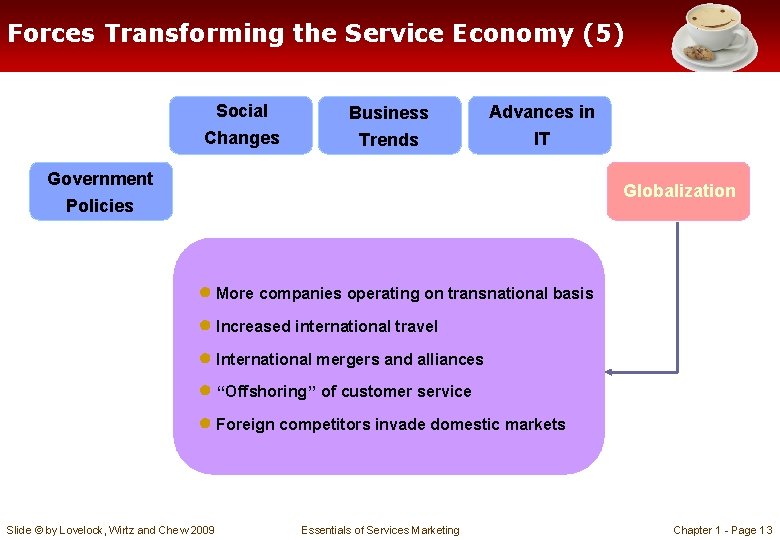
Forces Transforming the Service Economy (5) Social Changes Business Trends Advances in IT Government Policies Globalization ● More companies operating on transnational basis ● Increased international travel ● International mergers and alliances ● “Offshoring” of customer service ● Foreign competitors invade domestic markets Slide © by Lovelock, Wirtz and Chew 2009 Essentials of Services Marketing Chapter 1 - Page 13
What Are Services? Slide © by Lovelock, Wirtz and Chew 2009 Essentials of Services Marketing Chapter 1 - Page 14
What are Services? (1) § Services involve a form of rental, offering benefits without transfer of ownership Ø Include rental of goods Ø Marketing tasks for services differ from those involved in selling goods and transferring ownership Slide © by Lovelock, Wirtz and Chew 2009 Essentials of Services Marketing Chapter 1 - Page 15
What are Services? (2) § Five broad categories within non-ownership framework: 1. Rented goods services 2. Defined space and place rentals 3. Labor and expertise rentals 4. Access to shared physical environments 5. Systems and networks: access and usage Slide © by Lovelock, Wirtz and Chew 2009 Essentials of Services Marketing Chapter 1 - Page 16
What are Services? (3) § Implications of Renting Versus Owning (Service Insights 1. 1) Ø Markets exist for renting durable goods rather than selling them Ø Renting portions of larger physical entity (e. g. , office space, apartment) can form basis for service Ø Customers more closely engaged with service suppliers Ø Time plays central role in most services Ø Customer choice criteria may differ between rentals and outright purchases Ø Services offer opportunities for resource sharing Slide © by Lovelock, Wirtz and Chew 2009 Essentials of Services Marketing Chapter 1 - Page 17
Four Broad Categories of Services Slide © by Lovelock, Wirtz and Chew 2009 Essentials of Services Marketing Chapter 1 - Page 18
Four Broad Categories of Services § Based on differences in nature of service act (tangible/intangible) and who or what is direct recipient of service (people/possessions), there are four categories of services: Ø People processing Ø Possession processing Ø Mental stimulus processing Ø Information processing Slide © by Lovelock, Wirtz and Chew 2009 Essentials of Services Marketing Chapter 1 - Page 19
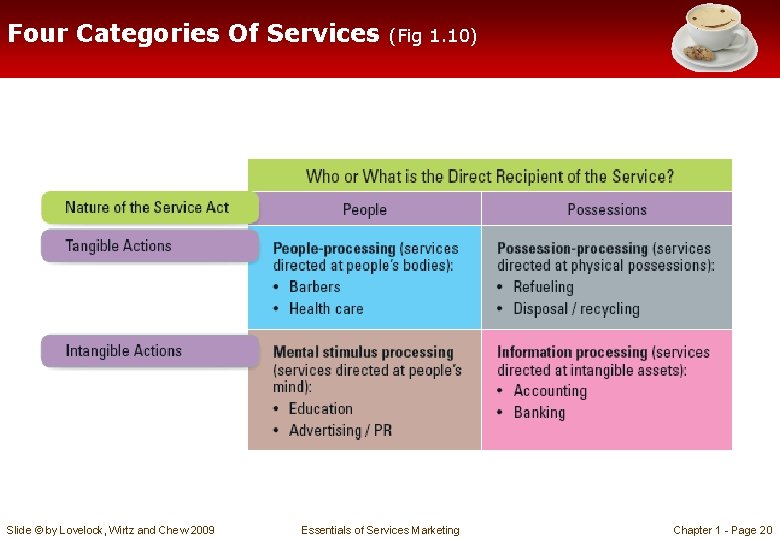
Four Categories Of Services Slide © by Lovelock, Wirtz and Chew 2009 (Fig 1. 10) Essentials of Services Marketing Chapter 1 - Page 20
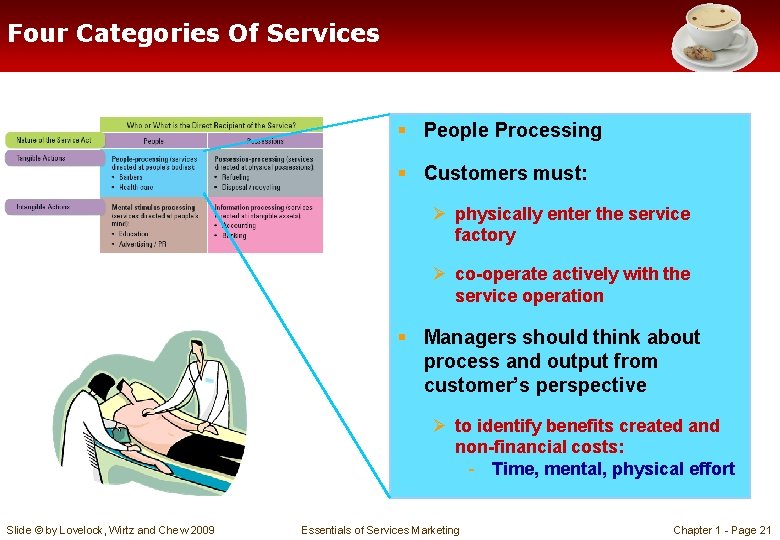
Four Categories Of Services § People Processing § Customers must: Ø physically enter the service factory Ø co-operate actively with the service operation § Managers should think about process and output from customer’s perspective Ø to identify benefits created and non-financial costs: - Time, mental, physical effort Slide © by Lovelock, Wirtz and Chew 2009 Essentials of Services Marketing Chapter 1 - Page 21
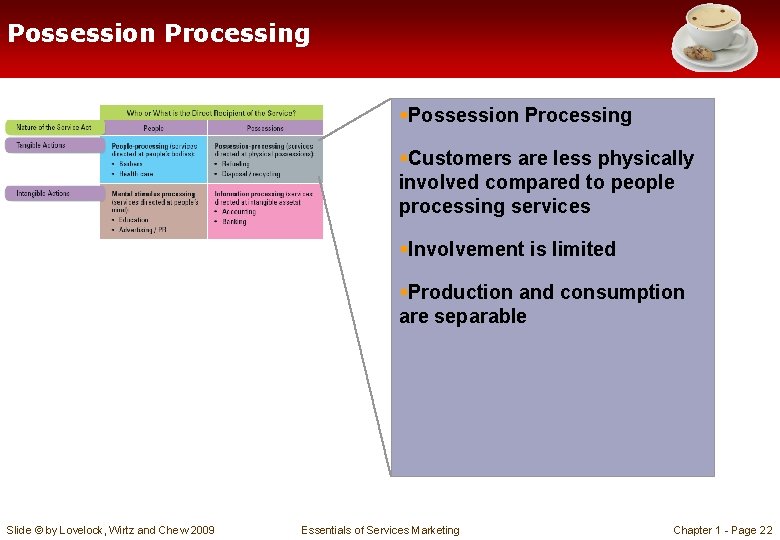
Possession Processing §Customers are less physically involved compared to people processing services §Involvement is limited §Production and consumption are separable Slide © by Lovelock, Wirtz and Chew 2009 Essentials of Services Marketing Chapter 1 - Page 22
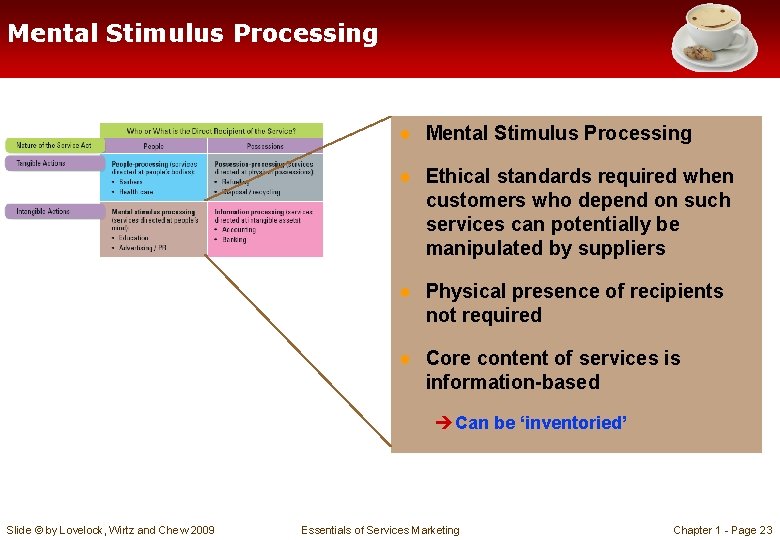
Mental Stimulus Processing ● Ethical standards required when customers who depend on such services can potentially be manipulated by suppliers ● Physical presence of recipients not required ● Core content of services is information-based èCan be ‘inventoried’ Slide © by Lovelock, Wirtz and Chew 2009 Essentials of Services Marketing Chapter 1 - Page 23
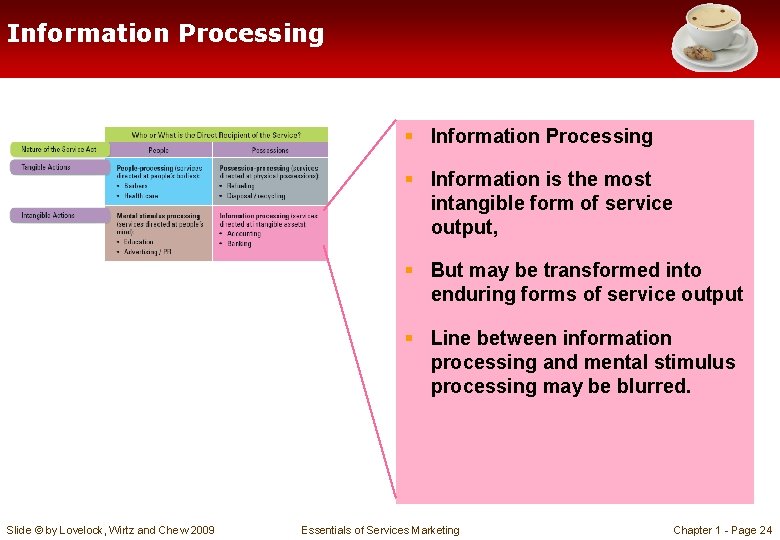
Information Processing § Information is the most intangible form of service output, § But may be transformed into enduring forms of service output § Line between information processing and mental stimulus processing may be blurred. Slide © by Lovelock, Wirtz and Chew 2009 Essentials of Services Marketing Chapter 1 - Page 24
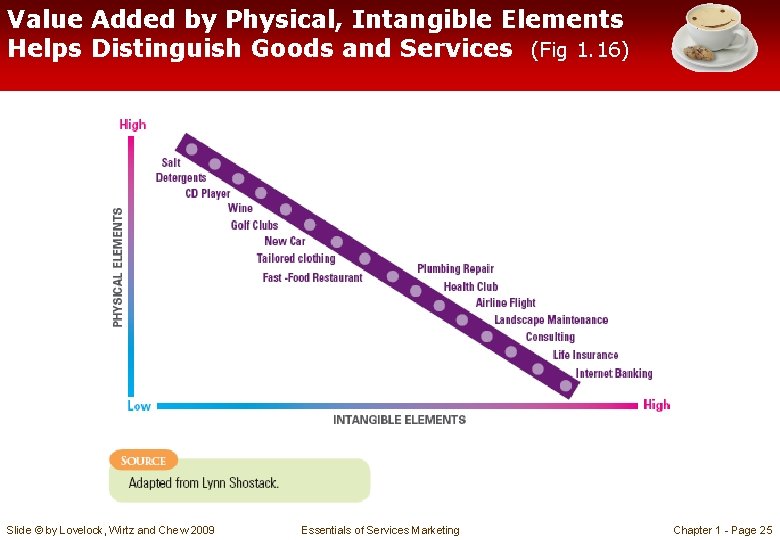
Value Added by Physical, Intangible Elements Helps Distinguish Goods and Services (Fig 1. 16) Slide © by Lovelock, Wirtz and Chew 2009 Essentials of Services Marketing Chapter 1 - Page 25
Defining Services § Services Ø Are economic activities offered by one party to another Ø Most commonly employ time-based performances to bring about desired results in: - Recipients themselves - Objects or other assets for which purchasers have responsibility § In exchange for their money, time, and effort, service customers expect to obtain value from Ø Access to goods, labor, facilities, environments, professional skills, networks, and systems; Ø But they do not normally take ownership of any of the physical elements involved. Slide © by Lovelock, Wirtz and Chew 2009 Essentials of Services Marketing Chapter 1 - Page 26
Challenges Posed by Services Slide © by Lovelock, Wirtz and Chew 2009 Essentials of Services Marketing Chapter 1 - Page 27
Services Pose Distinctive Marketing Challenges § Marketing management tasks in the service sector differ from those in the manufacturing sector. § The eight common differences are: Ø Most service products cannot be inventoried Ø Intangible elements usually dominate value creation Ø Services are often difficult to visualize and understand Ø Customers may be involved in co-production Ø People may be part of the service experience Ø Operational inputs and outputs tend to vary more widely Ø The time factor often assumes great importance Ø Distribution may take place through nonphysical channels Slide © by Lovelock, Wirtz and Chew 2009 Essentials of Services Marketing Chapter 1 - Page 28
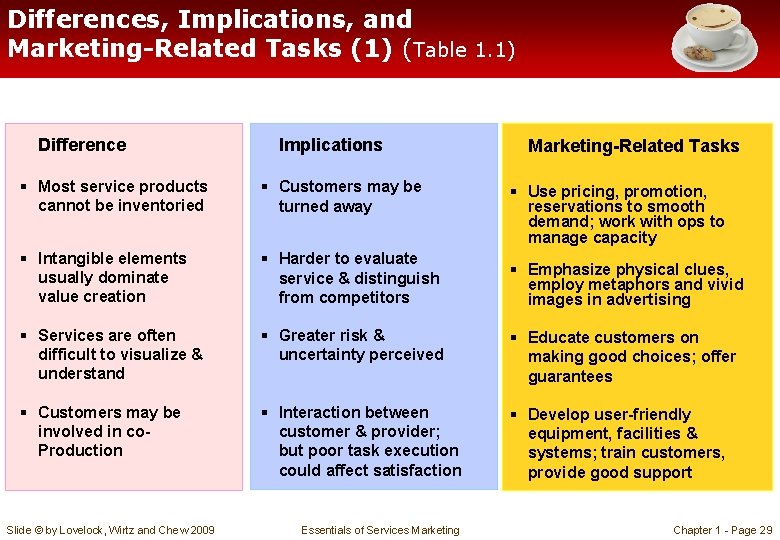
Differences, Implications, and Marketing-Related Tasks (1) (Table 1. 1) Difference Implications Marketing-Related Tasks § Most service products cannot be inventoried § Customers may be turned away § Intangible elements usually dominate value creation § Harder to evaluate service & distinguish from competitors § Services are often difficult to visualize & understand § Greater risk & uncertainty perceived § Educate customers on making good choices; offer guarantees § Customers may be involved in co. Production § Interaction between customer & provider; but poor task execution could affect satisfaction § Develop user-friendly equipment, facilities & systems; train customers, provide good support Slide © by Lovelock, Wirtz and Chew 2009 Essentials of Services Marketing § Use pricing, promotion, reservations to smooth demand; work with ops to manage capacity § Emphasize physical clues, employ metaphors and vivid images in advertising Chapter 1 - Page 29
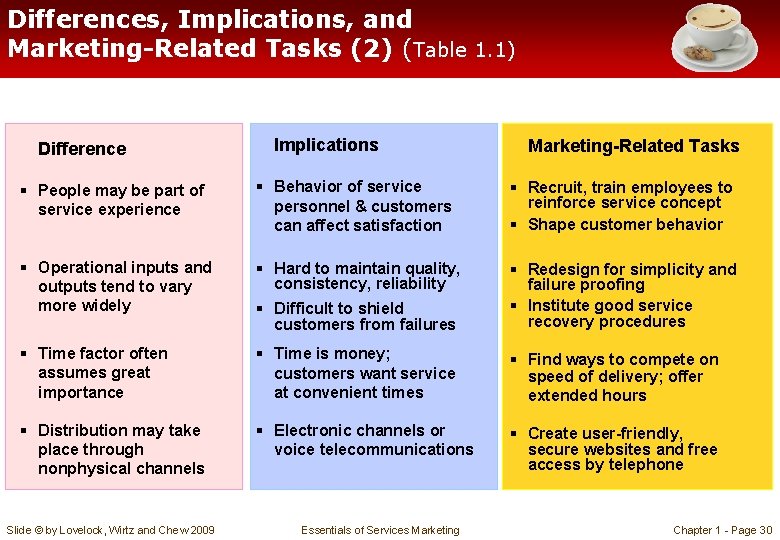
Differences, Implications, and Marketing-Related Tasks (2) (Table 1. 1) Difference Implications Marketing-Related Tasks § People may be part of service experience § Behavior of service personnel & customers can affect satisfaction § Recruit, train employees to reinforce service concept § Shape customer behavior § Operational inputs and outputs tend to vary more widely § Hard to maintain quality, consistency, reliability § Difficult to shield customers from failures § Redesign for simplicity and failure proofing § Institute good service recovery procedures § Time factor often assumes great importance § Time is money; customers want service at convenient times § Find ways to compete on speed of delivery; offer extended hours § Distribution may take place through nonphysical channels § Electronic channels or voice telecommunications § Create user-friendly, secure websites and free access by telephone Slide © by Lovelock, Wirtz and Chew 2009 Essentials of Services Marketing Chapter 1 - Page 30
Expanded Marketing Mix for Services Slide © by Lovelock, Wirtz and Chew 2009 Essentials of Services Marketing Chapter 1 - Page 31
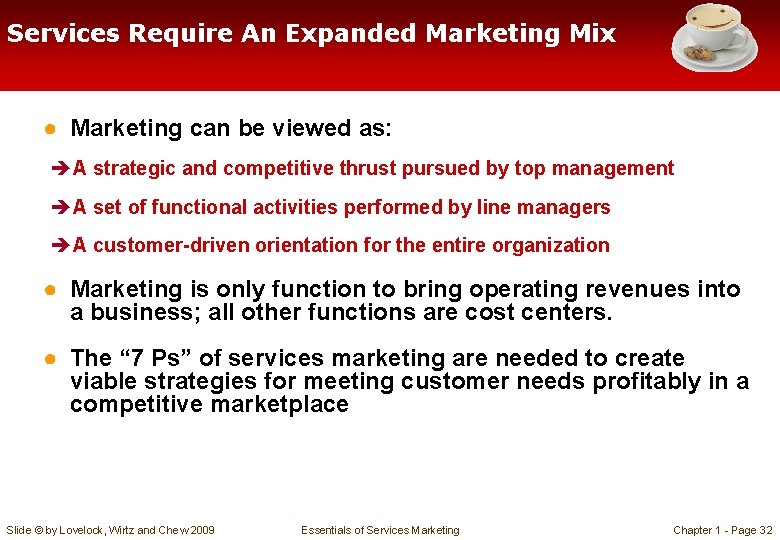
Services Require An Expanded Marketing Mix ● Marketing can be viewed as: èA strategic and competitive thrust pursued by top management èA set of functional activities performed by line managers èA customer-driven orientation for the entire organization ● Marketing is only function to bring operating revenues into a business; all other functions are cost centers. ● The “ 7 Ps” of services marketing are needed to create viable strategies for meeting customer needs profitably in a competitive marketplace Slide © by Lovelock, Wirtz and Chew 2009 Essentials of Services Marketing Chapter 1 - Page 32
The 7 Ps of Services Marketing ● Product elements (Chapter 4) ● Place and time (Chapter 5) ● Price and other user outlays (Chapter 6) ● Promotion and education (Chapter 7) ● Process (Chapter 8) ● Physical environment (Chapter 10) ● People (Chapter 11) ●I don’t care if you learn this. Slide © by Lovelock, Wirtz and Chew 2009 Essentials of Services Marketing Chapter 1 - Page 33
Traditional 4 Ps Applied to Services (1) § Product elements Ø Service products are at the heart of services marketing strategy Ø Marketing mix begins with creating service concept that offers value Ø Service product consists of core and supplementary elements - Core products meet primary needs - Supplementary elements are value-added enhancements Slide © by Lovelock, Wirtz and Chew 2009 Essentials of Services Marketing Chapter 1 - Page 34
Traditional 4 Ps Applied to Services (2) § Place and time Ø Service distribution can take place through physical and nonphysical channels Ø Some firms can use electronic channels to deliver all (or at least some) of their service elements Ø Information-based services can be delivered almost instantaneously electronically Ø Delivery Decisions: Where, When, How Ø Time is of great importance as customers are physically present Ø Convenience of place and time become important determinants of effective service delivery Slide © by Lovelock, Wirtz and Chew 2009 Essentials of Services Marketing Chapter 1 - Page 35
Traditional 4 Ps Applied to Services (3) § Price and other user outlays Ø Marketers must recognize that customer costs involve more than price paid to seller Ø Identify and minimize non-monetary costs incurred by users: - Additional monetary costs associated with service usage (e. g. , travel to service location, parking, phone, babysitting, etc. ) - Time expenditures, especially waiting - Unwanted mental and physical effort - Negative sensory experiences Ø Revenue management is an important part of pricing Slide © by Lovelock, Wirtz and Chew 2009 Essentials of Services Marketing Chapter 1 - Page 36
Traditional 4 Ps Applied to Services (4) § Promotion and Education Ø Plays three vital roles: - Provide information and advice - Persuades the target customers of merit of service product or brand - Encourages customer to take action at specific time Ø Customers may be involved in co-production so: - Teach customer how to move effectively through the service process - Shape customers’ roles and manage their behavior Slide © by Lovelock, Wirtz and Chew 2009 Essentials of Services Marketing Chapter 1 - Page 37
Extended Mix for Managing the Customer Interface (1) § Process Ø How firm does things may be as important as what it does Ø Customers often actively involved in processes, especially when acting as coproducers of service Ø Operational inputs and outputs vary more widely - Quality and content varies among employees, between employees - Variations can be with different customers - Variations from time of the day Ø Variability can be reduced by: - Standardized procedures - Implementing rigorous management of service quality - Training employees more carefully - Automating tasks - Train employees in service recovery procedures Ø Manage process design and “flow of customers Slide © by Lovelock, Wirtz and Chew 2009 Essentials of Services Marketing Chapter 1 - Page 38
Extended Mix for Managing the Customer Interface (2) § Physical environment Ø Design servicescape and provide tangible evidence of service performances Ø Create and maintain physical appearances - Buildings/landscaping - Interior design/furnishings - Vehicles/equipment - Staff grooming/clothing - Sounds and smells - Other tangibles Ø Manage physical cues carefully— can have profound impact on customer impressions Slide © by Lovelock, Wirtz and Chew 2009 Essentials of Services Marketing Chapter 1 - Page 39
Extended Mix for Managing the Customer Interface (3) § People Ø Interactions between customers and contact personnel strongly influence customer perceptions of service quality Ø Well-managed firms devote special care to selecting, training and motivating service employees Ø Other customers can also affect one’s satisfaction with a service Slide © by Lovelock, Wirtz and Chew 2009 Essentials of Services Marketing Chapter 1 - Page 40
- Slides: 40